

Organizations everywhere are under pressure to protect customer data, fight off cyber threats, and prove their security to clients. Here is something that surprises most leaders. By 2025, all businesses certified under the old ISO 27001 standard must transition to a new version, with 11 new controls, or risk losing their certification entirely. Most companies think staying compliant just means checking a few extra boxes. The real story is that these changes reshape how your business manages risk, builds trust, and wins customers in a digital-first world.
Table of Contents
- What Is 27001 ISO Certification?
- Key Requirements and 2025 Updates
- Steps to Achieve 27001 ISO Certification
- Benefits for Businesses and Organizations
Quick Summary
| Takeaway | Explanation |
|---|---|
| ISO 27001 is a Comprehensive Framework | It provides a structured methodology for organizations to manage information security risks, encompassing people, processes, and technology. |
| 2025 Transition is Essential | Organizations currently certified under the 2013 standard must transition to the 2022 version by October 31, 2025, implementing 11 new controls to address emerging cybersecurity challenges. |
| Risk Assessment is Core to Certification | Conducting a thorough risk assessment, including threat identification and control implementation, is crucial for successful certification and ensuring information security effectiveness. |
| Strategic Competitive Advantage | ISO 27001 certification enhances market differentiation, credibility, and customer trust, establishing organizations as leaders in protecting sensitive data. |
| Continuous Improvement is Vital | The standard’s emphasis on ongoing reviews and updates to security practices fosters a culture of resilience against evolving cyber threats while ensuring compliance with regulatory requirements. |
What Is 27001 ISO Certification?
ISO/IEC 27001 represents a critical international standard for information security management that helps organizations protect their most valuable digital assets. This certification provides a comprehensive framework for establishing robust security protocols and managing information risks across an organization's entire operational ecosystem.
The Core Principles of ISO 27001
At its fundamental level, ISO/IEC 27001 is an internationally recognized standard that outlines the requirements for creating and maintaining an Information Security Management System (ISMS). The standard goes beyond simple technical controls, offering a holistic approach to information protection that addresses people, processes, and technology.
The certification helps organizations systematically assess and address information security risks by providing a structured methodology. This means companies can identify potential vulnerabilities, implement appropriate safeguards, and continuously improve their security posture. According to NSF International, the standard is applicable to organizations of all sizes and industries, making it a versatile tool for comprehensive information security management.
Key Components of ISO 27001 Certification
The certification process involves several critical components that distinguish it from other security frameworks. Organizations must develop a comprehensive risk assessment strategy that evaluates potential threats to information assets. This includes analyzing potential security vulnerabilities, understanding their potential impact, and creating targeted mitigation strategies.
Key elements of the certification include:
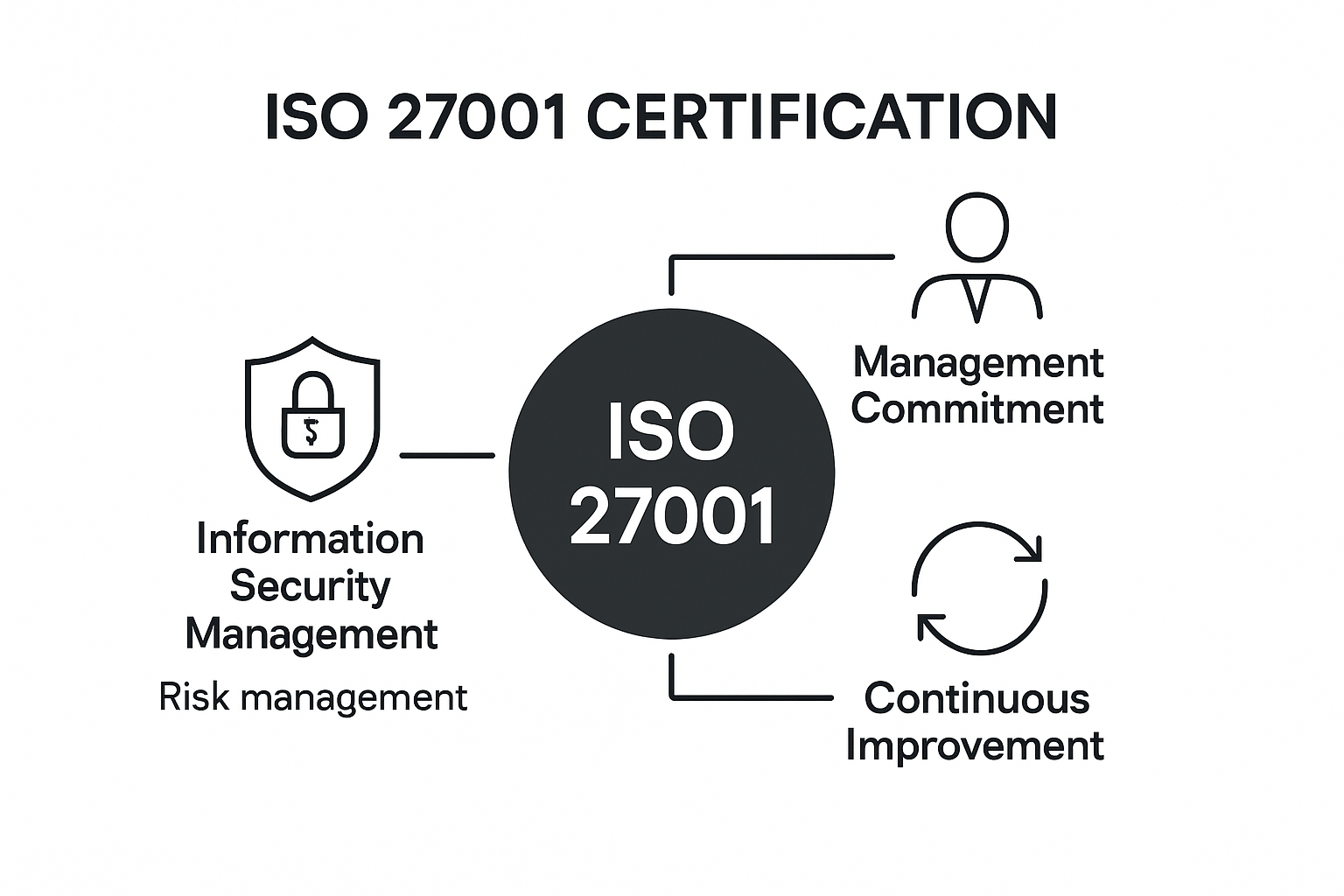
- Risk Management: Systematic identification and treatment of information security risks
- Management Commitment: Demonstrating leadership involvement in security processes
- Continuous Improvement: Regular reviews and updates to the Information Security Management System
The International Organization for Standardization emphasizes that ISO 27001 is not just about implementing technical controls but creating a culture of security awareness within an organization. This means training employees, establishing clear security policies, and ensuring that information protection becomes an integral part of the organizational strategy.
In the contemporary digital landscape, where cyber threats are increasingly sophisticated, ISO 27001 certification provides organizations with a structured approach to managing complex information security challenges. By following this standard, companies can demonstrate their commitment to protecting sensitive data, building trust with stakeholders, and maintaining a robust defense against potential security breaches.
Ultimately, ISO 27001 is more than a certification it is a comprehensive framework that empowers organizations to take a proactive and strategic approach to information security management. Whether you are a small startup or a large enterprise, the principles outlined in this standard can help you create a more resilient and secure digital environment.
Key Requirements and 2025 Updates
The ISO/IEC 27001 standard continues to evolve, with significant updates in 2022 that organizations must understand and implement by 2025. These changes reflect the dynamic nature of cybersecurity and the need for more comprehensive information protection strategies.
Structural Changes and New Control Framework
The 2022 version of ISO/IEC 27001 introduces a streamlined approach to information security management. BSI Group highlights a critical restructuring of the control framework. Previously, the standard comprised 14 categories and 114 controls. The new version dramatically simplifies this structure, reducing controls to 4 main categories and 93 total controls.
The updated categories now focus on:
- Organizational Controls: Addressing high-level security governance
- People Controls: Focusing on human aspects of information security
- Physical Controls: Managing physical access and protection
- Technological Controls: Covering digital and technical security measures
This restructuring aims to make the standard more adaptable and easier to implement across different types of organizations. According to ISACA, the simplification helps organizations more effectively align their information security practices with business objectives.
Critical 2025 Transition Requirements
One of the most important aspects for organizations is the transition timeline. Certification bodies have established a clear deadline: organizations currently certified under the 2013 version must complete their transition to the 2022 standard by October 31, 2025. This gives organizations approximately three years to update their Information Security Management System (ISMS) and achieve recertification.
The 2022 update introduces 11 new controls that address emerging cybersecurity challenges. These include:
- Threat Intelligence: Advanced mechanisms for identifying and responding to potential security risks
- Cloud Services Security: Comprehensive guidelines for securing cloud-based information systems
- Secure Coding Practices: Enhanced protocols for developing secure software and applications
Organizations must carefully evaluate these new requirements and develop a strategic approach to implementation. This may involve:
- Conducting a comprehensive gap analysis
- Updating existing security policies and procedures
- Training staff on new security protocols
- Implementing additional technical and organizational controls
Preparing for Certification in 2025
Successful transition requires a proactive and comprehensive approach. Cybersecurity experts recommend starting the preparation process early, allowing sufficient time for thorough implementation and internal audits. Organizations should view this transition not as a compliance burden but as an opportunity to strengthen their overall information security posture.
The updated standard reflects the increasingly complex digital landscape, addressing emerging technologies like cloud computing, remote work, and advanced cyber threats. By embracing these changes, organizations can demonstrate their commitment to robust information security and build trust with stakeholders.
Ultimately, the 2025 updates to ISO/IEC 27001 represent more than a simple certification refresh. They signify a strategic approach to information security that adapts to the rapidly changing technological environment, ensuring organizations remain resilient and protected in an increasingly digital world.
To clarify the major structural and control changes in the 2022 ISO/IEC 27001 update compared to the previous version, the following table summarizes the key differences:
| Version | Number of Control Categories | Number of Controls | Category Focus |
|---|---|---|---|
| 2013 | 14 | 114 | Varied security domains |
| 2022 | 4 | 93 | Organizational, People, Physical, Technological |
Steps to Achieve 27001 ISO Certification
Achieving ISO 27001 certification requires a strategic and systematic approach that transforms an organization's information security management practices. The process demands careful planning, commitment, and a comprehensive understanding of the standard's requirements.
Initial Planning and Scope Definition
The journey begins with establishing clear organizational commitment and defining the precise scope of the Information Security Management System (ISMS). Qualitians emphasizes that top management must actively support and allocate necessary resources for this critical initiative.
Key initial steps include:
- Stakeholder Engagement: Identifying and involving key stakeholders across different organizational departments
- Asset Identification: Mapping all information assets that require protection
- Boundary Determination: Clearly defining the organizational boundaries for the ISMS
Successful scope definition requires a holistic view of the organization's information ecosystem, considering technological infrastructure, operational processes, and potential security vulnerabilities. According to Cybersecurity experts, this initial phase sets the foundation for a robust information security strategy.
Risk Assessment and Control Implementation
Risk assessment represents the core of the ISO 27001 certification process. IT Governance recommends a systematic approach to identifying, analyzing, and mitigating information security risks.
The risk assessment process typically involves:
- Threat Identification: Comprehensively mapping potential security threats
- Vulnerability Analysis: Evaluating existing security mechanisms
- Impact Assessment: Determining potential consequences of security breaches
- Control Selection: Implementing appropriate risk mitigation strategies
Organizations must develop a robust risk treatment plan that addresses identified vulnerabilities. This involves selecting and implementing security controls from the ISO 27001 Annex A, which provides a comprehensive catalog of potential security measures.
Documentation and Certification Audit
The final phase involves creating extensive documentation and preparing for the certification audit. This includes developing detailed security policies, procedures, and evidence of ISMS implementation. Certification bodies recommend maintaining comprehensive documentation that demonstrates the following:
- Policy Documentation: Clear and concise information security policies
- Risk Treatment Records: Detailed documentation of risk assessment and mitigation
- Evidence of Implementation: Proof of control effectiveness
- Management Review Documentation: Records of ongoing system reviews
The certification process involves two primary audits. The first stage evaluates the organization's ISMS documentation and readiness. The second stage conducts a more comprehensive examination of the ISMS implementation, verifying that all requirements are met.
Successful certification requires more than a one-time effort. Organizations must demonstrate a commitment to continuous improvement, regularly reviewing and updating their information security practices. This means ongoing risk assessments, internal audits, and adaptive security strategies.
Ultimately, achieving ISO 27001 certification is not just about passing an audit. It represents a fundamental transformation of how an organization approaches information security, creating a culture of proactive risk management and continuous protection of critical digital assets.
To assist organizations in understanding the high-level certification journey, the following table outlines the primary steps in achieving ISO 27001 certification:
| Step | Description |
|---|---|
| Initial Planning & Scope Definition | Define project scope, engage stakeholders, allocate resources |
| Risk Assessment & Control Implementation | Identify threats, assess risks, select and implement controls |
| Documentation Preparation | Develop policies, procedures, and evidence of security controls |
| Internal Audit | Review ISMS for effectiveness and compliance prior to certification audit |
| Certification Audit | Undergo official two-stage audit by external certification body |
| Continuous Improvement | Ongoing reviews, monitoring, and updates to maintain certification |
Benefits for Businesses and Organizations
ISO 27001 certification delivers far-reaching advantages that extend well beyond basic compliance, transforming an organization's approach to information security and creating substantial strategic value. The certification represents a comprehensive framework for protecting digital assets while simultaneously driving business performance and competitive advantage.
Strategic Competitive Advantages
Deloitte highlights that ISO 27001 certification provides organizations with a significant market differentiation tool. By demonstrating a commitment to robust information security practices, businesses can distinguish themselves in increasingly competitive markets. This certification signals to potential clients and partners that an organization takes data protection seriously.
Key competitive benefits include:
- Enhanced Credibility: Proving rigorous security standards to stakeholders
- Market Differentiation: Standing out among competitors
- Increased Customer Trust: Demonstrating commitment to protecting sensitive information
According to Oxford University's Information Security research, organizations with ISO 27001 certification often experience improved client relationships and increased business opportunities, particularly in sectors where data security is paramount.
Risk Management and Operational Efficiency
Beyond external perceptions, ISO 27001 delivers substantial internal benefits. Risk management experts emphasize that the certification provides a systematic approach to identifying, assessing, and mitigating information security risks. This proactive methodology helps organizations prevent potential security breaches before they occur.
Operational efficiency improvements include:
- Reduced Security Incidents: Systematic risk identification and mitigation
- Lower Potential Financial Losses: Preventing costly data breaches
- Streamlined Security Processes: Creating standardized information protection protocols
The standard encourages organizations to develop a comprehensive understanding of their information ecosystem, enabling more intelligent resource allocation and more effective security investments. By implementing a structured Information Security Management System (ISMS), businesses can transform security from a reactive cost center to a strategic asset.
Regulatory Compliance and Continuous Improvement
ISO 27001 certification assists organizations in navigating complex regulatory landscapes. Compliance specialists note that the certification helps businesses meet multiple regulatory requirements across different industries, reducing the complexity of maintaining separate compliance frameworks.
Continuous improvement mechanisms embedded in the standard ensure that:
- Adaptation: Security practices evolve with changing technological landscapes
- Regular Assessments: Ongoing evaluation of security controls
- Cultural Transformation: Embedding security awareness throughout the organization
Moreover, the certification process fosters a culture of continuous learning and improvement. Organizations are required to regularly review and update their information security practices, ensuring they remain resilient against emerging cyber threats.
Ultimately, ISO 27001 certification is more than a technical achievement. It represents a holistic approach to information security that aligns technological safeguards with strategic business objectives, creating a robust framework for sustainable digital protection and organizational resilience.
Frequently Asked Questions
What is ISO 27001 certification?
ISO 27001 certification is an international standard for information security management systems (ISMS) that helps organizations protect their valuable information assets by establishing a comprehensive framework for managing information security risks.
What are the key updates to ISO 27001 for 2025?
The key updates to ISO 27001 for 2025 include the introduction of 11 new controls, a restructuring of control categories from 14 to 4 main categories, and a simplified control framework with a total of 93 controls to address emerging cybersecurity challenges.
How can organizations prepare for the transition to the new ISO 27001 standard by 2025?
Organizations can prepare by conducting a gap analysis, updating existing security policies, training staff on new protocols, and implementing additional technical and organizational controls to align with the 2022 version of the standard before the October 31, 2025 deadline.
What are the benefits of achieving ISO 27001 certification?
Achieving ISO 27001 certification provides strategic advantages such as enhanced credibility, improved risk management, operational efficiency, and better regulatory compliance, positioning organizations as leaders in data protection and building trust with clients.
Stop Letting Security Questionnaires Hold Up Your ISO 27001 Certification
Is your team overwhelmed by endless security questionnaires just as you try to update for the new ISO 27001:2022 requirements? As discussed in our guide, staying compliant now means stronger documentation, faster response times, and tighter evidence. This pressure often slows down compliance teams and delays ISO audits. But you do not have to let tedious manual processes stall your progress or put your certification at risk.
Imagine completing complex security reviews and risk documentation in minutes, not hours. Skypher gives your team the edge with our advanced AI Questionnaire Automation Tool, real-time collaboration, and seamless integrations that help you respond to ISO 27001 requests quickly and with total accuracy. Unblock your compliance journey and get ahead of the October 2025 deadline. Visit Skypher today and discover how easy it can be to accelerate your ISO 27001 transition right now.