

Security questions are the silent gatekeepers for countless digital accounts and they hold the keys to our most sensitive information. Nearly 20 percent of account hacks take advantage of weak or predictable security questions. Most people believe these personal prompts are safe and unique. Yet surprisingly, the questions we use to protect ourselves often turn into the easiest way in for attackers.
Table of Contents
- 1: Understand the Purpose of Security Questions
- 2: Choose Questions with Clear, Personal Answers
- 3: Avoid Common and Easily Guessable Questions
- 4: Ensure Questions Are Relevant to the Individual
- 5: Limit the Number of Security Questions
- 6: Regularly Review and Renew Security Questions
- 7: Educate Users on Effective Security Practices
Quick Summary
| Takeaway | Explanation |
|---|---|
| Create memorable security questions. | Select questions that users can easily remember but are hard for others to guess or research. |
| Avoid commonly guessed questions. | Eliminate standard queries like "What is your mother's maiden name?" that attackers can easily find online. |
| Limit the number of security questions. | Use three to four well-crafted questions to prevent user fatigue and enhance security consistency. |
| Regularly review and update questions. | Periodically reassess security questions to ensure relevance and adapt to changing personal circumstances. |
| Educate users on security practices. | Teach users about effective strategies for choosing security answers and recognizing potential threats to their information. |
1: Understand the Purpose of Security Questions
Security questions serve as a critical authentication mechanism designed to verify a user's identity during account recovery or access restoration processes. Unlike standard passwords, these questions are crafted to rely on personal information that only the legitimate account owner would typically know.
The primary objective of security questions is to create an additional layer of identity verification beyond traditional password protection. When implemented effectively, they help prevent unauthorized access by introducing a personalized challenge that external actors cannot easily guess or replicate.
When developing list security questions, organizations should focus on creating questions that meet several key criteria:
- Questions must be memorable for the legitimate user
- Answers should be difficult for others to research or predict
- Information required must remain consistent over time
- Responses should have limited potential variations
Protecting digital identities requires carefully selecting questions that balance user convenience with robust security protocols. The most effective security questions avoid publicly available information and instead target unique personal experiences or knowledge.
Companies frequently make critical mistakes when designing security questions. Common errors include using overly broad queries that can be easily discovered through social media research or selecting questions with predictable answer patterns. Strategic question design demands nuanced understanding of personal information accessibility.
For maximum security, organizations should implement a multi-factor approach that does not exclusively rely on security questions. These questions work best when combined with additional authentication methods like two-factor verification or biometric validation.
Ultimately, the goal is creating a personalized security barrier that remains both user-friendly and challenging for potential unauthorized access attempts.
2: Choose Questions with Clear, Personal Answers
Selecting security questions requires a strategic approach that prioritizes unambiguous and personally unique responses. The effectiveness of list security questions hinges on crafting queries that generate precise, consistent answers only the legitimate user can confidently provide.
The core challenge lies in designing questions that strike a delicate balance between being memorable and resisting external manipulation. Questions must be specific enough to prevent generic responses while remaining straightforward for the account owner to answer accurately across multiple authentication attempts.
Potential characteristics of strong security questions include:
- Answers that do not change over time
- Information unique to the individual
- Responses not easily discoverable through public research
- Details consistently remembered by the user
Digital identity experts recommend avoiding questions with potentially multiple interpretations. For instance, a question like "What was your favorite childhood pet?" could generate inconsistent responses depending on how the user interprets "favorite" or remembers specific pets.
Weak security questions often emerge from overly broad or ambiguous prompts. Questions sourced from social media profiles, public records, or easily guessable personal history create significant vulnerability. Attackers can frequently reconstruct answers through minimal online research or social engineering techniques.
Professional security practitioners suggest developing questions that tap into deeply personal yet verifiable memories. These might include specific childhood experiences, unique family traditions, or personal achievements that remain stable throughout an individual's lifetime.
The goal is constructing a personalized authentication mechanism that serves as an additional verification layer. By prioritizing clarity, specificity, and personal relevance, organizations can develop robust security questions that effectively validate user identity while maintaining a straightforward user experience.
3: Avoid Common and Easily Guessable Questions
Developing robust list security questions demands a proactive strategy for eliminating predictable or universally accessible information. Cybercriminals have sophisticated techniques for exploiting common security question patterns, making it critical to design questions that resist standard reconnaissance methods.
Many organizations inadvertently implement security questions that can be quickly compromised through minimal online research or basic social engineering tactics. These vulnerable questions typically involve broad, publicly available personal details that attackers can readily discover or manipulate.
Common security questions that should be completely eliminated include:
- "What is your mother's maiden name?"
- "What was your first car?"
- "Where were you born?"
- "What is your high school mascot?"
Research from cybersecurity experts demonstrates that these standard queries create significant authentication vulnerabilities. Social media platforms, genealogy websites, and public records provide attackers with extensive personal information that can be used to systematically guess or reconstruct security question responses.
Successful security question design requires moving beyond traditional biographical queries. Instead, organizations should focus on developing unique, personally specific challenges that cannot be easily reconstructed through external data sources. Questions should tap into deeply personal experiences or knowledge that remain consistent yet difficult for others to predict.
Moreover, security professionals recommend implementing dynamic approaches that introduce variability and complexity into the authentication process. This might involve rotating security questions, requiring multiple question responses, or incorporating additional verification layers that supplement traditional security queries.
The fundamental objective is creating an authentication mechanism that remains simultaneously user-friendly and resilient against sophisticated unauthorized access attempts. By thoughtfully designing security questions that resist common guessing strategies, organizations can significantly enhance their digital identity protection protocols.
4: Ensure Questions Are Relevant to the Individual
Crafting list security questions that genuinely resonate with an individual's unique experiences forms a critical component of robust authentication strategies. The most effective security questions transcend generic biographical information and instead tap into deeply personal, verifiable memories that remain consistent throughout a user's lifetime.
Relevance in security questions means creating queries that only the specific account holder can confidently answer. This approach transforms authentication from a potentially frustrating process into a personalized verification mechanism that feels intuitive and user-friendly.
Key considerations for developing individually relevant security questions include:
- Questions that reflect unique personal experiences
- Queries specific to the individual's background
- Information that remains stable over extended periods
- Details not easily discoverable through external research
Security authentication experts recommend developing questions that create a personal narrative verification rather than relying on standardized biographical data. This might involve exploring more nuanced personal history elements that go beyond basic demographic information.
For instance, instead of asking about a first car or hometown, organizations could design questions around specific childhood memories, unique family traditions, or personal achievements that carry deep personal meaning. These types of queries are significantly more challenging for potential attackers to replicate or guess.
The fundamental goal is constructing an authentication layer that feels simultaneously secure and intuitive. By prioritizing individual relevance, organizations can develop a more sophisticated approach to identity verification that respects user privacy while maintaining robust security protocols.
Successful implementation requires a delicate balance between creating questions that are personally meaningful and ensuring they can be consistently and accurately recalled by the user. This approach transforms security questions from a potential point of vulnerability into a sophisticated, personalized authentication mechanism.
5: Limit the Number of Security Questions
Strategic limitation of security questions is crucial in maintaining both user experience and robust authentication protocols. While additional questions might seem like enhanced security, an excessive number of queries can actually diminish the effectiveness of the verification process.
Organizations must carefully balance the depth of authentication with user convenience. Too many security questions create unnecessary friction, potentially leading users to select simplistic or predictable responses that undermine the entire security mechanism.
Key considerations for determining the optimal number of security questions include:
- Maintaining user engagement
- Preventing authentication fatigue
- Ensuring meaningful verification
- Reducing cognitive load during access attempts
Cybersecurity experts recommend implementing three to four well-crafted security questions as the ideal range. This quantity provides sufficient depth for verification without overwhelming the user or creating complex memorization challenges.
Professional security practitioners emphasize that each additional question exponentially increases the complexity of the authentication process. Beyond four questions, users typically experience significant mental fatigue, which can lead to decreased accuracy in response recall or potential abandonment of the authentication attempt.
Moreover, limiting the number of questions allows organizations to concentrate on developing high-quality, deeply personalized queries rather than generating a large volume of generic or redundant challenges. Each question should serve a distinct purpose in the verification process, providing unique insights into the user's identity.
The strategic approach involves selecting questions that are simultaneously precise, memorable, and difficult to replicate. By carefully curating a concise set of security questions, organizations can create a more effective, user-friendly authentication experience that maintains robust security standards without introducing unnecessary complexity.
6: Regularly Review and Renew Security Questions
Maintaining the integrity of list security questions requires a proactive approach to periodic review and strategic updating. Security is not a one-time configuration but an ongoing process that demands continuous attention and refinement.
Organizations must recognize that personal information and individual circumstances change over time. Stagnant security questions become increasingly vulnerable as more personal data becomes accessible through digital platforms and social networks.
Critical aspects of security question maintenance include:
- Reviewing questions annually
- Checking relevance of existing queries
- Assessing potential exposure of personal information
- Updating answers to reflect current knowledge
Cybersecurity experts recommend implementing a systematic approach to security question management. This involves not just changing the questions themselves, but also encouraging users to periodically verify and potentially modify their responses.
Technological advancements and shifting digital landscapes mean that what was once a secure question can become predictable. For instance, a security question about a childhood pet might become compromised if similar information is shared across social media platforms.
Streamline your security questionnaire process by developing a comprehensive review mechanism. This could involve automated prompts, periodic user notifications, or integrated security question refresh protocols that encourage ongoing engagement.
The goal is creating a dynamic authentication environment that adapts to changing personal and technological contexts. By treating security questions as a living system rather than a static set of queries, organizations can significantly enhance their identity verification mechanisms.
Ultimately, regular review transforms security questions from a potential vulnerability into a robust, adaptable layer of digital protection. Organizations that prioritize this continuous refinement demonstrate a sophisticated understanding of modern cybersecurity challenges.
7: Educate Users on Effective Security Practices
User education represents the most critical line of defense in maintaining robust security question protocols. Organizations must invest significant effort in transforming users from potential vulnerability points into informed, proactive security partners.
Effective security awareness goes beyond simply instructing users about list security questions. It involves cultivating a comprehensive understanding of digital identity protection, empowering individuals to make intelligent authentication decisions.
Key educational priorities for users include:
- Understanding social engineering risks
- Recognizing potential information disclosure vulnerabilities
- Learning strategies to generate complex, memorable answers
- Developing critical thinking about personal information sharing
Successful security education requires a multifaceted approach that breaks down complex cybersecurity concepts into digestible, actionable insights. Explore our security knowledge resources to help users develop sophisticated digital protection strategies.
Professional security practitioners emphasize the importance of contextual learning experiences. This means moving beyond generic warnings and providing concrete, relatable scenarios that demonstrate the real-world implications of poor security practices.
Organizations should implement comprehensive training programs that cover:
- Techniques for creating strong security question responses
- Methods to avoid sharing potentially compromising personal information
- Strategies for maintaining consistent, memorable answers
- Recognizing potential authentication manipulation attempts
The ultimate goal is transforming users from potential security weak points into active, informed participants in their own digital protection. By investing in continuous, engaging education, organizations can significantly reduce the risk of unauthorized access through compromised security questions.
Below is a comprehensive table summarizing the 7 essential tips for choosing list security questions as covered in the article.
| Tip | Key Points | Benefits/Outcomes |
|---|---|---|
| Understand the Purpose | Security questions provide an extra identity verification layer beyond passwords. | Enhances account protection and reduces risk of unauthorized access. |
| Choose Clear, Personal Answers | Select specific, memorable questions with answers unique to the individual and difficult to research. | Increases answer consistency and limits vulnerability to attacks. |
| Avoid Common, Guessable Questions | Eliminate use of widespread or publicly accessible information (e.g., mother’s maiden name, birth place). | Reduces risk from social engineering and data gathering exploits. |
| Ensure Relevance to the Individual | Craft questions around unique personal experiences, not generic or easily found details. | Improves user recall and boosts authentication effectiveness. |
| Limit the Number of Questions | Use 3-4 well-crafted questions to prevent fatigue and promote engagement. | Streamlines authentication without compromising security. |
| Regularly Review and Renew | Assess and update questions/answers periodically to reflect changing personal or public information. | Maintains security as user details or public data exposure shifts. |
| Educate Users on Security Practices | Train users to recognize threats, avoid sharing sensitive info, and create strong answers. | Fosters a culture of proactive digital protection and reduces weak points. |
Moreover, user education is not a one-time event but an ongoing process that must adapt to emerging digital threats and technological innovations. Successful security awareness programs create a culture of vigilance, where individuals understand their critical role in maintaining robust digital identity protection.
Make Security Questionnaire Challenges a Thing of the Past
Are you tired of struggling with vague, repetitive, or overly broad list security questions? As highlighted in our article, selecting the right security questions is crucial for protecting digital identities and reducing unauthorized access risks. But even when you know the best practices, ensuring your organization consistently applies them across every client interaction can feel overwhelming. That is where Skypher can turn knowledge into true efficiency and confidence.
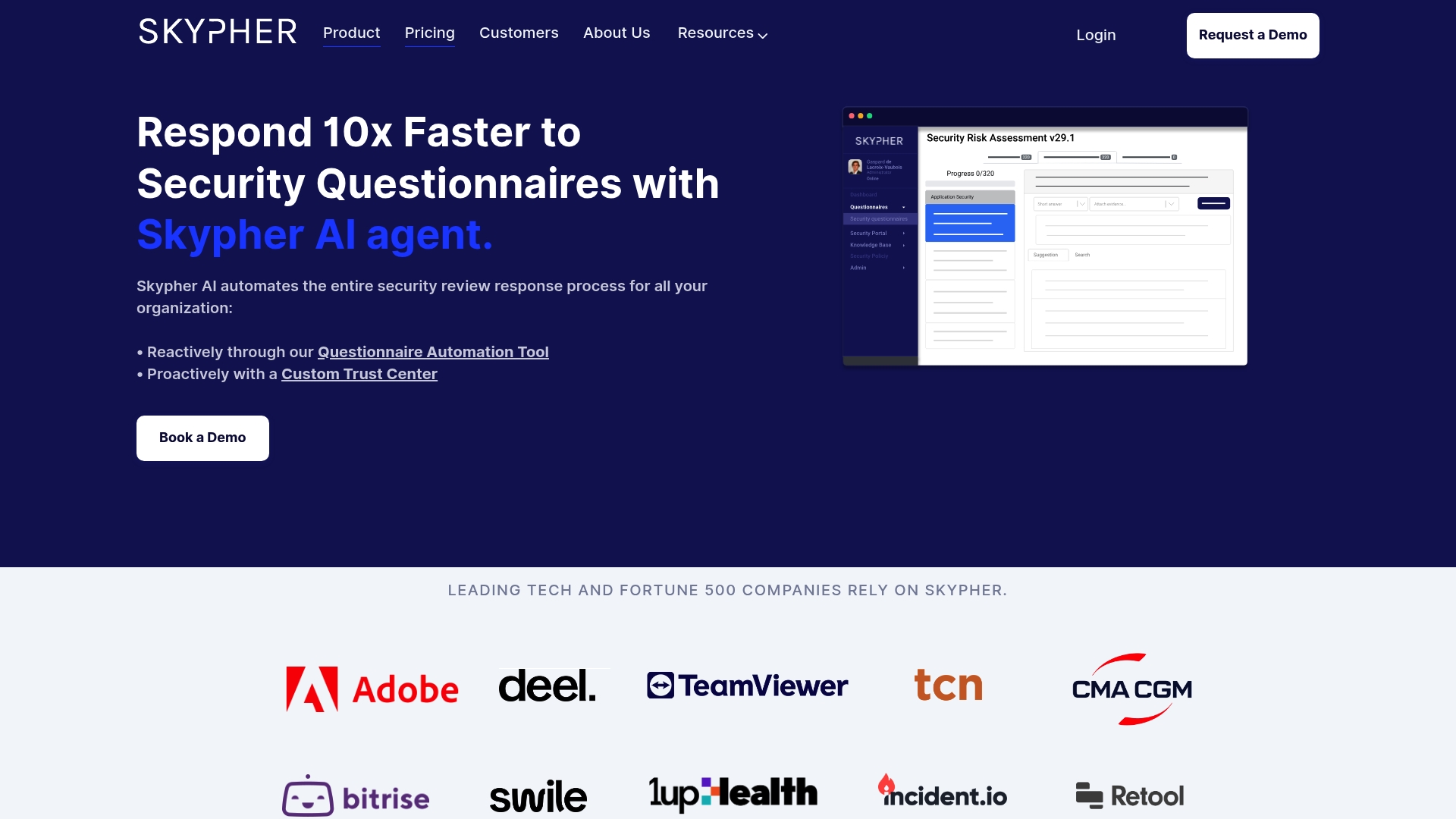
Elevate your security questionnaire processes today. With the AI Questionnaire Automation Tool, your team can automate and streamline security reviews. Answer custom security questions in minutes, maintain consistent answers, and keep your organization's verification process robust. Visit Skypher now and discover how modern automation can help you avoid common mistakes, shorten response times, and build stronger trust with your clients. Take control of your security questions and prove your readiness today.
Frequently Asked Questions
What makes a good security question?
A good security question is memorable, has a specific answer that is difficult for others to guess or research, and remains consistent over time. It should target unique personal experiences rather than relying on publicly available information.
How many security questions should I use?
It's recommended to use three to four well-crafted security questions. This number strikes a balance between thorough verification and user convenience, preventing authentication fatigue.
Why should I avoid common security questions?
Common security questions, such as "What is your mother's maiden name?" or "Where were you born?", can be easily compromised through social media and public records. It's crucial to use unique, personally specific challenges that are not widely accessible.
How often should security questions be updated?
It's important to regularly review and renew security questions, ideally on an annual basis. Personal circumstances change, and periodic updates help maintain the integrity of the authentication process.