

Security questionnaires shape how companies protect their digital assets and decide which partners they can trust. Hundreds of major firms now require detailed cybersecurity assessments before signing a deal and over 70 percent of organizations say these questionnaires influence their business decisions. Most teams think of these forms as dull paperwork. The real story is that every answer reveals just how serious an organization is about defending against threats—and sometimes, those answers matter more than any product demo.
Table of Contents
- 1: Understand the Purpose of Security Questionnaires
- 2: Gather Relevant Documentation and Resources
- 3: Assign Roles and Responsibilities Within Your Team
- 4: Customize Responses for Specific Client Needs
- 5: Use Clear and Concise Language in Your Answers
- 6: Review and Validate Your Responses with Stakeholders
- 7: Implement a Continuous Improvement Process
Quick Summary
| Takeaway | Explanation |
|---|---|
| Security questionnaires assess cybersecurity risks. | They help organizations evaluate potential vulnerabilities and establish trust between business partners. |
| Prepare thorough documentation before responding. | Compiling cybersecurity policies, incident plans, and compliance records ensures an effective and accurate response process. |
| Assign clear roles within your team. | Defining specific responsibilities enhances workflow efficiency and ensures comprehensive coverage of the security questionnaire's requirements. |
| Customize responses for each client's needs. | Tailoring answers to align with the client's industry and risks demonstrates a personalized approach and builds trust. |
| Implement continuous improvement practices. | Regularly review and refine questionnaire responses to improve accuracy and adaptability in response to evolving security frameworks. |
1: Understand the Purpose of Security Questionnaires
Security questionnaires represent critical assessment tools that organizations use to evaluate cybersecurity risks, compliance standards, and vendor security postures. When businesses engage in partnerships or technology integrations, these comprehensive documents help determine potential vulnerabilities and establish trust between parties.
These structured questionnaires serve multiple strategic purposes beyond simple information gathering. Learn more about security assessment strategies that help organizations proactively manage technological risks.
Key objectives of security questionnaires typically include:
-
Identifying potential security vulnerabilities in systems and processes
-
Evaluating vendor risk management before establishing business relationships
-
Ensuring regulatory compliance across different industry standards
-
Establishing baseline security expectations for technology partnerships
By meticulously designing and responding to these questionnaires, organizations can create transparent communication channels that highlight their commitment to robust cybersecurity practices. The process allows businesses to demonstrate their technical capabilities, risk management protocols, and commitment to protecting sensitive information.
Companies must recognize that security questionnaires are not merely bureaucratic exercises but strategic tools for risk mitigation. Comprehensive responses reveal an organization's security maturity, technological preparedness, and ability to protect critical digital assets.
Professional teams approach these questionnaires with a systematic mindset, understanding that each response contributes to building organizational credibility and trustworthiness in an increasingly complex digital ecosystem. Explore our guide on navigating security assessment challenges to develop a more strategic approach to these critical evaluations.
2: Gather Relevant Documentation and Resources
Successful completion of security questionnaires requires meticulous preparation and comprehensive documentation gathering. Organizations must systematically compile resources that demonstrate their security posture, technological capabilities, and risk management protocols.
Explore how to streamline security documentation to ensure a robust and efficient assessment process.
Critical documentation typically includes:
-
Cybersecurity policy documents outlining organizational security frameworks
-
Incident response plans detailing procedures for managing potential security breaches
-
Network architecture diagrams showing system configurations and data flow
-
Compliance certification records from relevant industry standards
Professional teams recognize that thorough documentation serves multiple strategic purposes. Accurate and comprehensive resources not only facilitate smoother questionnaire completion but also demonstrate an organization's commitment to transparency and rigorous security practices.
Technology professionals should develop a centralized repository of security documentation, ensuring quick access and consistent information. This approach minimizes response times and reduces the likelihood of inconsistent or incomplete submissions.
Effective documentation gathering requires collaboration across multiple departments. Security teams, IT professionals, legal representatives, and compliance officers must work together to compile a holistic set of resources that accurately represents the organization's security capabilities.
Learn about optimizing your security assessment workflow to transform documentation gathering from a complex task into a strategic advantage. By treating security questionnaires as opportunities for demonstrating organizational excellence, businesses can turn these assessments into powerful tools for building trust and credibility.
3: Assign Roles and Responsibilities Within Your Team
Successful security questionnaire completion demands a strategic approach to team organization. Establishing clear roles and responsibilities ensures efficient workflow, reduces potential information gaps, and minimizes response inconsistencies.
Understand organizational security responsibilities to create a robust team framework for handling complex security assessments.
Key team roles typically include:
-
Security Coordinator: Overall questionnaire management and strategic oversight
-
Technical Expert: Providing detailed technical security information
-
Compliance Specialist: Ensuring regulatory alignment and standard adherence
-
Documentation Manager: Organizing and tracking supporting documentation
Effective team configuration requires understanding each member's strengths and expertise. Organizations must match individual skills with specific questionnaire components, allowing team members to contribute their most relevant knowledge.
Communication protocols are equally critical. Establish clear channels for information sharing, review processes, and collaborative problem solving. Regular team meetings and shared digital workspaces can help synchronize efforts and maintain consistency across different sections of the security questionnaire.
Senior leadership should actively support this role assignment process. Empowering team members with decision making authority and providing necessary resources demonstrates organizational commitment to thorough security assessments.
Learn about optimizing team collaboration for more effective security questionnaire management. By developing a well structured team approach, organizations transform complex security assessments from challenging tasks into strategic opportunities for demonstrating technological preparedness and risk management capabilities.
4: Customize Responses for Specific Client Needs
Customizing security questionnaire responses requires a nuanced approach that goes beyond generic answers. Organizations must develop tailored strategies that address each client's unique technological ecosystem, compliance requirements, and specific risk management concerns.
Understand client-specific security assessment techniques to create more precise and meaningful responses.
Key considerations for customization include:
-
Analyzing the client's industry sector and specific regulatory landscape
-
Identifying unique technological infrastructure and potential vulnerability points
-
Understanding the client's risk tolerance and security expectations
-
Mapping your security capabilities directly to their specific requirements
Successful customization demands deep research and proactive communication. Professional teams invest time in understanding the client's technological context, allowing them to craft responses that demonstrate precise alignment with the client's security needs.
Technical teams should develop flexible response templates that can be quickly adapted to different client scenarios. This approach allows for rapid customization while maintaining consistency in core security messaging.
Contextual understanding goes beyond technical specifications. Emotional intelligence plays a crucial role in crafting responses that not only provide accurate information but also build trust and demonstrate organizational empathy.
Explore advanced questionnaire response strategies to transform security assessments from bureaucratic exercises into opportunities for relationship building. By treating each questionnaire as a unique communication channel, organizations can differentiate themselves through thoughtful, tailored approaches that showcase their commitment to client security.
5: Use Clear and Concise Language in Your Answers
Communication in security questionnaires demands precision, clarity, and directness. Professional responses require strategic language choices that convey complex technical information without unnecessary complexity or ambiguity.
Master the art of clear technical communication to enhance the effectiveness of your security assessments.
Key principles for effective communication include:
-
Eliminate technical jargon that might confuse readers
-
Use active voice to create direct and understandable statements
-
Provide specific examples when explaining complex security processes
-
Write at an accessible comprehension level for non technical audiences
Concise language serves multiple strategic purposes. It demonstrates professionalism, reduces misinterpretation risks, and helps reviewers quickly understand your organization's security capabilities. Technical experts must translate complex security concepts into clear, straightforward explanations that resonate with diverse audiences.
Avoid overcomplicating responses with unnecessary technical details. Instead, focus on creating precise statements that directly address the questionnaire's specific requirements. Each sentence should provide meaningful information without redundancy or excessive elaboration.
Contextual understanding is crucial. While maintaining technical accuracy, responses should be crafted to ensure that individuals with varying levels of technical expertise can comprehend the core security principles and practices being described.
Discover strategies for effective technical communication to transform your security questionnaire responses from complex technical documents into clear, compelling narratives that build trust and demonstrate organizational competence.
6: Review and Validate Your Responses with Stakeholders
Validating security questionnaire responses requires comprehensive collaboration across multiple organizational departments. Effective stakeholder engagement transforms responses from individual perspectives into holistic representations of an organization's security capabilities.
Learn about strategic stakeholder validation to enhance your security assessment process.
Key stakeholders typically involved in the review process include:
-
Information Security Managers who assess technical accuracy
-
Legal Representatives ensuring regulatory compliance
-
Compliance Officers verifying standard adherence
-
Technical Experts confirming detailed technical descriptions
Systematic review processes help minimize potential errors and inconsistencies in security questionnaire responses. Organizations should establish clear protocols for multi stage validation that allow each stakeholder group to contribute their specialized expertise.
Collaboration platforms and shared documentation systems can streamline the review process, enabling real time feedback and version tracking. Transparent communication channels are crucial for efficient stakeholder engagement, allowing team members to provide input without creating bureaucratic bottlenecks.
Beyond technical accuracy, stakeholder validation serves a strategic purpose. It demonstrates organizational commitment to comprehensive security assessment, building trust with potential clients and partners by showcasing a disciplined, collaborative approach to risk management.
Discover advanced validation techniques to transform your security questionnaire responses into powerful tools for organizational credibility. By treating each review as an opportunity for refinement, teams can create responses that truly reflect their technological capabilities and commitment to security excellence.
7: Implement a Continuous Improvement Process
Continuous improvement transforms security questionnaire responses from static documents into dynamic, evolving strategies that reflect an organization's commitment to excellence. Proactive organizations view each questionnaire as an opportunity for learning and refinement, creating systematic approaches to enhance their security documentation and processes.
Explore cybersecurity process optimization techniques to develop robust improvement frameworks.
Key elements of a continuous improvement strategy include:
-
Regular performance metrics tracking for questionnaire response times
-
Quarterly review of historical questionnaire feedback
-
Documented lessons learned from previous security assessments
-
Periodic training for team members on emerging security standards
Technological tools play a crucial role in implementing continuous improvement processes. Organizations should leverage data analytics and reporting mechanisms to identify patterns, bottlenecks, and opportunities for streamlining their security questionnaire responses.
Effective continuous improvement demands a cultural commitment. Teams must cultivate an environment that views constructive criticism as a valuable resource for growth, encouraging open dialogue about potential enhancements to security assessment methodologies.
Documentation becomes a critical component of this process. Maintaining comprehensive records of past questionnaire responses, including successful strategies and areas requiring development, allows organizations to build institutional knowledge and rapidly adapt to changing security landscapes.
Discover advanced improvement methodologies to transform your security assessment approach. By treating continuous improvement as a strategic imperative, organizations can develop more responsive, accurate, and compelling security questionnaire responses that demonstrate technological agility and commitment to excellence.
Below is a comprehensive table summarizing the main steps, benefits, and strategies discussed in the article for successfully completing security questionnaires.
| Step / Principle | Key Actions & Considerations | Benefits / Outcomes |
|---|---|---|
| Understand Purpose | Grasp objectives: risk evaluation, compliance, trust-building | Demonstrates security maturity and establishes trust |
| Gather Documentation | Collect cybersecurity policies, incident plans, architecture diagrams, certifications | Enables accurate responses and highlights transparency |
| Assign Roles | Define team roles: coordinator, technical expert, compliance, documentation | Boosts efficiency and ensures complete, consistent answers |
| Customize Responses | Tailor answers to client industry, risks, and regulatory context | Improves client trust and showcases adaptability |
| Use Clear, Concise Language | Avoid jargon, use active voice, provide examples, ensure clarity for non-experts | Enhances professionalism, reduces misinterpretation, quickens review |
| Review & Validate with Stakeholders | Collaborate with security, legal, compliance, technical experts for multi-stage review | Minimizes errors, demonstrates discipline, builds organizational credibility |
| Implement Continuous Improvement | Regularly assess workflow, gather lessons learned, train team on new standards | Increases response quality, agility, and institutional knowledge |
Eliminate the Stress of Security Questionnaires with Skypher
Completing security questionnaires takes time, coordination, and constant attention to detail. The article highlighted how manual processes often lead to scattered documentation, missed deadlines, and lost client trust. If your team is struggling to gather the right resources, customize every response, and collaborate effectively, you are not alone. Many organizations face these hurdles, but automation and real-time collaboration can change everything. Streamline your workflow, reduce mistakes, and make your responses truly shine with the right technology.
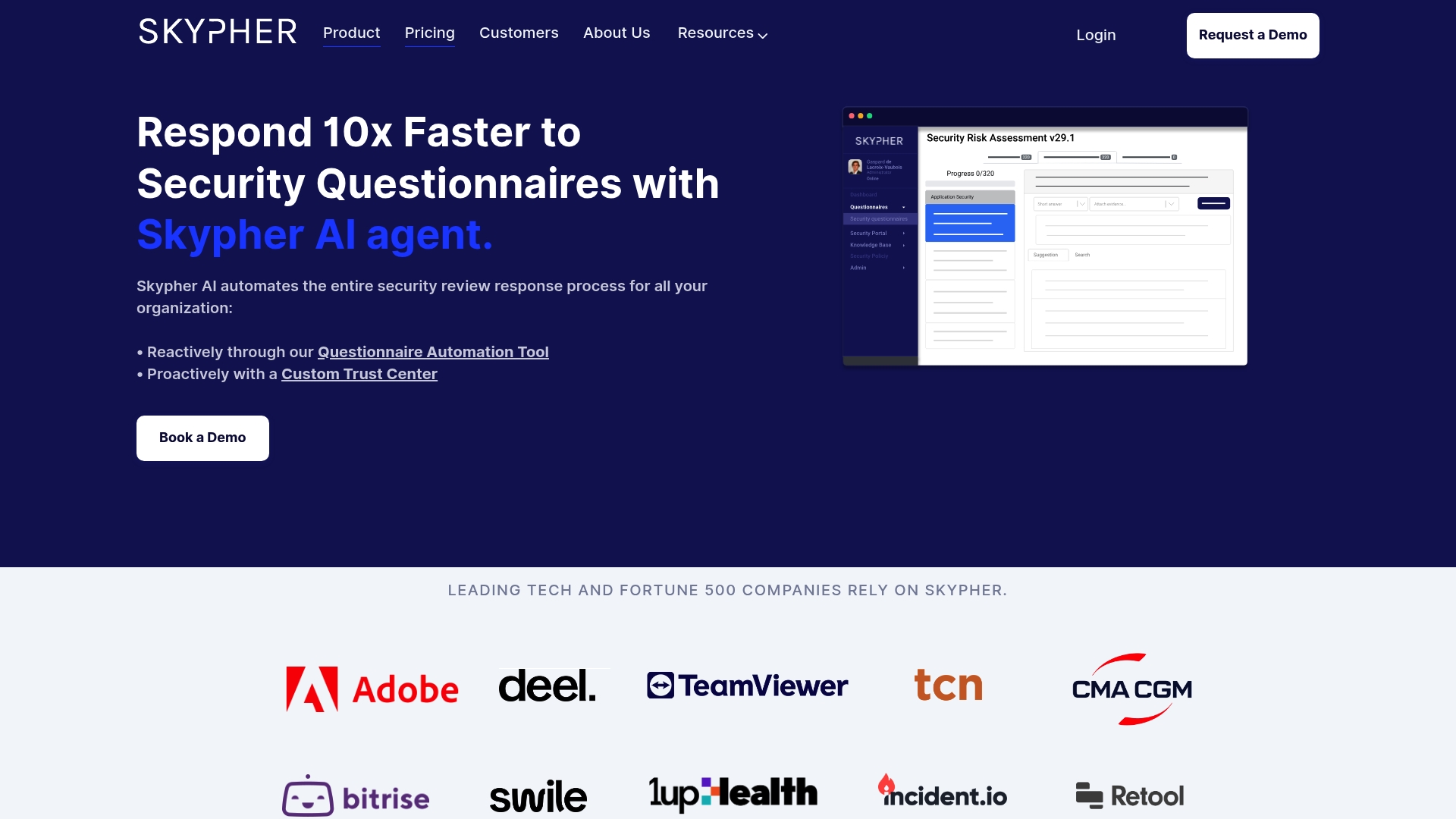
It's time to overcome security questionnaire fatigue. Discover how Skypher can help you automate repetitive tasks, unify documentation, and enable your team to collaborate in real time. Our AI-driven Questionnaire Automation Tool supports over 40 integrations and customizable workflows tailored to meet every unique client request. Take charge of your next assessment and protect valuable client relationships. See how Skypher drives faster, more accurate security reviews for leading organizations. Start your transformation today.
Frequently Asked Questions
What are security questionnaires used for?
Security questionnaires are tools that organizations use to assess cybersecurity risks, compliance standards, and vendor security postures. They help identify potential vulnerabilities and establish trust in partnerships.
How can I gather the necessary documentation for a security questionnaire?
To complete a security questionnaire successfully, compile relevant documents such as cybersecurity policies, incident response plans, network architecture diagrams, and compliance certification records. A centralized repository can streamline this process.
What roles should be assigned within a team to complete security questionnaires effectively?
Key roles typically include a Security Coordinator for overall management, a Technical Expert for detailed security information, a Compliance Specialist for regulatory alignment, and a Documentation Manager for organizing supporting documents.
How can I customize my responses to better meet a client's needs in a security questionnaire?
Customize responses by analyzing the client's industry and regulatory landscape, understanding their unique technological infrastructure and risk tolerance, and mapping your security capabilities directly to their requirements.