

Security startups face a wild mix of opportunity and risk. Some reports show that over 70 percent of security startups struggle to find product-market fit in their first three years. You might think technical innovation is the only thing that matters. The truth is, real success hinges on how you connect with customers, shape your value, and build trust in a world obsessed with compliance and data.
Table of Contents
- 1: Understand Your Target Market
- 2: Develop a Unique Value Proposition
- 3: Focus on Building Strong Partnerships
- 4: Invest in Effective Marketing Channels
- 5: Leverage Data Analytics for Insights
- 6: Stay Compliant with Regulations
- 7: Foster a Culture of Innovation
Quick Summary
| Takeaway | Explanation |
|---|---|
| Understand your target market deeply | Conduct comprehensive research to identify unique security needs and pain points in various industries. |
| Craft a compelling value proposition | Articulate how your security solution uniquely solves specific problems and provides measurable benefits. |
| Build strategic partnerships | Form alliances that enhance credibility and accelerate market entry, focusing on shared objectives and mutual value. |
| Utilize effective marketing channels | Leverage platforms that allow substantive engagement with decision-makers, showcasing distinct technical expertise. |
| Embrace a culture of innovation | Foster an environment that encourages risk-taking and creative problem-solving to stay ahead in security technology. |
1: Understand Your Target Market
For security startups, understanding your target market represents the foundational strategy that determines long term success. This process goes beyond basic demographic analysis and requires deep comprehension of potential clients' specific security challenges, technological ecosystems, and pain points.
According to the National Counterterrorism Center, establishing security leadership involves understanding critical business assets and their associated risks. This principle directly translates to market research for security startups.
Key considerations for targeting your market include:
- Vertical Market Segmentation: Identify specific industries with urgent security needs
- Technological Complexity: Understand the technical sophistication of potential clients
- Regulatory Environment: Recognize compliance requirements unique to different sectors
Successful security startups recognize that different organizations have vastly different security requirements. A financial institution will have dramatically different security priorities compared to a healthcare provider or a technology company. Your research must dive deep into sector specific security challenges.
To effectively map your target market, conduct comprehensive research through:
- Direct interviews with potential clients
- Analyzing industry reports and cybersecurity threat landscapes
- Reviewing existing security solution gaps
The goal is not just identifying who might need your solution, but understanding precisely why they need it. This means going beyond surface level market analysis and developing a nuanced understanding of organizational security dynamics.
By meticulously studying your target market, you create a strategic foundation that allows your security startup to develop solutions that are not just technically sound, but strategically relevant to potential clients' specific needs.
2: Develop a Unique Value Proposition
In the crowded security startup ecosystem, a compelling value proposition becomes your critical differentiator. This is not merely a marketing slogan but a strategic declaration of how your solution solves specific problems more effectively than existing alternatives.
According to research in the Journal of Business-to-Business Marketing, technology-based startups must craft value propositions that attract pilot customers and demonstrate tangible benefits. This means moving beyond generic security claims to articulate precise, measurable advantages.
Key elements of a robust value proposition for security startups include:
- Specificity: Clearly define the exact security challenge you solve
- Quantifiable Impact: Demonstrate measurable improvements in security posture
- Competitive Differentiation: Highlight what makes your approach unique
Successful security startups understand that clients are not purchasing a product but investing in a solution that mitigates real risks. Your value proposition must translate technical capabilities into business outcomes. This means showing how your security solution reduces potential financial losses, minimizes operational disruptions, and provides measurable risk reduction.
To develop a powerful value proposition, consider the following strategic approaches:
- Conduct deep customer research to understand pain points
- Analyze competitor offerings to identify gaps
- Develop clear, concise messaging that resonates with decision makers
Your value proposition should answer three fundamental questions: What problem do you solve? How do you solve it differently? What tangible benefits will clients experience?
Remember that a truly exceptional value proposition goes beyond features. It communicates a transformative approach to security that aligns with your target market's strategic objectives. By crafting a value proposition that speaks directly to client needs, your security startup can stand out in a competitive landscape and attract customers who recognize the unique value you provide.
3: Focus on Building Strong Partnerships
Partnerships represent a critical growth strategy for security startups, enabling rapid market penetration and credibility enhancement. Strategic alliances can transform a nascent security solution into a trusted industry resource.
According to CISA, collaborative approaches are essential in reducing cybersecurity risks and minimizing potential threats across complex technological ecosystems.
Key partnership strategies for security startups include:
- Technology Integration Partners: Platforms that complement your security solutions
- Academic Research Collaborations: Universities providing cutting edge insights
- Industry Certification Partners: Organizations validating your technological capabilities
Successful partnerships are not merely transactional but strategic relationships that create mutual value. This means identifying partners who share similar technological philosophies and complementary market objectives.
Effective partnership development requires:
- Thorough due diligence on potential partner capabilities
- Clear communication of mutual benefit expectations
- Structured collaboration frameworks
Networking becomes instrumental in building these partnerships. Attend cybersecurity conferences, participate in industry working groups, and engage with professional associations. These platforms provide opportunities to showcase your startup's unique capabilities and connect with potential strategic allies.
The most valuable partnerships extend beyond formal agreements. They involve knowledge exchange, joint problem solving, and a shared commitment to advancing cybersecurity standards. By cultivating relationships with technology providers, research institutions, and industry leaders, security startups can accelerate their growth trajectory and establish themselves as significant players in the rapidly evolving security landscape.
Remember that trust is the fundamental currency in security partnerships. Your startup's reputation, technological competence, and commitment to collaborative innovation will determine the strength and longevity of these critical relationships.
4: Invest in Effective Marketing Channels
For security startups, selecting the right marketing channels is not just about visibility but about connecting with decision makers who understand complex security challenges. Strategic marketing transforms technical capabilities into compelling narratives that resonate with potential clients.
According to the National Academies of Sciences, Engineering, and Medicine, targeted communication is crucial for technology startups seeking growth and market penetration.
Effective marketing channels for security startups include:
- LinkedIn Professional Networking: Targeted B2B engagement
- Technical Conferences: Direct interaction with cybersecurity professionals
- Specialized Industry Webinars: Demonstrating thought leadership
- Podcast Appearances: Sharing expert insights
Understanding your target audience means recognizing that security professionals demand substantive, evidence based content. Your marketing should not rely on flashy promises but showcase technical depth, real world problem solving, and measurable security improvements.
Critical marketing strategies involve:
- Creating detailed technical whitepapers
- Producing case studies with quantifiable security outcomes
- Developing educational content that addresses specific industry challenges
Digital marketing for security startups requires a nuanced approach. Traditional advertising often falls flat. Instead, focus on channels that allow for deep technical communication. Platforms like GitHub, specialized cybersecurity forums, and technical conferences provide opportunities to demonstrate genuine expertise.
Content marketing becomes your primary vehicle for building credibility. This means producing materials that showcase your startup's unique approach to solving complex security problems. Your content should bridge the gap between technical complexity and business value, helping potential clients understand how your solution mitigates real world risks.
Remember that in the security industry, trust is your most valuable currency. Marketing channels are not just about broadcasting messages but establishing your startup as a credible, knowledgeable partner in navigating increasingly complex cybersecurity landscapes.
5: Leverage Data Analytics for Insights
In the rapidly evolving security landscape, data analytics emerges as a critical differentiator for startups seeking to transform raw information into strategic advantages. By systematically analyzing complex security data, startups can uncover patterns, predict potential threats, and develop more sophisticated defense mechanisms.
According to University of Cambridge research, leveraging data analytics can significantly enhance cybersecurity education and awareness programs by identifying specific vulnerabilities and tailoring insights to organizational needs.
Key data analytics strategies for security startups include:
- Threat Intelligence Mapping: Tracking emerging cybersecurity trends
- Behavioral Pattern Recognition: Identifying anomalous network activities
- Predictive Risk Modeling: Forecasting potential security breaches
- Performance Optimization: Measuring security solution effectiveness
Machine learning algorithms play a crucial role in transforming vast amounts of security data into actionable intelligence. These sophisticated tools can process complex datasets far more rapidly than traditional human analysis, enabling startups to develop proactive rather than reactive security strategies.
Critical considerations for implementing data analytics include:
- Investing in advanced analytical tools
- Developing robust data collection methodologies
- Creating cross functional teams with diverse technological expertise
Successful security startups recognize that data analytics is not just about collecting information but interpreting it strategically. This means developing nuanced insights that go beyond surface level observations and provide meaningful context for security decision making.
The most effective data analytics approaches integrate multiple data sources, combining internal security logs, external threat intelligence, and industry wide trends. By creating comprehensive analytical frameworks, security startups can develop more sophisticated, adaptive solutions that anticipate and mitigate potential risks before they materialize.
Ultimately, data driven insights become your startup's competitive advantage. They transform raw information into strategic knowledge, enabling your organization to stay ahead of increasingly complex and dynamic security challenges.
6: Stay Compliant with Regulations
Navigating the complex regulatory landscape is crucial for security startups seeking sustainable growth and market credibility. Regulatory compliance is not merely a legal requirement but a strategic imperative that demonstrates your startup's commitment to professional standards and client protection.
According to the European Union Agency for Cybersecurity, startups must proactively track and comply with transnational and regional regulations to facilitate market growth and reduce business risks.
Critical regulatory compliance areas for security startups include:
- Data Privacy Regulations: GDPR, CCPA, HIPAA
- Industry Specific Security Standards: PCI DSS, NIST Framework
- International Security Certifications: ISO 27001, SOC 2
Comprehensive compliance requires more than superficial adherence. It demands a holistic approach that integrates regulatory requirements into your startup's core operational and technological architecture. This means developing robust internal processes that systematically address legal and ethical considerations.
Key strategies for maintaining regulatory compliance involve:
- Conducting regular compliance audits
- Implementing continuous monitoring systems
- Developing adaptive documentation frameworks
- Training team members on regulatory requirements
Successful security startups recognize that compliance is an ongoing journey, not a one time checkbox. Proactive compliance becomes a competitive advantage, signaling to potential clients that your organization takes security and legal responsibilities seriously.
Technological solutions must be designed with regulatory considerations embedded from their inception. This means building flexibility into your product architecture that allows for rapid adaptation to evolving regulatory landscapes. Your security solutions should not only solve technical challenges but demonstrate a nuanced understanding of legal and ethical constraints.
Remember that transparency is key. Clearly communicating your compliance strategies builds trust with clients, investors, and regulatory bodies. By positioning compliance as a core value rather than a bureaucratic requirement, your security startup can differentiate itself in a crowded marketplace.
7: Foster a Culture of Innovation
For security startups, innovation is not a luxury but a survival mechanism. Continuous technological evolution demands an organizational culture that embraces creativity, encourages risk taking, and transforms challenges into breakthrough solutions.
According to MIT Sloan Management Review, creating an environment where employees feel safe to experiment is fundamental to developing innovative approaches in technology driven industries.
Key principles for cultivating an innovative culture include:
- Psychological Safety: Encouraging team members to share unconventional ideas
- Rapid Prototyping: Implementing quick iteration cycles
- Cross Functional Collaboration: Breaking down departmental silos
- Continuous Learning: Investing in ongoing skill development
Innovation thrives in environments that view failures as learning opportunities, not setbacks. Security startups must create frameworks that reward creative problem solving and recognize that breakthrough solutions often emerge from seemingly unsuccessful attempts.
Critical strategies for embedding innovation include:
- Allocating dedicated time for experimental projects
- Establishing innovation reward mechanisms
- Creating open communication channels
- Implementing flexible work structures
Successful security startups understand that innovation extends beyond technological development. It encompasses reimagining organizational processes, challenging existing paradigms, and developing solutions that anticipate future security challenges rather than merely responding to current threats.
Leadership plays a crucial role in fostering this culture. Executives must model curiosity, demonstrate openness to new ideas, and create organizational structures that support experimental thinking. This means moving beyond traditional hierarchical models towards more adaptive, collaborative approaches.
Ultimately, innovation is a mindset, not a department. By embedding creative thinking into every organizational layer, security startups can develop resilient, forward thinking solutions that distinguish them in an increasingly competitive marketplace.
Below is a comprehensive table summarizing the seven core strategies for growing your security startup, including each strategy's main focus and the strategic benefits highlighted in the article.
| Strategy | Description | Strategic Benefit |
|---|---|---|
| Understand Your Target Market | Deep research into specific client needs, sectors, and pain points | Builds solutions that fit real-world security demands |
| Develop a Unique Value Proposition | Define and communicate clear, measurable solutions to unique challenges | Differentiates your startup and attracts the right clients |
| Build Strong Partnerships | Establish alliances with tech partners, researchers, and certification bodies | Expands credibility and accelerates market entry |
| Invest in Effective Marketing Channels | Focus on targeted, evidence-based channels to reach decision makers | Enhances trust and positions the startup as an expert |
| Leverage Data Analytics for Insights | Use advanced analytics to predict threats and improve solutions | Drives smarter strategies and future-readiness |
| Stay Compliant with Regulations | Proactively integrate privacy, industry, and international compliance | Minimizes risk and demonstrates professional reliability |
| Foster a Culture of Innovation | Encourage risk-taking, rapid prototyping, and team collaboration | Ensures adaptability and breakthrough advancements |
Transform Your Security Startup’s Growth with Automated Questionnaire Response
Building a security startup means navigating complex trust issues, juggling compliance, and responding quickly to time-consuming security questionnaires. The article highlights how crucial it is to understand your target market, create a unique value proposition, and prove your reliability through strong partnerships and innovation. Yet, many startups struggle with slow manual survey responses and missed sales opportunities because security reviews take too long. Does your team spend hours wrestling with repetitive risk assessments, losing valuable time you could use closing deals or developing new features?
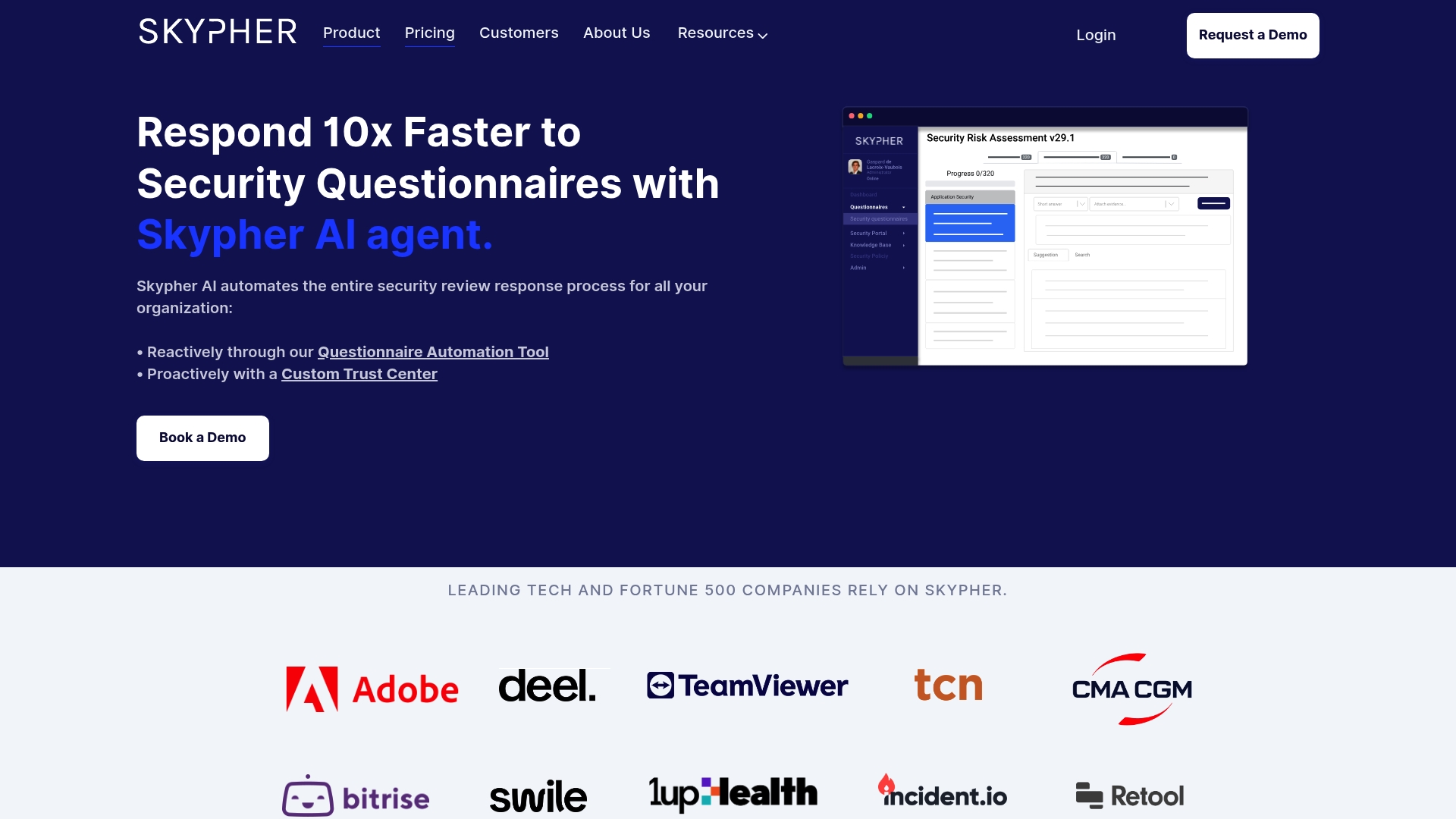
You do not have to fall behind competitors who automate these tasks. Skypher's AI Questionnaire Automation Tool lets your security team answer even the most complex questionnaires in minutes, not hours. You can collaborate in real time across tools like Slack and ServiceNow, integrate instantly with over 40 TPRM platforms, and manage documentation for compliance in one place. Visit https://skypher.co to see how our advanced automation and custom Trust Center can accelerate your sales process and strengthen your market credibility. Streamline security reviews and grow your security startup with confidence. Start transforming your process now and gain that strategic edge the article talks about.
Frequently Asked Questions
What are the key strategies for growing a security startup?
The key strategies include understanding your target market, developing a unique value proposition, building strong partnerships, investing in effective marketing channels, leveraging data analytics, staying compliant with regulations, and fostering a culture of innovation.
How can I identify my target market for a security startup?
To identify your target market, conduct thorough research, including direct interviews with potential clients, analyzing industry reports, and reviewing cybersecurity threat landscapes to understand the specific security challenges and pain points of different sectors.
What is the importance of a unique value proposition for a security startup?
A unique value proposition is crucial as it differentiates your startup from competitors by clearly articulating how your security solution effectively addresses specific problems and delivers measurable benefits, thereby attracting potential clients.
Why is compliance important for security startups?
Compliance is vital as it demonstrates your commitment to legal and ethical standards, reduces business risks, and enhances trust with clients, thereby contributing to sustainable growth and market credibility.
Recommended
- The ever growing number of security questionnaires and what you and your company can do to face it
- The different formats & mistakes made when writing or answering security questionnaires
- Gaspard de Lacroix - Saasy - Webflow HTML Website Template
- Blog - Skypher
- Top Strategies for Website Growth in 2025: Boost Traffic & Results