

Over 85 percent of organizations now rely on artificial intelligence to manage risk, marking a dramatic shift from manual methods. With threats growing more complex and business environments changing faster than ever, smart risk management is critical for survival. AI doesn't just identify risks, it analyzes them with near-instant accuracy and powers decisions that help companies stay one step ahead of disaster.
Table of Contents
- Defining AI's Role in Risk Management
- Types of Risks Managed by AI Tools
- How AI Automates Risk Identification and Response
- Leading Use Cases in Security and Compliance
- Challenges and Limitations of AI-Driven Risk Management
- Ensuring Regulatory Compliance with AI Solutions
Key Takeaways
| Point | Details |
|---|---|
| AI Transforms Risk Management | AI shifts risk management from reactive to proactive strategies, enabling organizations to anticipate and mitigate risks with enhanced accuracy. |
| Predictive Analytics and Automation | AI provides predictive analytics and automated decision support, facilitating faster and more informed risk assessments. |
| Proactive Compliance Solutions | AI enhances regulatory compliance by automating monitoring and documentation, leading to more adaptive and risk-aware organizations. |
| Challenges of AI Adoption | Despite its benefits, AI-driven risk management faces challenges like data integrity issues and algorithmic bias, necessitating careful implementation. |
Defining AI's Role in Risk Management
Risk management has undergone a profound transformation with the emergence of artificial intelligence (AI), shifting from traditional reactive approaches to proactive, intelligent strategies. In today's complex business landscape, AI enables organizations to anticipate, analyze, and mitigate potential risks with unprecedented precision and speed.
At its core, AI in risk management functions like an advanced early warning system. By leveraging machine learning algorithms and sophisticated data analysis techniques, AI can process massive volumes of structured and unstructured data from multiple sources simultaneously. This allows businesses to identify potential risks before they escalate, whether those risks are financial, operational, cybersecurity-related, or compliance-oriented.
Key Capabilities of AI in Risk Management
AI brings several transformative capabilities to risk management processes:
- Predictive Analytics: AI models can forecast potential risk scenarios with remarkable accuracy
- Real-Time Monitoring: Continuous data scanning for emerging threats and anomalies
- Automated Decision Support: Instant risk scoring and recommendation generation
- Pattern Recognition: Detecting subtle correlations humans might miss
For organizations in high-stakes industries like finance and technology, AI represents more than a tool—it's a strategic advantage. By integrating intelligent systems that can learn, adapt, and provide actionable insights, companies can move from defensive risk management to proactive risk optimization. The result is not just protection, but a competitive edge that transforms potential vulnerabilities into strategic opportunities.
The integration of AI into risk management isn't about replacing human expertise, but augmenting it. Skilled professionals can now leverage AI-powered insights to make more informed, nuanced decisions faster than ever before. As machine learning models continuously improve, their risk assessment capabilities become increasingly sophisticated, creating a dynamic ecosystem of intelligent risk management.
Types of Risks Managed by AI Tools
AI tools have revolutionized risk management by providing sophisticated capabilities to address a wide spectrum of organizational risks. According to TechTarget, AI brings numerous advantages, including increased ability to predict business risks, improved decision-making speed, and automated risk monitoring.
Risk Categories Transformed by AI
AI technologies are particularly powerful in managing several critical risk domains:
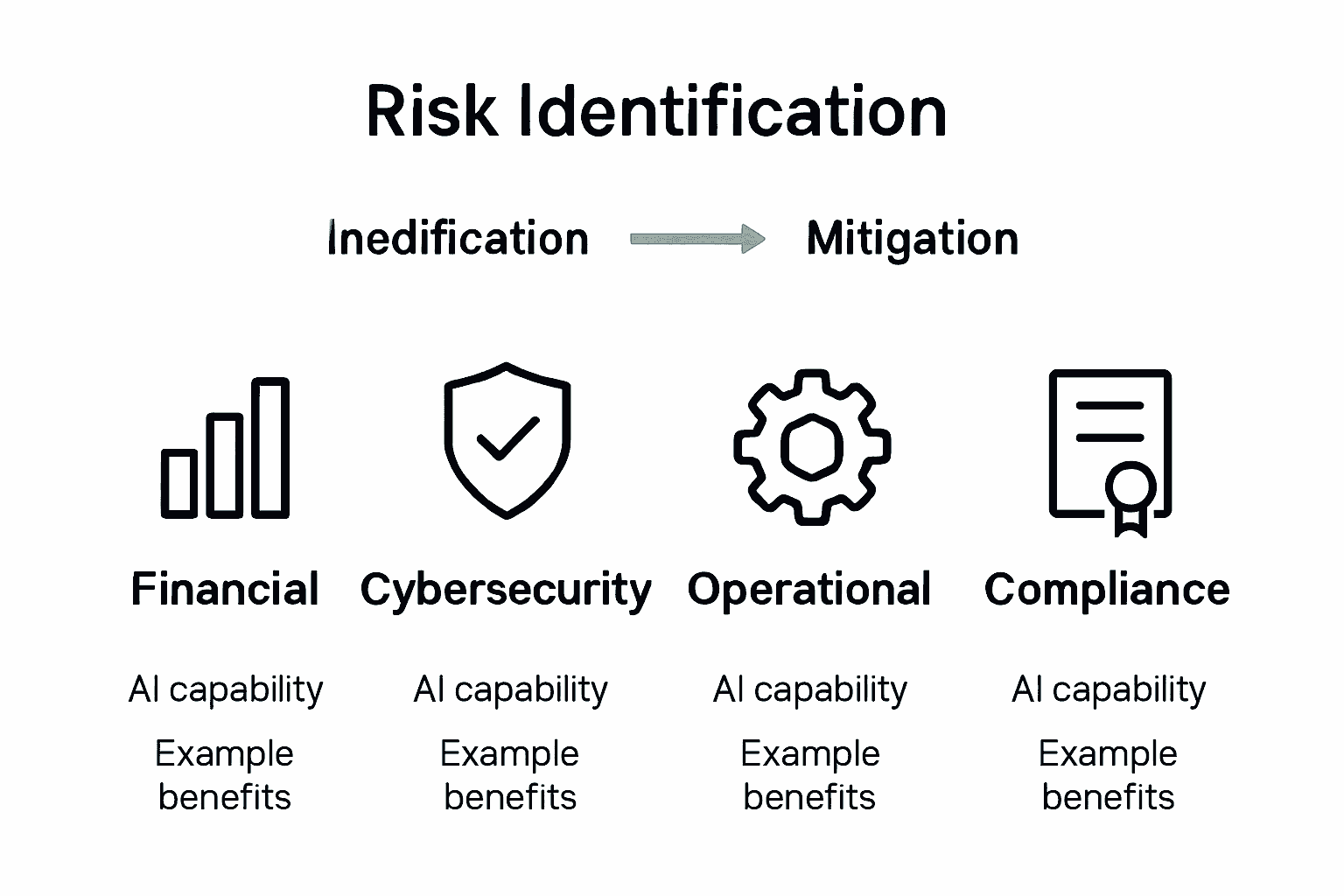
Here's a comparison of how AI addresses different types of organizational risks:
| Risk Category | AI Capabilities | Example Benefits |
|---|---|---|
| Financial Risks | Predictive analytics<br>Pattern recognition | Improved credit scoring<br>Early fraud detection |
| Cybersecurity Risks | Real-time monitoring<br>Anomaly detection | Faster breach response<br>More accurate threat alerts |
| Operational Risks | Process analysis<br>Automated alerts | Fewer process failures<br>Increased efficiency |
| Compliance Risks | Automated monitoring<br>Report generation | Faster regulatory updates<br>Reduced audit workload |
- Financial Risks: Advanced predictive models can analyze market trends, investment patterns, and potential economic disruptions
- Cybersecurity Risks: Real-time threat detection and anomaly identification
- Operational Risks: Identifying potential process failures and efficiency bottlenecks
- Compliance Risks: Automated monitoring of regulatory requirements and potential violations
Research from SuasPress highlights the remarkable precision of AI in risk assessment. For instance, AI-powered credit risk models demonstrate a 20% increase in predictive accuracy compared to traditional methods, while market risk management sees a 30% improvement in anomaly detection speed and precision.
Beyond numerical improvements, AI enables a proactive risk management approach. By continuously learning from vast datasets, AI systems can identify subtle risk patterns that might escape human analysts. This means organizations can anticipate potential threats, allocate resources more strategically, and develop more robust risk mitigation strategies. The dynamic nature of AI tools ensures that risk management becomes an adaptive, intelligent process rather than a static, reactive procedure.
For organizations seeking to transform their risk management approach, integrating AI is no longer optional—it's a strategic imperative. These intelligent systems don't just process data; they provide actionable insights that can fundamentally reshape how businesses understand, predict, and manage complex risk landscapes.

How AI Automates Risk Identification and Response
AI has fundamentally transformed risk identification and response processes, shifting organizations from reactive approaches to proactive, intelligent strategies. According to TechTarget, AI enables risk management teams to leverage machine learning algorithms that analyze historical patterns and forecast potential risk events before they occur, allowing for prevention of critical business disruptions.
AI-Driven Risk Automation Techniques
The automation of risk identification involves several sophisticated technological mechanisms:
- Predictive Pattern Recognition: Analyzing historical data to predict future risk scenarios
- Real-Time Anomaly Detection: Continuous monitoring of system behaviors and identifying potential threats
- Automated Threat Scoring: Assigning risk levels and prioritizing potential vulnerabilities
- Contextual Risk Analysis: Understanding complex interconnections between different risk factors
As noted by IBM, AI risk management goes beyond simple threat detection. It involves implementing comprehensive frameworks that ensure safety, fairness, and respect for human rights while maintaining robust protection mechanisms.
The true power of AI in risk automation lies in its ability to process and analyze massive datasets exponentially faster than human analysts. By continuously learning from new information, AI systems can dynamically adjust risk models, providing organizations with a living, breathing risk management infrastructure that evolves in real-time.
This means businesses can anticipate potential challenges, allocate resources more strategically, and develop more resilient operational frameworks.
For forward-thinking organizations, embracing AI-driven risk identification isn't just about technology—it's about transforming risk from a potential threat into a strategic opportunity. Check out our best practices for automating security response processes to understand how cutting-edge AI can revolutionize your risk management approach.
Leading Use Cases in Security and Compliance
Artificial Intelligence has become a transformative force in security and compliance, revolutionizing how organizations approach risk management and regulatory adherence. According to Reuters, AI is increasingly shaping critical processes by offering unprecedented efficiencies in legal research, document analysis, and predictive analytics.
Key Security and Compliance Applications
AI demonstrates remarkable capabilities across multiple compliance domains:
- Regulatory Monitoring: Automatic tracking of changing legal and industry regulations
- Fraud Detection: Real-time identification of suspicious financial transactions and potential security breaches
- Risk Assessment: Dynamic evaluation of organizational vulnerabilities
- Compliance Documentation: Automated generation and verification of compliance reports
IBM emphasizes that AI governance goes beyond simple rule enforcement, establishing comprehensive frameworks that ensure safety, fairness, and respect for human rights while maintaining robust protection mechanisms.
The most sophisticated AI systems now provide intelligent, context-aware compliance solutions that adapt in real-time. By processing vast amounts of data exponentially faster than human analysts, these systems can identify subtle patterns, predict potential compliance risks, and recommend preemptive actions. This proactive approach transforms compliance from a reactive, checkbox exercise into a strategic, intelligence-driven process.
For organizations seeking to stay ahead of complex regulatory landscapes, understanding AI's role in security and compliance is no longer optional. Explore our guide to cybersecurity GRC strategies to discover how cutting-edge AI technologies are reshaping risk management and regulatory compliance.
Challenges and Limitations of AI-Driven Risk Management
While AI has revolutionized risk management, it is not without significant challenges and inherent limitations. According to research from IRE Journals, one of the primary obstacles facing AI-driven risk management is the critical issue of data quality and availability. Many organizations struggle with fragmented data ecosystems, legacy systems, and incomplete datasets that can compromise the accuracy and reliability of AI predictions.
Key Limitations in AI Risk Management
The most prominent challenges include:
- Data Integrity Issues: Incomplete or biased datasets leading to skewed risk assessments
- Algorithmic Bias: Potential for built-in prejudices that can distort risk evaluation
- Interpretability Challenges: Difficulty in understanding complex AI decision-making processes
- Regulatory Compliance: Ensuring AI systems meet evolving legal and ethical standards
Reuters highlights that AI technologies raise significant ethical, legal, and practical challenges beyond their technological capabilities.
Moreover, the black-box nature of many AI systems creates substantial transparency problems. While these systems can process enormous amounts of data with incredible speed, they often provide limited insight into how specific conclusions are reached. This opacity can be particularly problematic in high-stakes risk management scenarios where understanding the reasoning behind a decision is as crucial as the decision itself.
Learn essential strategies for GRC analysts navigating these complex challenges to effectively leverage AI while mitigating its inherent limitations. The future of risk management lies not in blind adoption, but in a nuanced, critically informed approach that balances technological innovation with human oversight.
Ensuring Regulatory Compliance with AI Solutions
Regulatory compliance represents one of the most complex challenges in modern technological ecosystems, with AI solutions emerging as a powerful mechanism for navigating intricate legal landscapes. According to research from ArXiv, different global regions are developing unique approaches to AI risk management, investigating how to classify risks, implement compliance measures, and prioritize transparency across diverse technological environments.
Key Strategies for AI Compliance
Effective AI-driven regulatory compliance requires a multi-dimensional approach:
- Automated Monitoring: Continuous tracking of regulatory changes
- Risk Assessment: Dynamic evaluation of potential compliance violations
- Documentation Management: Automated generation of compliance evidence
- Policy Alignment: Ensuring AI systems adhere to evolving legal frameworks
A groundbreaking study from ArXiv introduces a probabilistic risk assessment framework specifically designed for advanced AI technologies. This innovative approach allows organizations to systematically identify potential risks, estimate their likelihood and severity, and meticulously document underlying assumptions and analyses.
The most sophisticated AI compliance solutions go beyond simple rule-checking. They create adaptive systems that can interpret complex regulatory requirements, anticipate potential compliance challenges, and provide actionable recommendations in real-time. By integrating machine learning algorithms with comprehensive regulatory databases, these tools transform compliance from a reactive process to a proactive, intelligence-driven strategy.
Learn more about understanding the GRC framework and how cutting-edge AI technologies are revolutionizing regulatory compliance across industries. The future of effective risk management lies in embracing intelligent, adaptive compliance solutions that can navigate increasingly complex global regulatory environments.
Unlock Smarter Risk Management with AI-Powered Automation
Navigating the complexities of AI-driven risk management requires tools that not only identify and assess risks accurately but also streamline your security and compliance workflows. If you are facing challenges with timely and precise security questionnaire responses or overwhelmed by the demand for real-time risk insights, Skypher is designed to solve these pain points. Our AI Questionnaire Automation Tool supports rapid, accurate completion of security reviews, helping you stay ahead in financial, cybersecurity, operational, and compliance risk areas discussed in the article.
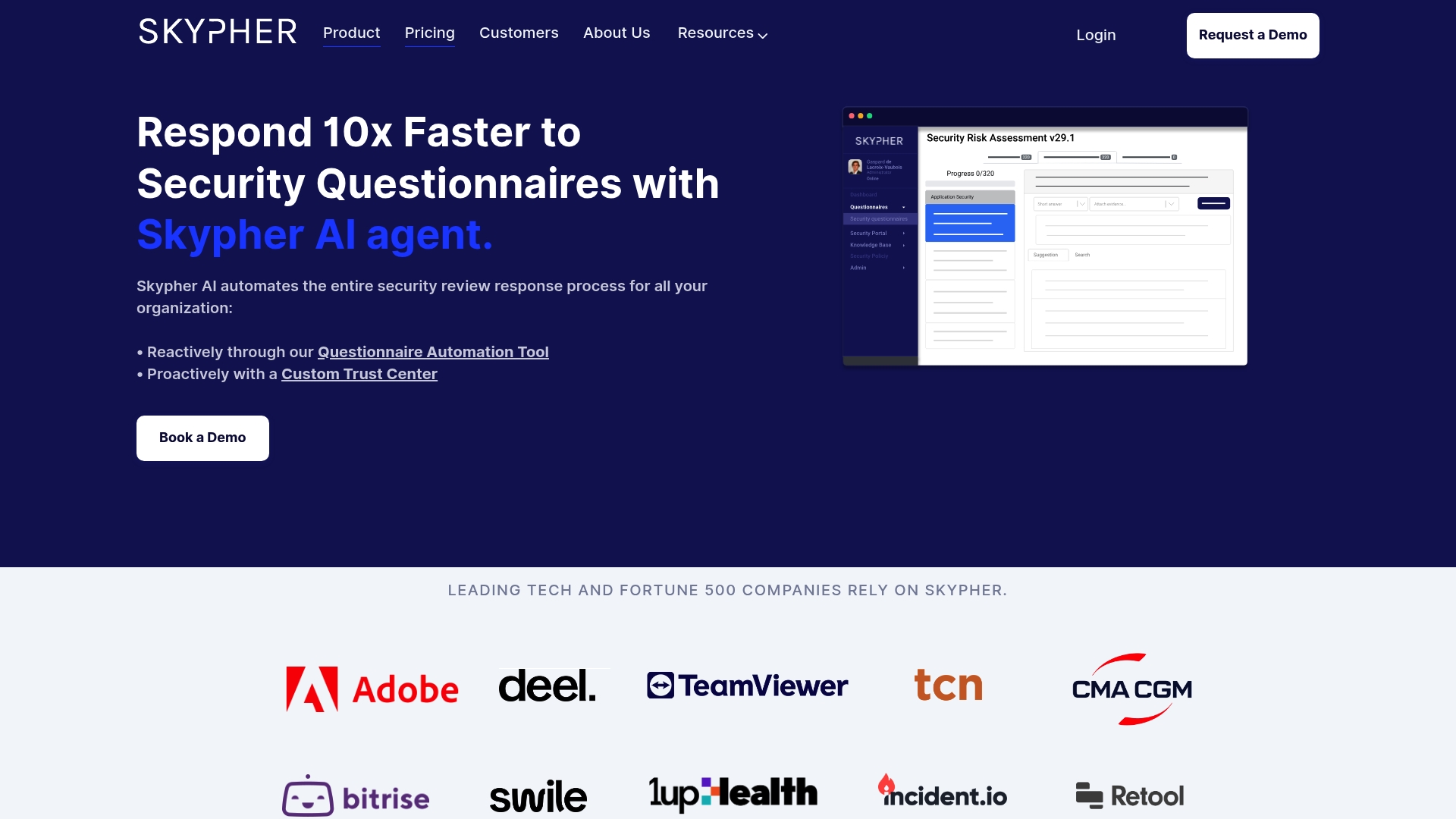
Experience how seamless collaboration, advanced AI parsing, and deep integrations with platforms like ServiceNow and Slack enable your teams to work smarter. Don’t let data overload or slow responses put your organization at risk. Visit Skypher today to explore how our solution can transform your risk and compliance management. Start accelerating your security review process now with our AI-powered automation tools and discover best practices for automating security response processes. Make the shift from reactive to proactive risk management and gain a competitive edge with Skypher.
Frequently Asked Questions
What is the role of AI in risk management?
AI plays a transformative role in risk management by shifting organizations from reactive to proactive strategies. It helps in anticipating, analyzing, and mitigating potential risks with precision and speed by leveraging machine learning algorithms and data analysis techniques.
What types of risks can AI tools manage?
AI tools can effectively manage various types of risks, including financial risks (like credit scoring and fraud detection), cybersecurity risks (through real-time monitoring), operational risks (by identifying process failures), and compliance risks (automated monitoring of regulatory requirements).
How does AI improve risk identification and response?
AI improves risk identification and response by automating processes such as predictive pattern recognition, real-time anomaly detection, automated threat scoring, and contextual risk analysis, allowing organizations to anticipate challenges and develop resilient operational frameworks.
What are the challenges of integrating AI in risk management?
Key challenges include data integrity issues, algorithmic bias, interpretability challenges in understanding AI decision-making, and ensuring regulatory compliance with evolving legal and ethical standards.
Recommended
- 7 Essential Tips for Every GRC Analyst to Succeed
- AI powered recommendation engine | Security Questionnaire Automation | Skypher
- Understanding the GRC Framework: Key Concepts Explained
- Cybersecurity GRC: Essential Strategies for 2025 Success
- The Impact of AI on SEO in 2025: Key Changes for Businesses
- Big Data Analytics in Finance Industry- Here to stay! | Ambeone