
Security reviews and compliance checks often slow down even the fastest teams. Long forms, scattered documents, and endless back and forth can drain hours from your week. New tools now promise to make these headaches a thing of the past. Imagine answering complex questionnaires in minutes instead of days. Picture all your critical security information organized in one place and ready to share at any moment. Some platforms even use smarter technology to suggest answers or catch errors before you hit send. Curious about what these solutions can do and how they actually work in practice? The next comparison might surprise you.
Table of Contents
Skypher Respond
At a Glance
Skypher Respond is an AI-powered platform that automates security questionnaire responses, enabling teams to complete reviews up to 10x faster while keeping accuracy high. It centralizes security content, supports collaboration with granular access controls, and shortens sales cycles by making posture communication repeatable and professional. There are trade-offs—pricing is quote-based and teams unfamiliar with AI-driven workflows may face a short learning curve—but those are deliberate design choices to prioritize enterprise-grade customization and accuracy.
Core Features
Skypher’s core is its AI Questionnaire Automation Tool: an agent-driven engine that drafts, validates, and populates security questionnaire answers from centralized security content and connected data sources. It stores and manages all security data in one place, integrates with internal wikis and external sources for higher confidence in responses, and enforces granular access controls so security and sales teams collaborate without friction. The platform is built to reduce manual effort, accelerate response times, and present a consistent security posture to clients and prospects.
Pros
- Skypher dramatically speeds up security questionnaire responses, helping teams complete reviews up to 10x faster, which shortens procurement and sales cycles.
- It reduces manual effort and repetitive work by automating the end-to-end response process, freeing your security and solutions engineers for higher-value tasks.
- Centralized storage makes managing and updating security content straightforward, so your single source of truth stays current and auditable.
- The platform helps build trust with customers by generating clear, consistent communications that reflect your true security posture.
- Skypher integrates multiple data sources and internal knowledge to reach high accuracy (reported at 96%), improving first-pass acceptance rates.
- Autonomous AI handling of security reviews reduces workload for busy teams while preserving oversight through access controls and collaboration tools.
Who It's For
Security, sales, and solutions teams at medium and large organizations that frequently respond to RFPs and security questionnaires will get the most value from Skypher. If your organization struggles with long response times, scattered security documentation, or inconsistent answers that slow deals down, Skypher Respond is built to remove those bottlenecks and give you a repeatable, auditable workflow.
Unique Value Proposition
Skypher Respond combines fast, autonomous AI response generation with centralized content management and enterprise-grade collaboration controls—an uncommon trio. Rather than just automating text, Skypher connects your internal wikis and external data, validates answers against a single source of truth, and preserves human oversight through granular permissions. The result: faster responses, fewer back-and-forths during sales cycles, and measurable gains in deal velocity and customer confidence. It’s not a blunt chatbot; it’s an accuracy-first automation engine tailored for organizations that need reliable, auditable security communications at scale.
Real World Use Case
A solutions engineering team at a tech company used Skypher Respond to automate answers to complex vendor security questionnaires, cutting turnaround from days to hours and boosting their sales win rate by improving responsiveness and consistency in customer-facing security documents.
Pricing
Quote-based — flexible pricing; contact Skypher for a custom quote based on company size and needs.
Website: https://skypher.co
1up
At a Glance
1up automates RFPs, security questionnaires, and sales enablement by extracting answers from your existing knowledge sources, enabling teams to respond far faster with higher accuracy. It claims up to 11x faster questionnaire completion and emphasizes enterprise-grade security and reliability. If your sales, compliance, or security teams are drowning in documents and repetitive questions, 1up is built to reduce that overhead quickly.
Core Features
1up centralizes knowledge automation from websites, Google Drive, Confluence, and other repositories to generate answers to RFPs and questionnaires in minutes. Key capabilities include complete questionnaire automation (with a browser plugin for answering on any web-based form), rapid RFP completion workflows, and chat-tool integration so sales reps can pull authoritative answers inside Slack, Teams, or Google Chat. The platform prioritizes answer accuracy and aims to eliminate hallucinations by grounding responses in your sources.
Pros
- Dramatically faster response times: The product advertises completing RFPs and questionnaires 11x faster, reducing days of work to minutes for many tasks.
- Reliable, grounded answers: 1up emphasizes high reliability and no hallucinations, which helps preserve trust with security and compliance reviewers.
- Broad knowledge connectors: It automates knowledge retrieval from websites, cloud drives, and Confluence, cutting manual search time across disparate repositories.
- Seamless collaboration in chat tools: Native integrations with Slack, Teams, and Google Chat let sales teams get lightning-fast answers where they already work.
- Built for enterprise security: The platform positions itself as enterprise-ready and trusted by large organizations with strong security needs.
Cons
- Enterprise pricing requires contact: While starter and tiered pricing is listed, full enterprise pricing details require contacting sales, which can delay evaluation for budget-conscious teams.
- Initial setup and configuration needed: Connecting data sources and configuring integrations requires upfront effort, which means an implementation phase before you realize time savings.
- Limited public detail on feature gaps: The provided information does not enumerate specific limitations or areas for improvement, making it harder to fully assess edge cases prior to trial.
Who It's For
1up targets sales teams, product marketing, compliance, and security professionals who need to automate complex questionnaire responses and accelerate knowledge sharing. It’s a fit for medium to large organizations that manage frequent RFPs, respond to security reviews, and need answers surfaced inside chat workflows to close deals faster.
Unique Value Proposition
1up’s unique value is its combination of source-grounded answer generation and workflow-first delivery—browser automation plus in-chat access—designed specifically to shrink RFP and questionnaire cycles while maintaining high answer fidelity for security-conscious enterprises.
Real World Use Case
WalkMe cut their RFP response time by 90% after adopting 1up, shifting multi-day tasks into minutes and enabling faster deal closures and operational efficiency improvements.
Pricing
Starting at $300/month for the Starter plan, with Business at $600/month and Pro at $800/month; Enterprise pricing is available upon contact.
Website: https://1up.ai
SafeBase by Drata
At a Glance
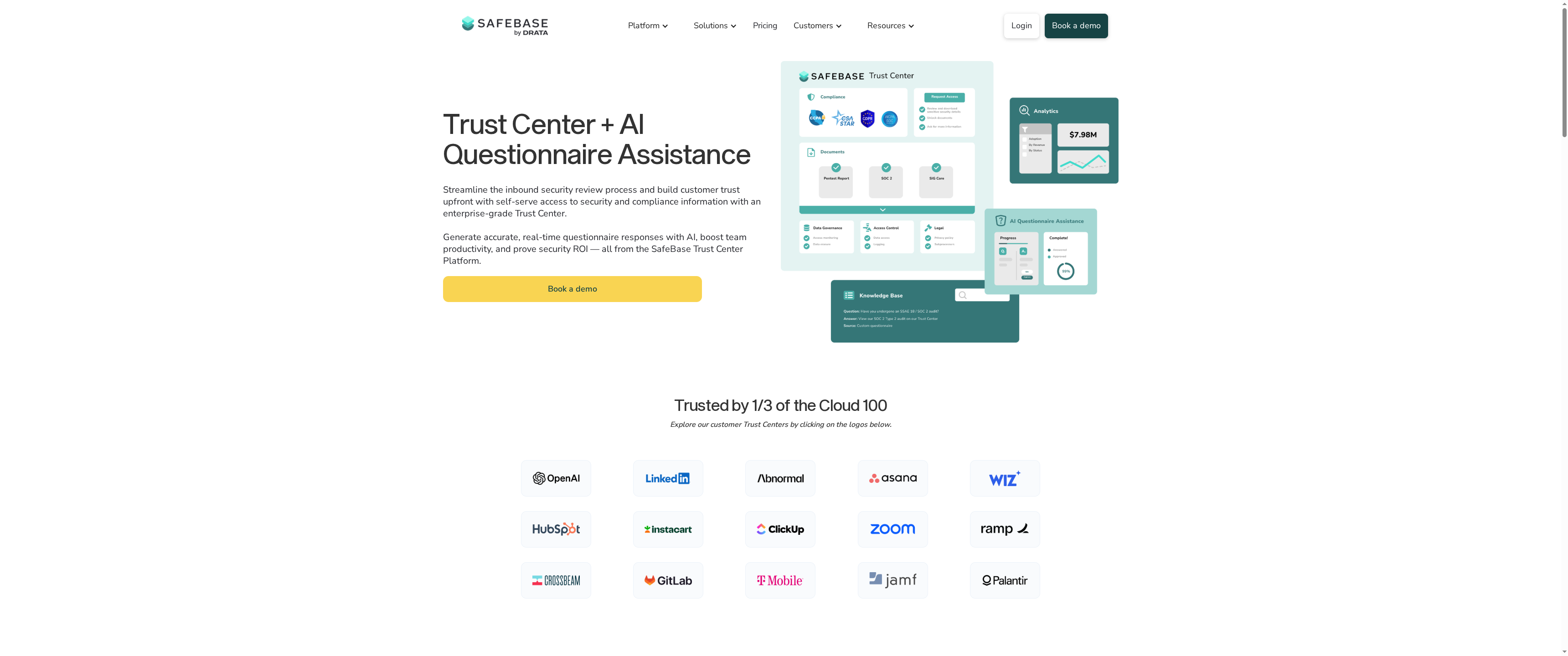
SafeBase by Drata is a trust center platform built to compress the inbound security review process and give customers self-serve access to compliance information. Its AI-powered questionnaire assistance and customizable trust centers speed responses and present a consistent, branded security story to prospects. Integrations and analytics let security and revenue teams measure engagement and tie security efforts to deal velocity. Bottom line: SafeBase is a pragmatic choice for mid-to-large orgs that need to scale trust without reassigning an army of reviewers.
Core Features
SafeBase combines a self-serve trust center with AI-assisted questionnaire responses, allowing teams to serve up security and compliance artifacts on demand. You get customizable trust centers with branding and granular permissions, AI-powered questionnaire assistance for faster responses, and integrations across Slack, Teams, Salesforce, HubSpot, DocuSign, Ironclad, and more. The platform also provides advanced analytics dashboards so you can measure security-related revenue, track engagement metrics, and demonstrate the business impact of your trust program.
Pros
- Speeds up security questionnaire responses significantly, letting teams move from manual research to automated answers.
- Enhances customer trust and transparency by exposing vetted policies, artifacts, and controls in a consistent, branded portal.
- Provides strong integrations with popular workflow tools, making it easier to embed trust workflows into sales and support motions.
- Supports customization and branding to align the trust center with company identity and partner-facing materials.
- Offers scalable plans suitable for different organizational sizes, so teams can start small and expand the footprint as needs grow.
Cons
- Complexity may be overwhelming for very small organizations or those with minimal security review needs, increasing setup time and governance overhead.
- Pricing details for advanced and enterprise tiers require direct contact, which reduces upfront transparency for procurement and procurement-led evaluations.
- Requires some level of technical integration for advanced features, meaning you may need developer or IT support to unlock full value.
Who It's For
SafeBase targets mid and large organizations with significant security compliance requirements and frequent inbound security reviews. If your security, GRC, or sales teams spend hours responding to questionnaires, or you want to convert lengthy audits into self-serve experiences for prospects, SafeBase is designed for you. It’s especially relevant where sales velocity and trust signals are tightly coupled.
Unique Value Proposition
SafeBase’s distinct value is the combination of a branded, self-serve trust center with AI-assisted questionnaire automation and measurable analytics. That trio helps security teams reduce manual toil, maintain consistent messaging to customers, and tie those improvements directly to engagement and revenue metrics.
Real World Use Case
A SaaS company used SafeBase to reduce security review time from several hours to just 15 minutes, while simultaneously increasing customer trust and transparency—shortening sales cycles and reducing back-and-forth evidence requests.
Pricing
Starting at a free option; advanced and enterprise plans require contacting sales for a quote.
Website: https://safebase.io
OneTrust
At a Glance
OneTrust provides a broad, enterprise-grade governance platform that unifies AI governance, privacy, third-party risk, and compliance workflows into a single product suite. It’s built to scale — the platform is used widely across large organizations and supports automated policy enforcement and model tracking for AI projects. Expect a powerful, integrated solution that requires deliberate onboarding and executive sponsorship to unlock its full value. Worth the investment for enterprises aiming for centralized control and regulatory consistency.
Core Features
OneTrust’s core capabilities span AI governance and risk decision automation, consent and preferences management, real-time data use policy enforcement, privacy automation, and comprehensive third-party assessment and monitoring. The platform also highlights model tracking and transparency for AI projects and automated lifecycle management for tech and data governance. In short: it combines governance workflows, monitoring, and compliance automation into an end-to-end system designed for enterprise complexity.
Pros
- Comprehensive end-to-end platform covering multiple governance areas, enabling teams to centralize privacy, AI, and third-party risk workflows in one place.
- Strong customer base including 75 of the Fortune 100, which demonstrates enterprise-scale trust and real-world applicability across regulated industries.
- Extensive patent portfolio indicates sustained investment in innovation and proprietary approaches to governance and automation.
- Recognition as a leader in GRC and AI governance solutions by industry reports provides independent validation of capabilities and market positioning.
- Various solution packages are customizable to organizational needs, allowing tailored deployments for different governance maturity levels.
Cons
- The platform’s breadth drives complexity, and organizations should expect a meaningful learning curve to configure and operationalize advanced features.
- Pricing and licensing are quote-based and tied to solution packages, usage metrics, and asset inventories, which means cost transparency requires direct consultation.
- Large-scale enterprise deployments have the potential for high total cost of ownership if scope and integration needs aren’t tightly controlled.
Who It's For
OneTrust is designed for large enterprises and organizations that need to establish scalable, centralized governance for data, privacy, and AI. If you’re a CISO, head of GRC, or risk executive managing complex vendor ecosystems, high regulatory exposure, or enterprise AI programs, this platform is built to meet those demands. Smaller teams may find it more than they need.
Unique Value Proposition
OneTrust’s unique value lies in combining breadth and depth: it links AI governance and model transparency with privacy automation and third-party risk monitoring in a single platform. That integrated approach reduces fragmentation across teams and supports consistent policy enforcement across data, models, and vendors.
Real World Use Case
A Fortune 100 company uses OneTrust to automate privacy compliance, govern an array of AI models with model-tracking and transparency, and continuously monitor third-party vendors for risk and regulatory adherence — transforming manual audits into automated, policy-driven workflows.
Pricing
Quote-based: pricing is determined by selected solution packages and usage metrics (users, data volume, asset inventory) and is provided through a personalized consultation.
Website: https://onetrust.com
Vanta
At a Glance
Vanta is an AI-driven compliance and third-party risk management platform that automates evidence collection, continuous controls monitoring, and vendor security reviews. It supports more than 35 compliance frameworks and is trusted by over 12,000 customers, making it a credible choice for organizations that need scale and broad coverage. The platform’s strength is automation and continuous monitoring, which reduces manual effort and shortens audit cycles. However, pricing and granular limitations aren’t specified in the provided material, and the breadth of features may require structured onboarding.
Core Features
Vanta’s core capabilities center on automated compliance for 35+ frameworks (including SOC 2, ISO 27001, and HITRUST), continuous controls monitoring with real-time alerts, and vendor risk management that leverages AI-powered reviews and monitoring. It also supports customer trust management via questionnaires and trust centers, and deploys AI agents to automate evidence collection, security reviews, and risk management workflows. Those combined capabilities aim to convert repetitive, manual tasks into continuous, auditable processes.
Pros
- Automates manual compliance and risk management tasks: Vanta reduces repetitive work by automating evidence collection and control checks, freeing security and compliance teams for higher-value work.
- Supports a wide range of compliance frameworks and standards: With support for 35+ frameworks, Vanta helps organizations pursuing multiple certifications without managing separate toolchains.
- Provides continuous monitoring and real-time alerts: Continuous controls monitoring delivers near real-time visibility into control drift and incidents, which helps teams respond faster.
- Streamlines vendor security reviews and questionnaires: The platform centralizes vendor risk workflows, making it easier to run and track security reviews.
- Backed by a large customer base: Being trusted by over 12,000 customers signals maturity and broad market adoption.
Cons
- Limited specificity on constraints in the available summary: The source material does not provide granular limitations or known gaps, so buyers may need to ask for detailed platform boundaries during evaluation.
- Feature breadth could overwhelm teams without guided onboarding: Given the wide scope of capabilities, organizations may require structured implementation and training to realize full value.
- Pricing details are not provided in the source content: The absence of transparent pricing in the provided material means procurement will likely require direct vendor engagement to assess TCO.
Who It's For
Vanta is best suited for organizations of various sizes that need to automate compliance, risk management, and customer trust programs—especially teams managing multiple frameworks or pursuing SOC 2 or ISO 27001 certification. It fits security, compliance, and GRC leaders who want continuous monitoring and automated evidence workflows, as well as startups that need to accelerate audits to win customers.
Unique Value Proposition
Vanta’s unique value is its combination of broad framework support, continuous controls monitoring, and AI-driven automation for evidence and vendor reviews. This positions Vanta as a single-pane solution for both internal compliance and external trust-building efforts, reducing manual lift and creating a continuous compliance posture.
Real World Use Case
A SaaS startup uses Vanta to accelerate SOC 2 readiness, automate vendor security reviews, and run continuous monitoring so controls remain auditable between audits—helping the company close deals faster by demonstrating reliable, automated security posture.
Pricing
Quote-based (pricing details are not provided in the source content).
Website: https://vanta.com
Perimeter VRM
At a Glance
Perimeter VRM is a streamlined vendor risk management platform designed for rapid deployment and continuous oversight. It combines 24/7 vendor monitoring, automated assessments, and AI-powered evidence extraction to reduce manual work and deliver fast time-to-value. For teams that must scale vendor security oversight quickly, it promises meaningful efficiency gains while preserving verification rigor.
Core Features
Perimeter VRM offers continuous vendor monitoring and risk identification around the clock, plus built-in assessment workflows, notifications, issue management, and reporting. The platform extracts information from evidentiary documentation to verify vendor responses and uses multiple data points to validate vendor attestations. It supports secure sharing of compliance documents and can auto-populate RFPs and security questionnaires with up-to-date data, which reduces repetitive data entry and shortens response cycles.
Pros
- Rapid onboarding and time-to-value: The platform can be implemented quickly, with reported time-to-value in as little as five days, enabling faster operational impact for busy security teams.
- Substantial reduction in manual effort: Perimeter VRM claims an 80% reduction in manual work, which directly cuts the hours teams spend chasing evidence and updating status trackers.
- 24/7 continuous monitoring: Continuous vendor monitoring provides near-real-time visibility into vendor risk changes, helping you spot and react to issues outside normal business hours.
- Automated, verified lifecycle management: Workflows, notifications, and issue management are automated and monitored, reducing human error while maintaining an auditable risk lifecycle.
- AI with guardrails for risk professionals: Built-in AI extracts and verifies information from vendor documents while offering controls suitable for risk teams who need explainability and oversight.
Cons
- Limited published detail on specific limitations: The product description does not provide granular limitations or edge-case behaviors, making it harder to evaluate fit for highly specialized environments.
- Potential functional gaps noted by users: User feedback suggests the platform may not perfectly cover every niche feature, indicating there could be gaps for highly customized vendor-risk workflows.
- Unspecified technical/integration constraints: The documentation does not specify detailed integration limits or supported enterprise configurations, so teams with complex ecosystems may need to validate compatibility during evaluation.
Who It's For
Perimeter VRM is aimed at organizations that need an automated, verifiable vendor risk program with rapid deployment—especially security, GRC, and vendor risk teams in regulated industries that require continuous monitoring and evidence-based attestation verification. If you need to scale vendor oversight quickly and reduce manual back-and-forth, this platform fits that mandate.
Unique Value Proposition
Perimeter VRM’s core value is combining fast time-to-value with continuous monitoring plus AI-driven evidence extraction and attestation verification, enabling teams to both automate repetitive tasks and maintain verification integrity through guardrails.
Real World Use Case
A healthcare organization uses Perimeter VRM to continuously monitor its suppliers’ security posture, automatically verify vendor attestations using document extraction, and manage remediation workflows—cutting manual effort and accelerating risk decisions during audits.
Pricing
Quote-based (pricing details are not explicitly provided in the available content).
Website: https://processbolt.com
SafeBase by Drata
At a Glance
SafeBase by Drata is a trust center platform that centralizes security documentation and automates inbound security reviews with AI help. It’s built to shorten review cycles—claims include up to 80% time savings—and to provide a single, self-serve hub customers can use to verify security posture. For security, sales, and GRC teams, it balances visibility and automation with integrations that embed trust into existing workflows.
Core Features
SafeBase combines a customizable trust center URL with a single hub for reports, policies, and security artifacts, plus AI-powered questionnaire assistance to accelerate responses. The platform includes advanced search, knowledge base and clickwrap NDA support, automated access approval and trust center updates, analytics dashboards, custom permission profiles, an API for customization, and multi-language and external website support. Integrations with Slack, Teams, Jira, Salesforce, HubSpot, DocuSign, Ironclad, and others let you connect security artifacts directly into sales and engineering processes.
Pros
- Significant efficiency gains: The platform claims to streamline security reviews and can save teams up to 80% of the time typically spent on inbound questionnaires.
- Improves buyer confidence: A centralized, branded trust center makes it easier for prospects to self-serve security information, which helps maintain and scale customer trust.
- AI-assisted questionnaire automation: Built-in AI tools accelerate and increase the accuracy of responses to complex questionnaires, reducing manual effort for security teams.
- Strong workflow integration: Native connectors to Slack, Salesforce, Jira, and other tools embed trust management into sales and engineering workflows, minimizing context switching.
- Actionable analytics: Dashboards provide security metrics that help you demonstrate ROI and track the impact of your security program over time.
Cons
- Pricing transparency is limited: The product description lists Foundation (free), Advanced, and Enterprise plans but does not provide detailed pricing or feature-by-plan breakdowns, making budgeting harder.
- Implementation complexity can vary: Depending on your organization’s size and existing processes, setup and customization may require significant time and coordination.
- Support level details are sparse: The content lacks specific information on support tiers and response SLAs, which matters for enterprises with strict uptime or service requirements.
Who It's For
SafeBase is aimed at organizations—especially SaaS vendors and cloud service providers—that need to scale security reviews, automate questionnaires, and present a unified security posture to customers. If your sales motion requires fast proof of security and your engineering or compliance teams are fielding frequent assessments, this is designed for you.
Unique Value Proposition
SafeBase’s strength is combining a public, customizable trust center with AI-driven questionnaire assistance and deep workflow integrations so teams can both reduce manual review work and give prospects instant access to verified security evidence. It’s positioned to convert time-savings directly into better sales velocity and reduced overhead for security teams.
Real World Use Case
Customers report dramatic outcomes: Crossbeam reduced inbound questionnaires by 98% after launching a trust center, and Jamf shortened engineer review time from 3 hours to 15 minutes using AI questionnaire assistance—examples that illustrate both operational and sales enablement benefits.
Pricing
Choose from different plans: Foundation (free), Advanced, and Enterprise, based on the level of automation, customization, and features required.
Website: https://safebase.io
Security Questionnaire and Compliance Tools Comparison
This table provides a side-by-side comparison of various security questionnaire and compliance tools, highlighting their features, pros, cons, and pricing details to help you make an informed decision.
| Feature | Skypher Respond | 1up | SafeBase by Drata | OneTrust | Vanta |
|---|---|---|---|---|---|
| Core Features | AI Questionnaire Automation<br>Centralized Security Management | Centralized Knowledge Automation<br>Chat-tool Integration<br>Browser Plugin | AI-Powered Assistance<br>Customizable Trust Center | AI Governance<br>Privacy Automation | Automated Compliance<br>Continuous Monitoring |
| Pros | Speeds up responses<br>Builds customer trust<br>High accuracy | Fast response times<br>Grounded answers<br>Integrates with chat tools | Streamlines reviews<br>Improves buyer confidence<br>Strong integration | Comprehensive platform<br>Strong governance capabilities | Automates compliance tasks<br>Supports 35+ frameworks<br>Continuous monitoring |
| Cons | Learning curve with AI<br>Quote-based pricing | Enterprise pricing requires contact<br>Initial setup needed | Complexity for small orgs<br>Pricing requires contact | Complexity and cost<br>Requires executive sponsorship | Implementation required<br>Pricing details not transparent |
| Pricing | Quote-based | Starting at $300/month<br>Enterprise upon contact | Foundation (free), Advanced and Enterprise plans (contact for details) | Quote-based | Quote-based |
| Usability | Medium to large orgs<br>Frequent RFP responses | Sales, compliance, security teams<br>Medium to large orgs | Mid to large orgs<br>Frequent reviews | Large enterprises<br>Centralized governance needs | Various org sizes<br>Multiple compliance frameworks |
| Website | skypher.co | 1up.ai | safebase.io | onetrust.com | vanta.com |
Accelerate Your Third-Party Risk Management with AI-Driven Automation
Managing third-party risk is complex and time-consuming as highlighted in the "Best ai Third-Party Risk Management Solutions – Expert Comparison 2025" article. Organizations often face bottlenecks like slow security questionnaire responses, scattered documentation, and inconsistent answers that delay deals and dilute trust. Key challenges include needing rapid, accurate answers grounded in your verified security posture while collaborating seamlessly across teams. If you are searching for a smarter way to tackle these persistent obstacles, efficiency and precision in your workflows must be a top priority.
Skypher offers a powerful solution with our AI Questionnaire Automation Tool designed specifically for medium and large businesses in tech and finance sectors. Leveraging proprietary AI confidence scoring and integrations with over 30 top third-party risk management platforms including ServiceNow and OneTrust, Skypher helps answer even the most complex questionnaires with speed and accuracy. Our platform supports real-time collaboration through Slack and MS Teams and connects with your internal knowledge bases like Confluence and Google Drive to keep responses consistent and auditable. This results in dramatically shorter response cycles and improved trust with clients and partners.
Ready to leave behind manual reviews and fractured processes? Experience how automation can transform your vendor risk program.
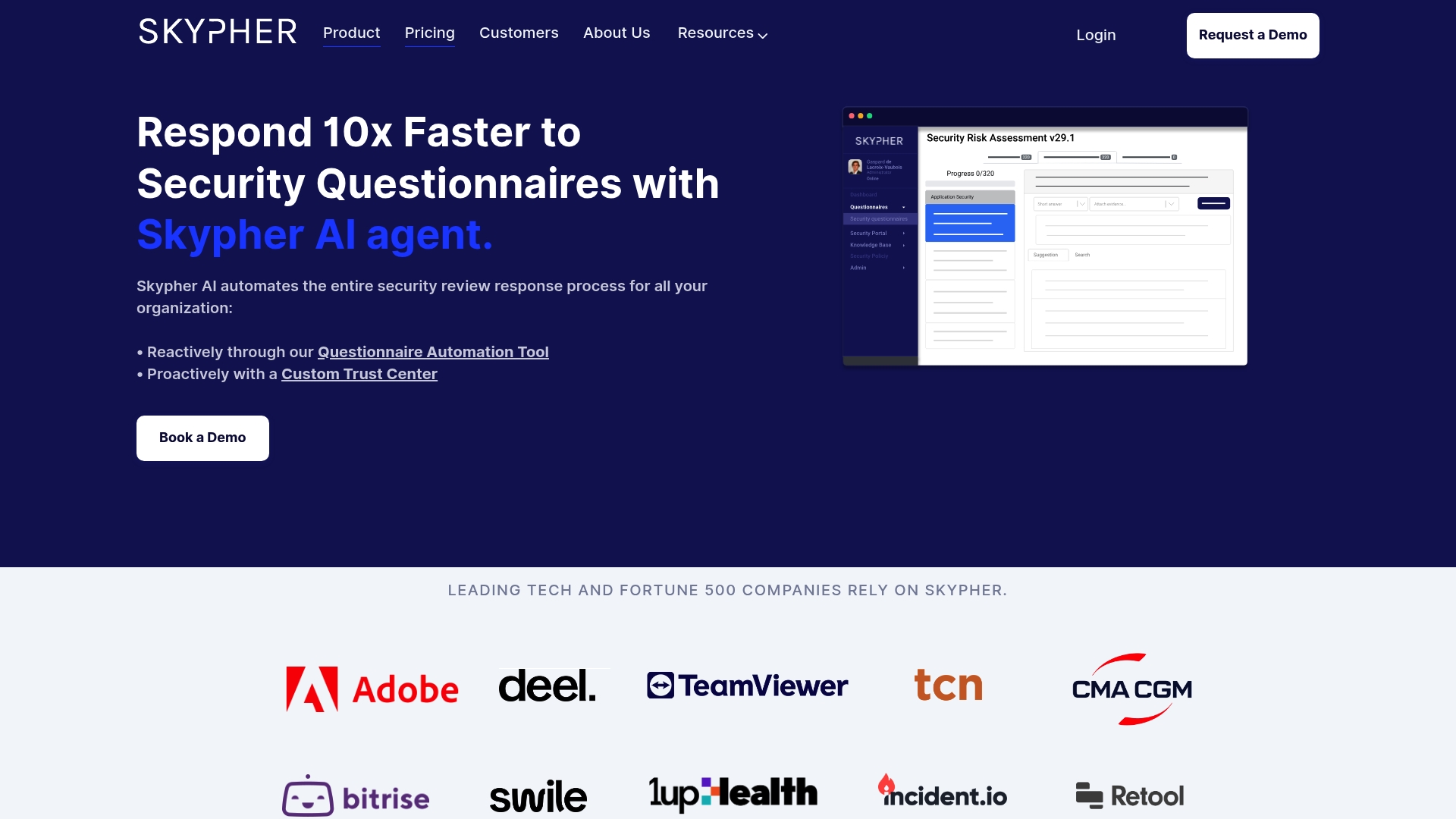
Discover the advantage of an AI-first approach to third-party risk management. Visit Skypher today to see how our customizable Trust Center and advanced security questionnaire automation empower your teams to move faster and close deals with confidence.
Frequently Asked Questions
What are the benefits of using AI for third-party risk management solutions?
By using AI for third-party risk management, organizations can automate data collection, enhance accuracy, and reduce manual effort. This not only speeds up vendor assessments but can also decrease turnaround times by up to 80%.
How can I choose the right AI third-party risk management solution for my organization?
To choose the right AI third-party risk management solution, assess your specific needs such as compliance requirements, integration capabilities, and scalability. Start by evaluating at least three options to see which aligns best with your business objectives.
What key features should I look for in an AI third-party risk management solution?
Look for features such as automated assessments, continuous monitoring, customizable reporting, and AI-powered evidence extraction. Prioritize platforms that offer real-time alerts to ensure timely risk management decisions.
How does AI enhance the accuracy of third-party risk assessments?
AI enhances accuracy by analyzing large volumes of data, identifying patterns, and automating validation processes. By leveraging AI, organizations can increase the accuracy of assessments to as high as 96%, leading to more informed risk decisions.
How quickly can I implement an AI third-party risk management solution?
You can typically implement an AI third-party risk management solution quickly, often within a few weeks to a couple of months, depending on your organization's size and needs. Begin by defining your requirements and selecting a suitable platform to start the onboarding process.
What metrics should I track to measure the effectiveness of my third-party risk management solution?
Track metrics such as response time to vendor assessments, the accuracy of risk ratings, and the time saved on manual processes. Aim to quantify improvements such as reducing manual effort by around 80% or increasing assessment efficiency by at least 50%.
Recommended
- Comprehensive Guide to Third Party Vendor Risk Assessment
- What is Vendor Risk Management? Understanding Its Importance and Implementation
- Mitigate Vendor Management Risks Effectively in 2025
- SIG Assessment Guide 2025: Process, Benefits, and Tips
- Top 5 BrightEdge Alternatives – Expert Comparison 2025
- How to Implement AI Safely in Your Business Operations