

Answering security questionnaires and managing compliance reviews can slow down even the best teams. Imagine cutting days of back and forth into just a few hours. Some tools use smart automation, others rely on detailed analytics, and a few offer all-in-one solutions that claim to turn tedious reviews into simple workflows. Each promises to help you respond faster and keep your security content organized, but not every option fits every need. Curious which features really make a difference and how these solutions stand apart? Keep reading to see how different platforms tackle the challenge of security reviews and compliance.
Table of Contents
Skypher

At a Glance
Skypher automates the security review response process so teams can answer questionnaires up to 10x faster using AI-powered automation. The platform centralizes security content and lets an autonomous AI agent draft and complete reviews in under two hours, turning days of back-and-forth into hours. For security, sales, and solutions teams in tech organizations, Skypher shortens sales cycles and strengthens client trust without adding operational overhead.
Core Features
Skypher’s core is an AI questionnaire automation engine that combines a unified security content store, knowledgebase, and integrations with external data sources to generate accurate responses quickly. Key capabilities include AI-driven automation, questionnaire response in less than 2 hours, centralized document and content management, and an autonomous AI agent that can handle reviews on behalf of technical teams. The platform is collaborative by design, with granular access controls that let security and sales teams work together while keeping sensitive data protected.
Pros
- Dramatically faster response times: Skypher reduces turnaround from days to hours, enabling faster deal momentum and fewer stalled sales cycles.
- High accuracy leveraging multiple sources: The system achieves around 96% accuracy by combining knowledgebase content, documents, and external data sources for context-aware answers.
- Autonomous review handling saves expert time: An AI agent can take over repetitive questionnaire work so security engineers spend time on higher-value tasks.
- Centralized content management: Unified storage for templates, policies, and past answers simplifies governance and ensures consistent responses across teams.
- Collaboration with access controls: Granular permissions let sales and security collaborate without exposing unnecessary details, preserving both speed and compliance.
Who It's For
Skypher is built for security, sales, and solutions teams inside tech companies that regularly face security questionnaires and lengthy security reviews. If your organization frequently delays deals because of security disclosures, or if you maintain a large library of fragmented security content, Skypher matches your needs. It fits medium and large teams that require both automation and tight control over security messaging.
Unique Value Proposition
Skypher’s unique advantage is combining autonomous AI-driven questionnaire completion with a single source of truth for security content—delivered as a SaaS product tailored to shorten sales cycles. Where many tools focus only on tracking questionnaires or offering templates, Skypher actively writes responses, cross-checks multiple content sources, and returns finished reviews in under two hours. That shifts the burden from human reviewers to a managed, auditable AI workflow that preserves governance through access controls and a knowledgebase. The result: faster deals, fewer manual errors, and consistent security disclosures that build client trust. Design choices such as flexible pricing and a centralized content model prioritize enterprise customization and operational control rather than one-size-fits-all bundles.
Real World Use Case
A solutions engineering team used Skypher to cut questionnaire turnaround from days to hours, which directly accelerated proof-of-concept timelines and contract signings. The autonomous agent drafted answers, the security team reviewed selectively, and sales closed deals faster because security responses no longer created bottlenecks.
Pricing
Flexible pricing for companies of all sizes; get a custom quote by talking to a product specialist.
Website: https://skypher.co
Safebase
At a Glance
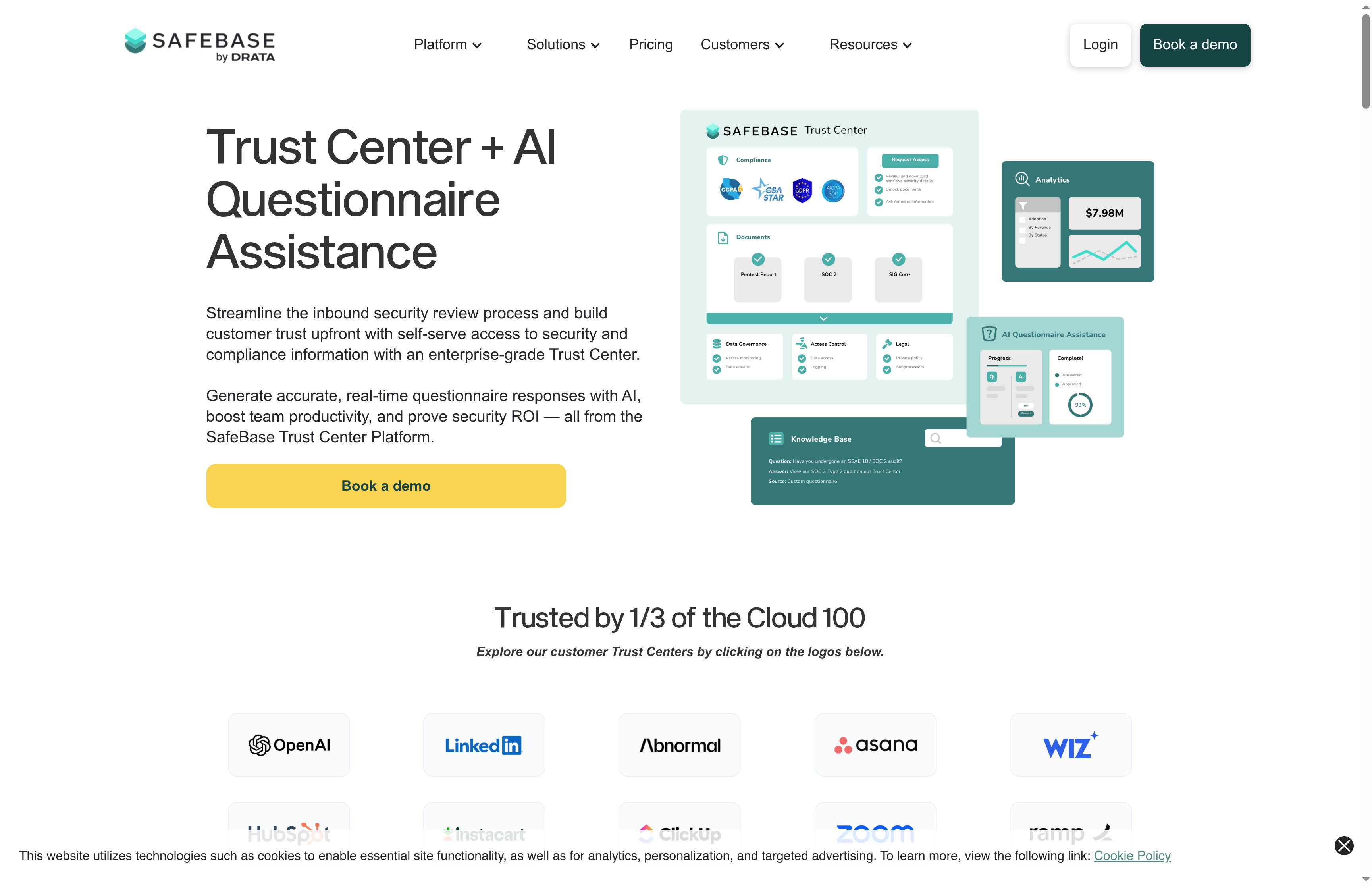
Safebase is an enterprise-grade trust center platform built to accelerate security reviews and make compliance evidence easy to share. It centralizes security and compliance information in a self-serve portal, combines AI-assisted questionnaire responses, and ties security work back to business outcomes with analytics. If you need to reduce response times and demonstrate security ROI across sales and engineering teams, Safebase is worth evaluating. It’s powerful — and that power comes with some adoption overhead.
Core Features
Safebase provides a self-serve trust center where customers and internal teams can find security documentation and compliance evidence on demand. The platform includes AI-powered questionnaire assistance for real-time, accurate answers, a rules engine and permission profiles for tailored access control, and advanced search to locate controls and artifacts quickly. It integrates into collaboration and sales workflows—including Slack, Teams, Jira, and Salesforce—and offers analytics dashboards to track security metrics and revenue impact tied to security efforts.
Pros
- Dramatically reduces questionnaire time: Safebase’s AI assistance and centralized content reportedly cut time spent on questionnaires by 80% or more, freeing security teams to focus on higher-value tasks.
- Builds customer trust proactively: A customizable trust center gives external stakeholders direct access to security posture and artifacts, reducing friction during sales cycles and audits.
- Real-time, AI-powered answers: The platform’s AI helps produce faster, more consistent questionnaire responses, which improves turnaround and lowers the error rate in repeated security reviews.
- Strong integration footprint: Native integrations with common collaboration and CRM tools enable smoother workflows between security, sales, and engineering teams, enhancing operational productivity.
- Measurable security ROI: Built-in analytics let you quantify the business impact of security work, linking security efforts to revenue outcomes and justification for investment.
Cons
- Feature complexity can slow adoption: Safebase’s advanced capabilities and customizability may require formal training and process changes before teams realize full value.
- Opaque pricing requires outreach: Pricing tiers exist (Foundation, Advanced, Enterprise), but specific costs are available only through sales contact, which complicates quick budgeting decisions.
Who It's For
Safebase is best for medium to large organizations that handle complex security documentation, need to scale security reviews across sales channels, and want to show tangible business value from security investments. Security, GRC, and sales enablement teams that prioritize speed, auditability, and integrations will gain the most.
Unique Value Proposition
Safebase uniquely combines a customer-facing trust portal with AI-driven questionnaire automation and analytics that tie security activity to revenue impact. That blend helps organizations not only answer questions faster but also proactively prove the business value of their security programs.
Real World Use Case
A company like Asana used Safebase to increase security documentation throughput by 10x and to accelerate go-to-market activities through a centralized trust program, cutting review cycles and enabling faster contract closures.
Pricing
Pricing plans include Foundation, Advanced, and Enterprise, each offering different feature sets and scalability options; specific pricing details are available upon contact with the sales team.
Website: https://safebase.io
Vanta

At a Glance
Vanta is an AI-powered trust management platform that automates compliance and vendor risk work while helping organizations build customer trust. It centralizes continuous controls monitoring, automated evidence collection, and questionnaire automation into a single platform, and it recently expanded vendor monitoring capabilities through its acquisition of Riskey. For teams that want to reduce manual audit overhead and maintain ongoing compliance, Vanta is a strong contender — but expect to pair automation with human oversight.
Core Features
Vanta focuses on automating the repetitive parts of compliance and trust management: automated evidence collection for 35+ frameworks (including SOC 2, ISO 27001, and HITRUST), continuous controls monitoring with real-time alerts, AI-driven vendor reviews, and automated security questionnaires plus a trust center for customers. The platform presents these capabilities as a unified, AI-powered system that aims to manage risk, compliance, and customer trust without forcing you to stitch together multiple tooling layers.
Pros
- Automates manual compliance tasks: Vanta reduces time spent gathering evidence and preparing audit artifacts by automating evidence collection across many frameworks.
- Supports a wide range of frameworks: With coverage of 35+ frameworks, the platform works for organizations pursuing SOC 2, ISO 27001, HITRUST, and similar standards.
- Provides continuous monitoring and real-time alerts: Ongoing control checks and alerts let teams detect drift and respond faster than quarterly or annual reviews.
- Scales from startups to enterprises: The product claims scalability across startup, mid-market, and enterprise use cases, which helps organizations grow without swapping core tooling.
- Strengthened vendor risk management: The acquisition of Riskey and AI-driven vendor reviews enhance ongoing vendor monitoring and risk assessment.
Cons
- Pricing details are not published on the website: This lack of transparency makes budgeting and vendor evaluation slower because you must contact sales for cost estimates.
- Potential over-reliance on automation requires oversight: While automation speeds work, it can surface false positives or miss context that a human reviewer would catch, so teams should plan governance and spot checks.
- Integration specifics are not clearly listed: The product description does not enumerate exact integrations or compatibility details, which can complicate implementation planning with existing toolchains.
Who It's For
Vanta is best suited for organizations that need to automate and scale compliance programs—startups preparing for audits, mid-market companies expanding security practices, and enterprises seeking continuous assurance. If your team wants to cut audit preparation time and centralize trust signals for customers and vendors, Vanta fits that profile.
Unique Value Proposition
Vanta packages AI-powered evidence collection, continuous control monitoring, and questionnaire automation into one trust management platform that spans compliance frameworks and vendor monitoring. Its integrated approach aims to accelerate audits and improve visibility, minimizing the manual work that typically drains security and compliance teams.
Real World Use Case
A company uses Vanta to automate SOC 2 documentation and continuous monitoring, which reduces audit preparation time and audit-related costs while improving vendor and customer trust through an automated trust center and questionnaire workflow.
Pricing
Not specified on the website; interested buyers need to contact Vanta for custom pricing and plan details.
Website: https://vanta.com
OneTrust
At a Glance
OneTrust is a market-recognized leader that combines privacy, security, and third-party risk management into a unified platform. It emphasizes AI governance and privacy automation to help organizations scale GRC programs and embed compliance across the AI lifecycle. The platform is best suited for enterprises with complex regulatory footprints or extensive vendor relationships. If you need a single system to centralize privacy, consent, and vendor risk, OneTrust is a heavyweight contender. Short learning curve? Not always. Expect implementation effort for larger deployments.
Core Features
OneTrust provides a unified platform that brings together privacy, security, and third-party risk management capabilities. Key capabilities listed by the vendor include AI governance to operationalize controls across the AI lifecycle, consent and preferences management to support consumer transparency, data use governance with real-time policy enforcement, and privacy automation designed to streamline compliance tasks. Those modules are intended to interoperate so you can manage consent, enforce policies, assess vendors, and automate repetitive privacy workflows from a single console.
Pros
- Recognized leader in data privacy compliance: OneTrust has strong market recognition, which signals maturity and broad enterprise adoption.
- Comprehensive and integrated platform: The solution consolidates privacy, security, and third-party risk workflows so teams avoid tool sprawl and duplicate effort.
- Supports AI governance and automation: Built-in AI governance features aim to embed controls across the model lifecycle rather than treating AI as an afterthought.
- Scalable packages for different organizational needs: OneTrust is positioned to scale from business units to global enterprises with complex regulatory requirements.
- Strong industry recognition and customer base: A robust customer footprint provides validation and often a sizable library of best practices and templates.
Cons
- Information about specific pricing and plans is not provided on the website: You must contact sales or request a demo to get concrete pricing, which slows evaluation cycles.
- Details about user interface and ease of use are not specified: The vendor description lacks granular information about usability, so you should request live demos to validate workflow ergonomics.
- Potential complexity for smaller organizations without additional onboarding info: The platform’s breadth may introduce implementation overhead for smaller teams that lack dedicated privacy or GRC resources.
Who It's For
OneTrust is best for medium-to-large organizations that require an enterprise-grade approach to privacy, AI governance, and third-party risk. If your organization operates across multiple jurisdictions, manages many vendors, or is actively developing and deploying AI models, OneTrust is designed to meet those needs. If you’re a small shop with a single compliance owner and limited budget, expect heavier onboarding and a need to justify ROI.
Unique Value Proposition
OneTrust’s unique value lies in bundling privacy, AI governance, and third-party risk into one extensible platform, enabling cross-functional teams to enforce policies and automate workflows from a unified system. That consolidation reduces friction between legal, security, and product teams and helps sustain consistent controls as programs scale.
Real World Use Case
A large enterprise uses OneTrust to manage privacy compliance across multiple jurisdictions: automating consent collection, monitoring third-party risks through vendor assessments, and governing AI models to ensure responsible deployment and policy enforcement. The result: centralized reporting, faster audit response, and reduced manual coordination across teams.
Pricing
Explore pricing through contact or demo, as specific details are not listed on the website.
Website: https://onetrust.com
ProcessUnity
At a Glance
ProcessUnity is a comprehensive, AI-enabled third-party risk management (TPRM) platform that targets organizations seeking end-to-end vendor risk control. It blends automated workflows, AI-driven evidence review, and a global risk exchange to accelerate onboarding and reduce manual backlog. The platform emphasizes scalability and customization, backed by strong customer support and industry recognition. If you need a centralized TPRM engine that can scale across complex vendor ecosystems, ProcessUnity is worth evaluating.
Core Features
ProcessUnity combines several core capabilities: AI-driven evidence reviews and control validation, automated third-party risk management processes, accelerated vendor onboarding and due diligence, a global risk exchange with extensive vendor profiles, and threat and vulnerability response tools. The platform also includes cybersecurity risk management features and an ROI calculator to quantify potential savings. Together these elements support an end-to-end lifecycle from vendor onboarding through ongoing control validation and incident response.
Pros
- Highly scalable and customizable solution: ProcessUnity is designed to grow with complex vendor fleets and can be tailored to specific workflows and risk models.
- Strong customer support and guidance: Users report robust vendor support that helps with program design and implementation.
- Effective risk management from onboarding to execution: The platform covers vendor onboarding, assessment, control validation, and remediation in a single workflow.
- Automated workflows reducing manual workload: Automation decreases repetitive tasks, helping teams eliminate due diligence backlogs and focus on higher-value risk decisions.
- Positive customer testimonials and industry recognition: The solution’s reputation and customer feedback indicate practical value in enterprise deployments.
Cons
- Potential heavy integration and expertise requirements: Relying on advanced AI and automation may necessitate considerable integration effort and subject-matter expertise to realize full value.
- Cost considerations for smaller organizations: The platform’s enterprise focus suggests pricing and implementation scope could be a barrier for smaller teams.
- Limited public detail on disadvantages: The vendor-provided content does not enumerate explicit drawbacks, which makes it harder to anticipate edge-case limitations in advance.
Who It's For
ProcessUnity is best suited for medium to large organizations and enterprise teams that require a mature, scalable TPRM program. If your security, risk, or compliance function must manage hundreds to thousands of vendors, automate control validation, and demonstrate ROI, this platform aligns well with your needs. It also fits teams that have access to integration resources or vendor governance expertise.
Unique Value Proposition
ProcessUnity’s differentiator is its combination of AI-driven evidence review and a global risk exchange that accelerates onboarding while maintaining continuous control validation. The embedded ROI calculator and breadth of automation position it as a solution that not only reduces manual effort but also helps justify program investment.
Real World Use Case
A Fortune 500 company used ProcessUnity to streamline vendor onboarding, automate risk assessments, and strengthen cybersecurity measures—resulting in faster onboarding cycles, reduced due diligence backlog, and measurable operational improvements.
Pricing
Pricing information is not provided on the website and is likely available upon request or during a demo.
Website: https://processunity.com
Security and Compliance Tools Comparison
This table provides a comprehensive overview of five security and compliance tools. Each product offers unique features to enhance security processes within organizations. The table helps you compare their key features, pros, cons, and pricing options to make informed decisions.
| Product | Features | Pros | Cons | Pricing |
|---|---|---|---|---|
| Skypher | AI questionnaire automation, content management | Faster response times, high accuracy, collaborative features | Contact for pricing | Flexible pricing, custom quote |
| Safebase | Self-serve trust center, AI questionnaire assistance | Reduces questionnaire time, builds customer trust | Feature complexity, opaque pricing | Pricing tiers, contact for details |
| Vanta | Compliance automation, vendor monitoring | Automates compliance tasks, supports many frameworks | Pricing not published, reliance on automation | Contact for custom pricing |
| OneTrust | Privacy and risk management platform | Recognized leader, comprehensive platform | Pricing not transparent, potential complexity | Contact for demo/pricing |
| ProcessUnity | AI-risk management, global risk exchange | Scalable solution, strong support | Heavy integration needs, cost considerations | Contact for demo/pricing |
Accelerate Your Third-Party Risk Management with Skypher
Managing third-party risk is a crucial challenge highlighted in the Best Third-Party Risk Management Software comparison. Lengthy security questionnaires and fragmented content often cause delays and increase operational strain. Skypher understands these pain points and offers a powerful AI Questionnaire Automation Tool that can handle hundreds of questions in minutes. This helps your security, sales, and compliance teams speed up reviews, reduce errors, and maintain consistent answers across every engagement.
By centralizing security content with AI-powered automation and providing seamless integrations with platforms like OneTrust and ServiceNow, Skypher transforms the painful manual process into an efficient, collaborative experience. Plus, its support for real-time collaboration over Slack and MS Teams boosts team productivity while keeping sensitive data protected.
Take control of your security review process today. Discover how our AI Questionnaire Automation Tool and custom Trust Center can cut your response times and strengthen client trust.
Ready to fast-track your third-party risk workflows before the next audit cycle? Visit Skypher to see how automation delivers speed and accuracy in security reviews.
Frequently Asked Questions
What features should I look for in third-party risk management software?
When evaluating third-party risk management software, prioritize features like automated workflows, real-time risk assessments, and seamless integration with existing systems. Identify your organization’s specific needs, then create a checklist of must-have features to guide your selection process.
How can third-party risk management software improve my compliance efforts?
Third-party risk management software enhances compliance by automating documentation processes, facilitating audit trails, and ensuring that vendors adhere to industry standards. Assess your current compliance challenges, and look for software that offers built-in compliance reporting features to streamline your efforts.
What is the average implementation time for third-party risk management software?
The implementation time for third-party risk management software typically ranges from a few weeks to several months, depending on the complexity of your needs and the software’s capabilities. Define your timeline by consulting with vendors to establish an achievable schedule for setup and training.
How does vendor risk assessment differ from third-party risk management?
Vendor risk assessment is a crucial component of third-party risk management, focusing specifically on evaluating individual suppliers' risks. Use tools designed for third-party risk management to conduct comprehensive assessments that factor in multiple vendors and integrate the results into a holistic risk strategy.
What metrics can help evaluate the effectiveness of third-party risk management software?
To evaluate the effectiveness of third-party risk management software, monitor metrics such as reduction in compliance breaches, time saved during risk assessments, and improved vendor scorecard ratings. Establish baseline metrics before implementing the software, and compare these figures after three to six months of use for meaningful insights.