
Checklist compliance sounds like a tedious paperwork chore, but that perception is way off. Companies that embrace dynamic compliance frameworks have been shown to lower operational risks and improve audit accuracy by more than 40 percent. Most people think of checklists as lifeless documents gathering dust in a drawer. In reality, they can be your organization’s fastest route to efficiency, accountability, and even competitive advantage.
Table of Contents
- What Is Checklist Compliance and Why It Matters
- Key Steps for Achieving Checklist Compliance in 2025
- Common Challenges and Practical Solutions
- Checklist Compliance Best Practices for Organizations
Quick Summary
| Takeaway | Explanation |
|---|---|
| Develop a dynamic compliance framework | Create living checklists that adapt to regulatory changes, ensuring ongoing relevance and compliance accuracy. |
| Leverage technology for tracking | Use automated systems to monitor compliance in real-time, reducing errors and improving efficiency. |
| Cultivate a culture of accountability | Foster an environment where compliance is a shared responsibility, enhancing organizational adherence and engagement. |
| Implement regular training programs | Offer ongoing education to employees about compliance requirements and their roles in maintaining standards. |
| Establish clear documentation | Create comprehensive records that detail compliance processes, allowing for effective audits and assessments. |
What Is Checklist Compliance and Why It Matters
Checklist compliance represents a systematic approach to ensuring organizations meet critical regulatory, operational, and safety standards through structured documentation and verification processes. It goes beyond simple tick-box exercises, serving as a strategic framework that helps businesses maintain accountability, reduce risks, and demonstrate consistent performance across multiple domains.
The Fundamental Purpose of Compliance Checklists
At its core, checklist compliance provides a standardized method for organizations to validate that essential procedures and requirements are consistently followed. According to the U.S. Department of Justice, a well-designed compliance checklist serves multiple critical functions. These include identifying potential legal vulnerabilities, establishing clear performance expectations, and creating a transparent mechanism for tracking organizational adherence to established protocols.
Companies across various industries utilize compliance checklists to address complex regulatory environments. Key benefits include:
- Risk Mitigation: Systematically identifying and addressing potential compliance gaps before they become significant issues
- Operational Consistency: Ensuring uniform standards are applied across different teams and departments
- Documentation Evidence: Creating verifiable records of compliance efforts for potential audits or regulatory reviews
Below is a table summarizing the key benefits of checklist compliance for organizations:
| Key Benefit | Description |
|---|---|
| Risk Mitigation | Identifies and addresses potential compliance gaps before major issues arise |
| Operational Consistency | Ensures uniform standards are applied across teams and departments |
| Documentation Evidence | Provides verifiable records for audits or regulatory reviews |
Implementation and Strategic Importance
Effective checklist compliance requires more than simply creating a document. As COSMOS Compliance Universe highlights, successful implementation involves developing clear policies, conducting regular internal audits, and fostering a culture of accountability. This approach transforms compliance from a reactive requirement into a proactive strategic asset.
Organizations that embrace comprehensive compliance checklists gain significant competitive advantages. They demonstrate commitment to quality, build trust with stakeholders, and create robust frameworks that protect against potential legal or operational risks. The checklist becomes a living document that evolves with changing regulatory landscapes, ensuring continuous alignment with industry standards and best practices.
Moreover, Governancepedia emphasizes that modern compliance checklists are not static tools but dynamic instruments of organizational governance. They enable businesses to systematically evaluate performance, identify improvement opportunities, and maintain a transparent approach to meeting complex regulatory requirements.
By integrating thorough compliance checklists into their operational strategies, organizations can transform potential administrative burdens into powerful mechanisms for continuous improvement and risk management. The key lies in developing nuanced, context-specific checklists that reflect the unique challenges and requirements of each business environment.
Key Steps for Achieving Checklist Compliance in 2025
As organizations navigate increasingly complex regulatory environments, achieving robust checklist compliance requires a strategic and proactive approach. The landscape of compliance continues to evolve, demanding more sophisticated and adaptive methodologies that go beyond traditional documentation practices.
Developing a Comprehensive Compliance Framework
Successful checklist compliance in 2025 begins with creating a comprehensive and dynamic framework. According to OSHA's Compliance Guide, organizations must establish a systematic approach that encompasses multiple critical elements. This involves developing clear, detailed checklists that are not just static documents but living instruments that can adapt to changing regulatory requirements.
Key components of an effective compliance framework include:
- Precise Documentation: Creating exhaustive and clear checklist templates that capture all essential compliance requirements
- Regular Review Mechanisms: Implementing periodic assessments to ensure checklist accuracy and relevance
- Stakeholder Engagement: Involving team members from various departments to ensure comprehensive coverage
The following table summarizes the key components required for an effective compliance framework:
| Component | Purpose |
|---|---|
| Precise Documentation | Ensures all requirements are thoroughly captured and clarified |
| Regular Review Mechanisms | Keeps checklists accurate and aligned with current regulations |
| Stakeholder Engagement | Involves cross-functional teams for comprehensive compliance coverage |
Technology and Automation in Compliance Management
Technology plays a pivotal role in modernizing compliance approaches. Organizations are increasingly leveraging digital tools to streamline checklist compliance processes. Automated compliance tracking systems enable real-time monitoring, instant notifications for potential compliance gaps, and comprehensive documentation that can withstand rigorous audit scrutiny.
Integrating advanced technologies allows businesses to move beyond manual tracking. Learn more about streamlining complex documentation processes with innovative technological solutions that reduce human error and enhance overall compliance efficiency.
Training and Cultural Integration
Technology alone cannot guarantee compliance. Organizations must cultivate a culture of accountability and continuous learning. This involves comprehensive training programs that educate employees about the importance of checklist compliance, the specific requirements of their roles, and the potential consequences of non-compliance.
Effective training should be interactive, regularly updated, and tailored to specific organizational needs. It must go beyond simple instruction, creating an environment where compliance is viewed as a collective responsibility rather than a bureaucratic requirement.
The most successful organizations in 2025 will be those that view checklist compliance not as a burden but as a strategic opportunity. By developing robust frameworks, leveraging technology, and fostering a culture of continuous improvement, businesses can transform compliance from a regulatory obligation into a competitive advantage.
Ultimately, checklist compliance is about more than ticking boxes. It represents an organization's commitment to excellence, risk management, and maintaining the highest standards of operational integrity.
Common Challenges and Practical Solutions
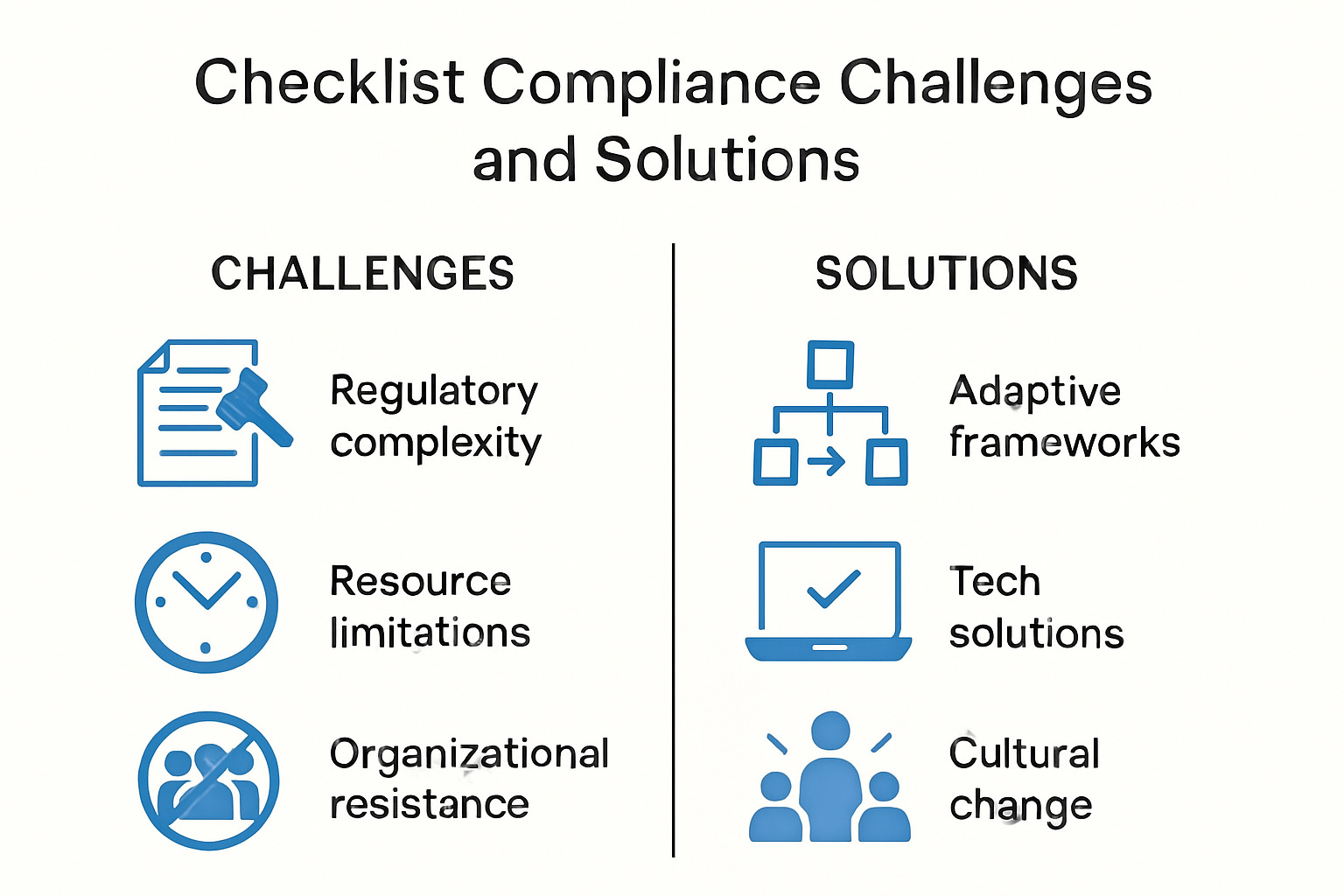
Checklist compliance is not without its complexities. Organizations frequently encounter significant obstacles that can undermine their efforts to maintain robust compliance frameworks. Understanding these challenges and implementing strategic solutions is crucial for successful regulatory adherence.
Navigating Regulatory Complexity
One of the most significant challenges in checklist compliance is managing the ever-changing landscape of regulatory requirements. According to Governancepedia, organizations struggle with the dynamic nature of legal and industry-specific regulations. Practical strategies to address this challenge include:
- Continuous Learning: Establishing dedicated resources for tracking regulatory updates
- Adaptive Frameworks: Creating flexible compliance checklists that can be quickly modified
- Expert Consultation: Engaging legal and compliance professionals for periodic review
Resource and Implementation Challenges
Implementing comprehensive compliance checklists often requires significant organizational resources. Many businesses face constraints related to budget, personnel, and technological capabilities. The SCH Group recommends creating a central repository for compliance documents and maintaining clear accountability mechanisms.
Key implementation solutions include:
- Developing a centralized compliance documentation system
- Establishing clear responsibility matrices
- Implementing technology-driven tracking and monitoring tools
Explore our guide on managing complex documentation processes to understand how technology can streamline compliance efforts.
Below is a table that compares common checklist compliance challenges with practical solutions mentioned in the article:
| Challenge | Solution(s) |
|---|---|
| Regulatory Complexity | Continuous learning, adaptive frameworks, expert consultation |
| Resource & Implementation Constraints | Centralized documentation, clear responsibility matrices, tech-driven monitoring |
| Cultural & Organizational Resistance | Interactive training, demonstrate compliance benefits, foster accountability culture |
Cultural and Organizational Resistance
Perhaps the most nuanced challenge is overcoming organizational resistance to compliance processes. Employees may view checklists as bureaucratic obstacles rather than essential risk management tools. Addressing this requires a multifaceted approach that transforms compliance from a perceived burden into a shared organizational value.
Successful strategies include:
- Developing interactive and engaging training programs
- Demonstrating the direct benefits of compliance to individual roles
- Creating a positive organizational culture that values accountability
The most effective compliance programs go beyond mere documentation. They create a holistic approach that integrates regulatory requirements into the daily workflow, making compliance a natural part of organizational operations rather than an external imposition.
Ultimately, overcoming compliance challenges requires a combination of strategic planning, technological innovation, continuous learning, and cultural transformation. Organizations that view compliance as a dynamic, collaborative process are better positioned to navigate complex regulatory landscapes and minimize potential risks.
Checklist Compliance Best Practices for Organizations
Developing robust checklist compliance strategies requires a comprehensive and systematic approach that goes beyond simple documentation. Organizations must implement strategic frameworks that transform compliance from a mandatory requirement into a proactive risk management tool.
Establishing a Comprehensive Documentation Framework
Effective checklist compliance begins with creating a structured and centralized documentation system. According to SC&H Group, organizations should develop a central repository that breaks down compliance requirements with precision. Key elements of a strong documentation framework include:
- Creating detailed checklists with clear accountability measures
- Specifying consistent data sources and documentation standards
- Implementing signature and date tracking for verified actions
- Establishing clear responsibility matrices for each compliance task
Technology and Process Integration
Modern compliance requires seamless integration of technology and human expertise. Organizations must move beyond traditional paper-based approaches to create dynamic, adaptable compliance systems. Learn more about streamlining complex documentation processes to understand how technological solutions can enhance compliance efficiency.
Advanced compliance strategies should leverage:
- Automated tracking and monitoring tools
- Real-time reporting capabilities
- Integrated risk management platforms
- Flexible digital checklists that can be quickly updated
Continuous Improvement and Adaptive Strategies
The U.S. Department of Health and Human Services emphasizes the importance of creating adaptive compliance frameworks that can evolve with changing regulatory landscapes. This approach requires:
- Regular review and update of compliance checklists
- Periodic training and stakeholder education
- Establishing clear feedback mechanisms
- Conducting routine internal audits
Successful organizations treat compliance as a dynamic process rather than a static requirement. This means creating a culture of continuous learning and improvement, where compliance is viewed as a strategic advantage rather than a bureaucratic burden.
The most effective compliance programs integrate seamlessly into organizational workflows, making adherence to standards a natural part of daily operations. By developing comprehensive, technology-enabled, and adaptable compliance strategies, organizations can transform regulatory requirements into opportunities for enhanced performance and risk management.

Frequently Asked Questions
What is checklist compliance?
Checklist compliance refers to a systematic approach that ensures organizations meet regulatory, operational, and safety standards through structured documentation and verification processes.
Why is checklist compliance important for organizations?
Checklist compliance helps organizations mitigate risks, maintain operational consistency, and provide documentation evidence for audits, ultimately enhancing accountability and quality.
What are some key steps to achieve checklist compliance in 2025?
Key steps include developing a comprehensive compliance framework, leveraging technology for automation, and implementing continuous training programs for employees about compliance requirements.
How can organizations overcome challenges in checklist compliance?
Organizations can navigate challenges by establishing ongoing education programs, utilizing adaptive compliance frameworks, and fostering a culture that prioritizes accountability and teamwork.
Transform Compliance Checklists Into Fast, Automated Wins
Do you find checklist compliance overwhelming because of constant regulatory changes, scattered documentation, or manual errors? The article showed that many teams struggle to maintain truly dynamic, up-to-date compliance and that legacy processes slow down audits and team productivity. That recurring pressure to meet standards perfectly, every single time, can lead to stress and missed opportunities to focus on your core business.
With Skypher's AI Questionnaire Automation Tool, you can put an end to repetitive compliance headaches. Imagine instantly transforming your detailed checklists into automated workflows, with real-time tracking, collaboration, and integrations that work directly with your existing tools. Streamline your security questionnaire responses and unlock more time for your team.
If you are ready to move from static forms to a seamless, collaborative compliance process, explore how Skypher can help you stay ahead of regulatory demands. Discover how our platform turns checklists into a productivity advantage across your organization. Try it now for faster, more accurate compliance.
Recommended
- The different formats & mistakes made when writing or answering security questionnaires
- The Case for Security Questionnaire Automation
- Guides - Saasy - Webflow HTML Website Template
- The ever growing number of security questionnaires and what you and your company can do to face it
- Production Test Explained: Best Practices and Tools for 2025
- Contract Review Checklist: Steps to Review a Contract - Loft Legal