

Running access reviews might sound like a simple box to check for IT compliance. Turns out, missing just one dormant account can open the door for costly breaches, with insider threats causing up to 60 percent of security incidents. The real surprise is most organizations never define clear objectives for their access reviews. And that oversight often makes their entire security effort weaker from the very start.
Table of Contents
- Step 1: Define Access Review Objectives
- Step 2: Gather User Access Data
- Step 3: Analyze User Access and Permissions
- Step 4: Identify and Remediate Access Issues
- Step 5: Document Findings and Actions Taken
- Step 6: Review and Refine Access Protocols
Quick Summary
| Key Point | Explanation |
|---|---|
| 1. Define Clear Objectives | Establish the scope and goals of the access review to align with security strategies. |
| 2. Gather Comprehensive User Data | Extract detailed user access reports and role definitions to create a holistic view of permissions. |
| 3. Analyze and Identify Risks | Systematically assess access permissions for discrepancies and develop a risk-scoring mechanism. |
| 4. Remediate Access Issues Promptly | Prioritize high-risk access issues and develop specific action plans for permission modifications. |
| 5. Document Findings Thoroughly | Create detailed records of the access review process to ensure transparency and accountability for future audits. |
Step 1: Define Access Review Objectives
Defining clear objectives is the critical foundation of an effective access review process. At its core, this initial step transforms a potentially complex security assessment into a structured, purposeful investigation that protects your organization's digital resources.
Begin by mapping out the specific scope of your access review. This means identifying precisely which systems, applications, databases, and network resources require examination. Organizations typically start by categorizing their digital infrastructure into sensitivity levels. Confidential financial systems will demand more rigorous review protocols compared to general communication platforms.
Your objectives should encompass several key dimensions. First, determine whether you are conducting a comprehensive review of all access permissions or targeting a specific subset of critical systems. According to Illinois State University's Information Security Guidance, the initial identification of information resources is paramount to a successful review.
Next, articulate the precise goals of your access review. Are you aiming to eliminate unnecessary permissions, ensure compliance with regulatory standards, detect potential security vulnerabilities, or validate current access allocation? Each objective will slightly modify your review approach. For instance, a compliance-focused review might prioritize documenting every permission change, while a security-focused review might emphasize identifying and removing excessive or dormant access rights.
Establish clear metrics and success criteria for your review. These might include quantitative targets like reducing unauthorized access attempts by a specific percentage, or qualitative goals such as improving overall permission granularity. By setting measurable objectives upfront, you create a framework for evaluating the effectiveness of your access review process.
Finally, align your access review objectives with broader organizational security strategies. This ensures that your review is not an isolated exercise but an integrated component of your comprehensive cybersecurity approach. Your objectives should reflect your organization's risk tolerance, compliance requirements, and strategic security vision.
To help readers quickly understand the focus and criteria for a successful access review, the following table summarizes common access review objectives along with corresponding metrics and sample outcomes.
| Objective | Metric Example | Sample Outcome |
|---|---|---|
| Eliminate unnecessary permissions | % reduction in excess rights | 30% fewer accounts with redundant access |
| Ensure regulatory compliance | # of compliance issues documented | All regulatory gaps identified and addressed |
| Detect security vulnerabilities | # of dormant/orphaned accounts found | Inactive accounts removed within 2 days |
| Validate access allocations | % match between access and job roles | 95% of users matched to appropriate permissions |
| Improve permission granularity | # of permissions adjusted | Granular access applied to financial systems |
Step 2: Gather User Access Data
Gathering user access data represents the investigative core of your access review process. This critical step transforms abstract access permissions into a tangible, comprehensive snapshot of your organization's digital landscape. By meticulously collecting and documenting user access information, you create the foundation for precise security assessment and potential permission refinement.
Begin by extracting comprehensive user access reports from your primary identity management systems. This typically involves generating detailed exports from your directory services, such as Active Directory, LDAP, or cloud identity platforms. According to ISACA's User Access Review Verification Guide, these exports should capture comprehensive user profile details, including usernames, email addresses, department affiliations, and current access privileges.
Your data gathering process must extend beyond simple user lists. Compile role definitions that provide context for each user's permissions. This means documenting not just who has access, but why they have specific system privileges. Map each user's access rights against their current job responsibilities, identifying potential discrepancies between authorized and necessary access levels.
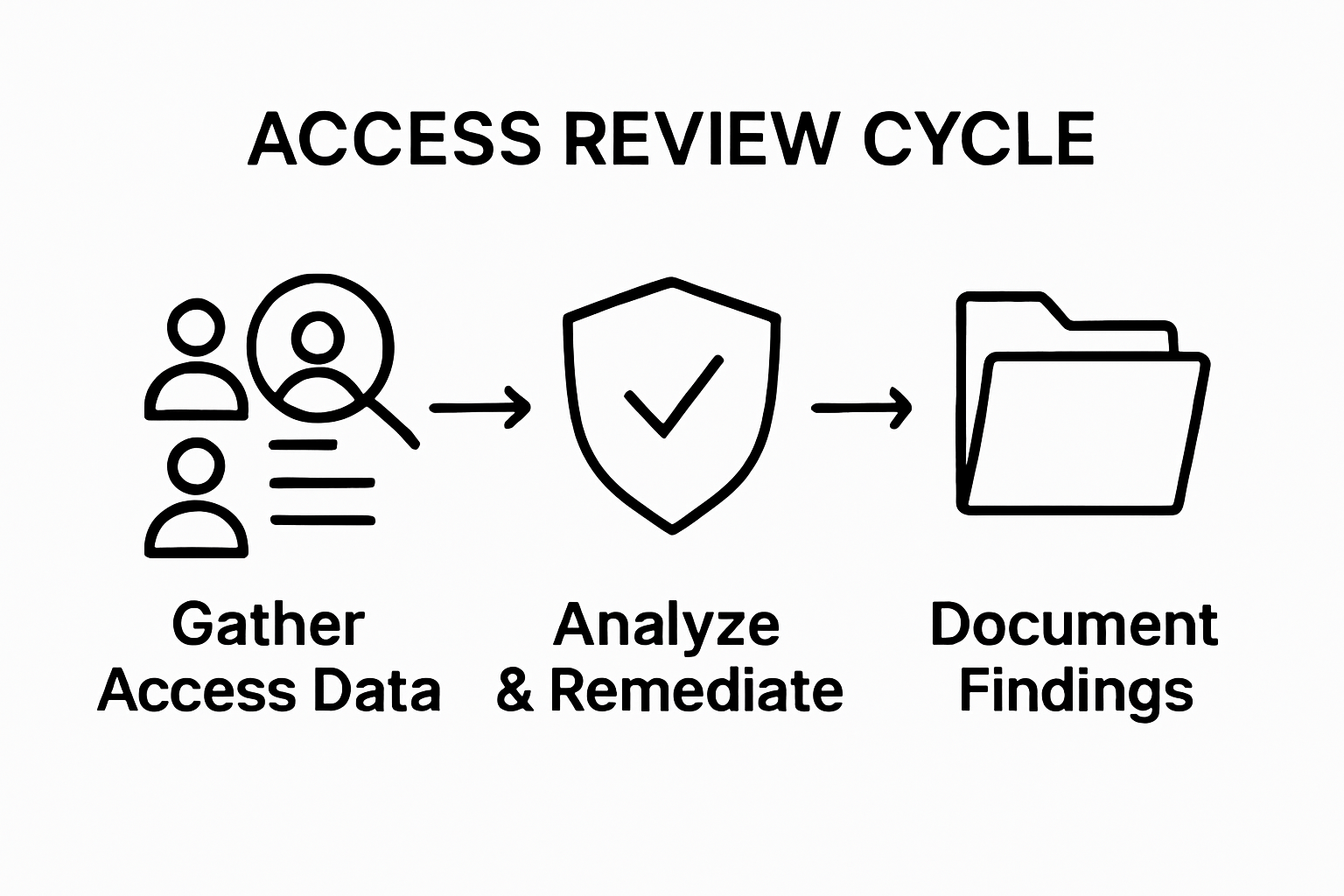
Integrate multiple data sources to create a holistic view of user access. This includes cross-referencing information from human resources systems, project management tools, and specialized access management platforms. Look for indicators of potential access anomalies, such as former employees with lingering permissions or staff who have changed roles but retained previous system credentials.
Pay special attention to privileged accounts and administrative access. These high-sensitivity permissions require extra scrutiny and detailed documentation. Develop a systematic approach to tracking these critical access levels, noting the specific systems and resources each privileged user can interact with.
Verify the completeness of your gathered data by performing several critical checks. Confirm that your access reports include timestamps of last system login, current status of user accounts, and any recent permission modifications. The goal is to create a comprehensive, time-stamped record that provides a clear picture of your organization's current access landscape.
Conduct a preliminary review of the collected data to identify any immediate red flags or obvious permission discrepancies. This initial assessment will help streamline subsequent review stages and highlight areas requiring immediate attention.
Step 3: Analyze User Access and Permissions
Analyzing user access and permissions transforms raw data into actionable security insights. This critical step goes beyond simple record-keeping, diving deep into the intricate landscape of organizational digital access to identify potential vulnerabilities, inefficiencies, and security risks.
Begin by systematically comparing each user's current access permissions against their actual job responsibilities. Look for permission drift - a gradual accumulation of access rights that no longer align with an individual's current role. This often occurs when employees change positions or departments but retain historical system credentials. Carefully examine each user's access profile, flagging permissions that seem excessive or unrelated to their core job functions.
According to the Cybersecurity and Infrastructure Security Agency (CISA) Insider Threat Mitigation Guide, analyzing user permissions is crucial for preventing potential security breaches. Develop a structured approach to categorizing access levels, creating clear distinctions between read, modify, and administrative permissions across different systems and applications.
Implement a risk-scoring mechanism to prioritize your analysis. High-risk permissions might include direct access to financial systems, sensitive customer data, or critical infrastructure controls. Create a nuanced scoring system that considers factors like the sensitivity of accessed resources, frequency of system use, and potential business impact of unauthorized access.
Look for patterns that might indicate security vulnerabilities. This includes identifying dormant accounts with no recent activity, detecting multiple accounts assigned to a single individual, and uncovering instances of shared credentials. Pay special attention to privileged accounts, which often represent the most significant potential security risk.
Cross-reference user access data with recent organizational changes. Staff turnover, departmental restructuring, and project completions can create unexpected access anomalies. Verify that terminated employees have had their system access completely revoked and that employees who have changed roles have appropriate, updated permissions.
Document your findings comprehensively, creating a clear narrative of your analysis. Prepare a detailed report that highlights potential security risks, unnecessary access privileges, and recommended permission modifications. This documentation will serve as a critical reference point for subsequent access review stages and future security planning.
Complete your analysis by generating a preliminary list of recommended access adjustments. This should include specific suggestions for permission removals, modifications, and potential access consolidation. Your goal is to create a more streamlined, secure, and logically structured access environment.
Below is a step overview table to provide a concise reference for each main step in the access review process, the key activity involved, and the desired outcome. Use this as a checklist to track your progress and ensure thoroughness at each stage.
| Step | Key Activity | Desired Outcome |
|---|---|---|
| 1. Define Objectives | Set review goals and targets | Clear scope and purpose established |
| 2. Gather User Access Data | Collect access reports and role mapping | Complete, accurate user access inventory |
| 3. Analyze Access & Permissions | Compare access vs. job roles | Permission discrepancies and risks identified |
| 4. Remediate Access Issues | Adjust or remove permissions | Security vulnerabilities reduced |
| 5. Document Findings & Actions | Record issues and resolutions | Audit-ready documentation created |
| 6. Review & Refine Protocols | Update access management processes | Access policies aligned with security needs |
Step 4: Identify and Remediate Access Issues
Identifying and remediating access issues represents the most actionable phase of your access review process. This critical step transforms analytical insights into concrete security improvements, directly addressing the vulnerabilities uncovered during your previous investigation.
Begin by prioritizing access issues based on their potential security impact. High-risk permissions demand immediate attention, particularly those involving sensitive systems, financial resources, or critical infrastructure. Create a systematic approach that categorizes access problems into immediate, moderate, and low-priority remediation tracks.
According to ISACA's User Access Review Guidelines, the remediation process should be comprehensive yet precise. For each identified access issue, develop a specific action plan that outlines exact steps for permission modification or revocation. This might involve completely removing unnecessary access rights, adjusting permission levels, or implementing more granular access controls.
Communicate directly with department managers and team leaders to validate your findings. Their operational insights can help distinguish between seemingly unnecessary access that might be mission-critical and genuinely redundant permissions. Develop a collaborative approach that balances security requirements with operational efficiency.
Implement a structured workflow for access modifications. This includes creating formal documentation for each permission change, establishing a clear approval process, and maintaining an audit trail of all modifications. Ensure that each remediation action is accompanied by a detailed rationale, providing transparency and accountability throughout the process.
Address dormant and orphaned accounts with particular urgency. These represent significant security risks, as they often remain unmonitored and can provide unauthorized entry points. Develop a protocol for systematically disabling or removing accounts associated with former employees, discontinued projects, or long-inactive user profiles.
Pay special attention to privileged and administrative accounts. These high-sensitivity access points require more rigorous review and potentially more complex remediation strategies. Consider implementing additional authentication measures, such as multi-factor authentication or time-limited access permissions for these critical account types.
Verify the effectiveness of your remediation efforts through comprehensive testing. This involves confirming that modified permissions function as intended, ensuring no unintended disruptions to operational workflows, and validating that access changes meet both security requirements and business needs.
Document the entire remediation process meticulously. Your records should include detailed logs of all access modifications, justifications for each change, and the individuals responsible for approving and implementing these adjustments.

Step 5: Document Findings and Actions Taken
Documenting findings and actions represents the critical archival phase of your access review process. This step transforms your entire review into a comprehensive, actionable record that serves multiple crucial purposes, from compliance documentation to future security planning.
Begin by creating a structured documentation framework that captures the full scope of your access review. This comprehensive report should provide a clear narrative of your investigation, including the initial objectives, methodological approach, detailed findings, and specific remediation actions implemented. The goal is to create a document that tells the complete story of your access review journey.
According to Illinois State University's Information Security Guidance, documentation should be thorough and transparent. Develop a report that includes precise details about each identified access issue, including the specific systems involved, the nature of the permission discrepancy, and the exact steps taken to address the problem.
Ensure your documentation includes quantitative and qualitative metrics. This means capturing not just the raw numbers of access modifications, but also the broader security implications of these changes. Include statistical summaries such as the total number of access permissions reviewed, the percentage of issues remediated, and the potential security risk reduction achieved through your review process.
Create a clear timeline of actions, detailing when each access issue was identified, reviewed, and resolved. This chronological approach provides a transparent record of your review process and helps track the progression of security improvements. Include specific dates, responsible personnel, and approval signatures to add credibility and accountability to your documentation.
Prepare multiple versions of your documentation tailored to different stakeholder needs. A technical version with granular details for IT security teams, and a high-level executive summary that highlights key findings and strategic implications. This ensures that both technical and leadership audiences can easily understand the review's outcomes and significance.
Include recommendations for future access review cycles based on your current findings. Identify patterns, recurring issues, or systemic challenges that emerged during your review. These forward-looking insights can help refine future access management strategies and prevent similar issues from recurring.
Ensure your documentation is stored securely, with appropriate access controls that match the sensitivity of the information. Consider implementing a version control system that allows tracking of document modifications and maintains a historical record of your access review documentation.
Finally, establish a process for regular review and update of this documentation. Security is an ongoing process, and your access review documentation should be a living resource that continues to provide value well beyond the initial review cycle.
Step 6: Review and Refine Access Protocols
Reviewing and refining access protocols transforms your access review from a one-time assessment into a dynamic, continuously improving security strategy. This critical step ensures that your organization's access management remains adaptive, responsive, and aligned with evolving business and technological landscapes.
Begin by conducting a comprehensive holistic assessment of your existing access protocols. This means looking beyond individual permissions and examining the entire framework of how access is granted, maintained, and revoked within your organization. Evaluate the current processes for their efficiency, scalability, and alignment with your organization's strategic objectives.
According to CISA's Access Control Best Practices, protocol refinement should focus on creating more intelligent and adaptive access management systems. Develop a flexible framework that can quickly respond to organizational changes, such as staff transitions, new project initiations, or shifts in business strategy.
Implement a risk-based approach to protocol refinement. This involves creating different access tiers that correspond to varying levels of organizational risk. For high-sensitivity systems, consider implementing additional authentication layers, such as multi-factor authentication, time-limited access, or real-time monitoring protocols.
Engage stakeholders from multiple departments to gather comprehensive insights. IT security teams can provide technical perspectives, while department leaders can offer operational context. This collaborative approach ensures that refined protocols balance security requirements with practical business needs.
Develop clear, standardized procedures for common access-related scenarios. Create explicit guidelines for processes like onboarding new employees, transferring staff between departments, managing contractor access, and offboarding team members. These standardized protocols reduce ambiguity and minimize potential security gaps.
Integrate automated tools and technologies to support your refined access protocols. Consider implementing identity governance solutions that can provide real-time visibility into access patterns, automatically flag potential security anomalies, and facilitate more dynamic access management.
Establish a continuous improvement mechanism for your access protocols. This means scheduling regular review cycles, perhaps quarterly or semi-annually, to reassess and update your access management framework. Create feedback loops that allow for quick adjustments based on emerging security threats, technological advancements, or organizational changes.
Finally, develop a comprehensive training and communication strategy to ensure all team members understand the updated access protocols. Clear communication helps foster a culture of security awareness and ensures consistent implementation across the organization.
Transform Access Reviews Into a Seamless, Automated Process
Struggling to keep access reviews accurate and efficient? Many organizations face real challenges turning raw data into actionable security improvements. If you are overwhelmed by manual processes, worried about missed permissions, or simply seeking to align with best practices, Skypher can help you reclaim control. Our AI-driven platform takes complex review steps—like mapping permissions, generating reports, and documenting every action—and simplifies them into a fast, collaborative workflow. This means less risk for you and more time for your core business.

Why wait when every day of delayed remediation exposes your organization to unnecessary threats? Take the next step and see how our Questionnaire Automation Tool empowers you to conduct secure, audit-ready access reviews with confidence. Visit Skypher now and protect your business with smarter security processes.
Frequently Asked Questions
What are the objectives of conducting an access review?
The primary objectives include eliminating unnecessary permissions, ensuring compliance with regulatory standards, detecting security vulnerabilities, and validating current access allocations.
How do I gather user access data for an access review?
Gather user access data by extracting comprehensive reports from identity management systems, documenting user profile details, compiling role definitions, and integrating multiple data sources for a holistic view.
What is permission drift and why is it important to analyze?
Permission drift refers to the accumulation of access rights that no longer align with an individual's current job role. It's crucial to analyze because it can lead to unnecessary security risks and access vulnerabilities.
What steps should I take to remediate identified access issues?
Prioritize access issues based on risk, communicate with department managers for validation, implement a structured workflow for changes, and document the remediation process thoroughly.