
Continuous security monitoring is the frontline defense in today's complex cyber landscape. The average cost of a data breach reached $4.35 million globally in 2022, highlighting the critical need for proactive security measures. But here’s the kicker: most organizations still operate on outdated periodic assessments. The real game changer is a strategy that continuously adapts and evolves, allowing businesses to identify threats before they escalate. Embracing continuous monitoring transforms your cybersecurity posture from reactive to resilient, empowering you to safeguard your digital assets effectively.
Table Of Contents
- What is continuous security monitoring?
- Why is Monitoring Security Continuously Important?
- Essential Components of Security Monitoring
- How to Implement Continuous Monitoring
Quick Summary
| Takeaway | Explanation |
|---|---|
| Continuous Security Monitoring is Essential | Organizations need to adopt continuous security monitoring as a proactive approach to maintain a real-time defense against evolving cyber threats, moving beyond traditional periodic assessments. |
| Cost of Cyber Breaches is Rising | The average cost of a data breach is significantly high, showcasing the need for rapid threat detection and real-time risk management to prevent financial losses and reputational damage. |
| Comprehensive Strategy is Key | Implementing continuous security monitoring requires integrating technology, processes, and human expertise to create a responsive security environment capable of adapting to emerging threats. |
| Importance of Tool Selection | Organizations should prioritize the selection of tools that offer real-time detection, data integration, and automated responses to enhance their security monitoring capabilities. |
| Ongoing Improvement is Necessary | Continuous security monitoring is an evolving process that necessitates regular reassessment, employee training, and a commitment to adapting security strategies to effectively combat new challenges. |
What is Continuous Security Monitoring?
Continuous security monitoring represents a critical, proactive approach to cybersecurity that enables organizations to maintain real-time visibility into their IT infrastructure's security posture. Unlike traditional security methods that rely on periodic assessments, continuous security monitoring provides an ongoing, dynamic mechanism for detecting, analyzing, and responding to potential security threats and vulnerabilities.
The Core Principles Of Continuous Monitoring
At its foundation, continuous security monitoring is about creating a persistent, comprehensive surveillance system for an organization's digital environment. NIST Special Publication 800-137 defines this approach as maintaining situational awareness through ongoing information security control assessment, with the ultimate goal of understanding the current security status across all organizational systems.
The methodology involves several key components:- Automated Threat Detection: Leveraging advanced tools and technologies to continuously scan networks, systems, and applications for potential security risks
- Real-Time Risk Assessment: Immediate identification and evaluation of potential vulnerabilities as they emerge
- Comprehensive Security Visibility: Providing a holistic view of an organization's entire digital ecosystem
Technological Foundations and Implementation
Continuous security monitoring integrates multiple technological strategies to create a robust defense mechanism. Organizations typically employ a combination of automated tools, machine learning algorithms, and advanced analytics to achieve comprehensive security coverage. Gartner research suggests that modern continuous monitoring solutions can process thousands of security events per second, enabling near-instantaneous threat detection and response.
The implementation typically involves:
- Deploying sophisticated monitoring tools that track network traffic, system logs, and user activities
- Establishing baseline security configurations
- Creating automated alert systems for potential security anomalies
- Developing rapid incident response protocols
By PurpleSec's analysis, continuous security monitoring allows organizations to transform their cybersecurity approach from reactive to proactive. Instead of waiting for security breaches to occur, companies can now identify and mitigate potential risks before they escalate into significant threats.
The strategic importance of continuous security monitoring cannot be overstated.  In an era where cyber threats evolve at unprecedented speeds, traditional periodic security assessments are no longer sufficient. Continuous monitoring provides organizations with the agility and insight necessary to protect their digital assets effectively, ensuring that security measures adapt in real-time to the ever-changing threat landscape.
Ultimately, continuous security monitoring is more than just a technological solution—it's a comprehensive strategy that integrates people, processes, and technology to create a dynamic, responsive security ecosystem.
Why is Monitoring Security Continuously Important?
In today's rapidly evolving digital landscape, continuous security monitoring has transformed from a recommended practice to an absolute necessity for organizations seeking to protect their digital assets and maintain robust cybersecurity defenses. The escalating complexity and sophistication of cyber threats demand a proactive, real-time approach to security management.
The Rising Cost of Cybersecurity Breaches
Cybersecurity incidents are becoming increasingly expensive and potentially devastating for organizations. IBM's Cost of a Data Breach Report reveals that the average total cost of a data breach in 2022 reached $4.35 million globally, underscoring the critical importance of continuous security monitoring. These financial implications extend beyond immediate monetary losses, encompassing reputational damage, legal complications, and potential long-term business disruptions.
The primary reasons continuous security monitoring has become crucial include:
- Rapid Threat Detection: Identifying potential security vulnerabilities and attack vectors before they can be exploited
- Compliance Requirements: Meeting stringent regulatory standards across various industries
- Real-Time Risk Management: Providing instantaneous insights into an organization's security posture
Evolving Threat Landscape and Organizational Resilience
Gartner research indicates that cyber threats are becoming increasingly sophisticated, with attackers developing more complex and adaptive techniques. Continuous security monitoring enables organizations to stay ahead of these emerging threats by:
- Implementing automated threat intelligence gathering
- Analyzing patterns and anomalies in real-time
- Providing immediate incident response capabilities
- Maintaining comprehensive visibility across digital infrastructure
By PurpleSec's analysis, organizations that adopt continuous security monitoring can reduce their vulnerability window significantly. Traditional periodic security assessments leave critical gaps that sophisticated attackers can exploit, whereas continuous monitoring creates an ongoing, dynamic defense mechanism.
Strategic Business Imperative
Beyond technical considerations, continuous security monitoring has become a strategic business imperative. Cybersecurity Ventures predicts that global cybercrime damages will reach $10.5 trillion annually by 2025, emphasizing the economic significance of robust security practices.
For modern enterprises, continuous security monitoring is not just about preventing breaches—it's about maintaining operational integrity, protecting stakeholder trust, and ensuring business continuity. The ability to detect, assess, and respond to security threats in real-time has become a fundamental competitive advantage in an increasingly digital world.
As technology continues to advance and cyber threats become more sophisticated, continuous security monitoring will only grow in importance. Organizations that invest in comprehensive, proactive security strategies will be better positioned to navigate the complex and challenging cybersecurity landscape of the future.
Essential Components of Security Monitoring
Continuous security monitoring is a complex ecosystem comprising multiple interconnected components that work together to provide comprehensive protection against cyber threats. Understanding these essential elements is crucial for organizations seeking to develop a robust and effective security monitoring strategy.
Core Technological Infrastructure
BitSight's security research highlights five critical components that form the foundation of an effective continuous security monitoring framework. These include strategic identification of critical data, establishing regular vulnerability patching processes, comprehensive endpoint monitoring, robust incident response protocols, and leveraging automation to enhance threat detection.
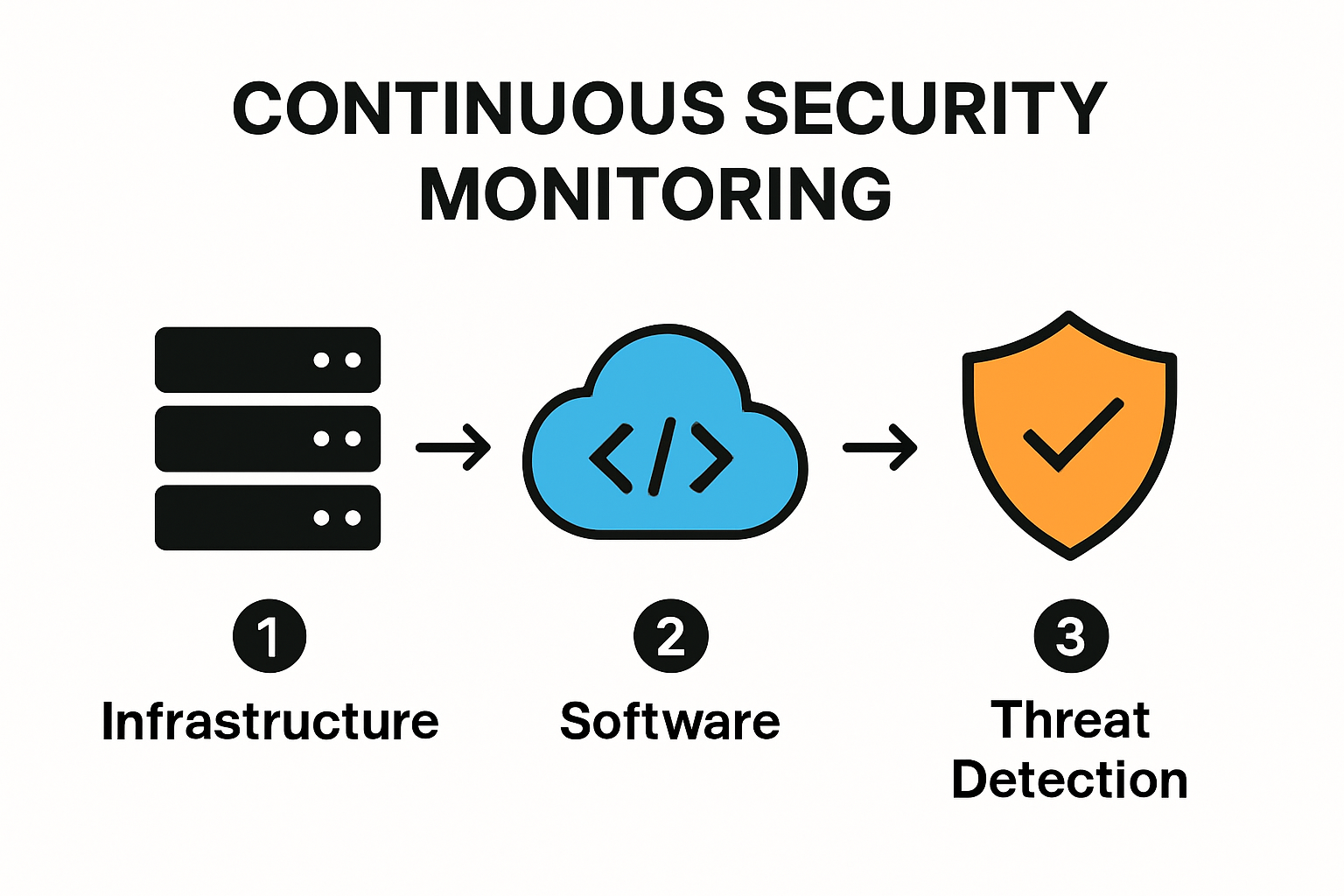
The technological infrastructure typically encompasses several key monitoring domains:
- Endpoint Monitoring: Tracking security information and potential vulnerabilities across all organizational devices
- Network Monitoring: Analyzing network traffic for unauthorized access and potential security breaches
- Application Monitoring: Evaluating performance metrics and identifying potential security risks within software applications
- Cloud Monitoring: Providing real-time visibility into cloud infrastructure and potential security exposures
Monitoring System Architecture
PurpleSec's comprehensive analysis reveals that an effective continuous security monitoring system consists of four primary components:
- Monitoring Application: A centralized system designed to collect and receive data from multiple sources, including system logs, network traffic, and user activities
- Analytics Engine: Advanced tools that search for patterns, trends, and anomalies within collected data
- Visualization Dashboard: Real-time interface displaying key performance indicators, security metrics, and potential threat alerts
- Notification System: Automated mechanism to alert security personnel about potential security incidents
Strategic Implementation Considerations
Successful continuous security monitoring goes beyond technological implementation. Gartner research emphasizes the importance of creating a holistic approach that integrates technology, processes, and human expertise.
Key strategic considerations include:
- Establishing clear communication protocols for incident reporting
- Developing comprehensive incident response plans
- Creating a culture of security awareness within the organization
- Continuously updating monitoring tools and techniques
- Implementing machine learning and artificial intelligence to enhance threat detection capabilities
The complexity of modern cybersecurity requires a multifaceted approach. Organizations must view continuous security monitoring not as a singular technological solution, but as a dynamic, adaptive strategy that evolves alongside emerging cyber threats.
By integrating advanced technologies, strategic processes, and human expertise, organizations can create a robust continuous security monitoring framework that provides comprehensive protection, real-time threat detection, and rapid response capabilities. The goal is not just to defend against current threats, but to anticipate and mitigate potential future security challenges.
How to Implement Continuous Monitoring
Implementing continuous security monitoring requires a strategic, methodical approach that transforms cybersecurity from a reactive process to a proactive, dynamic defense mechanism. Organizations must carefully design and execute a comprehensive strategy that integrates technology, processes, and human expertise.
Initial Planning And Assessment
Sprinto's cybersecurity research outlines a four-phase approach to implementing continuous security monitoring: identification, preparation, execution, and review. The initial planning stage involves several critical steps:
- Identifying Critical Assets: Mapping out all digital infrastructure, including networks, applications, endpoints, and cloud resources
- Establishing Security Objectives: Defining clear, measurable goals for monitoring and threat detection
- Risk Assessment: Conducting a comprehensive evaluation of existing security vulnerabilities
During this phase, organizations must develop a detailed understanding of their unique security landscape. NIST guidelines recommend creating a comprehensive inventory of all information systems, understanding their interconnections, and identifying potential points of vulnerability.
Tool Selection And Infrastructure Development
Selecting the right tools is crucial for effective continuous security monitoring. Gartner's cybersecurity research suggests organizations should focus on solutions that offer:
- Real-time threat detection capabilities
- Comprehensive data collection across multiple platforms
- Advanced analytics and machine learning integration
- Automated incident response mechanisms
- Scalable infrastructure that can adapt to evolving threats
Key technological components include:
- Security Information and Event Management (SIEM) systems
- Endpoint Detection and Response (EDR) tools
- Network monitoring solutions
- Cloud security platforms
- Automated threat intelligence systems
Implementation And Continuous Improvement
PurpleSec's analysis emphasizes the importance of establishing clear metrics and performance indicators. Organizations should:
- Develop detailed monitoring policies and procedures
- Train security personnel on new monitoring technologies
- Create incident response protocols
- Implement regular security awareness training
- Establish continuous feedback loops for ongoing improvement
Successful implementation requires more than just technological deployment. It demands a cultural shift towards proactive security thinking. Organizations must foster an environment where security is everyone's responsibility, not just the IT department's mandate.
The most effective continuous monitoring strategies are those that remain flexible and adaptive. Cyber threats evolve rapidly, and monitoring approaches must be equally dynamic. Regular reassessment, ongoing training, and a commitment to technological innovation are essential for maintaining robust security postures.
Ultimately, continuous security monitoring is not a one-time project but an ongoing journey of protection, detection, and response. By adopting a comprehensive, strategic approach, organizations can create resilient defense mechanisms that protect against both current and emerging cyber threats.
Frequently Asked Questions
What is continuous security monitoring?
Continuous security monitoring is a proactive cybersecurity approach that enables organizations to maintain real-time visibility into their IT infrastructure's security status, allowing for the detection, analysis, and response to potential security threats continuously.
Why is continuous security monitoring important?
Continuous security monitoring is essential due to the rising costs of cyber breaches and the evolving threat landscape. It allows organizations to quickly identify vulnerabilities, comply with regulations, and maintain operational integrity by providing real-time insights into security postures.
How can organizations implement continuous security monitoring?
To implement continuous security monitoring, organizations should follow a strategic approach that includes initial planning, identifying critical assets, selecting appropriate monitoring tools, and establishing a framework for ongoing assessment and improvement.
What are the key components of a continuous security monitoring strategy?
The key components of a continuous security monitoring strategy include automated threat detection, real-time risk assessment, a robust technological infrastructure, endpoint and network monitoring, and an effective incident response protocol.
Unlock Your Cyber Resilience with Skypher
In a world where the average cost of a data breach reaches a staggering $4.35 million, organizations can no longer afford to sit back and wait for threats to materialize. With the evolving complexities of cyber risks highlighted in our guide to Continuous Security Monitoring, the need for proactive, real-time solutions is more urgent than ever—especially in the tech and finance sectors.
Imagine a scenario where your team navigates through security questionnaires effortlessly, minimizing the risks that come from delayed assessments. With Skypher’s AI-driven Questionnaire Automation Tool, you can enhance your security posture while significantly reducing the time needed for proof of concepts (POCs) and contract negotiations. Our platform offers:
- Real-time collaboration to keep your team aligned
- Integration with over 40 third-party risk management platforms to simplify your workflow
- A customizable Trust Center to boost client relations and confidence

Don’t wait for a breach to happen—act now to fortify your organization’s defenses. Visit https://skypher.co and discover how our innovative solutions can transform your approach to cybersecurity, ensuring you stay one step ahead in today’s fast-paced digital landscape.