

Companies everywhere talk about cybersecurity but getting certified sets a whole new standard. Most people expect these badges to be a basic checklist or a routine formality. The shock comes with Cyber Essentials Plus, where companies backed by this certification are 92 percent less likely to file a cyber insurance claim compared to their peers. That’s not marketing fluff. It’s real-world proof that jumping through a few extra hoops isn’t just for show and could be the smartest move a B2B firm can make.
Table of Contents
- What is Cyber Essentials Plus certification?
- Comparing Cyber Essentials vs Cyber Essentials Plus
- Why B2B Companies Choose Cyber Essentials Plus
- Preparing for a Cyber Essentials Plus Assessment
Quick Summary
| Takeaway | Explanation |
|---|---|
| Cyber Essentials Plus requires rigorous external assessments | Unlike basic certification, this version mandates comprehensive evaluation by accredited cybersecurity professionals for validation. |
| Emphasizes protection against common cyber threats | The certification evaluates controls like firewalls and malware protection, ensuring organizations are resilient against prevalent risks. |
| Provides strategic business advantages | Having Cyber Essentials Plus enhances credibility with clients, making it a valuable asset for B2B relationships and contracts. |
| Preparation involves thorough documentation and audits | Organizations must compile evidence of security measures and undertake thorough infrastructure audits before assessment. |
| Annual recertification keeps security measures current | The yearly requirement ensures firms continuously adapt and improve their cybersecurity posture in response to evolving threats. |
What Is Cyber Essentials Plus Certification?
Cyber Essentials Plus is a comprehensive cybersecurity certification that goes beyond basic security assessments by providing organizations with a rigorous verification of their digital defense mechanisms. Unlike standard security frameworks, this certification represents a proactive approach to identifying and mitigating potential cyber vulnerabilities.
Understanding the Core Components
At its foundation, Cyber Essentials Plus is a government-backed certification that evaluates an organization's technical controls against common internet-based cyber threats. The UK Government's National Cyber Security Centre designed this certification to help businesses demonstrate their commitment to robust cybersecurity practices.
The certification involves a detailed assessment that extends far beyond traditional self-assessment models. While basic Cyber Essentials certification relies on organizational self-reporting, Cyber Essentials Plus mandates an external, in-depth evaluation. This means accredited assessors conduct comprehensive vulnerability testing across multiple systems, providing a more authentic representation of an organization's security posture.
Technical Verification and Assessment Process
The certification process focuses on five critical technical control areas: boundary firewalls and internet gateways, secure configuration, user access control, malware protection, and patch management. According to AWS Compliance Documentation, these controls are meticulously examined through both remote and on-site vulnerability assessments.
During the assessment, cybersecurity experts perform detailed scans and penetration tests to validate the effectiveness of an organization's implemented security measures. This approach ensures that theoretical security controls translate into practical, robust defense mechanisms. The assessment typically includes:
- Comprehensive System Scanning: Detailed vulnerability identification across network infrastructure
- Penetration Testing: Simulated cyber attack scenarios to test defense mechanisms
- Configuration Review: Thorough examination of system and network configurations
For businesses operating in sensitive sectors like technology, finance, and healthcare, Cyber Essentials Plus offers more than just a certification. It provides a strategic framework for understanding and improving cybersecurity resilience. The rigorous evaluation helps organizations identify potential weaknesses before they can be exploited by malicious actors.
By pursuing this certification, companies demonstrate a proactive commitment to protecting their digital assets, customer data, and organizational reputation. The process goes beyond compliance checkbox exercises, offering genuine insights into an organization's security strengths and potential improvement areas.
The annual nature of the certification ensures that organizations continuously adapt to evolving cyber threats. As digital landscapes change rapidly, this certification provides a dynamic, forward-looking approach to cybersecurity management. Companies are not just obtaining a static credential but engaging in an ongoing process of security enhancement and threat mitigation.
Comparing Cyber Essentials vs Cyber Essentials Plus
Cyber Essentials and Cyber Essentials Plus represent two distinct levels of cybersecurity certification, each offering unique approaches to organizational security verification. While both certifications aim to improve an organization's cyber defense capabilities, they differ significantly in scope, rigor, and validation methods.
Assessment and Verification Methodology
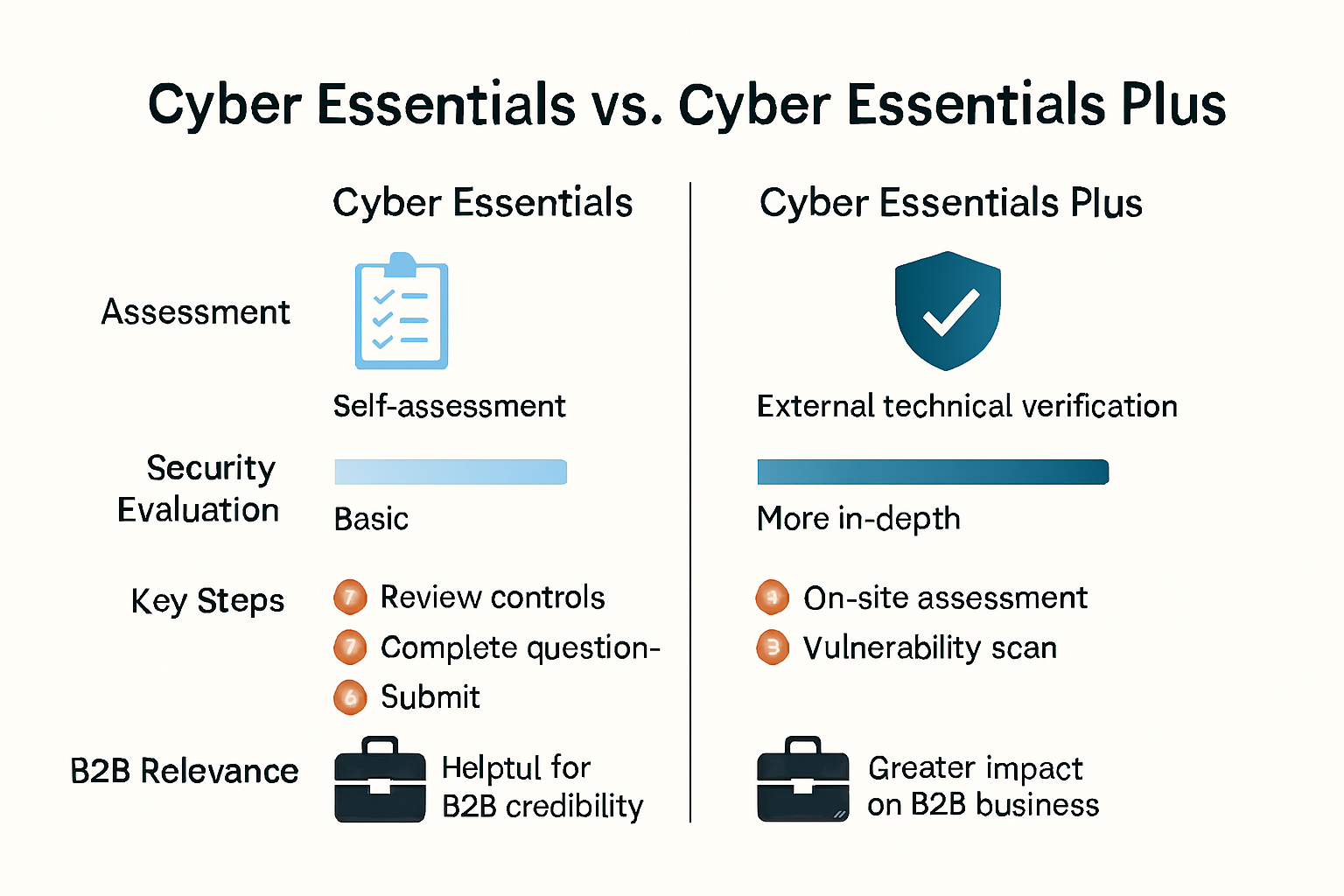
The fundamental difference between these certifications lies in their assessment approach. The National Cyber Security Centre explains that Cyber Essentials is a self-assessment model where organizations complete a questionnaire about their existing security controls. In contrast, Cyber Essentials Plus involves an active, hands-on verification process conducted by external cybersecurity professionals.
As recommended by NIST Special Publication 800-171, independent security assessments provide a higher level of confidence in an organization's security posture. The Plus certification aligns with this principle by introducing comprehensive external testing that goes beyond self-reported security measures.
Depth of Security Evaluation
Cyber Essentials certification requires organizations to demonstrate basic cybersecurity practices through a self-assessment questionnaire. Organizations answer a series of questions about their security controls, covering areas like boundary firewalls, secure configuration, user access control, malware protection, and patch management.
Cyber Essentials Plus elevates this approach through a more rigorous evaluation process that includes:
- Vulnerability Scanning: Comprehensive network and system vulnerability assessments
- Penetration Testing: Simulated cyber attack scenarios to test defense mechanisms
- On-Site Verification: Physical and remote assessments of security implementations
The advanced certification involves accredited assessors conducting detailed technical tests. These experts perform in-depth vulnerability scans, simulate potential cyber attacks, and thoroughly examine an organization's security infrastructure. This approach provides a more accurate and dynamic representation of an organization's true cybersecurity resilience.
Organizations seeking contracts with government agencies or operating in sensitive sectors often find Cyber Essentials Plus more compelling. The certification demonstrates a proactive commitment to cybersecurity that goes beyond basic compliance requirements. While Cyber Essentials offers a foundational starting point, Cyber Essentials Plus provides a comprehensive security validation that can significantly enhance an organization's credibility and trustworthiness.
Cost and complexity also differentiate these certifications. Cyber Essentials is generally less expensive and quicker to obtain, making it attractive for smaller organizations or those beginning their cybersecurity journey. Cyber Essentials Plus requires more time, resources, and a deeper investment in security infrastructure, but offers substantially more detailed insights and validation.
Ultimately, the choice between Cyber Essentials and Cyber Essentials Plus depends on an organization's specific needs, risk profile, and commitment to comprehensive cybersecurity. While the basic certification provides a valuable initial framework, the Plus version offers a more robust and credible approach to demonstrating organizational cyber resilience.
To help readers clearly see the differences between Cyber Essentials and Cyber Essentials Plus, the following table summarizes their key distinctions.
| Aspect | Cyber Essentials | Cyber Essentials Plus |
|---|---|---|
| Assessment Method | Self-assessment questionnaire | External, hands-on verification |
| Verification | Internal reporting | Conducted by accredited assessors |
| Depth of Evaluation | Basic security controls | In-depth technical testing |
| Typical Cost & Time | Lower cost, faster process | Higher cost, more time-intensive |
| Sector Suitability | Small organizations, beginners | B2B, regulated, or sensitive sectors |
| Outcome | Foundational certification | Comprehensive security validation |
Why B2B Companies Choose Cyber Essentials Plus
B2B companies increasingly recognize Cyber Essentials Plus as a strategic investment in their cybersecurity infrastructure. The certification transcends mere compliance, offering a comprehensive approach to digital risk management that resonates with organizations seeking robust security credentials.
Building Competitive Business Credibility
The UK Government's Cyber Essentials Scheme underscores the critical importance of demonstrating proactive cybersecurity measures. For B2B organizations, this certification serves as a powerful trust signal to potential clients and partners. Companies can learn more about strategic security communication and how certifications impact business relationships.
According to IASME Research, certified organizations are 92% less likely to file a cyber insurance claim. This statistic alone makes a compelling case for B2B companies to invest in advanced cybersecurity verification processes. The certification provides tangible evidence of an organization's commitment to protecting digital assets and maintaining secure operational environments.
Strategic Business and Contract Advantages
For many B2B companies, Cyber Essentials Plus is not just a security measure but a business enabler. The British Standards Institution highlights that the certification frequently becomes a prerequisite for accessing critical business and government contracts.
The certification offers several strategic advantages:
- Competitive Differentiation: Demonstrates superior security practices compared to non-certified competitors
- Risk Mitigation: Provides comprehensive vulnerability assessment and remediation guidance
- Contractual Compliance: Meets stringent security requirements for many enterprise and government procurement processes
B2B technology companies, particularly those in sensitive sectors like finance, healthcare, and technology, find exceptional value in this certification. The rigorous external assessment provides an independent validation of their security infrastructure, which can be a decisive factor in winning high-stakes contracts and establishing trust with enterprise clients.
Moreover, the certification process itself delivers significant internal benefits. By undergoing comprehensive vulnerability testing, organizations gain actionable insights into their security posture. Cybersecurity experts conduct detailed assessments that go beyond theoretical frameworks, identifying real-world vulnerabilities and providing specific recommendations for improvement.
The annual recertification requirement ensures that B2B companies maintain a dynamic and adaptive approach to cybersecurity. As threat landscapes continuously evolve, this certification compels organizations to regularly review and enhance their security controls. It transforms cybersecurity from a static compliance exercise into an ongoing strategic improvement process.
Financial considerations also play a crucial role. While the certification requires an investment, the potential cost savings from prevented security incidents and improved risk management far outweigh the initial expenditure. B2B companies view Cyber Essentials Plus not as an expense but as a strategic investment in their organizational resilience and market reputation.
Ultimately, Cyber Essentials Plus represents more than a technical certification. It is a comprehensive framework that enables B2B organizations to communicate their security maturity, build customer confidence, and demonstrate a proactive approach to digital risk management.
Preparing for a Cyber Essentials Plus Assessment
Preparing for a Cyber Essentials Plus assessment requires a strategic and comprehensive approach to cybersecurity verification. Organizations must systematically address technical controls, documentation, and organizational readiness to successfully navigate this rigorous certification process.
Initial Documentation and Self-Assessment
IT Governance emphasizes that the journey begins with a detailed self-assessment questionnaire covering five critical security controls: secure configuration, firewalls, user access controls, security update management, and malware protection. Companies can explore advanced security questionnaire strategies to enhance their preparation process.
The self-assessment phase demands meticulous documentation of existing security practices. Organizations must compile comprehensive evidence demonstrating the implementation of each required control. This documentation serves as the foundational blueprint for the subsequent external assessment, providing assessors with a clear overview of the organization's current security infrastructure.
Technical Control Verification
Jisc's certification preparation guidance highlights the importance of preparing for both remote and on-site technical assessments. The verification process involves detailed vulnerability scanning and penetration testing across multiple system domains.
Key preparation steps include:
- Infrastructure Audit: Comprehensive review of network configurations and security architecture
- Patch Management: Ensuring all systems have current security updates installed
- Access Control Review: Verifying user permissions and authentication mechanisms
- Endpoint Protection: Confirming malware protection and system hardening
Organizations must anticipate thorough technical examinations that simulate real-world cyber attack scenarios. Assessors will conduct in-depth scans to identify potential vulnerabilities, testing the effectiveness of implemented security controls across workstations, servers, and network infrastructure.
Technical preparation requires a holistic approach. This means not just implementing security controls but demonstrating their consistent and effective application. Organizations should develop robust evidence trails showing how security measures are maintained, monitored, and continuously improved.
The assessment process demands more than technical competence. It requires a cultural commitment to cybersecurity that permeates all organizational levels. Senior leadership must actively support and drive the certification preparation, understanding that Cyber Essentials Plus represents a strategic investment in organizational resilience.
For organizations preparing for a Cyber Essentials Plus assessment, the following table outlines the core steps in the preparation process based on the article’s guidance.
| Step | Description |
|---|---|
| Self-Assessment Questionnaire | Complete documentation of five key security controls |
| Infrastructure Audit | Review network configurations and security architecture |
| Patch Management | Ensure all systems have latest security updates |
| Access Control Review | Verify user permissions and authentication mechanisms |
| Endpoint Protection | Check malware protection and system hardening |
| Staff Training | Provide ongoing cybersecurity awareness and training |
| Resource Planning | Allocate time and budget for remediation and preparation |

Financial and resource planning is crucial. Organizations should allocate sufficient time and budget for potential remediation activities identified during the preparatory phase. The certification process often reveals improvement opportunities that require immediate attention and potential infrastructure investments.
Successful preparation also involves ongoing staff training and awareness programs. Employees must understand their role in maintaining cybersecurity standards, recognizing that certification is not a one-time event but a continuous commitment to security excellence. Technical controls are essential, but human factors play an equally critical role in maintaining a robust security posture.
Ultimately, preparing for a Cyber Essentials Plus assessment is about transforming cybersecurity from a compliance requirement into a strategic organizational capability. By approaching the certification with diligence, transparency, and a commitment to continuous improvement, companies can not only achieve certification but also significantly enhance their overall security resilience.
Frequently Asked Questions
What is Cyber Essentials Plus certification?
Cyber Essentials Plus is an advanced cybersecurity certification that requires an external, rigorous evaluation of an organization's security measures, focusing on protection against common cyber threats.
How does Cyber Essentials Plus differ from Cyber Essentials?
Cyber Essentials Plus involves hands-on, external verification by accredited assessors, while Cyber Essentials relies on a self-assessment questionnaire submitted by organizations to demonstrate basic cybersecurity practices.
What are the benefits of obtaining Cyber Essentials Plus certification for B2B companies?
Obtaining Cyber Essentials Plus enhances credibility with clients, reduces the likelihood of cyber insurance claims, and may become a prerequisite for certain contracts, particularly in sensitive sectors.
How can organizations prepare for a Cyber Essentials Plus assessment?
Organizations can prepare by completing a self-assessment questionnaire, conducting infrastructure audits, ensuring up-to-date security patches, verifying access controls, and training staff on cybersecurity best practices.
Take the Stress Out of Cyber Essentials Plus: Automate Your Security Questionnaire Process
Achieving Cyber Essentials Plus certification can be overwhelming. The article points out the real pain: complex documentation, intensive technical evaluation, and the ongoing demand to prove your security posture every year. For B2B companies in tech and finance, the challenge often comes down to preparing airtight evidence for external assessors without slowing your business. If your team dreads the manual effort and the risk of delays or missed details, Skypher can help you turn this obstacle into a competitive advantage.
Get ready for assessment the smart way by trusting Skypher's AI Questionnaire Automation Tool. Streamline the way you complete security reviews for Cyber Essentials Plus. Automate repetitive tasks, collaborate in real time, and ensure every answer meets the standard required for rigorous certification. Go to https://skypher.co now and see how you can be audit-ready faster and more accurately. Do not let manual mistakes or bottlenecks stall your contracts. Discover a new level of productivity and confidence as you prepare for your next Cyber Essentials Plus assessment.
Recommended
- The different formats & mistakes made when writing or answering security questionnaires
- Features
- Smart Security Knowledge Base - Saasy - Webflow HTML Website Template
- The ever growing number of security questionnaires and what you and your company can do to face it
- 5 Ways to Secure Your Small Business and Prevent Data Breach-Bista