

Every financial technology firm faces mounting pressure to safeguard sensitive data as threats grow more complex. With Artificial Intelligence now powering both cyber defense and automated compliance processes, the line between opportunity and risk shifts daily. Cybersecurity and compliance officers are finding that computational techniques simulating human cognition can dramatically speed up risk assessments while also demanding new levels of strategic oversight and control.
Table of Contents
- Cyber Security and Artificial Intelligence Defined
- Types of AI Applications in Security
- AI Automation in Questionnaire Response
- Compliance, Privacy, and Regulatory Challenges
- Emerging Threats and Security Gaps
- Best Practices for Enterprise Integration
Key Takeaways
| Point | Details |
|---|---|
| AI Enhances Cybersecurity | Artificial Intelligence significantly improves threat detection and response, enabling organizations to tackle sophisticated cyber threats more effectively. |
| AI Integration Challenges | Successful adoption of AI in cybersecurity requires navigating complex regulatory landscapes and maintaining ethical implementation practices. |
| Proactive Defense Strategies | Organizations must continuously update their security measures to counteract emerging AI-powered threats, ensuring robust and dynamic defenses. |
| Workforce Training | Investing in training for staff is crucial to ensuring they are equipped to leverage AI technologies effectively and responsibly within security frameworks. |
Cyber Security and Artificial Intelligence Defined
Artificial Intelligence (AI) represents a transformative computational technology designed to simulate human cognitive capabilities, particularly within the complex domain of cybersecurity. At its core, AI enables systems to learn, adapt, and respond to intricate security challenges with unprecedented speed and accuracy.
The National Institute of Standards and Technology (NIST) provides a comprehensive framework for understanding AI in cybersecurity, defining it as a technology that introduces both significant opportunities and inherent risks. Emerging AI technologies are fundamentally reshaping how organizations approach digital defense mechanisms.
Key characteristics of AI in cybersecurity include:
- Automated threat detection and response
- Advanced pattern recognition capabilities
- Real-time vulnerability assessment
- Predictive risk modeling
- Dynamic security infrastructure adaptation
Understanding AI's role requires recognizing its dual nature: while AI can dramatically enhance security protocols, it simultaneously introduces new potential vulnerabilities that must be carefully managed. Computational techniques simulating human cognition represent both a powerful tool and a potential strategic challenge for cybersecurity professionals.
Here's a summary of how AI supports different cybersecurity functions and their impact:
| AI Capability | Main Benefit | Business Impact |
|---|---|---|
| Automated threat detection | Faster threat identification | Reduces risk of breaches |
| Advanced pattern recognition | More accurate risk assessment | Improves security decision-making |
| Predictive risk modeling | Early detection of threats | Lowers response costs |
| Dynamic security adaptation | Real-time policy adjustments | Increases operational resilience |
Pro tip: Always approach AI implementation in cybersecurity with a balanced perspective, understanding both its transformative potential and inherent complexity.
Types of AI Applications in Security
The landscape of cybersecurity continues to evolve rapidly, with Artificial Intelligence emerging as a critical tool for defending digital infrastructures against increasingly sophisticated threats. Cyber AI applications have transformed how organizations approach security challenges, offering multifaceted strategies for threat detection and prevention.
According to the Cybersecurity and Infrastructure Security Agency (CISA), AI applications in security can be categorized into several key domains:
- Operational Technology (OT) Security Integration
- Automated Threat Detection
- Predictive Risk Modeling
- AI-Powered Vulnerability Assessment
- Intelligent Incident Response Systems
- Behavioral Anomaly Detection
Each category represents a unique approach to enhancing cybersecurity defenses. AI cybersecurity collaboration enables organizations to develop more dynamic and responsive security protocols, moving beyond traditional reactive models. These technologies leverage machine learning algorithms to analyze complex data patterns, identify potential security breaches, and generate proactive mitigation strategies.
The most advanced AI security applications focus on creating adaptive defense mechanisms that can learn, predict, and respond to emerging threats in real-time. By continuously analyzing network behaviors, machine learning models can distinguish between normal operational patterns and potential security incidents with unprecedented accuracy and speed.
Pro tip: Implement AI security tools incrementally, starting with low-risk environments to understand their unique capabilities and potential limitations.
AI Automation in Questionnaire Response
Artificial Intelligence is revolutionizing the way organizations approach complex questionnaire responses, transforming time-consuming manual processes into streamlined, intelligent interactions. AI automation tools are fundamentally reshaping how businesses and government agencies manage information gathering and decision-making processes.
The core capabilities of AI-driven questionnaire automation include:
- Rapid response generation
- Context-aware answer mapping
- Intelligent data extraction
- Consistency and accuracy verification
- Adaptive learning from previous responses
- Multilingual support capabilities
- Automatic risk and compliance assessment
Companies are increasingly leveraging AI questionnaire interaction methodologies to enhance response efficiency and reduce human error. These advanced systems can analyze complex questionnaires, understand nuanced requirements, and generate precise, contextually appropriate answers in a fraction of the time required by traditional manual approaches.
Modern AI questionnaire automation goes beyond simple template matching. These sophisticated systems employ machine learning algorithms that can comprehend complex language patterns, interpret subtle contextual cues, and dynamically adjust responses based on the specific requirements of each unique questionnaire. By integrating natural language processing and advanced pattern recognition, AI can now handle increasingly complex and specialized information requests with remarkable accuracy.
Pro tip: Implement AI questionnaire tools gradually, starting with well-structured, low-complexity questionnaires to build system confidence and fine-tune performance.
Compliance, Privacy, and Regulatory Challenges
The integration of Artificial Intelligence into cybersecurity frameworks has exponentially complicated regulatory landscapes, introducing unprecedented challenges for organizations navigating complex compliance environments. Privacy and AI challenges are rapidly evolving, demanding sophisticated strategies to manage emerging risks and regulatory expectations.
Key compliance and privacy challenges in AI-driven cybersecurity include:
- Data re-identification risks
- Algorithmic bias detection
- Cross-border regulatory variations
- Consent and transparency requirements
- Ethical data use frameworks
- Personal information protection standards
- Adaptive regulatory compliance mechanisms
U.S. and international regulatory approaches highlight the fragmented and dynamic nature of AI governance. Organizations must develop flexible compliance strategies that can rapidly adapt to changing regulations, addressing critical concerns such as potential discrimination, misinformation risks, and comprehensive data protection protocols.
The complexity of AI regulatory challenges extends beyond traditional compliance frameworks. Modern organizations must implement robust governance structures that not only meet current regulations but anticipate future legal and ethical requirements. This proactive approach involves continuous monitoring of regulatory shifts, investing in advanced compliance technologies, and maintaining transparent AI implementation practices.

This table illustrates common challenges in AI cybersecurity and effective mitigation strategies:
| Challenge | Mitigation Strategy | Implementation Focus |
|---|---|---|
| Algorithmic bias | Regular model audits | Fairness and accuracy |
| Data re-identification risks | Data anonymization techniques | Protecting personal data |
| Regulatory complexity | Continuous compliance monitoring | Rapid regulation adaptation |
| Consent and transparency | Clear user communication | Building trust and compliance |
Pro tip: Develop a cross-functional compliance team with legal, technical, and ethical experts to create a comprehensive AI governance strategy.
Emerging Threats and Security Gaps
Artificial Intelligence is dramatically transforming the cybersecurity threat landscape, introducing sophisticated and unprecedented challenges for organizational defense mechanisms. AI-assisted autonomous attacks represent a critical emerging threat that demands comprehensive and adaptive security strategies.
Key emerging cybersecurity threats include:
- AI-powered autonomous attack systems
- Advanced persistent threats with machine learning capabilities
- Intelligent phishing and social engineering techniques
- Automated vulnerability exploitation
- Sophisticated data manipulation algorithms
- Zero-day vulnerability detection and weaponization
- Adaptive malware with self-learning capabilities
Systematic review of AI misuse domains reveals complex attack mechanisms that exploit subtle vulnerabilities in existing security infrastructures. These threats extend beyond traditional cybersecurity frameworks, requiring organizations to develop multi-layered, intelligent defense strategies that can anticipate and neutralize evolving technological risks.
The intersection of artificial intelligence and cybersecurity creates a dynamic battlefield where attackers and defenders continuously adapt their strategies. Organizations must invest in advanced threat detection technologies, implement robust AI-driven security protocols, and maintain a proactive approach to identifying and mitigating potential security vulnerabilities before they can be exploited.
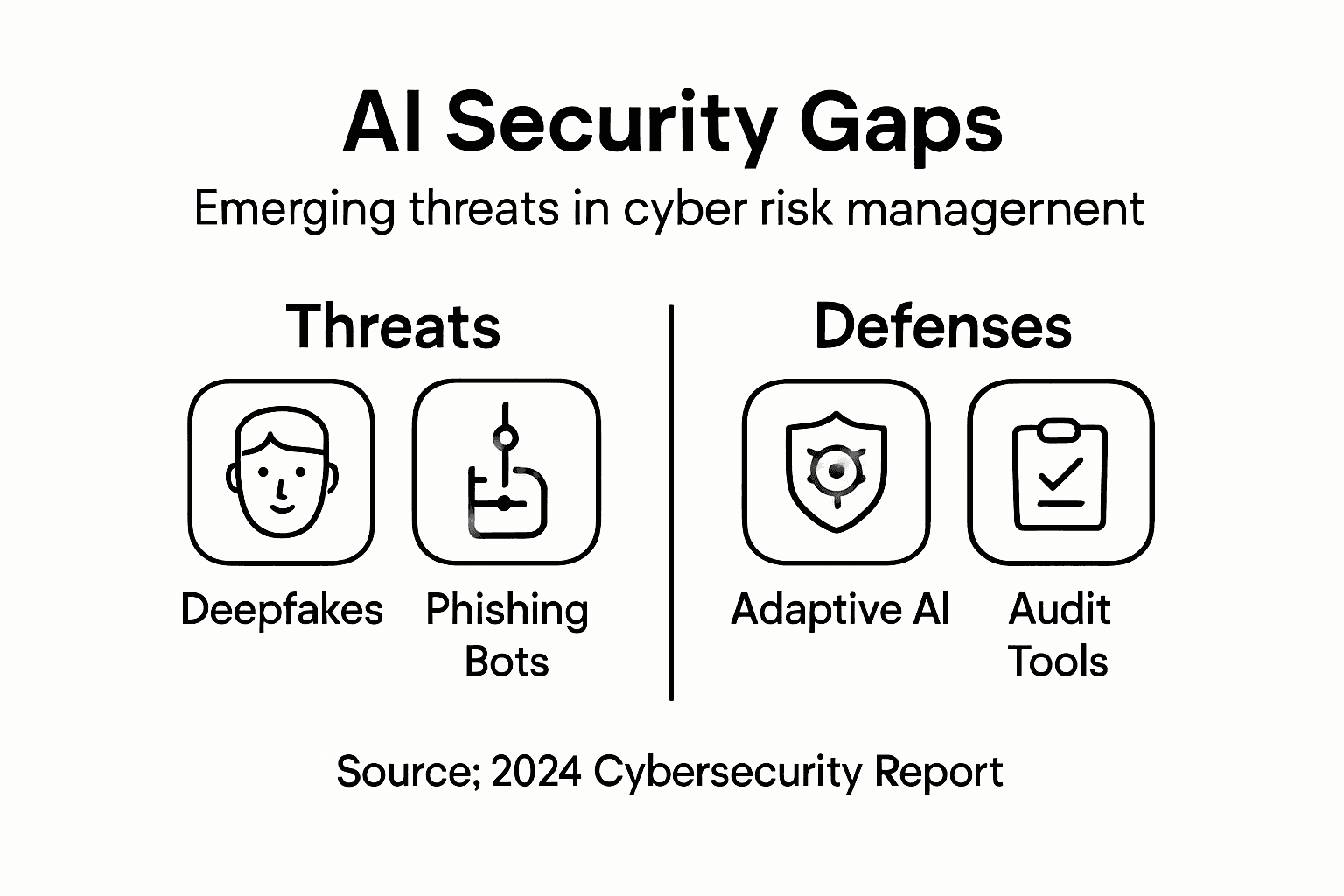
Pro tip: Regularly conduct comprehensive AI-powered security audits to identify and address potential vulnerabilities in your technological ecosystem.
Best Practices for Enterprise Integration
Enterprise AI integration represents a complex strategic challenge that requires comprehensive planning and systematic implementation. Cybersecurity Framework Profile for AI provides critical guidance for organizations seeking to navigate the intricate landscape of technological transformation and risk management.
Key best practices for successful enterprise AI integration include:
- Establishing clear governance frameworks
- Conducting thorough risk assessments
- Implementing robust security protocols
- Creating cross-functional AI integration teams
- Developing comprehensive training programs
- Ensuring continuous monitoring and evaluation
- Maintaining ethical AI deployment standards
- Building scalable and adaptable infrastructure
AI adoption harmonization strategies emphasize the importance of aligning AI technologies with existing organizational processes. Successful integration requires a holistic approach that balances technological innovation with rigorous security measures, ensuring that AI implementations enhance rather than compromise organizational resilience.
Enterprise AI integration is not a one-time event but a continuous journey of adaptation and learning. Organizations must develop flexible frameworks that can quickly respond to emerging technologies, evolving threats, and changing regulatory landscapes. This requires ongoing investment in skills development, technological infrastructure, and a culture of innovation and continuous improvement.
Pro tip: Create a dedicated AI governance committee with representation from IT, security, legal, and business strategy departments to ensure comprehensive and balanced AI integration.
Harness AI to Transform Your Cybersecurity Risk Management
The article highlights how Artificial Intelligence is reshaping cybersecurity by automating complex risk assessments and accelerating threat detection. If you struggle with managing security questionnaires swiftly while ensuring accuracy and compliance, you are not alone. Manual processes can drain resources and delay crucial security decisions in tech and finance sectors where speed and precision matter most. Skypher’s AI Questionnaire Automation Tool addresses these challenges by leveraging powerful AI to deliver rapid, accurate responses even for the most complex security reviews.
Why choose Skypher.
- Streamline response times with the ability to answer hundreds of questions in under a minute
- Integrate seamlessly with 40+ third-party risk management platforms including ServiceNow and Slack
- Collaborate in real time with your teams using our customizable Trust Center
- Benefit from enterprise-ready features including multilingual support and API integrations

Unlock efficiency and reduce risk in your cybersecurity workflows by automating the tedious task of questionnaire management. Visit Skypher’s platform today to discover how AI-powered automation can elevate your organization’s security posture. Learn more about our AI Questionnaire Automation Tool, explore integration capabilities like API connectors with TPRM platforms, and start transforming your response process now.
Frequently Asked Questions
What is the role of Artificial Intelligence in cybersecurity?
Artificial Intelligence enhances cybersecurity by enabling automated threat detection, advanced pattern recognition, real-time vulnerability assessments, and predictive risk modeling, significantly improving the speed and accuracy of security measures.
How can organizations integrate AI into their existing cybersecurity frameworks?
Organizations can integrate AI by establishing clear governance frameworks, conducting thorough risk assessments, creating cross-functional teams, and developing robust security protocols that align with existing processes.
What are the emerging threats associated with Artificial Intelligence in cybersecurity?
Emerging threats include AI-powered autonomous attacks, advanced persistent threats using machine learning, intelligent phishing techniques, automated vulnerability exploitation, and adaptive malware, all of which require advanced and adaptive defense strategies.
What compliance challenges do organizations face with AI-driven cybersecurity measures?
Organizations face challenges such as data re-identification risks, algorithmic bias detection, variations in cross-border regulations, and the need for consent and transparency, necessitating flexible compliance strategies to adapt to evolving regulatory landscapes.