

Security compliance feels like a never-ending race for many CISOs and GRC managers in global tech and finance organizations. As regulatory demands grow and client expectations tighten, manual processes waste valuable hours and slow down critical business outcomes. Adopting Governance, Risk, and Compliance automation means faster questionnaire responses, stronger audit trails, and more time focused on real risk reduction instead of paperwork.
Table of Contents
- Defining cyber security GRC fundamentals
- Key frameworks and regulatory requirements
- How GRC enables automation and efficiency
- Roles, responsibilities, and major risks
- Boosting sales processes through GRC innovation
Key Takeaways
| Point | Details |
|---|---|
| Understanding GRC Fundamentals | Governance, Risk, and Compliance are essential pillars that work together to enhance cybersecurity and protect organizational assets. |
| Importance of Frameworks and Regulations | Adhering to frameworks like ISO/IEC 27001 and regulations like HIPAA is critical to avoid legal penalties and ensure robust security measures. |
| Benefits of Automation | Implementing automation in GRC processes significantly reduces response times and improves accuracy, enabling teams to shift focus to strategic decision-making. |
| Role Clarity in GRC Teams | Clearly defined roles within GRC teams minimize risks and improve compliance standings, preventing critical vulnerabilities from being overlooked. |
Defining cyber security GRC fundamentals
GRC stands for Governance, Risk, and Compliance—three interconnected pillars that form the backbone of modern cybersecurity strategy. These elements work together to ensure organizations protect assets, meet regulatory requirements, and maintain stakeholder trust.
Governance establishes the framework and decision-making structures that guide cybersecurity efforts. Risk involves identifying, measuring, and managing threats to your organization. Compliance ensures adherence to legal, regulatory, and industry standards.
Understanding GRC cyber security fundamentals provides the foundation for building robust security programs. The three pillars function as an integrated system, not isolated components.
Here's what each pillar covers:
- Governance: Leadership alignment, policy creation, accountability structures, and security budgeting
- Risk: Threat identification, vulnerability assessment, risk scoring, and mitigation planning
- Compliance: Meeting ISO/IEC 27001, industry standards, and regulatory requirements like HIPAA or SOC 2
Organizations typically struggle when treating GRC as separate functions. Your CISO needs governance aligned with risk management, which feeds into compliance validation.
Key GRC framework concepts include documented policies, risk registers, compliance calendars, and audit readiness processes. These aren't bureaucratic exercises—they're protective mechanisms.
For tech and finance organizations specifically, GRC directly impacts vendor relationships, client contracts, and due diligence processes. A weak GRC posture delays sales cycles and damages client trust.
Strong GRC fundamentals reduce security incident response time by up to 40% and accelerate client onboarding by weeks, not months.
The practical application begins with designing governance frameworks aligned to business objectives, establishing audit readiness mechanisms, and implementing risk oversight structures. Real-world skills matter more than theory here.
Pro tip: Start mapping your current governance, risk, and compliance activities across your organization before purchasing tools—you'll identify gaps and overlaps that automation should address, not create.
Key frameworks and regulatory requirements
Frameworks and regulations form the backbone of any credible GRC program. They provide structure, standardization, and measurable benchmarks for security investments.
Most organizations operate under multiple regulatory regimes simultaneously. A financial services company might need to satisfy SEC requirements, PCI DSS for payments, and SOC 2 for cloud services all at once.
Here are the most common frameworks your organization likely encounters:
- ISO/IEC 27001: International standard for information security management systems; requires documented controls and periodic audits
- NIST Cybersecurity Framework: Voluntary U.S. standard organized around five core functions: Identify, Protect, Detect, Respond, and Recover
- CIS Controls: Prioritized set of 20 safeguards with clear implementation steps and measurable outcomes
- SOC 2: Service organization control framework; Type I (design) and Type II (operating effectiveness) reports
Regulatory requirements vary by industry and geography. Financial institutions face stricter mandates than tech startups, though that gap is closing fast.
Key regulatory regimes include HIPAA for healthcare data, GDPR for European personal data, and understanding HIPAA security requirements for organizations handling protected health information. Compliance isn't optional—violations result in substantial fines and reputational damage.
Here's how common GRC frameworks and regulations compare:
| Name | Type | Key Focus | Typical Audience |
|---|---|---|---|
| ISO/IEC 27001 | Framework | Information security | Global enterprises |
| NIST Cybersecurity | Framework | Cyber risk management | U.S. critical industries |
| CIS Controls | Framework | Security safeguards | IT security teams |
| SOC 2 | Framework | Service assurance | SaaS and cloud providers |
| HIPAA | Regulation | Healthcare data | U.S. healthcare entities |
| GDPR | Regulation | Personal data privacy | Firms handling EU data |
| PCI DSS | Regulation | Payment card security | Merchants, payment firms |
Your compliance obligations determine your baseline security controls; your risk profile determines what you must do beyond that baseline.
Frameworks differ from regulations in an important way. Frameworks are recommendations and best practices you can customize. Regulations are mandatory requirements with legal consequences for non-compliance.
Many CISOs build their GRC programs by selecting one primary framework, then mapping it to applicable regulations. This approach prevents overlap and confusion while ensuring nothing falls through cracks.
The practical challenge isn't understanding frameworks—it's proving compliance to auditors, regulators, and security questionnaires. Documentation, evidence collection, and audit trails matter as much as the controls themselves.
Your vendor management process should enforce framework compliance from new partners. A third-party vendor with weak controls becomes your compliance liability.
Pro tip: Map all your frameworks and regulations into a single compliance calendar, color-coded by function (governance, risk, compliance); this prevents audit cycles from surprising you and helps prioritize resource allocation.
How GRC enables automation and efficiency
Manual GRC processes consume thousands of hours annually. Your team responds to questionnaires one by one, auditors request the same documentation repeatedly, and compliance calendars slip out of sync.

Automation transforms this reality. Instead of manual data entry and redundant document collection, systems handle repetitive tasks at scale.
Automation solves real pain points for your organization:
- Questionnaire responses generated in minutes instead of weeks
- Compliance evidence centralized and version-controlled
- Risk assessments updated automatically as new threats emerge
- Audit trails generated continuously without manual logging
AI and machine learning amplify these gains further. AI significantly enhances GRC processes by automating repetitive tasks, analyzing large datasets for potential risks, and enabling predictive decision-making that adapts dynamically to changes.
For CISOs managing vendor questionnaires, automation is a game-changer. Instead of your team manually answering the same 50 questions across 20 vendor assessments, the system learns your organization's answers and applies them consistently.
Automation reduces questionnaire response time by up to 90% while simultaneously improving accuracy and consistency across your entire organization.
Consider the vendor onboarding scenario: a new SaaS vendor sends a 150-question security assessment. Without automation, your team spends 15 hours researching and typing responses. With automation, the system matches the vendor's questions to your existing documentation and generates a draft response in under 5 minutes.
Compliance efficiency improves dramatically as well. Audit preparation that once took 2 months now happens continuously through automated evidence collection and reporting.
Integration with existing tools matters here. Systems that connect to ServiceNow, OneTrust, and Slack eliminate manual data transfer between platforms, reducing errors and accelerating workflows.
Risk management becomes proactive instead of reactive. Automated monitoring flags control gaps before auditors discover them, giving your team time to remediate issues.
The practical benefit: your team shifts from administrative work to strategic decision-making. Less time copying and pasting data means more time analyzing risk trends and improving your security posture.
Pro tip: Start automation with your most frequent, repetitive task—usually security questionnaires—to demonstrate quick wins and build organizational buy-in before expanding to other GRC processes.
Roles, responsibilities, and major risks
GRC doesn't work with a single person owning everything. It requires a coordinated team with clearly defined roles, each accountable for specific outcomes.
The structure of your GRC team directly impacts your compliance posture and risk management effectiveness. Unclear ownership creates gaps where important tasks slip through cracks.
Key roles that make GRC function effectively:
- CISO or Chief Risk Officer: Sets strategy, allocates resources, reports to board on risk trends
- GRC Manager: Coordinates day-to-day activities, ensures deadlines met, manages workflows
- Risk Analyst: Identifies threats, quantifies impact, recommends controls and remediation
- Compliance Officer: Monitors regulatory changes, tracks audit requirements, ensures policy adherence
- Internal Auditor: Tests controls, documents evidence, identifies gaps for leadership
- Security Engineer: Implements technical controls, maintains security tools, responds to incidents
Each role depends on the others. Your risk analyst identifies a vulnerability. Your security engineer implements a fix. Your compliance officer verifies it meets regulatory requirements. Your auditor documents the evidence.
Below is a summary of key GRC team roles and their core responsibilities:
| Role | Primary Responsibility | Impact on Organization |
|---|---|---|
| CISO/Risk Officer | Set strategy, lead reporting | Guides risk and compliance vision |
| GRC Manager | Oversee daily GRC activities | Ensures process effectiveness |
| Risk Analyst | Identify and evaluate threats | Informs risk mitigation actions |
| Compliance Officer | Monitor and track regulations | Avoids legal and audit penalties |
| Security Engineer | Implement technical controls | Enhances defense capabilities |
| Internal Auditor | Test and document controls | Validates and improves practices |
GRC team structures integrate governance, risk, and compliance under a unified framework while managing common challenges like fast-changing regulations and cultural resistance.
Major risks emerge when responsibilities overlap or remain unassigned. One person can't simultaneously design controls, audit them, and report on their effectiveness—that's a conflict of interest.
Unclear GRC roles create blind spots where critical vulnerabilities go undetected and compliance deadlines get missed entirely.
Another significant risk: siloed teams that don't communicate. Your compliance team might work toward one goal while your security team pursues another, wasting resources and creating contradictions.
Staffing challenges plague many organizations. Experienced GRC professionals are scarce, turnover is common, and training takes months. Budget constraints force teams into understaffing that impacts audit readiness.
Regulatory changes accelerate faster than most teams can respond. A new regulation launches, and suddenly your team needs updated processes, retrained staff, and new documentation—all within months.
Cultural resistance also undermines GRC efforts. Business units view compliance as overhead rather than enablement, pushing back on security requirements or withholding necessary information.
The solution involves defining roles explicitly in writing, establishing clear escalation paths, and using technology to reduce manual burden. When your team isn't drowning in administrative work, they focus on real risk reduction.
Pro tip: Map your GRC team's responsibilities into a RACI matrix (Responsible, Accountable, Consulted, Informed) for each major process; this prevents role confusion and ensures nothing falls through cracks.
Boosting sales processes through GRC innovation
Weak GRC capabilities tank sales cycles. Enterprise buyers conduct security assessments before signing contracts. If your organization can't demonstrate compliance quickly and credibly, deals stall or die entirely.
GRC innovation directly impacts revenue. Organizations with mature, transparent compliance programs close deals faster and at higher valuations because they reduce buyer risk perception.
Here's what happens without GRC innovation:
- Security questionnaires take weeks to complete, delaying contract negotiations
- Inconsistent responses across different vendor assessments create credibility gaps
- Auditors request the same documentation repeatedly, slowing proof-of-concept timelines
- Missing compliance evidence forces deal renegotiation or contract termination
Modern GRC strategies align IT security with business objectives while streamlining compliance workflows and enhancing audit readiness—all of which build buyer confidence during sales engagements.
Automated questionnaire response is the fastest sales accelerant available. When a prospect sends a 200-question security assessment, your team responds in hours instead of weeks. That speed signals maturity and operational excellence to buyers.
Organizations with automated GRC processes close deals 40% faster and experience 60% fewer contract renegotiations related to security concerns.
Consider the proof-of-concept scenario. Enterprise prospects require extensive testing before committing to your product. Your sales team loses 4 weeks waiting for security clearance documentation. With GRC innovation, compliance evidence generates automatically, removing a major bottleneck.
Vendor consolidation also benefits from strong GRC. When you're evaluating multiple cloud providers, you need consistent security assessments across each option. Automated GRC frameworks let you compare vendors objectively using standardized evaluation criteria.
Trust Center portals and customizable compliance dashboards let prospects self-serve security information. They find answers immediately instead of emailing your team, which frees your staff for strategic conversations while demonstrating transparency.
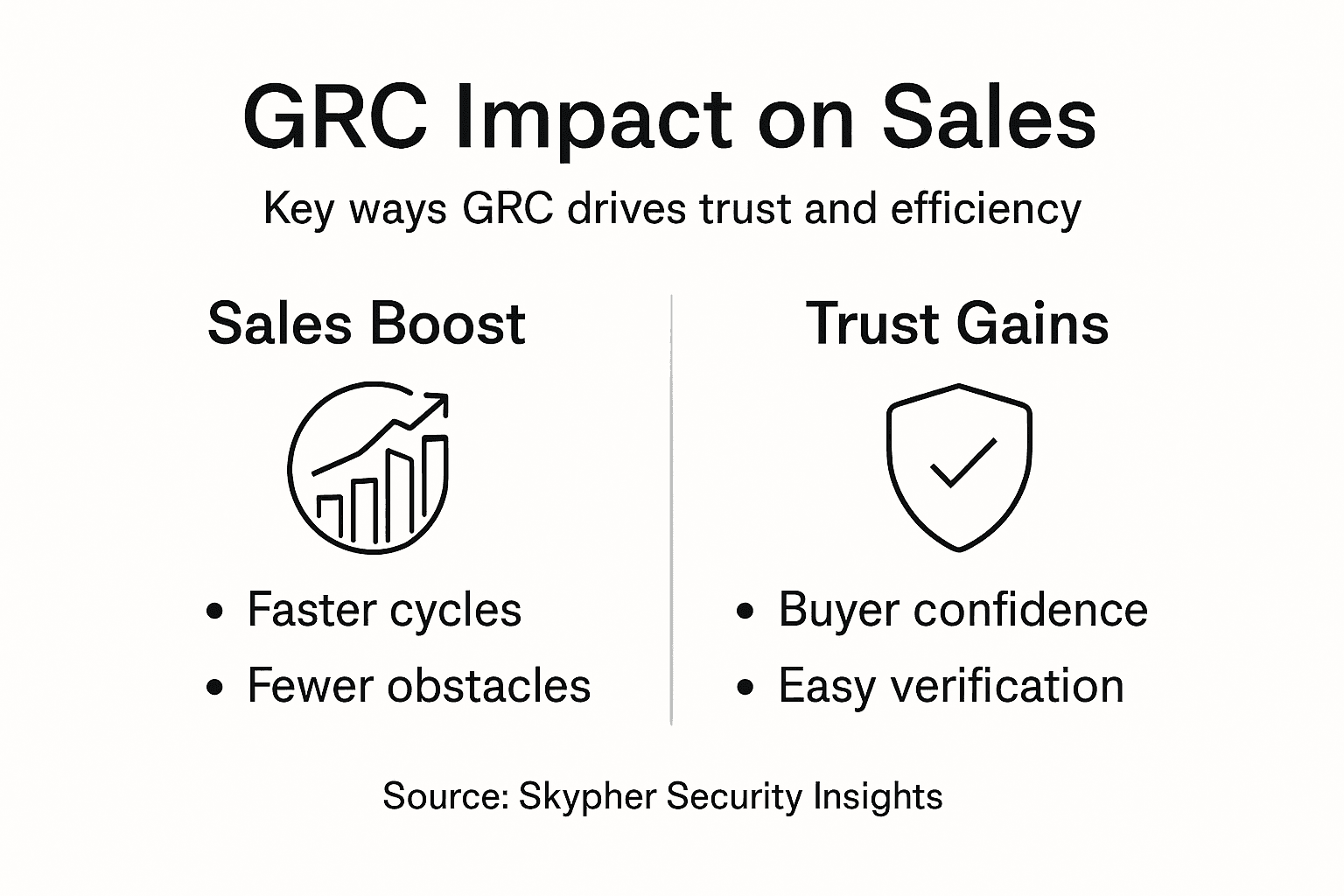
Client retention improves too. Customers who understand your compliance posture and can verify it independently renew contracts more confidently and recommend you to peers.
The business case is clear: GRC innovation reduces sales cycle friction, accelerates deal closure, and strengthens client relationships. Revenue teams and security teams finally align around shared objectives.
Pro tip: Create a standardized security questionnaire template from your most common buyer questions, then automate responses to it; this becomes your fastest sales enablement asset when prospects request assessments.
Elevate Your Cyber Security GRC Strategy with Skypher
The article highlights the critical challenges organizations face in managing governance, risk, and compliance efficiently. Tackling complex security questionnaires, keeping pace with evolving regulations, and streamlining audit readiness are pressing pain points that slow down your cybersecurity and sales processes. Skypher’s AI-powered Questionnaire Automation Tool is designed precisely to address these hurdles. It accelerates responses to demanding security assessments, integrates effortlessly with over 40 third-party risk management platforms, and enhances collaboration with real-time features connecting tools like Slack and ServiceNow.
When your GRC team shifts from manual, time-consuming tasks to strategic risk mitigation, your organization builds stronger trust and boosts sales velocity with potential clients. Leverage the power of Skypher’s customizable Trust Center to transparently showcase your compliance posture and reduce back-and-forth during contract negotiations. Don’t let fragmented GRC processes hold you back. Discover how to transform your cybersecurity compliance efforts by exploring how Skypher can automate and unify your GRC workflows today.

Ready to speed up your security questionnaires and strengthen compliance for faster deals and greater trust? Visit Skypher now to start your journey toward automated, efficient GRC management.
Frequently Asked Questions
What is GRC in cybersecurity?
GRC stands for Governance, Risk, and Compliance, which are three interconnected pillars that help organizations manage their cybersecurity strategies effectively to protect assets and meet regulatory requirements.
How does GRC impact vendor relationships?
A strong GRC posture is crucial for managing vendor relationships, as it ensures compliance standards are met. Weak GRC capabilities can damage client trust and delay sales cycles due to inadequate security assurance.
What are the main GRC frameworks and regulatory requirements?
Common GRC frameworks include ISO/IEC 27001, NIST Cybersecurity Framework, CIS Controls, and SOC 2. Regulatory requirements may encompass HIPAA for healthcare data and GDPR for data protection legislation, among others.
How can automation improve GRC processes?
Automation streamlines GRC processes by reducing manual data entry, centralizing compliance evidence, and updating risk assessments automatically, thus allowing teams to focus more on strategic decision-making instead of administrative tasks.