

Cyber security and artificial intelligence are reshaping how we defend our digital lives, and the connection between them is getting stronger by the day. But while tech headlines hype AI as a cure-all, the reality is far more complex. Cybercrime is expected to cost global economies trillions of dollars every year, and AI is both part of the solution and part of the problem.
Table of Contents
- Defining Cyber Security and Artificial Intelligence
- The Importance of Cyber Security in a Digital World
- How Artificial Intelligence Enhances Cyber Security Efforts
- Common Threats and Challenges in Cyber Security and AI Integration
- Future Trends: The Relationship Between Cyber Security and AI
Quick Summary
| Takeaway | Explanation |
|---|---|
| Cyber security is essential for all organizations. | Cyber security protects against financial losses, reputational harm, and operational disruptions caused by cyber attacks. |
| AI significantly enhances threat detection. | AI can identify potential threats and anomalies in network traffic much faster than human analysis, increasing threat detection rates by up to 95%. |
| Data management poses risks in AI systems. | AI systems relying on large datasets create vulnerabilities related to unauthorized access and privacy issues that organizations must address. |
| Proactive measures are the future of cyber security. | Organizations will increasingly adopt predictive models to identify and neutralize threats before they occur, shifting from reactive to anticipatory defense strategies. |
| Ethics in AI use is critical. | Ethical considerations and responsible governance in AI implementation are necessary to balance technological advancements with privacy and accountability. |
Defining Cyber Security and Artificial Intelligence
Cyber security and artificial intelligence represent two critical technological domains that are increasingly intertwined in our digital ecosystem. These complex fields emerge from different foundational principles but converge in powerful ways to address modern technological challenges.
To clarify the differences and synergy between cyber security and artificial intelligence, here's a table comparing their definitions, primary focus, and ways they intersect.
| Concept | Definition | Primary Focus | Intersection with Other Concept |
|---|---|---|---|
| Cyber Security | Protects digital systems, networks, programs, and data from unauthorized access and attacks. | Safeguarding digital infrastructure and data | Uses AI for advanced threat detection and predictive security |
| Artificial Intelligence | Simulates human-like intelligence for tasks like learning, reasoning, and decision-making. | Building systems that mimic human intelligence | Enhances cyber security through rapid analysis and automated response |
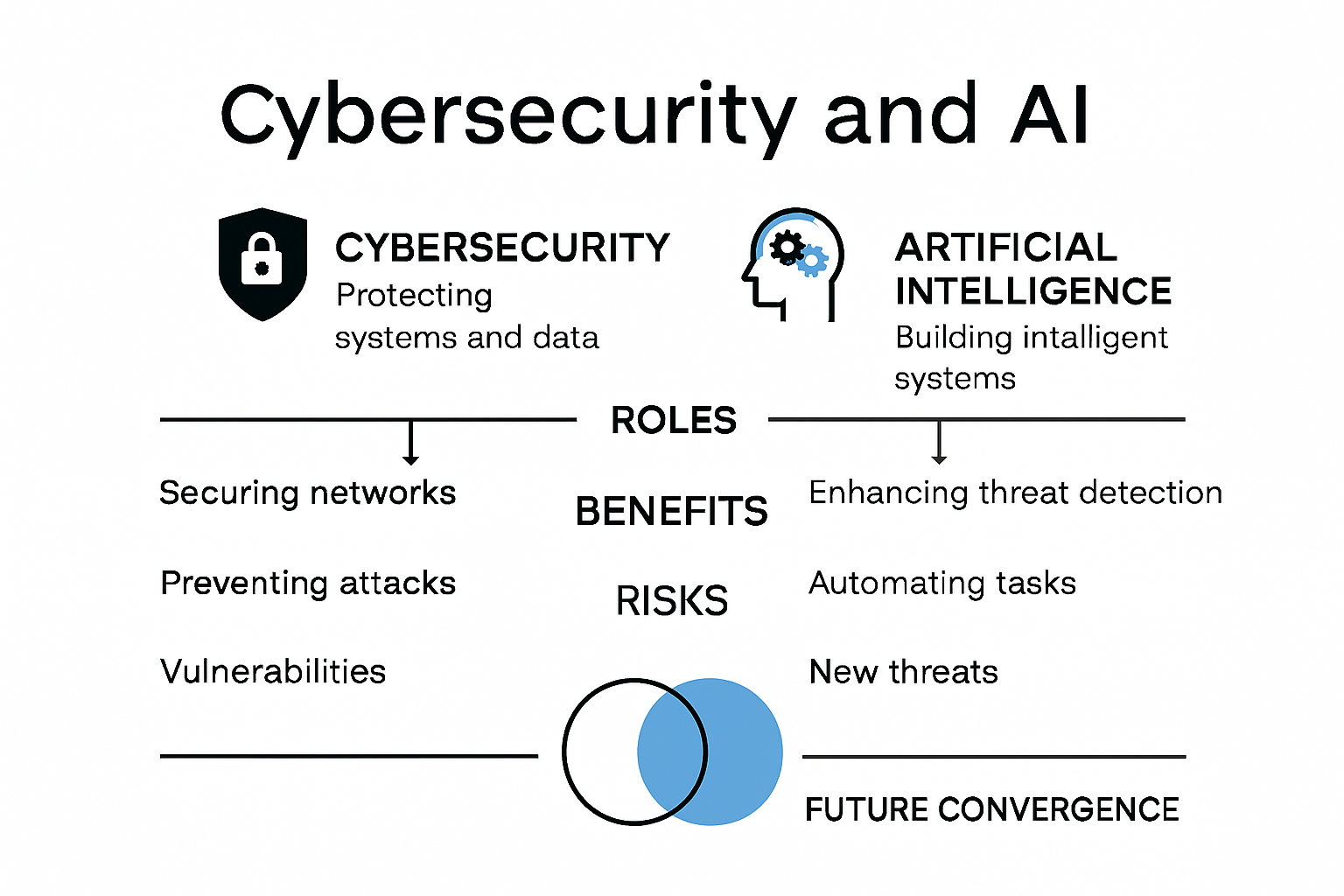
Understanding Cyber Security
Cyber security represents a comprehensive approach to protecting digital systems, networks, programs, and data from unauthorized access, attacks, and potential damage. Its primary objective is safeguarding digital infrastructure and information assets from malicious actors who seek to exploit vulnerabilities. According to National Institute of Standards and Technology, cyber security encompasses multiple layers of protection designed to defend computational resources and maintain data integrity.
Key aspects of cyber security include:
- Protecting digital systems from unauthorized intrusions
- Maintaining confidentiality of sensitive information
- Ensuring data integrity and preventing manipulation
- Implementing robust authentication mechanisms
- Developing proactive threat detection strategies
Artificial Intelligence: A Technological Frontier
Artificial intelligence represents a groundbreaking computational approach where machines simulate human-like intelligence, enabling them to learn, reason, and make decisions. As defined by the National Science Foundation, AI focuses on creating systems capable of performing tasks traditionally requiring human intelligence.
AI technologies leverage complex algorithms, machine learning models, and neural networks to process vast amounts of data, recognize patterns, and generate intelligent responses. These systems can adapt, improve performance over time, and solve intricate problems across various domains.
While cyber security and artificial intelligence might seem distinct, they are becoming increasingly interconnected. AI provides advanced tools for threat detection, anomaly identification, and predictive security analysis, transforming how organizations approach digital defense. Learn more about our AI-powered security solutions to understand how these technologies collaborate in protecting digital assets.
The Importance of Cyber Security in a Digital World
In an increasingly interconnected global landscape, cyber security has transformed from a technical consideration to a critical strategic imperative for organizations, governments, and individuals. The exponential growth of digital technologies has created unprecedented opportunities and simultaneously exposed significant vulnerabilities that demand robust protective measures.
Economic and Organizational Impact
Cyber attacks represent substantial financial risks for businesses across all sectors. According to National Cyber Security Centre, organizations face potential losses ranging from operational disruptions to significant financial damages and reputational harm. Cybercrime is estimated to cost global economies trillions of dollars annually, making cyber security not just a technical requirement but a fundamental business survival strategy.
Key economic considerations include:
- Potential financial losses from data breaches
- Reputation damage and client trust erosion
- Regulatory compliance penalties
- Business continuity disruptions
- Intellectual property protection
Protecting Critical Infrastructure
Modern critical infrastructure systems including energy grids, transportation networks, healthcare systems, and financial institutions are increasingly digitally connected. This interconnectedness creates complex vulnerability landscapes that require sophisticated cyber security approaches. Cybersecurity and Infrastructure Security Agency emphasizes that protecting these systems is crucial for national security and public safety.
Vital infrastructure protection involves:
- Securing communication networks
- Preventing potential cyber warfare tactics
- Maintaining essential service continuity
- Protecting sensitive governmental and public data
- Developing resilient technological ecosystems
Individual Privacy and Digital Rights
Beyond organizational contexts, cyber security directly impacts individual privacy and digital rights. Personal data protection has become a fundamental concern as digital interactions become more pervasive. Individuals face constant risks of identity theft, financial fraud, and unauthorized personal information exploitation.
Learn more about our advanced security questionnaire solutions that help organizations protect critical digital assets and maintain robust security frameworks. Effective cyber security is no longer optional but an essential component of responsible digital citizenship.
How Artificial Intelligence Enhances Cyber Security Efforts
Artificial intelligence has emerged as a transformative technology in cyber security, offering sophisticated solutions to increasingly complex digital threats. By leveraging advanced algorithms and machine learning capabilities, AI provides unprecedented capabilities for detecting, analyzing, and responding to potential security vulnerabilities.
Here is a summary table highlighting the main features and benefits of AI integration in cyber security as covered in this article.
| AI-Enhanced Security Feature | Description | Key Benefit |
|---|---|---|
| Advanced Threat Detection | AI analyzes massive data to spot threats and anomalies quickly | Faster, more accurate detection |
| Intelligent Vulnerability Management | Uses machine learning to uncover system weaknesses before exploitation | Proactive defense |
| Adaptive Response and Mitigation | Automatically isolates threats and implements countermeasures without human input | Real-time protection |
Advanced Threat Detection and Prevention
AI systems revolutionize threat detection by processing massive volumes of data exponentially faster than traditional human analysis. According to IEEE Computer Society, AI can increase threat detection rates up to 95% by identifying subtle patterns and anomalies that might escape human observation.
Key AI threat detection capabilities include:
- Real time monitoring of network traffic
- Predictive identification of potential security breaches
- Automated pattern recognition across complex systems
- Rapid anomaly detection and isolation
- Continuous learning and adaptation to emerging threat landscapes

Intelligent Vulnerability Management
Machine learning algorithms enable proactive vulnerability management by continuously analyzing system behaviors, user interactions, and network configurations. AI powered systems can identify potential security weaknesses before they can be exploited, providing organizations with a critical preventative defense mechanism.
Vulnerability management techniques powered by AI encompass:
- Automated security patch recommendations
- Predictive risk assessment
- Dynamic security configuration optimization
- Intelligent access control mechanisms
- Comprehensive system health monitoring
Adaptive Response and Mitigation
Beyond detection, AI introduces dynamic response capabilities that can automatically neutralize potential threats. These intelligent systems can instantaneously isolate compromised network segments, block malicious traffic, and implement protective measures without human intervention.
Explore our advanced security questionnaire automation to understand how AI transforms cybersecurity strategies. The integration of artificial intelligence represents a quantum leap in digital defense, enabling organizations to stay ahead of increasingly sophisticated cyber threats.
Common Threats and Challenges in Cyber Security and AI Integration
The convergence of cyber security and artificial intelligence introduces a complex landscape of potential risks and sophisticated challenges that demand nuanced understanding and strategic approaches. As organizations increasingly adopt AI technologies, they must navigate intricate technological, ethical, and operational considerations.
Data Vulnerability and Privacy Risks
Artificial intelligence systems fundamentally rely on massive datasets, creating inherent vulnerabilities in data management and privacy protection. According to National Institute of Standards and Technology, AI introduces significant re-identification risks that can potentially compromise sensitive information.
Key data vulnerability challenges include:
- Potential unauthorized data access
- Risk of algorithmic bias and discrimination
- Sophisticated data reconstruction techniques
- Challenges in maintaining data anonymity
- Complex regulatory compliance requirements
Adversarial AI Attacks
Malicious actors are developing increasingly sophisticated techniques to exploit AI systems, creating novel cyber security challenges. These adversarial attacks can manipulate machine learning models, introducing deliberate misclassifications or generating deceptive inputs that compromise system integrity.
Potential adversarial attack strategies encompass:
- Model poisoning during training phases
- Evasion attacks targeting prediction mechanisms
- Manipulation of input data to generate false outputs
- Exploiting algorithmic vulnerabilities
- Undermining machine learning model reliability
Technological Complexity and Integration Challenges
Integrating AI into existing cyber security infrastructures presents significant technological and operational complexities. Organizations must balance advanced technological capabilities with robust governance frameworks to mitigate potential risks and ensure effective implementation.
Explore our comprehensive security questionnaire solutions to understand how advanced technologies can be integrated securely. Successful cyber security and AI integration requires continuous adaptation, strategic planning, and a holistic approach to technological risk management.
Future Trends: The Relationship Between Cyber Security and AI
The evolving landscape of cyber security and artificial intelligence represents a dynamic symbiosis where technological innovation continuously reshapes defensive strategies. As digital ecosystems become increasingly complex, the integration of AI and cyber security promises transformative approaches to protecting digital infrastructure.
Predictive and Proactive Defense Mechanisms
Future cyber security strategies will shift from reactive to predictive models, leveraging AI's advanced predictive capabilities. According to Gartner Research, machine learning algorithms will enable organizations to anticipate and neutralize potential threats before they materialize, fundamentally changing threat management paradigms.
Key predictive defense characteristics include:
- Anticipatory threat identification
- Continuous risk assessment
- Dynamic security protocol adaptation
- Automated vulnerability prediction
- Real time threat intelligence generation
Autonomous Security Systems
AI will increasingly enable self governing security ecosystems that can independently detect, analyze, and respond to complex cyber threats. These autonomous systems will reduce human intervention, minimize response times, and create more resilient digital environments.
Autonomous security system capabilities will encompass:
- Self healing network infrastructures
- Intelligent incident response mechanisms
- Automated security patch deployment
- Contextual threat understanding
- Adaptive learning from security incidents
Ethical AI and Responsible Governance
The future of cyber security and AI integration demands robust ethical frameworks and responsible governance models. Organizations must balance technological capabilities with privacy considerations, transparency, and accountability to build trust and mitigate potential risks.
Discover our advanced security questionnaire automation to understand how cutting edge technologies can be implemented responsibly. The convergence of cyber security and AI represents not just a technological evolution, but a fundamental reimagining of digital protection strategies.
Ready to Bridge Cyber Security and AI for Faster, Safer Security Reviews?
You just learned how the worlds of cyber security and artificial intelligence overlap and why advanced protection and efficiency are more important than ever. If your team struggles with overwhelming security questionnaires, slow responses, or increased risk due to manual errors, you are not alone. The danger of threats and the speed of digital transformation mean that traditional processes are holding organizations back.

Take action now by experiencing how Skypher uses AI to help you complete security questionnaires faster and with greater accuracy. Our AI Questionnaire Automation Tool streamlines even the toughest reviews while supporting real-time collaboration and integrations with over 40 platforms. Do not let manual security tasks expose your organization to risk or delay deals. Start your journey with Skypher and transform your security response process today.
Frequently Asked Questions
What is the primary purpose of cyber security?
Cyber security aims to protect digital systems, networks, programs, and data from unauthorized access, attacks, and damage, ensuring the integrity and confidentiality of information.
How does artificial intelligence enhance cyber security?
Artificial intelligence enhances cyber security by providing advanced tools for threat detection, vulnerability management, and adaptive response capabilities, allowing organizations to respond more effectively to potential cyber threats.
What are some common challenges faced when integrating AI into cyber security?
Common challenges include data privacy risks, adversarial AI attacks, and the technological complexity of integrating AI tools with existing cyber security frameworks, which require careful management and planning.
Why is cyber security important for individual digital rights?
Cyber security is essential for protecting individual privacy and digital rights as it helps prevent identity theft and unauthorized data access, ensuring that personal information remains secure in an increasingly connected world.
Recommended
- AI powered recommendation engine - Saasy - Webflow HTML Website Template
- The ever growing number of security questionnaires and what you and your company can do to face it
- Skypher - Security Questionnaires Automation
- The different formats & mistakes made when writing or answering security questionnaires
- The Future of AI: Insights from Experts in the Field
- Security Consulting Basics: A Guide for IT Professionals