

Cybersecurity threats are evolving so rapidly that more than 80 percent of organizations report at least one significant breach each year. As digital environments grow more complex, relying on outdated protection methods simply is not enough. Businesses of every size need a smarter, adaptive defense strategy that matches the sophistication of modern attacks. This guide shows how proven security measures like Zero Trust, risk automation, and AI-driven detection can help you protect sensitive data and maintain full compliance in a changing world.
Table of Contents
- 1. Implement Zero Trust Architecture Across Your Organization
- 2. Automate Risk Assessments and Security Questionnaires
- 3. Enhance Access Control with Modern SSO and MFA
- 4. Integrate Security Tools for Real-Time Collaboration
- 5. Adopt AI-Driven Threat Detection and Incident Response
- 6. Regularly Update Policies for Compliance and Data Privacy
- 7. Foster Continuous Security Training for All Teams
Quick Summary
| Takeaway | Explanation |
|---|---|
| 1. Implement Zero Trust Architecture | Every access request should undergo rigorous verification, emphasizing continuous identity validation and authorization. |
| 2. Automate Risk Assessments | Utilizing automation can enhance the frequency and accuracy of risk assessments, reducing human error in security evaluations. |
| 3. Enhance Access Control with SSO and MFA | Integrating Single Sign-On and Multi-Factor Authentication improves security by adding multiple layers of user verification. |
| 4. Integrate Security Tools for Collaboration | Connecting security tools fosters real-time communication and incident response, enhancing overall organizational defense strategies. |
| 5. Foster Continuous Security Training | Ongoing training programs empower all employees to understand their roles in cybersecurity, creating a proactive security culture. |
1. Implement Zero Trust Architecture Across Your Organization
Zero Trust Architecture (ZTA) represents a fundamental shift in cybersecurity strategy that assumes no user or system should be automatically trusted. As recommended by the National Institute of Standards and Technology, this approach requires continuous verification of every access request, regardless of where it originates.
Traditional network security models operated on a "trust but verify" principle. Zero Trust flips this paradigm completely by enforcing "never trust, always verify" as its core philosophy. This means every user, device, and application must prove its identity and authorization before gaining access to organizational resources.
Implementing Zero Trust requires a comprehensive approach across multiple dimensions. Key implementation strategies include:
- Verify identity rigorously using multi-factor authentication
- Implement least privilege access controls
- Segment network resources into micro-perimeters
- Monitor and log all network activities continuously
According to the ACE Journal, successful Zero Trust deployment involves treating every network connection as potentially hostile. This means creating granular access policies that validate users identity multiple times throughout their session, dramatically reducing potential breach points.
Practically speaking, organizations can start by mapping all current access permissions, identifying over privileged accounts, and gradually implementing strict authentication protocols. The goal is creating a dynamic security environment where trust is never assumed but continuously earned through real-time verification.
2. Automate Risk Assessments and Security Questionnaires
Automating risk assessments and security questionnaires represents a strategic approach to modernizing organizational cybersecurity practices. By leveraging technology to streamline these critical evaluation processes, businesses can dramatically reduce manual workload and improve overall security posture.
The CRAMM methodology demonstrates how systematic risk management can be significantly enhanced through automated tools. These technologies enable organizations to conduct more frequent, consistent, and comprehensive security evaluations without overwhelming internal teams.
Key advantages of automation include:
- Reducing human error in risk assessment processes
- Enabling real-time continuous monitoring
- Creating standardized evaluation frameworks
- Accelerating response times to potential vulnerabilities
NIST's guidelines on Zero Trust Architecture emphasize that automation is not just a convenience but a necessity in managing evolving cybersecurity threats. Automated systems can rapidly adapt to new risk landscapes, providing organizations with dynamic and responsive security protocols.
Practically speaking, organizations should invest in AI-powered risk assessment platforms that integrate seamlessly with existing security infrastructure. This approach allows for comprehensive data collection, intelligent analysis, and rapid generation of actionable insights. As the cybersecurity landscape continues to evolve, those who embrace automation will be best positioned to protect their digital assets effectively.
For a deeper understanding of managing complex security questionnaires, explore our guide on security questionnaire challenges.
3. Enhance Access Control with Modern SSO and MFA
Single Sign-On (SSO) and Multi-Factor Authentication (MFA) represent powerful tools for securing organizational access in an increasingly complex digital landscape. By implementing these technologies, businesses can significantly reduce unauthorized access risks while simplifying user authentication processes.
NIST's Zero Trust Architecture publication emphasizes these technologies as critical components of modern cybersecurity strategies. Unlike traditional password-based systems, SSO and MFA create multiple layers of verification that make unauthorized access exponentially more challenging.
Key benefits of implementing SSO and MFA include:
- Reducing password fatigue for employees
- Creating robust identity verification mechanisms
- Minimizing potential entry points for cybercriminals
- Enabling centralized access management
According to the ACE Journal, successful implementation requires a comprehensive approach that goes beyond simply adding authentication steps. Organizations must design a holistic strategy that integrates these technologies seamlessly with existing infrastructure.
Practically speaking, businesses should select MFA solutions that support multiple verification methods such as biometric scans, hardware tokens, and authenticator apps. This approach ensures flexibility while maintaining stringent security protocols. The goal is creating an authentication ecosystem that is both user friendly and incredibly secure.
Remember that effective access control is not about creating barriers but about creating intelligent, adaptive security mechanisms that protect your organization without disrupting workflow.
4. Integrate Security Tools for Real-Time Collaboration
Modern cybersecurity demands more than isolated defense mechanisms. Integrating security tools for real-time collaboration creates a dynamic, responsive ecosystem that can rapidly detect, communicate, and neutralize potential threats across organizational networks.
NIST's Zero Trust Architecture guidelines emphasize the critical importance of interconnected security platforms. By enabling different security tools to communicate and share insights instantaneously, organizations can create a more intelligent and adaptive defense strategy.
Strategic integration priorities include:
- Implementing centralized security dashboards
- Enabling cross platform threat intelligence sharing
- Creating automated incident response workflows
- Establishing unified communication channels for security teams
According to the ACE Journal, successful tool integration requires a holistic approach that goes beyond technological compatibility. Organizations must develop a culture of collaborative security where information flows seamlessly and quickly.
Practically speaking, businesses should invest in security platforms with robust API capabilities and open integration frameworks. This allows different tools like intrusion detection systems, threat intelligence platforms, and incident management software to work together smoothly.
For insights into enhancing organizational efficiency through collaboration, explore our article on increasing company efficiency. The goal is transforming your security infrastructure from a collection of separate tools into a unified, intelligent defense network.
5. Adopt AI-Driven Threat Detection and Incident Response
Artificial Intelligence is revolutionizing cybersecurity by transforming reactive defense mechanisms into proactive intelligent systems. AI powered threat detection represents a quantum leap in an organization's ability to predict, identify, and neutralize potential security risks before they escalate.
Research from the systematic literature review reveals that machine learning algorithms can analyze vast amounts of network data exponentially faster than traditional human monitoring methods. These intelligent systems learn from historical threat patterns, creating adaptive security frameworks that continuously evolve against emerging cyber risks.
Key capabilities of AI driven threat detection include:
- Real-time anomaly identification
- Predictive threat intelligence
- Automated incident classification
- Rapid response mechanism generation
Advanced research on Zero Trust Architecture demonstrates how AI can create dynamic security models that adjust permissions and access controls in milliseconds based on contextual risk assessments. This means your security infrastructure becomes a living intelligent system rather than a static defensive barrier.
Practically speaking, organizations should invest in AI security platforms that offer machine learning capabilities with transparent decision making processes. The goal is creating a system that not only detects threats but understands the nuanced context of potential security incidents.
For strategic insights into cybersecurity governance, explore our guide on Cybersecurity GRC strategies for 2025. Remember that successful AI implementation requires continuous learning and human oversight to maximize effectiveness.
6. Regularly Update Policies for Compliance and Data Privacy
In the rapidly evolving digital landscape, static policies are a recipe for vulnerability. Organizations must treat their compliance and data privacy frameworks as living documents that adapt continuously to emerging technological and regulatory challenges.
NIST's publication on Zero Trust Architecture emphasizes that policy updates are not optional but fundamental to maintaining robust cybersecurity infrastructure. Regular policy refinement ensures your organization remains resilient against new threat vectors and regulatory requirements.
Critical areas for consistent policy review include:
- Data handling and storage protocols
- User access and permission management
- Incident response and reporting mechanisms
- Third party vendor risk assessments
According to the ACE Journal, successful policy management requires a proactive approach that anticipates changes rather than reacting to them. This means developing flexible frameworks that can quickly incorporate new security insights and regulatory mandates.
Practically speaking, organizations should establish quarterly policy review cycles with cross functional teams including legal, IT, and compliance departments. These reviews should assess current policies against emerging threats, technological shifts, and updated regulatory landscapes.
For a comprehensive approach to maintaining your security compliance standards, review our guide on essential security compliance steps. Remember that in cybersecurity, stagnation equals vulnerability.
7. Foster Continuous Security Training for All Teams
Cybersecurity is no longer just an IT department responsibility. Every team member represents a critical line of defense in protecting organizational assets and preventing potential breaches.
NIST's guide on Zero Trust Architecture emphasizes that effective security training must transcend traditional compliance checklists. Modern training programs need to create a proactive security culture where every employee understands their role in maintaining organizational resilience.
Key elements of comprehensive security training include:
- Interactive simulation based learning
- Regular phishing awareness workshops
- Role specific cybersecurity modules
- Practical incident response scenarios
According to the ACE Journal, successful training programs transform security from a technical requirement into a shared organizational mindset. This means moving beyond annual mandatory training sessions toward continuous learning experiences that keep teams engaged and informed.
Practically speaking, organizations should develop adaptive training platforms that personalize content based on an employee's role, technical proficiency, and potential exposure to cyber risks. Gamification techniques and real world case studies can help make these training sessions more compelling and memorable.
For professionals seeking to build robust security knowledge, explore our smart security knowledge base for cutting edge insights and training resources. Remember that in cybersecurity, human awareness is often the most powerful defensive tool.
This table summarizes key strategies and implementation methods for enhancing organizational cybersecurity as discussed in the article.
| Strategy | Implementation | Expected Results |
|---|---|---|
| Zero Trust Architecture | Verify identity rigorously with MFA; micro-perimeter network resources | Reduce breach points with continuous verification |
| Automated Risk Assessments | Use AI-powered tools for real-time monitoring and analysis | Decrease human error and accelerate vulnerability response |
| Enhanced Access Control | Implement SSO and MFA with biometric and token support | Simplify authentication and improve identity verification |
| Integrated Security Tools | Enable centralized dashboards; automate threat responses | Foster adaptive, intelligent defense mechanisms |
| AI-Driven Threat Detection | Deploy machine learning for anomaly and threat prediction | Transform reactive systems into proactive defenses |
| Regular Policy Updates | Quarterly reviews with cross-functional collaboration | Maintain compliance and adapt to regulatory changes |
| Continuous Security Training | Interactive modules and phishing awareness workshops | Cultivate organization-wide security awareness and resilience |
Strengthen Your Cybersecurity Strategy with Skypher's AI-Driven Solutions
The article highlights crucial cybersecurity best practices like Zero Trust Architecture, automated risk assessments, and seamless collaboration that organizations must adopt to stay secure and compliant in 2025. These goals often come with challenges such as managing complex security questionnaires, accelerating access controls, and integrating tools for real-time threat response. Skypher directly addresses these pain points by offering an advanced AI Questionnaire Automation Tool that instantly streamlines your security reviews, reduces manual workloads, and improves accuracy across diverse formats.
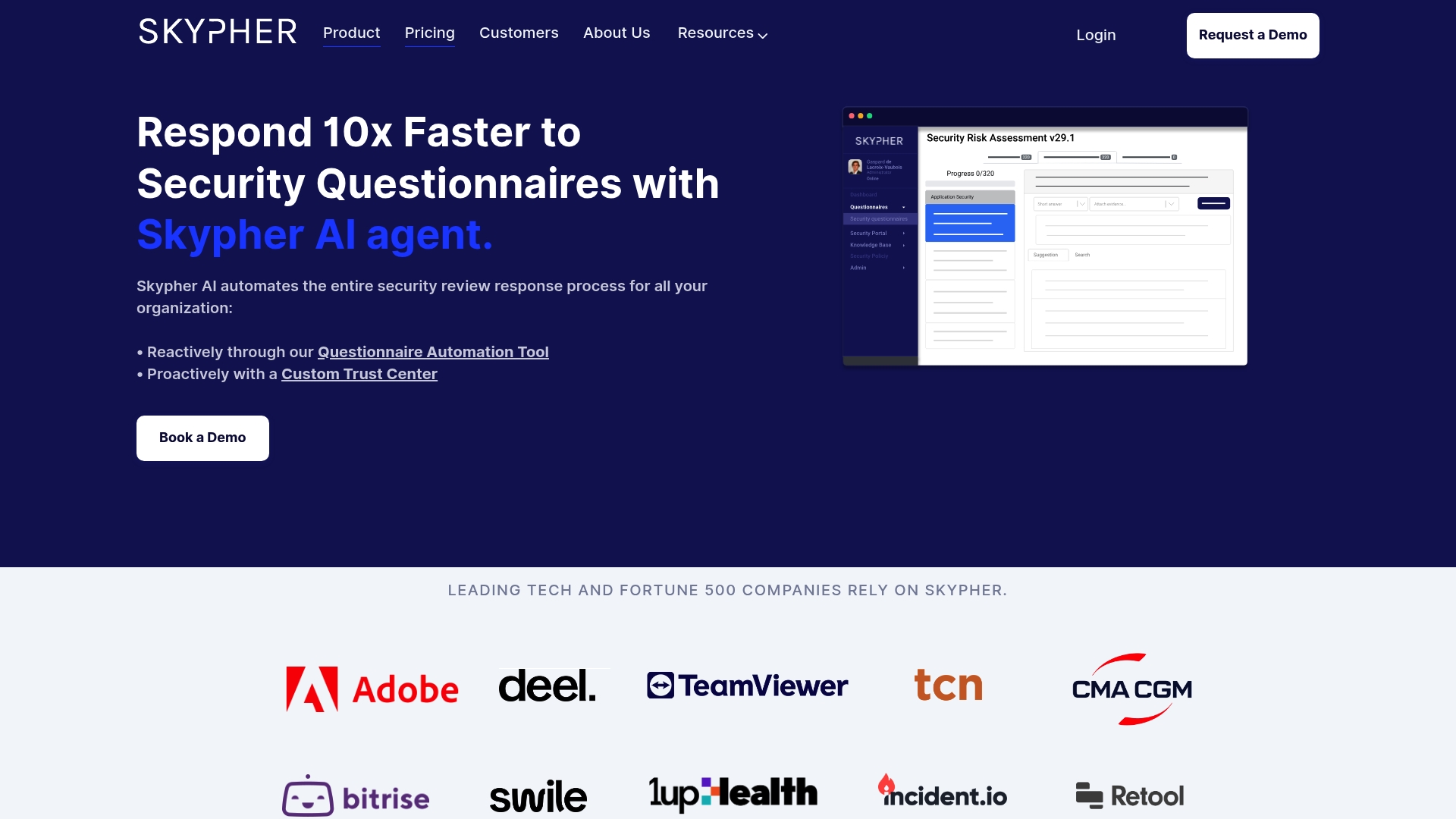
Take control of your cybersecurity processes today. Skypher's platform supports over 40 third-party risk management integrations and provides real-time collaboration features to unify your security teams effortlessly. Explore how Skypher can accelerate your compliance efforts and enhance your security posture by visiting Skypher. Start transforming tedious security tasks into efficient workflows and build resilience with automated, intelligent solutions built for organizations like yours.
Frequently Asked Questions
What are the core principles of Zero Trust Architecture for cybersecurity?
Zero Trust Architecture emphasizes the principle of "never trust, always verify." This means that every user, device, and application must continuously prove its identity and authorization before accessing any resources. To implement this, start by rigorously verifying identities using multi-factor authentication and regularly updating access permissions.
How can I automate my organization's risk assessments effectively?
To automate risk assessments, invest in AI-powered platforms that can streamline your evaluation processes. This will reduce human error and improve your overall security posture. Begin by mapping out current risk assessment practices and identifying areas where automation can enhance efficiency within 30 days.
What steps should I take to implement Single Sign-On (SSO) and Multi-Factor Authentication (MFA) in my organization?
To implement SSO and MFA, start by selecting solutions that support various verification methods like biometric scans and hardware tokens. This approach improves security while simplifying user access. Take action by training your teams on best practices for using these authentication methods within the next 60 days.
How do I effectively integrate security tools for better collaboration?
Integrate security tools by implementing centralized dashboards that enable real-time sharing of threat intelligence. This creates a more adaptive defense system. Take a proactive step by assessing your current tools and ensuring they can integrate with others by the end of the quarter.
What should I include in my organization's cybersecurity policy updates?
Your cybersecurity policy updates should cover data handling, user access management, and incident response protocols. Regularly refining these policies is essential to adapt to new threats and regulations. Establish a bi-annual review cycle to reassess and adjust these policies effectively.
How can I foster a culture of continuous security training for all employees?
Foster continuous security training by implementing interactive and role-specific learning programs that engage employees regularly. Incorporate simulations and phishing awareness workshops into your training schedule. Initiate this process by developing a training calendar that includes monthly sessions starting within the next 30 days.
Recommended
- Cybersecurity GRC: Essential Strategies for 2025 Success
- 7 Essential Steps for a Security Compliance Checklist
- Understanding GRC Cyber Security: Concepts and Importance
- 7 Effective Security Questions Examples for Your Business
- How to Secure Your Data: Essential Steps for Protection – buy2fix
- Effective Cybersecurity Training for Employees: A Step-by-Step Guide - SRS Networks