

Regulatory fines for data privacy violations have topped $1.2 billion globally in the past year alone. With such high stakes, every B2B business faces growing pressure to protect sensitive information and build trust. Understanding the right security steps can help your team guard against risks, avoid costly mistakes, and establish confidence with partners and clients.
Table of Contents
- 1. Understand Data Privacy Regulations Relevant to Your Sector
- 2. Implement Robust Access Controls and User Authentication
- 3. Encrypt Sensitive Data at Rest and in Transit
- 4. Train Employees on Data Privacy Awareness Regularly
- 5. Automate Security Questionnaire Response Processes
- 6. Monitor and Audit Data Access with Real-Time Tools
- 7. Establish a Clear Incident Response Plan
Quick Summary
| Takeaway | Explanation |
|---|---|
| 1. Understand relevant data privacy regulations | Knowledge of GDPR, CCPA, and HIPAA is essential for compliance in your specific industry sector. |
| 2. Implement strong access controls | Use Multi-Factor Authentication (MFA) and Role Based Access Control (RBAC) to protect sensitive data. |
| 3. Encrypt data at rest and in transit | Use strong encryption protocols to safeguard organizational information from cyber threats. |
| 4. Regularly train employees on data privacy | Consistent education helps staff recognize threats and understand data handling protocols. |
| 5. Develop a clear incident response plan | A structured approach is crucial to effectively manage data breaches and minimize damage. |
1. Understand Data Privacy Regulations Relevant to Your Sector
Every B2B team must recognize data privacy regulations as more than legal checkboxes they need to tick. These complex frameworks represent critical guardrails protecting sensitive business and customer information across different industry sectors.
The landscape of data protection is intricate and constantly evolving. According to research from WJARR, different sectors face unique regulatory challenges that require specialized compliance strategies. For instance, healthcare organizations must navigate HIPAA requirements, while financial services teams need to comply with GDPR and CCPA standards.
Key Regulatory Frameworks to Understand:
- GDPR (General Data Protection Regulation)
- CCPA (California Consumer Privacy Act)
- HIPAA (Health Insurance Portability and Accountability Act)
- SOC II Compliance Standards
Successful data privacy management means understanding which regulations specifically impact your industry. Transportation companies, for example, have distinct data usage ethical considerations compared to healthcare providers, as highlighted in research from arXiv.
To effectively implement sector specific data privacy practices, start by:
- Conducting a comprehensive regulatory audit
- Mapping your data flows against specific industry requirements
- Training your team on sector specific compliance nuances
- Developing adaptable data governance frameworks
Remember: Data privacy is not a one size fits all approach. Your strategy must be as unique as your business sector. Understanding the GRC Framework can provide additional insights into creating robust compliance strategies.
2. Implement Robust Access Controls and User Authentication
Access controls are the digital gatekeepers protecting your organization's most sensitive information. Without strategic authentication mechanisms, your data remains vulnerable to unauthorized intrusion and potential breaches.
Research from arXiv underscores the critical importance of robust access controls, particularly in data governance frameworks for sensitive sectors like healthcare and finance. Multi Factor Authentication (MFA) and Role Based Access Control (RBAC) are not optional extras. They are essential security strategies.
Key Authentication Best Practices:
- Implement zero trust security models
- Utilize multi factor authentication
- Create granular user permission levels
- Regularly audit and update access credentials
- Enable real time access monitoring
Advanced data platforms now embed sophisticated authentication techniques. According to research from arXiv, modern B2B enterprises are moving beyond traditional username password models toward more intelligent access control systems.
To effectively enhance your authentication strategy:
- Conduct comprehensive user access reviews quarterly
- Deploy adaptive authentication technologies
- Integrate biometric verification when possible
- Develop clear onboarding and offboarding protocols for user access
Understanding SOC II Type 1 can provide additional insights into building robust authentication frameworks that meet rigorous security standards. Remember: your authentication strategy is only as strong as its weakest entry point.
3. Encrypt Sensitive Data at Rest and in Transit
Data encryption acts as an invisible armor protecting your organization's most critical information from potential cyber threats. Think of it as a secure vault that shields your data whether it is stored on servers or moving across networks.
Research from arXiv highlights the strategic importance of comprehensive data encryption techniques for B2B enterprises. Encryption transforms readable data into complex code that can only be accessed with specific decryption keys.
Critical Encryption Strategies:
- Implement end to end encryption protocols
- Use strong cryptographic algorithms
- Protect data during storage and transmission
- Regularly rotate encryption keys
- Maintain detailed encryption key management processes
In sensitive sectors like healthcare and finance, encryption is not optional. Research from arXiv emphasizes that protecting patient and financial data requires robust encryption mechanisms that secure information both at rest (when stored) and in transit (while being transmitted).
To effectively implement data encryption:
- Select industry standard encryption protocols
- Use SSL TLS for network transmissions
- Deploy full disk encryption for storage systems
- Create comprehensive key management policies
- Train teams on encryption best practices
Understanding the HIPAA Security Rule can provide additional context on encryption requirements for regulated industries. Remember: your data is only as secure as your weakest encryption point.
4. Train Employees on Data Privacy Awareness Regularly
Employees are both your strongest defense and potential weakness in data privacy protection. Without consistent training, even well intentioned team members can accidentally compromise sensitive organizational information.
Research from arXiv emphasizes that regular employee training is a critical component of comprehensive data governance strategies. The human element remains the most unpredictable factor in cybersecurity.
Key Training Focus Areas:
- Recognizing phishing attempts
- Understanding data handling protocols
- Identifying potential security vulnerabilities
- Practicing secure communication methods
- Reporting suspicious activities
According to research from arXiv, ongoing education is not just recommended but necessary to ensure the security of enterprise data. Cybersecurity threats evolve rapidly and your training programs must keep pace.
To build an effective employee training program:
- Conduct quarterly security awareness workshops
- Use interactive and engaging training modules
- Simulate realistic cybersecurity scenarios
- Provide clear escalation protocols
- Reward proactive security behavior
Understanding the GRC Framework can help you develop a comprehensive approach to integrating data privacy training into your organizational culture. Remember: Your team is your first line of defense.
5. Automate Security Questionnaire Response Processes
Security questionnaires can drain your team's productivity and energy. Automation transforms this tedious process from a manual nightmare into a streamlined strategic advantage.
Research from arXiv introduces the Data Capsule paradigm, which demonstrates how technological innovations can automate complex compliance checking processes. This means faster response times and dramatically reduced human error.
Key Automation Strategies:
- Implement AI powered response generation
- Create comprehensive answer libraries
- Use template based response frameworks
- Integrate machine learning for continuous improvement
- Establish consistent response protocols
According to research from arXiv, automated data masking techniques within platforms can significantly aid in efficiently responding to intricate security questionnaires. Modern B2B teams need smart solutions that adapt quickly.
To effectively automate your security questionnaire processes:
- Analyze historical questionnaire responses
- Develop a centralized knowledge repository
- Train AI models with your organizational context
- Set up real time collaboration workflows
- Monitor and refine automation performance
The Case for Security Questionnaire Automation provides deeper insights into transforming this critical business process. Your goal: Turn questionnaires from a burden into a competitive advantage.
6. Monitor and Audit Data Access with Real-Time Tools
In the fast moving world of data privacy, visibility is power. Real-time monitoring transforms your data security from reactive defense to proactive protection.
Research from arXiv emphasizes the critical importance of continuous data access monitoring, particularly in sensitive sectors like healthcare and finance. Your tools should function like digital sentinels tracking every single data interaction.
Key Monitoring Capabilities:
- Track user login activities
- Record data access patterns
- Generate instant breach alerts
- Create comprehensive audit trails
- Detect anomalous behavior instantly
According to research from arXiv, implementing real-time tools is no longer optional for maintaining robust B2B enterprise data security. Modern organizations need intelligent systems that can identify potential risks before they escalate.
To build an effective real-time monitoring strategy:
- Select tools with advanced machine learning algorithms
- Configure granular access logging
- Establish clear baseline behavior metrics
- Create automated alert mechanisms
- Conduct regular penetration testing
Streamline GRC Audit can provide additional insights into developing comprehensive monitoring frameworks. Remember: In data privacy, what you cannot see can hurt you.
7. Establish a Clear Incident Response Plan
Data breaches are not a matter of if but when. A well structured incident response plan transforms potential disasters into manageable challenges.
Research from arXiv highlights the critical need for a comprehensive incident response framework as a vital component of data governance. Your plan is essentially a strategic roadmap that guides your team through potential security crises.
Key Incident Response Components:
- Define clear roles and responsibilities
- Create step by step escalation protocols
- Develop communication strategies
- Establish forensic investigation procedures
- Design recovery and remediation workflows
According to research from arXiv, B2B enterprises must approach incident response with meticulous preparation. Quick and coordinated action can significantly minimize potential damage and reputational risks.
To build a robust incident response strategy:
- Conduct regular tabletop exercise simulations
- Create comprehensive incident classification guidelines
- Develop pre approved communication templates
- Establish cross functional response teams
- Implement continuous training and update mechanisms
Understanding the GRC Framework can provide additional insights into developing comprehensive response strategies. Remember: Preparation is your best defense against potential security incidents.
Below is a comprehensive table summarizing the key strategies and implementation steps for data privacy, access control, encryption, employee training, automation, monitoring, and incident response discussed throughout the article.
| Strategy | Implementation Steps | Expected Results |
|---|---|---|
| Data Privacy Regulations | Conduct audits, map data flows, sector-specific training | Compliance with regulations and sector-specific security |
| Access Controls & User Authentication | Implement MFA, RBAC, conduct access reviews | Enhanced security and reduced unauthorized access |
| Data Encryption | Use strong cryptographic algorithms, end-to-end encryption | Protection of data at rest and in transit |
| Employee Training | Conduct regular workshops, simulate scenarios | Increased awareness and reduced human error risks |
| Automate Security Questionnaire Responses | Use AI for response generation, create answer libraries | Increased productivity and reduced human error |
| Real-Time Monitoring | Track access, generate alerts, configure logging | Proactive threat detection and response |
| Incident Response Planning | Define roles, conduct simulations, establish communication strategies | Quick mitigation of breaches and reduced impact |
Streamline Your Data Privacy Efforts with AI-Driven Automation
Managing data privacy best practices like robust access controls, encryption, and incident response can be complex and time-consuming. The struggle to keep up with evolving regulations and security questionnaire demands often drains your team’s productivity and focus. That is where Skypher steps in with cutting-edge AI tools designed to simplify your compliance workflows and accelerate your security questionnaire responses.
Skypher’s AI Questionnaire Automation Tool supports multiple formats and integrates with over 40 third-party risk management platforms. This means you can automate repetitive tasks such as generating accurate answers for security questionnaires at unprecedented speeds, freeing your team up to focus on critical data governance strategies highlighted in the 7 Essential Data Privacy Best Practices for B2B Teams. With real-time collaboration features and customizable Trust Centers, your organization gains stronger control and visibility over compliance processes.
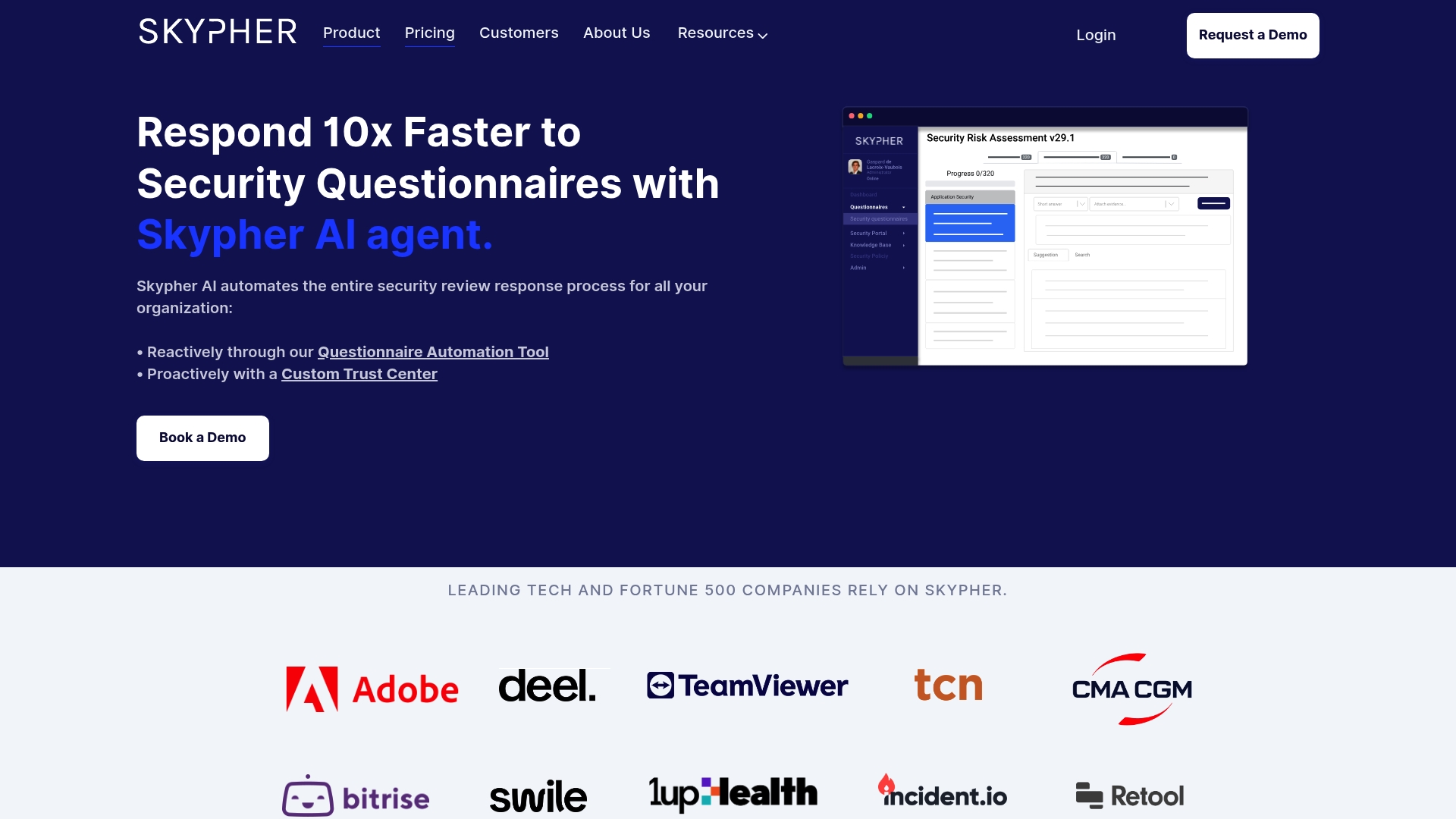
Ready to transform your data privacy operations and stay ahead in compliance management? Visit Skypher now to explore how our platform complements your sector-specific data privacy regulations and supports secure, efficient authentication, encryption, and incident response workflows. Empower your team to respond faster and smarter with AI Questionnaire Automation Tool. Take the next step towards resilience and trust in your cybersecurity posture today.
Frequently Asked Questions
How can I understand the data privacy regulations relevant to my B2B sector?
To understand the data privacy regulations impacting your sector, conduct a comprehensive regulatory audit. Identify frameworks like GDPR or HIPAA that apply to your industry and create a compliance strategy within 30 days.
What are the best practices for implementing access controls and user authentication?
To implement effective access controls, use multi-factor authentication and role-based access control. Regularly audit access credentials at least once a quarter to ensure that only authorized personnel have access to sensitive data.
How do I encrypt sensitive data both at rest and in transit?
To protect data, implement end-to-end encryption for both stored information and data being transmitted. Use strong cryptographic algorithms and rotate encryption keys every six months to maintain security integrity.
What key areas should I focus on when training employees about data privacy?
Focus employee training on recognizing phishing attempts, understanding data handling protocols, and identifying potential security vulnerabilities. Conduct these training sessions quarterly to ensure ongoing awareness and readiness.
How can I automate the security questionnaire response process effectively?
You can automate the security questionnaire response process by implementing AI-powered response generation tools and creating a comprehensive answer library. Set up these systems within 60 days to enhance efficiency and reduce human error in responses.
What components should be included in an incident response plan?
An effective incident response plan should define clear roles and responsibilities, develop communication strategies, and include forensic investigation procedures. Design this plan and conduct regular tabletop exercises to prepare your team for potential security incidents.
Recommended
- 7 Key Advantages of AI in Sales for B2B Success
- 7 Essential Steps for a Security Compliance Checklist
- The different formats & mistakes made when writing or answering security questionnaires
- Streamline GRC Audit: Step-by-Step Guide for B2B Teams
- 7 Slimme Tips voor Conversie Verhogende E-mails in B2B – Re:Positive
- GDPR Compliance in Testing: Practical Guide for Marketers 2025