

Most growing businesses discover that almost 60 percent of regulatory fines stem from gaps in compliance automation. Staying ahead means choosing the right solution, but finding clear answers about Drata pricing can be confusing. When every dollar counts and compliance missteps carry real risks, understanding Drata’s cost structure could shape your entire strategy. This guide demystifies the price tags, clarifies who benefits most, and helps you match your needs to the best-tiered plan.
Table of Contents
- What Is Drata Pricing and Who Needs It
- Types of Drata Plans and Feature Differences
- Core Pricing Factors and Cost Structure
- Enterprise Options and Customization Levels
- Comparing Drata Pricing to Alternatives
Key Takeaways
| Point | Details |
|---|---|
| Flexible Pricing Tiers | Drata offers three pricing plans (Foundation, Advanced, Enterprise) tailored to various organizational sizes and compliance needs. |
| Comprehensive Features | Each plan provides distinct features ranging from basic compliance automation to advanced security and governance solutions. |
| Hidden Costs Consideration | Organizations should anticipate potential additional costs related to framework implementation, support, and customization when budgeting for Drata services. |
| Competitive Analysis | Businesses must evaluate Drata's pricing against alternatives to ensure alignment with their unique compliance requirements and operational efficiency. |
What Is Drata Pricing and Who Needs It
Understanding Drata pricing is crucial for organizations seeking robust compliance and security automation solutions. According to smartsuite, Drata offers a strategic pricing model designed to accommodate different organizational sizes and compliance requirements, ranging from startup to enterprise levels.
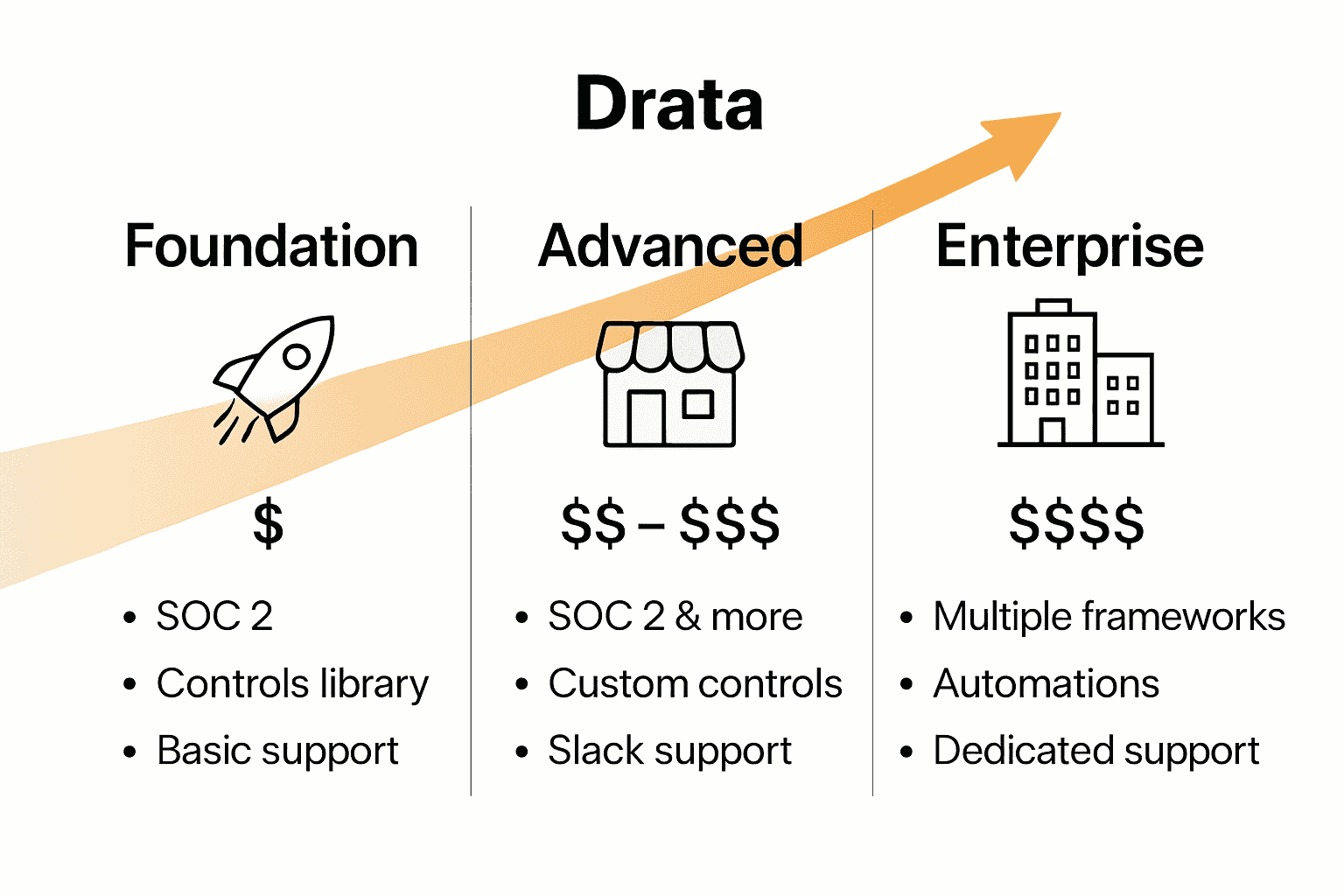
Drata's pricing structure is strategically segmented into three primary tiers:
- Foundation Plan: Approximately $7,000–$7,500 annually
- Advanced Plan: Around $15,000 per year
- Enterprise Plan: Ranging from $25,000 to $50,000+ annually
Each pricing tier is meticulously crafted to address specific organizational needs, allowing businesses to select a solution that matches their compliance complexity, team size, and security automation requirements. The tiered approach ensures that whether you're a small technology startup or a large financial institution, there's a tailored compliance management solution available.
The ideal candidates for Drata's pricing models include:
- Technology startups requiring initial compliance frameworks
- Mid-sized companies expanding their security infrastructure
- Enterprise organizations with complex regulatory requirements
- Financial services firms needing comprehensive security auditing
- Healthcare organizations managing sensitive patient data
By offering flexible pricing options, Drata enables organizations to invest strategically in their compliance and security posture without overwhelming their budgetary constraints.
 The pricing model reflects a nuanced understanding that cybersecurity and compliance are not one-size-fits-all propositions, but rather dynamic requirements that evolve with organizational growth and complexity.
Types of Drata Plans and Feature Differences
Navigating the world of compliance automation requires understanding the nuanced differences between Drata's plan offerings. According to smartsuite, Drata has strategically designed three distinct plan tiers to meet the evolving needs of organizations across different growth stages and compliance complexities.
Foundation Plan: Entry-Level Compliance Automation
The Foundation Plan serves as an ideal starting point for startups and small organizations beginning their compliance journey. Key characteristics include:
- Basic framework coverage
- Single framework support
- Essential automated compliance monitoring
- Limited user access
- Basic reporting capabilities
Advanced Plan: Scaling Compliance Infrastructure
Designed for growing companies with expanding compliance requirements, the Advanced Plan offers more comprehensive features:
- Multiple framework support
- Enhanced automated evidence collection
- Increased user licenses
- Advanced reporting and dashboard capabilities
- Integrations with multiple third-party platforms
Enterprise Plan: Comprehensive Governance Solution
The Enterprise Plan represents the pinnacle of Drata's compliance automation, targeting large organizations with complex regulatory landscapes:
- Unlimited framework coverage
- Advanced continuous control monitoring
- Custom compliance workflow designs
- Dedicated compliance success manager
- Comprehensive audit support
- Advanced security posture management
- Unlimited user licenses
- Priority technical support
The strategic differentiation between these plans allows organizations to select a solution that precisely matches their current compliance maturity and future growth trajectory. By offering scalable options, Drata ensures that businesses can incrementally enhance their security and compliance capabilities without unnecessary financial burden.
Whether you're a small startup seeking initial framework compliance or a large enterprise requiring sophisticated governance solutions, Drata's tiered approach provides a flexible pathway to robust, automated compliance management.
Core Pricing Factors and Cost Structure
Understanding the intricate pricing mechanism of Drata requires a deep dive into its multifaceted cost structure. According to Vendr, Drata's pricing is not a simple flat rate but a complex model comprising base platform fees and additional charges that can potentially increase total investment by 20-35%.
Base Platform Pricing Components
The fundamental pricing of Drata revolves around several key factors:
- Base Platform Fee: The foundational cost for using Drata's compliance automation infrastructure
- Framework-Specific Charges: Additional costs for each compliance standard implemented
- User License Fees: Pricing based on number of team members accessing the platform
- Integration Complexity: Potential extra charges for advanced third-party integrations
Framework Pricing Breakdown
As documented by AWS Marketplace, each compliance framework comes with a specific annual cost. For instance, frameworks like SOC 2 or ISO 27001 are typically priced around $7,500 per year. This means organizations must budget not just for the base platform, but for each unique compliance standard they need to implement.
Hidden and Additional Cost Considerations
Beyond the standard pricing model, organizations should anticipate potential supplementary expenses:
- Implementation services
- Premium support packages
- Custom workflow design
- Advanced reporting capabilities
- Dedicated compliance success management
These additional services can significantly impact the total cost of ownership, making it crucial for businesses to conduct a comprehensive financial assessment before committing to a specific Drata plan. The modular nature of Drata's pricing allows for flexible scaling, but also requires careful budgetary planning to avoid unexpected expenses.
Enterprise Options and Customization Levels
For organizations with complex compliance and security requirements, Drata's Enterprise plan represents the pinnacle of customizable governance solutions. According to smartsuite, the Enterprise plan offers advanced capabilities with pricing ranging from $25,000 to $50,000+ annually, providing a comprehensive suite of tools tailored to sophisticated organizational needs.
Comprehensive Enterprise Customization Features
The Enterprise plan distinguishes itself through multiple levels of customization and advanced capabilities:
- Unlimited Framework Coverage: Support for multiple compliance standards simultaneously
- Advanced Vendor Risk Management: Comprehensive third-party risk assessment tools
- Custom Trust Center Configuration: Fully adaptable security profile presentation
- Dedicated Compliance Success Management: Personalized strategic guidance
- Advanced Reporting and Analytics: Deep insights into compliance posture
Modular Approach to Enterprise Solutions
Drata's Enterprise offering allows organizations to build a precisely tailored compliance infrastructure through:
- Modular framework selection
- Custom integration design
- Scalable user access management
- Personalized workflow automation
- Advanced control monitoring
Strategic Customization Considerations
Enterprises can leverage Drata's flexible architecture to create a compliance ecosystem that:
- Adapts to unique organizational structures
- Supports complex multi-entity environments
- Provides granular control over security processes
- Enables continuous compliance monitoring
- Facilitates seamless audit preparation
By offering this level of customization, Drata empowers large organizations to transform compliance from a mandatory requirement into a strategic business advantage. The ability to design a fully personalized governance framework means enterprises can align their security and compliance efforts precisely with their specific operational objectives and risk management strategies.
Comparing Drata Pricing to Alternatives
Navigating the compliance automation landscape requires a strategic approach to evaluating pricing models across different platforms. While no single solution fits every organization perfectly, understanding the comparative advantages of Drata's pricing can help businesses make informed decisions about their compliance investment.
Pricing Structure Comparison
When evaluating compliance automation platforms, key comparative factors include:
- Base Platform Costs
- Per-Framework Pricing
- User License Expenses
- Implementation and Support Fees
- Scalability Options
Competitive Pricing Dimensions
Typical alternatives to Drata include:
- Vanta: Generally similar pricing structure, with annual costs ranging from $10,000-$40,000
- Secureframe: Comparable enterprise solutions starting around $15,000 annually
- Comply: Mid-market options with pricing between $8,000-$25,000 per year
- AuditBoard: Enterprise-level solutions with more complex pricing models
Cost-Value Analysis Considerations
Key differentiators in comparing compliance automation platforms extend beyond raw pricing:
- Depth of framework coverage
- Automation capabilities
- Integration flexibility
- Reporting and analytics sophistication
- Customer support quality
- Implementation complexity
Businesses should conduct a comprehensive total cost of ownership analysis that goes beyond surface-level pricing. While Drata's pricing might appear similar to competitors, its unique combination of features, ease of use, and comprehensive framework support often provides superior value for organizations serious about streamlining their compliance processes.
Ultimately, the most cost-effective solution is the one that minimizes manual effort, reduces compliance risks, and aligns precisely with an organization's specific governance requirements. Price should be evaluated as an investment in operational efficiency, not merely an expense.
Simplify Compliance Automation and Security Reviews with Skypher
Organizations navigating the complexities of Drata pricing and compliance automation face challenges such as managing multiple frameworks, handling extensive user licenses, and integrating various third-party platforms. The article highlights how costs can escalate with additional services and customized enterprise features. If you are looking to reduce the time and effort spent on security questionnaires while maintaining high accuracy and seamless collaboration across your teams, Skypher offers a powerful solution tailored for medium to large tech and finance organizations.
Skypher’s AI Questionnaire Automation Tool supports over 40 integrations with third-party risk management platforms and handles a broad range of formats with unmatched speed. Its customizable Trust Center and real-time collaboration features empower your teams to respond swiftly and confidently to security reviews, tackling exactly the kind of compliance complexity Drata’s tiered pricing tries to address. Leverage Skypher’s industry-leading automation to avoid costly delays and reduce manual workloads.
Discover how Skypher can transform your compliance response process today. Visit Skypher’s platform to explore our AI Questionnaire Automation Tool and learn how our Custom Trust Center drives greater efficiency. Take control of your security reviews now and stay ahead of evolving compliance demands with less effort and cost.
Frequently Asked Questions
What are the different pricing tiers offered by Drata?
Drata offers three primary pricing tiers: the Foundation Plan (approximately $7,000–$7,500 annually), the Advanced Plan (around $15,000 per year), and the Enterprise Plan (ranging from $25,000 to $50,000+ annually).
What features are included in the Foundation Plan of Drata?
The Foundation Plan includes basic framework coverage, single framework support, essential automated compliance monitoring, limited user access, and basic reporting capabilities, making it suitable for startups and small organizations.
How does the pricing for Drata change based on compliance frameworks?
Drata's pricing includes a base platform fee, with additional charges applied for each compliance framework implemented. For instance, compliance frameworks like SOC 2 or ISO 27001 typically add around $7,500 annually.
What customization options are available in the Enterprise Plan of Drata?
The Enterprise Plan offers extensive customization features, including unlimited framework coverage, advanced vendor risk management, custom trust center configuration, and dedicated compliance success management, allowing large organizations to tailor their compliance infrastructure to their specific needs.