

Selecting true GDPR compliant software can be the difference between effortless audits and urgent regulatory headaches. For IT Compliance Officers in global finance and tech, the challenge goes beyond just answering security questionnaires. When privacy principles are architected into every system layer, not only is compliance more reliable, but the efficiency of data management soars. This guide helps you identify software solutions built from the ground up to protect data and support your team's compliance responsibilities with confidence.
Table of Contents
- Defining GDPR Compliant Software Solutions
- Critical GDPR Principles for SaaS Platforms
- Key Features of GDPR-Compliant Applications
- Legal Obligations for Controllers and Processors
- Common Pitfalls and Risk Management Strategies
Key Takeaways
| Point | Details |
|---|---|
| GDPR Compliance is Integral | Software must embed GDPR principles from the design phase to avoid vulnerabilities and compliance gaps. |
| Understanding Roles is Crucial | Organizations should clearly differentiate between data controllers and processors to manage legal obligations and liabilities effectively. |
| Continuous Monitoring Required | GDPR compliance should be viewed as an ongoing process, necessitating regular assessments, training, and updates. |
| Vendor Evaluation is Key | Always request detailed information about Data Processing Agreements and the software's data handling capabilities when selecting vendors. |
Defining GDPR Compliant Software Solutions
GDPR compliant software is fundamentally about more than just checking boxes on a regulatory checklist. At its core, it refers to software systems and applications that are architected, built, and operated in accordance with the General Data Protection Regulation requirements. For IT Compliance Officers evaluating solutions, this means the software must embed privacy and data protection principles directly into its foundation, not as an afterthought. The distinction matters enormously. A system that bolts on compliance features after development creates gaps, vulnerabilities, and constant firefighting. True GDPR compliant software weaves data protection into every layer, from how data is collected and stored to how it is processed and eventually deleted.
The practical reality of GDPR compliance within software means your systems must enforce specific technical and organizational requirements across multiple dimensions. Building privacy into system design from the outset ensures that data minimization, user consent mechanisms, and access controls are not Band-Aid solutions but structural features. Consider data minimization as a design principle: compliant software collects only the personal data absolutely necessary for its stated purpose, reduces storage duration to what is legally required, and implements automated deletion workflows. User consent must be genuinely obtained before processing begins, not buried in terms that nobody reads. Encryption, both in transit and at rest, becomes non-negotiable. And critically, compliant software must provide audit trails that allow your organization to demonstrate accountability when regulators ask how you handled someone's data.
What makes this challenge unique for finance and tech organizations is that GDPR requirements must cascade through your entire software development lifecycle, from initial planning through ongoing maintenance. During the planning phase, you identify what personal data flows through your system and why. In design, you determine where encryption happens and how access is controlled. Testing must verify that consent workflows actually function, data deletion actually removes data permanently, and subject access requests can be fulfilled within the legal 30-day window. The testing phase cannot be separated from compliance; it is compliance. Rollout and maintenance phases demand monitoring and documentation. A compliant software solution anticipates regulatory change and allows you to update controls without redesigning the entire system.
For your organization, this translates into needing software that doesn't just handle security questionnaires efficiently but does so while maintaining ironclad data protection. When you evaluate solutions, look for evidence that privacy is architected in, not added on. The software should enable your team to answer security assessment questions accurately because the underlying systems genuinely implement the controls being asked about. This alignment between what the software does and what it can truthfully claim reduces the friction between your sales, compliance, and engineering teams.
Pro tip: When evaluating GDPR compliant software, request detailed information about the product's data processing architecture and request a Data Processing Agreement upfront. Your legal team needs evidence that the vendor has designed privacy in from day one, not just added features to appear compliant.
Critical GDPR Principles for SaaS Platforms
SaaS platforms occupy a unique position in the data protection ecosystem. Unlike traditional software you install and maintain yourself, SaaS vendors act as data processors handling personal information on behalf of their customers. This responsibility means the seven core GDPR principles are not optional guidelines but operational requirements built into every feature and process. Understanding these principles transforms how your organization evaluates SaaS solutions, because you need vendors who have architected compliance into their service delivery model, not vendors offering compliance as an add-on feature.
The first three principles form the foundation of lawful data handling. Lawfulness, fairness, and transparency require SaaS platforms to process data only when there is a legal basis to do so, to handle that data fairly without deception, and to communicate openly with users about what data is collected and why. For your organization using security questionnaire automation tools, this means the platform must not sell or repurpose your answers for marketing. Purpose limitation means data collected for security assessment responses cannot be used for profiling or other unrelated purposes. Data minimization demands that the platform asks for only the information necessary to function. A SaaS tool that collects extra data "just in case" or creates comprehensive user profiles fails this test.
The remaining four principles govern how platforms maintain data quality and security. Accuracy requires keeping personal data correct and current, which means your SaaS vendor must have systems to flag and correct outdated information. Storage limitation means data cannot be kept indefinitely. If your security questionnaire responses remain in the system five years after a vendor relationship ends, that violates storage limitation. Integrity and confidentiality demand encryption, access controls, and protection against unauthorized processing. Accountability is the principle that ties everything together. Your SaaS vendor must be able to prove, with documentation and evidence, that every principle is actually being followed. This is why Data Processing Agreements and audit trails matter so much.
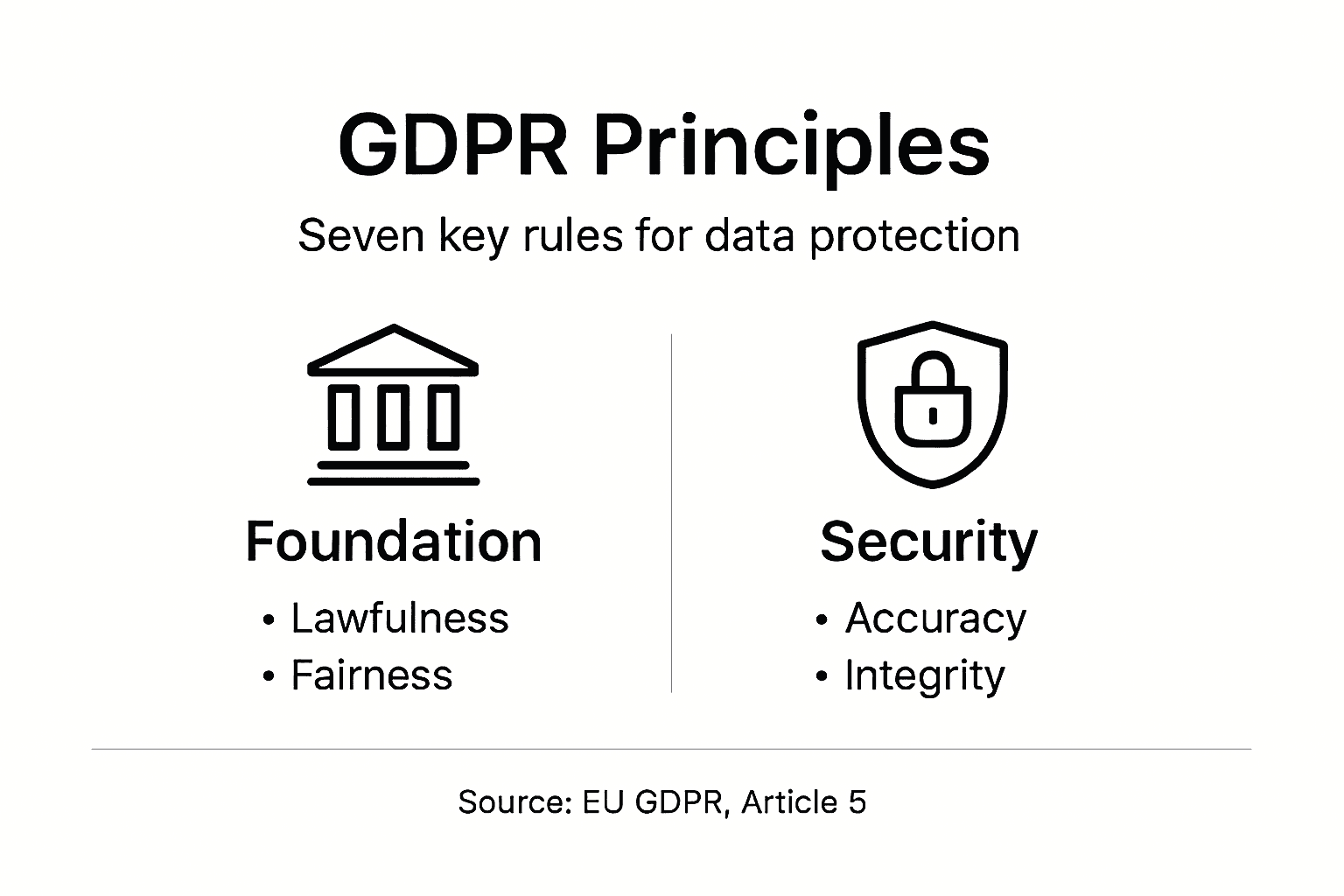
Here's a summary of the seven core GDPR principles and their practical impact on SaaS platforms:
| Principle | Description | Practical SaaS Example |
|---|---|---|
| Lawfulness, Fairness, Transparency | Data must be processed legally and openly | Platform explains data use to users |
| Purpose Limitation | Data used only for specified, explicit purposes | No repurposing user data for marketing |
| Data Minimization | Only minimal data collected for main function | Requests only essential information |
| Accuracy | Data must be kept current and correct | Outdated info corrected promptly |
| Storage Limitation | Personal data kept no longer than necessary | Data deleted after contract ends |
| Integrity & Confidentiality | Secured against unauthorized access or changes | Encryption and strict access controls |
| Accountability | Ability to prove compliance and responsible use | Maintains audit logs and evidence |
For finance and tech teams specifically, this translates into concrete evaluation criteria. When you review SaaS platforms, request their Data Processing Agreement upfront. Ask how the platform implements data minimization in practice. Demand to know the technical measures protecting data in transit and at rest. Request information about data retention policies and how deletion actually works. Ask for evidence of regular security assessments and penetration testing. The vendors willing to provide detailed answers are the ones who have actually built these principles into their product. The vendors who give vague responses or claim they cannot share technical details are signaling that compliance was added later, not architected from day one.
Pro tip: Create a standardized GDPR principles checklist based on these seven concepts and use it to evaluate every SaaS tool your organization considers, whether it handles security questionnaires, financial data, or customer information. Consistency in your evaluation prevents compliance gaps and makes it easier for your team to defend vendor selection decisions to auditors.
Key Features of GDPR-Compliant Applications
GDPR-compliant applications are recognizable by specific technical and operational capabilities that distinguish them from software that merely claims to be compliant. These features are not luxury additions or marketing checkboxes. They are the concrete mechanisms that transform regulatory requirements into functioning systems. For IT Compliance Officers evaluating security questionnaire automation tools or any SaaS platform, knowing what to look for prevents you from selecting a vendor whose compliance posture collapses under regulatory scrutiny.
The most fundamental feature is granular user consent management. Compliant applications do not process personal data without explicit, informed consent obtained before processing begins. This means the application provides clear explanations of what data will be collected, why it will be collected, and how long it will be retained. Users can withdraw consent at any time, and that withdrawal must be honored immediately. Beyond consent, GDPR-compliant applications implement data protection by design and default, meaning privacy controls are built into the core architecture rather than layered on top. The application minimizes data collection automatically, processes data using encryption and pseudonymization by default, and restricts access through role-based permissions. When your security questionnaire automation tool stores your responses, it should encrypt them immediately, not leave them visible in plain text while waiting for encryption to be "enabled" later.

The second category of essential features addresses user rights and transparency. Compliant applications must provide mechanisms for users to access their personal data on demand, download it in a usable format, and understand how it is being processed. They must allow users to request corrections to inaccurate data and have corrections processed within 30 days. Most importantly, they must honor erasure requests (the "right to be forgotten") by permanently deleting personal data when requested, with limited exceptions for legal obligations. Beyond user rights, compliant applications maintain detailed records of processing activities, creating an audit trail that demonstrates what data was collected, why, how it was used, and who accessed it. This documentation is not optional compliance theater. It is the evidence your organization produces when regulators ask for accountability.
The final set of features centers on security, breach response, and operational resilience. Compliant applications implement encryption for data in transit and at rest, multi-factor authentication for access control, and regular security assessments including penetration testing. When a data breach occurs, the application must have breach notification capabilities that alert your organization immediately so you can notify affected individuals within the 72-hour window mandated by GDPR. The application should provide detailed breach reports showing what data was compromised, when the breach was discovered, and what remediation steps are being taken. For your organization, this means you can fulfill regulatory notification obligations without scrambling to gather information from your vendor.
Pro tip: Request a detailed feature audit from any SaaS vendor, specifically asking how they operationalize consent management, data subject rights (access, correction, erasure), encryption, and breach notification. Ask for screenshots or demonstrations of these features in production rather than accepting documentation alone. Vendors confident in their compliance will welcome the technical review.
Legal Obligations for Controllers and Processors
Understanding who is legally responsible under GDPR is not an academic exercise. It determines liability when breaches occur, shapes your vendor agreements, and defines what your organization can and cannot ask third-party vendors to do. The distinction between controllers and processors is the foundation of GDPR governance, yet many organizations get this wrong, creating gaps that regulators and auditors quickly expose.
A data controller is the organization that decides why personal data is collected and how it will be processed. In most cases, your organization is the controller. You decide to conduct security questionnaires, you determine which questions get asked, and you choose which vendor processes those responses. Controllers bear the heaviest compliance burden. You must ensure that data processing is lawful, that you have a valid legal basis for collection, and that individuals are informed about how their data will be used. You are responsible for implementing data protection by design, conducting data protection impact assessments for high-risk processing, documenting your processing activities, and responding to individual rights requests within regulatory timeframes. When a breach occurs, you must notify regulators and affected individuals. Regulators typically pursue controllers first because controllers are where the compliance responsibility ultimately lies.
A data processor is an external vendor or contractor that handles personal data on your behalf, following your instructions. When you select a SaaS platform to automate security questionnaire responses, that vendor is acting as your processor. The processor must comply with GDPR obligations including implementing appropriate technical and organizational security measures, but the processor does not independently decide what data to collect or how to use it. The processor follows your instructions. This distinction matters enormously. Processors cannot repurpose your data for their own business objectives. They cannot use your questionnaire responses for marketing or product development. They can only do what you contractually authorize them to do. If they violate this principle, both the processor and you (as controller) bear liability, though the processor bears primary responsibility for their unauthorized processing.
The legal relationship between controller and processor must be formalized in a Data Processing Agreement (DPA). This is not optional paperwork. The DPA specifies what data the processor can access, what security measures the processor must implement, how long data is retained, what happens to data when the relationship ends, and what rights you have to audit the processor's compliance. Processors must grant you access to audit their systems, respond to individual rights requests on your behalf, and delete or return data upon contract termination. For finance and tech organizations, the DPA is your contractual protection. A processor refusing to sign a comprehensive DPA or offering only their own template with minimal obligations is signaling that they do not take processor responsibilities seriously. Joint controllers complicate this further. If your organization and a vendor jointly determine the purposes of data processing, you are joint controllers and share compliance responsibility. This creates ambiguity and should be avoided unless absolutely necessary.
Below is a comparison of data controller and data processor responsibilities under GDPR:
| Role | Main Responsibility | Common Tasks | Key Risk if Neglected |
|---|---|---|---|
| Data Controller | Decide purpose and means of data processing | Determine legal basis, inform users | Regulatory fines for non-compliance |
| Data Processor | Process data on controller's instructions | Implement security, ensure deletion | Breach of contract, legal liability |
Pro tip: Before signing any vendor agreement, have your legal team review the Data Processing Agreement to verify it addresses processor obligations, your audit rights, data security requirements, breach notification timelines, and data return or deletion procedures. Insist on a comprehensive DPA rather than accepting vendor-provided templates that minimize their obligations. This single document protects your organization when compliance questions arise.
Common Pitfalls and Risk Management Strategies
GDPR compliance failures rarely happen because organizations lack good intentions. They happen because organizations fail to identify where risks actually exist, underestimate the complexity of their data ecosystems, or implement controls that sound good in theory but break down in practice. For IT Compliance Officers, understanding common pitfalls is the first step toward building resilience. The second step is adopting a structured approach to risk management that catches problems before regulators do.
The first major pitfall is inadequate risk assessment and visibility. Many organizations conduct security questionnaires and assume they have mapped their data flows. They have not. They discover years later that data is moving through systems they did not know existed, being retained far longer than documented, or accessible to employees who should never have access. This visibility gap becomes catastrophic when a breach occurs and regulators ask what data was compromised. Adopting a structured risk management framework helps organizations systematically identify, assess, and mitigate risks across their entire data infrastructure rather than addressing compliance piecemeal. The second pitfall is weak security controls disguised as compliance. An organization implements encryption because it sounds like compliance, but the encryption keys are stored alongside the encrypted data. Multi-factor authentication is enabled but not required. Access controls exist but are never reviewed. These controls create a false sense of security while exposing data to preventable breaches.
The third pitfall is treating compliance as a one-time event rather than continuous operation. Your organization conducts a security assessment, answers questionnaires, receives a certification, and then ignores compliance for 12 months until the next audit. In that time, staff turnover brings new employees without privacy training. System updates introduce misconfigurations. Vendors change their data processing practices without notifying you. GDPR compliance requires continuous monitoring and adjustment. The fourth pitfall is inadequate transparency and documentation. Your organization processes personal data but cannot produce clear documentation explaining why, for how long, and with what controls. When regulators ask these questions, your inability to answer confidently signals poor governance. The fifth pitfall, often overlooked, is insufficient staff training on data handling responsibilities. Compliance officers cannot be everywhere. Your organization needs employees at every level understanding what GDPR means, why data protection matters, and what their role is in maintaining it.
Effective risk management strategies address these pitfalls systematically. First, map your data flows comprehensively. Work across your organization to identify every system handling personal data, every third-party vendor processing data on your behalf, and every data transfer point. Second, implement security controls with accountability. Do not just enable controls. Test them regularly, verify they function as intended, and document that testing. Third, establish governance processes that persist beyond compliance audits. Schedule quarterly reviews of data handling practices, conduct regular staff training, and maintain audit trails demonstrating continuous oversight. Fourth, formalize your vendor management program. Every processor handling your data requires a Data Processing Agreement, regular security assessments, and documented audit rights. Fifth, build an incident response plan before you need it. When a breach occurs, response speed matters. Organizations with documented procedures respond in hours. Organizations without procedures spend days figuring out who to call.
Pro tip: Create a risk register documenting every data processing activity, the risks associated with each activity, existing controls, and residual risk ratings. Update this quarterly and use it to guide your compliance resource allocation. This single document demonstrates accountability to regulators and helps your team focus on genuine risks rather than compliance theater.
Enhance Your GDPR Compliance with Skypher’s AI-Powered Automation
Navigating GDPR requirements demands software that is architected for privacy from day one. As highlighted in the article "GDPR Compliant Software Securing Data and Trust," embedding core principles like data minimization, transparent consent management, and robust security controls into your technology stack is essential to reduce compliance risk and build trust. If your organization is struggling with the complexity of data processing obligations or faces delays completing detailed security questionnaires, Skypher’s SaaS platform offers a powerful solution tailored for tech and finance sectors.

Skypher's AI Questionnaire Automation Tool accelerates the security review process by intelligently parsing every questionnaire format and leveraging real-time collaboration across teams. With over 30 API integrations including ServiceNow and Slack, plus multilingual support and enterprise-grade security features, Skypher ensures your data handling aligns with GDPR principles from data collection to secure storage and deletion. It also supports customizable Trust Centers that boost transparency with your clients while strengthening your audit readiness.
Discover how to move beyond piecemeal compliance and put end-to-end data protection controls into practice. Explore Skypher’s AI Questionnaire Automation Tool and learn how seamless integration with your existing risk management platforms can transform your GDPR response processes. Visit Skypher today and take the next step toward operational efficiency and uncompromising privacy governance.
Frequently Asked Questions
What is GDPR compliant software?
GDPR compliant software refers to systems and applications designed from the ground up to meet the requirements of the General Data Protection Regulation, ensuring data protection and privacy principles are embedded in every layer of the software.
Why is user consent important in GDPR compliance?
User consent is crucial because GDPR mandates that personal data must not be processed without explicit, informed consent from the individual. This consent must be obtained before data processing begins and can be withdrawn at any time.
How can organizations ensure data minimization with their software?
Organizations can ensure data minimization by designing software that only collects personal data that is absolutely necessary for its intended purpose, limiting storage duration, and implementing automated deletion workflows.
What role does a Data Processing Agreement (DPA) play in GDPR compliance?
A Data Processing Agreement formalizes the relationship between data controllers and processors, outlining how personal data will be handled, what security measures are in place, and the responsibilities of each party to ensure compliance with GDPR.