

Most European tech firms face mounting pressure as GDPR enforcement tightens and expectations for automated compliance rise. With regulators issuing over 40 percent more fines than the previous year, the risks extend well beyond data mishandling. Whether you manage a Canadian, American, or European operation, developing collaboration around smart GDPR software is critical. This article unpacks the actionable principles and automation strategies that help compliance teams reduce risks, respond faster, and keep cross-functional projects moving efficiently.
Table of Contents
- GDPR Software Compliance: Critical Principles
- Essential Requirements for SaaS Providers
- Automating Compliance With Advanced Tools
- Roles, Rights, and Data Subject Requests
- Managing Risks, Liabilities, and Common Pitfalls
Key Takeaways
| Point | Details |
|---|---|
| GDPR Principles | Software companies must integrate GDPR principles such as Lawfulness, Fairness, and Purpose Limitation to ensure legal compliance and protect data privacy. |
| SaaS Compliance Challenges | SaaS providers need to create comprehensive frameworks to manage data processing and implement Privacy by Design principles throughout product development. |
| Automation Benefits | Advanced automation tools streamline GDPR compliance processes, allowing organizations to efficiently manage data tracking, consent management, and compliance monitoring. |
| Risk Management Strategy | Organizations should adopt a proactive risk management approach, integrating technical and organizational frameworks to address compliance risks effectively. |
GDPR Software Compliance: Critical Principles
GDPR establishes fundamental data protection principles that software companies must meticulously implement across their technology platforms. These principles are not mere suggestions but legally binding requirements that form the backbone of responsible data management. Organizations must understand and embed these core guidelines to ensure comprehensive data privacy protection.
The core GDPR principles encompass several critical dimensions of data processing. Lawfulness demands that organizations have explicit legal justification for collecting and using personal data. Fairness and Transparency require clear communication with individuals about how their data will be utilized. Purpose Limitation restricts companies from using data beyond its original intended context, preventing potential misuse. Data Minimization compels businesses to collect only information that is strictly necessary for their specified objectives.
Implementing these principles requires robust technical and organizational measures. Software platforms must integrate data protection mechanisms that guarantee Accuracy of personal information, enable Storage Limitation through automated data retention policies, and maintain Integrity and Confidentiality through advanced security protocols. This means developing systems that can automatically detect outdated information, securely anonymize or delete unnecessary data, and protect against unauthorized access or breaches.
Technical teams should design compliance frameworks that systematically address each GDPR principle. This involves creating comprehensive data mapping processes, implementing granular access controls, developing transparent consent mechanisms, and establishing clear data lifecycle management strategies. Automated compliance tools can help organizations track and demonstrate accountability, generating audit trails and ensuring consistent adherence to regulatory requirements.
Here's a summary of how GDPR principles impact software design and business practices:
| GDPR Principle | Software Design Impact | Business Benefit |
|---|---|---|
| Lawfulness | Integrates legal checks during data entry | Reduces risk of non-compliance |
| Fairness & Transparency | Customizable user consent dialogs | Builds user trust |
| Purpose Limitation | Dedicated fields for data purpose | Prevents data misuse |
| Data Minimization | Only collects required data fields | Lowers storage costs |
| Accuracy | Automated data validation routines | Improves customer satisfaction |
| Storage Limitation | Timed deletion policies | Eases audit and compliance |
| Integrity & Confidentiality | Advanced encryption protocols | Protects brand reputation |
Pro tip: Conduct a quarterly comprehensive review of your data processing activities to proactively identify and address potential GDPR compliance gaps before they become significant risks.
Essential Requirements for SaaS Providers
SaaS providers face complex compliance challenges under GDPR, requiring comprehensive strategies that go beyond basic data protection. Organizations must develop robust frameworks to systematically manage data processing requirements across their entire technology ecosystem. This involves creating intricate mechanisms for tracking, documenting, and securing personal data throughout its lifecycle.
Key compliance requirements for SaaS platforms include implementing Data Protection Impact Assessments (DPIAs), establishing clear legal bases for data processing, and developing transparent consent mechanisms. Providers must design systems that enable users to understand exactly how their data will be utilized, including precise information about data collection purposes, storage duration, and potential sharing practices. Privacy by Design principles mandate that data protection considerations are integrated into every stage of product development, not treated as an afterthought.
Technical infrastructure plays a critical role in GDPR compliance. SaaS companies must implement advanced security protocols that protect personal information through encryption, access controls, and robust authentication mechanisms. This includes developing comprehensive data mapping processes that track information flow, creating secure data deletion procedures, and establishing incident response protocols for potential breaches. Organizations need granular control systems that can demonstrate accountability and provide detailed audit trails of data processing activities.

International data transfer represents another complex compliance challenge for SaaS providers. Companies must carefully evaluate data transfer mechanisms, ensuring they meet stringent EU regulatory standards when processing information across different geographic regions. This requires developing sophisticated compliance frameworks that account for variations in global privacy regulations and implementing technical safeguards that protect individual data rights regardless of geographic location.
Pro tip: Create a dedicated cross-functional compliance team that includes legal, technical, and security professionals to develop a holistic approach to GDPR requirements.
Automating Compliance With Advanced Tools
GDPR compliance demands sophisticated technological solutions that can transform complex regulatory requirements into systematic, manageable processes. Advanced automation tools enable organizations to streamline their data protection strategies, reducing manual overhead and minimizing the risk of human error. These sophisticated platforms integrate multiple compliance functions, creating a comprehensive ecosystem that tracks, monitors, and manages data processing activities with unprecedented precision.
Key automation capabilities include Comprehensive Data Mapping, which allows organizations to visualize and track personal data flows across entire technology infrastructures. Consent Management Systems automatically capture, document, and validate user permissions, ensuring transparent and lawful data processing. Real-time monitoring tools provide immediate insights into potential compliance gaps, enabling proactive risk mitigation and rapid response to emerging regulatory challenges.
Advanced compliance tools go beyond simple tracking, incorporating intelligent features that support ongoing regulatory adherence. Automated audit trail generation, continuous compliance scoring, and integrated risk assessment mechanisms help organizations maintain a dynamic and responsive compliance strategy. These platforms can automatically update documentation, generate detailed reports, and provide predictive insights into potential compliance vulnerabilities, transforming regulatory compliance from a reactive task to a strategic organizational capability.
Technology solutions must address the multifaceted nature of GDPR requirements, including data subject rights management, cross-border data transfer protocols, and intricate consent tracking. Sophisticated AI-powered platforms can automatically handle data subject access requests, manage consent withdrawal processes, and ensure that data processing activities remain transparent and accountable. By leveraging advanced automation, organizations can create robust compliance frameworks that adapt to evolving regulatory landscapes while maintaining operational efficiency.
Pro tip: Select compliance automation tools that offer seamless integration with your existing technology ecosystem and provide comprehensive, customizable reporting capabilities.
Roles, Rights, and Data Subject Requests
GDPR fundamentally transforms the landscape of data protection by establishing clear roles and comprehensive rights for individuals, creating a robust framework for personal data management. Organizations must understand the intricate responsibilities of data controllers and processors, which define the legal obligations for handling personal information across digital platforms. This regulatory approach ensures transparency and accountability in data processing activities, empowering individuals with unprecedented control over their personal data.
The regulation defines several critical roles within the data management ecosystem. Data Controllers bear primary responsibility for determining the purposes and means of data processing, while Data Processors handle data processing activities on behalf of controllers. Data Protection Officers play a crucial role in monitoring compliance, serving as intermediary experts who ensure organizations meet stringent regulatory requirements. Each role carries specific legal obligations that must be meticulously understood and implemented across technology platforms.
Compare GDPR roles and responsibilities for quick reference:
| Role | Key Duty | Accountability Area |
|---|---|---|
| Data Controller | Defines data processing purposes | Legal decisions and outcomes |
| Data Processor | Executes processing per instructions | Operations and procedures |
| Data Protection Officer | Oversees compliance strategy | Internal audits and reporting |
| Data Subject | Exercises rights over personal data | Requests and consent actions |
Data subjects are granted extensive rights under GDPR, including the right to access, rectify, erase, restrict processing, and transfer personal data. Access Rights enable individuals to request comprehensive information about how their data is being processed. The Right to Erasure (also known as the right to be forgotten) allows individuals to demand complete deletion of their personal information under specific circumstances. Data Portability gives users the ability to receive their data in a structured, commonly used format, enabling easy transfer between service providers.
Implementing these rights requires sophisticated technological infrastructure that can quickly and accurately respond to complex data subject requests. SaaS providers must develop robust systems capable of verifying user identities, retrieving relevant information across multiple data repositories, and executing precise data management actions. This demands advanced authentication mechanisms, comprehensive data mapping technologies, and automated response systems that can handle requests efficiently while maintaining stringent security protocols.
Pro tip: Develop a standardized workflow for handling data subject requests that includes clear verification processes, automated tracking, and documented response procedures.
Managing Risks, Liabilities, and Common Pitfalls
GDPR compliance requires a proactive approach to managing complex legal and technological risks. Organizations face substantial potential liabilities that extend far beyond simple regulatory fines, encompassing reputational damage, operational disruptions, and potential legal challenges. Understanding these risks demands a comprehensive strategy that integrates technical safeguards, organizational policies, and continuous monitoring mechanisms.
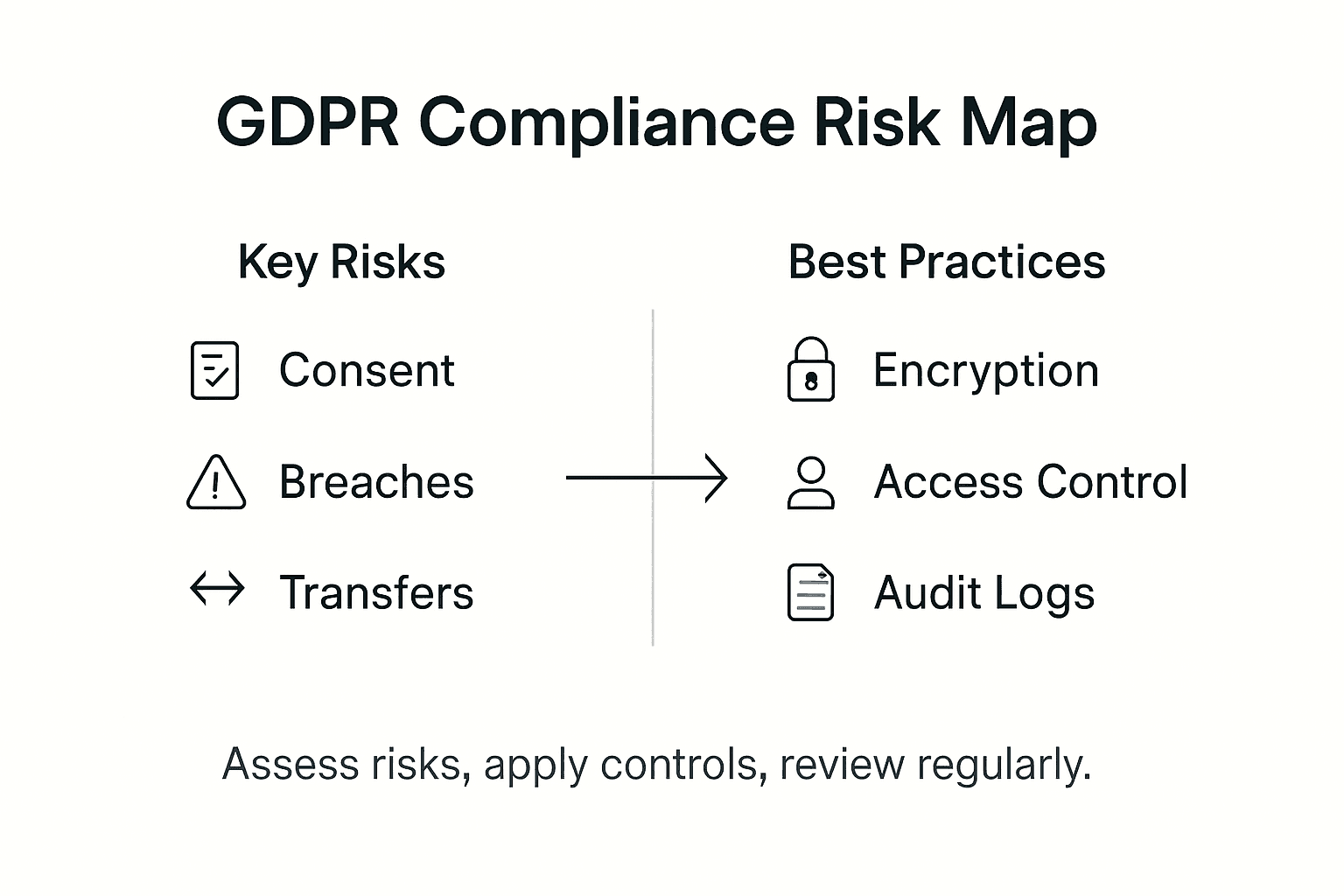
The most significant compliance risks emerge from several critical areas. Insufficient Consent Mechanisms can trigger immediate regulatory scrutiny, with potential penalties reaching up to 4% of global annual turnover. Data Security Vulnerabilities represent another major risk point, where inadequate protection protocols can lead to devastating data breaches. Organizations must implement robust Privacy by Design principles, ensuring that data protection is not an afterthought but a fundamental component of system architecture and operational processes.
Technical teams need to develop sophisticated risk mitigation strategies that go beyond basic compliance checkboxes. This involves conducting thorough Data Protection Impact Assessments (DPIAs), creating comprehensive data mapping processes, and establishing clear accountability frameworks. Advanced risk management requires continuous monitoring systems that can detect potential compliance gaps in real time, enabling proactive intervention before minor issues escalate into significant regulatory challenges.
Implementing effective risk management demands a holistic approach that integrates legal, technical, and operational perspectives. SaaS providers must develop cross-functional compliance teams that can quickly adapt to evolving regulatory landscapes. This includes creating detailed incident response protocols, maintaining meticulous documentation of data processing activities, and developing transparent communication mechanisms that enable rapid resolution of potential compliance issues.
Pro tip: Develop a comprehensive risk assessment matrix that combines legal, technical, and operational risk factors to create a dynamic and adaptive compliance strategy.
Simplify GDPR Compliance for SaaS with AI-Driven Automation
The article highlights the intricate challenges SaaS providers face in meeting GDPR requirements, including managing data subject requests, automating compliance workflows, and enforcing stringent security controls. These complex responsibilities demand a robust solution designed to reduce manual effort while boosting accuracy and accountability. Key pain points such as data mapping, consent management, and real-time risk monitoring can overwhelm teams without the right tools.
Skypher delivers exactly what SaaS companies need to master GDPR compliance efficiently. Our AI Questionnaire Automation Tool accelerates response times to security questionnaires by handling hundreds of questions in under a minute, ensuring consistent compliance documentation and rapid audit readiness. With seamless integration to over 30 third-party risk management platforms like ServiceNow, advanced trust center customization, and collaboration features that connect your entire team, Skypher transforms cumbersome GDPR processes into agile workflows. Explore how our platform tackles purpose limitation, storage limitation, and data subject rights directly by streamlining data privacy proofs at every step.

Don’t let GDPR complexities slow your SaaS growth or expose your organization to risks. Discover how Skypher’s intelligent automation can enhance your compliance posture and operational productivity today. Visit Skypher to start accelerating your GDPR readiness with cutting-edge AI tools and 24/7 enterprise support. Unlock effortless compliance now and build greater trust with your clients.
Frequently Asked Questions
What are the key GDPR principles that software companies must follow?
The key GDPR principles include Lawfulness, Fairness and Transparency, Purpose Limitation, Data Minimization, Accuracy, Storage Limitation, and Integrity and Confidentiality. These principles guide organizations in responsible data management and compliance.
How can SaaS providers ensure compliance with GDPR requirements?
SaaS providers can ensure compliance by implementing Data Protection Impact Assessments (DPIAs), establishing clear legal bases for data processing, and integrating Privacy by Design principles into their product development processes.
What role do data controllers and data processors play in GDPR compliance?
Data Controllers are responsible for determining the purposes and methods of data processing, while Data Processors handle data processing activities on behalf of the controllers. Both roles carry specific legal obligations for data management.
How can automation tools help in maintaining GDPR compliance?
Automation tools can streamline compliance processes by enabling comprehensive data mapping, managing consent effectively, monitoring compliance continuously, and generating audit trails. These capabilities help organizations reduce manual overhead and minimize the risk of human error.