

Companies are racing to keep up with new rules and threats, and the demand for skilled GRC auditors is about to explode. Surprising as it sounds, over 80 percent of organizations plan to increase their investments in governance, risk, and compliance by 2025. Most people imagine GRC auditors as old-school checklist followers. The real shock is that these professionals now shape technology strategies and lead the charge on AI-powered risk detection.
Table of Contents
- Understanding the GRC Auditor Role
- Key Responsibilities and Daily Tasks
- Essential Skills and Certifications
- How to Succeed as a GRC Auditor in 2025
Quick Summary
| Takeaway | Explanation |
|---|---|
| Core Responsibilities of GRC Auditors | GRC auditors conduct comprehensive risk assessments and evaluate control mechanisms to ensure compliance with regulations and alignment with business objectives. |
| Essential Skills and Competencies | GRC auditors need a blend of technical expertise in cybersecurity and compliance, along with strong communication and critical thinking skills to effectively translate complex findings. |
| Technological Adaptation | Embracing emerging technologies like AI and advanced data analytics will enhance the ability to detect risks and improve compliance monitoring strategies. |
| Continuous Professional Development | Successful GRC auditors must prioritize ongoing learning, staying current with regulatory changes and technological advancements to navigate complex business challenges effectively. |
Understanding the GRC Auditor Role
GRC auditors play a critical role in helping organizations maintain robust governance, risk management, and compliance frameworks. These professionals serve as guardians of organizational integrity, ensuring that companies adhere to regulatory requirements and maintain effective internal control systems.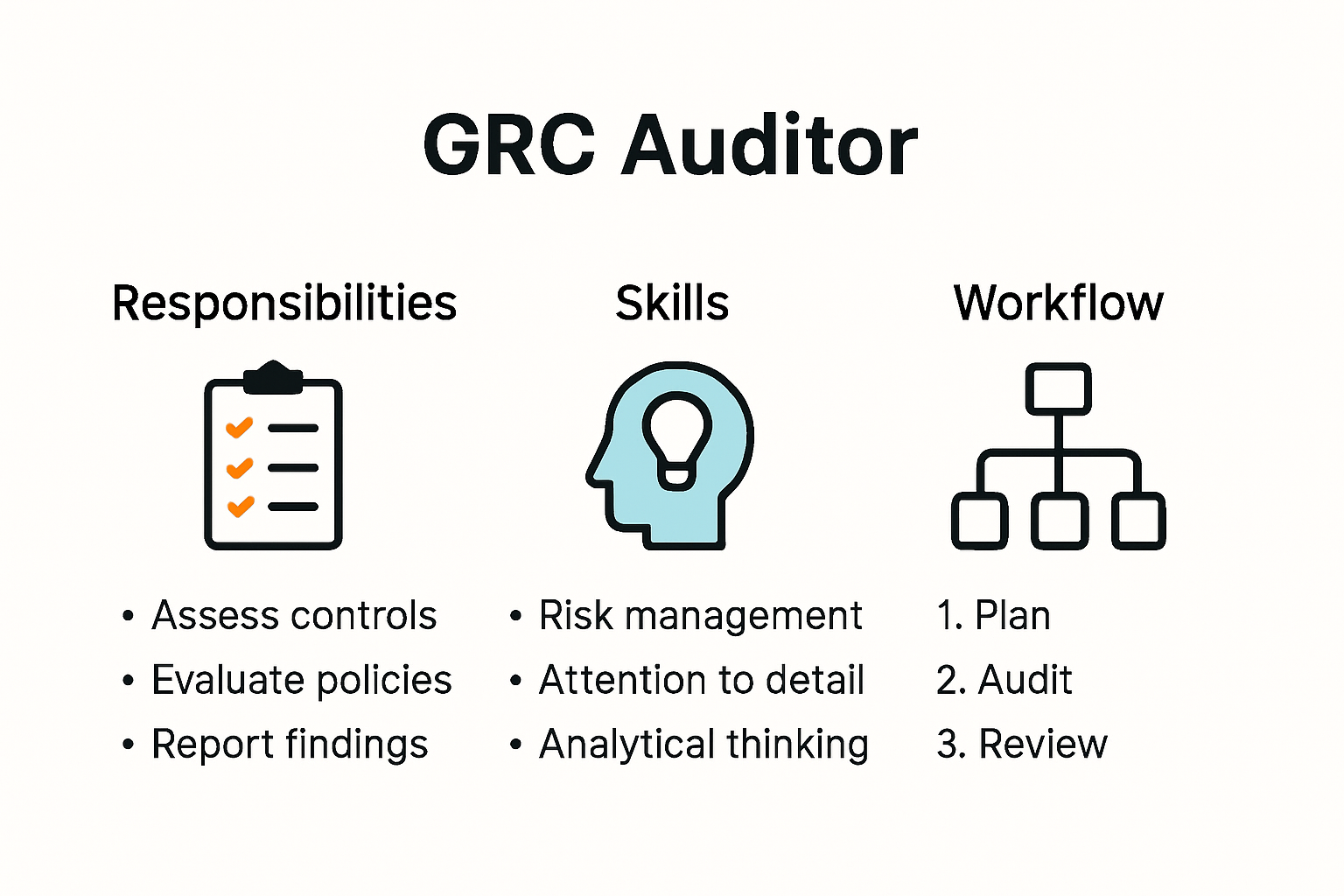
Core Responsibilities of a GRC Auditor
A GRC auditor's primary function involves comprehensive assessment and validation of an organization's internal processes and control mechanisms. ISACA highlights that these professionals focus on aligning organizational activities with strategic business objectives while managing potential risks effectively.
The core responsibilities include conducting thorough risk assessments, evaluating existing control frameworks, and identifying potential vulnerabilities within organizational systems. GRC auditors systematically examine documentation, interview key personnel, and analyze operational procedures to ensure compliance with industry standards and regulatory requirements.
Technical and Strategic Skills Required
Successful GRC auditors must possess a unique blend of technical expertise and strategic thinking. Portland Community College emphasizes that these professionals need comprehensive knowledge across multiple domains, including cybersecurity, regulatory frameworks, and organizational governance.
Key skills include advanced analytical capabilities, deep understanding of compliance standards, proficiency in risk assessment methodologies, and strong communication abilities. GRC auditors must translate complex technical findings into actionable insights that senior management can understand and implement.
Compliance and Risk Management Approach
The United Nations International Computing Centre underscores that GRC auditors are instrumental in developing and supporting an organization's comprehensive control environment. Their work involves creating robust risk management strategies, conducting internal audits, and ensuring adherence to international standards.
These professionals do not merely identify problems but also recommend strategic solutions that help organizations proactively manage potential risks. They serve as critical advisors who help businesses navigate complex regulatory landscapes while maintaining operational efficiency and maintaining stakeholder trust.
In an increasingly complex business environment, GRC auditors have become essential guardians of organizational integrity, helping companies balance innovation with responsible governance and risk management strategies.
Key Responsibilities and Daily Tasks
GRC auditors have a multifaceted role that requires precision, strategic thinking, and comprehensive organizational understanding. Their daily tasks are complex and critical to maintaining an organization's operational integrity and regulatory compliance.
Comprehensive Risk Assessment Processes
Portland Community College highlights that GRC auditors must conduct systematic and thorough risk assessments across multiple organizational domains. These assessments involve identifying potential vulnerabilities, evaluating existing control mechanisms, and developing strategies to mitigate potential risks.
A typical risk assessment involves several key activities:
- Documentation Review: Analyzing organizational policies, procedures, and existing control frameworks
- Security Control Evaluation: Examining current security implementations and their effectiveness
- Vulnerability Mapping: Identifying potential weaknesses in technological and operational systems

To clarify the main activities in a comprehensive risk assessment, here's a table summarizing each step and its purpose:
| Activity | Description |
|---|---|
| Documentation Review | Analyze policies, procedures, and control frameworks |
| Security Control Evaluation | Examine effectiveness of existing security implementations |
| Vulnerability Mapping | Identify technological and operational weaknesses |
| Risk Mitigation Strategy | Develop solutions to address identified risks |
Compliance Monitoring and Reporting
Virginia Retirement System emphasizes the importance of developing and maintaining robust compliance monitoring systems. GRC auditors are responsible for tracking regulatory changes, ensuring organizational alignment with current legal requirements, and creating comprehensive compliance reports.
Key reporting responsibilities include:
- Developing detailed audit reports
- Tracking compliance metrics
- Recommending corrective actions for identified gaps
- Preparing presentations for senior management
Stakeholder Collaboration and Implementation
Careers Page Research indicates that GRC auditors must work closely with various organizational stakeholders to implement effective governance strategies. This involves cross-functional communication, collaborative problem-solving, and strategic guidance.
Critical collaboration activities include:
- Conducting interviews with department leaders
- Facilitating risk management workshops
- Providing training on compliance best practices
- Developing actionable recommendations for process improvements
GRC auditors serve as critical bridge builders between organizational departments, translating complex regulatory requirements into practical, implementable strategies. Their work ensures that organizations not only meet legal requirements but also develop resilient and adaptive governance frameworks that support long-term strategic objectives.
Essential Skills and Certifications
GRC auditors must develop a comprehensive skill set and pursue targeted certifications to excel in their increasingly complex professional roles. These requirements extend beyond technical knowledge and encompass a holistic approach to governance, risk management, and compliance.
Technical and Analytical Competencies
ISACA identifies key technical skills that are crucial for GRC professionals. These include advanced capabilities in governance frameworks, risk analysis, cybersecurity, and security control implementation. Successful GRC auditors must demonstrate proficiency in areas such as ISO/IEC 27001 standards, internal auditing methodologies, and comprehensive risk management strategies.
Core technical competencies include:
- Advanced Data Analysis: Ability to interpret complex data sets and identify potential risk patterns
- Cybersecurity Understanding: Comprehensive knowledge of information security principles
- Regulatory Framework Expertise: Deep understanding of multiple compliance standards
Professional Certifications
ISC2 offers the Certified in Governance, Risk and Compliance (CGRC) certification, which validates a professional's expertise in protecting and maintaining information systems. This certification covers critical domains including security governance, risk management, compliance programs, and control implementation.
Key certifications for GRC auditors include:
- CGRC (Certified in Governance, Risk and Compliance)
- CISA (Certified Information Systems Auditor)
- CRISC (Certified in Risk and Information Systems Control)
- GRC Auditor (GRCA) Certification
The following table summarizes the main certifications and the skills or areas they validate:
| Certification | Focus Area / Validation |
|---|---|
| CGRC | Governance, risk management, compliance programs |
| CISA | Information systems auditing and control |
| CRISC | Risk management, information systems control |
| GRC Auditor (GRCA) Certification | GRC auditing knowledge and practice |
Soft Skills and Professional Attributes
OCEG emphasizes that beyond technical skills, GRC auditors must possess exceptional communication and interpersonal abilities. These professionals serve as critical translators between complex technical findings and strategic business objectives.
Essential soft skills include:
- Strategic Communication: Ability to explain complex technical concepts to non-technical stakeholders
- Critical Thinking: Advanced analytical capabilities for comprehensive risk assessment
- Ethical Decision Making: Strong moral compass and commitment to organizational integrity
The evolving landscape of governance, risk, and compliance demands continuous learning and adaptability. GRC auditors must remain committed to professional development, staying current with emerging technologies, regulatory changes, and innovative risk management strategies.
Professionals in this field are not just technical experts but strategic partners who help organizations navigate increasingly complex regulatory environments while maintaining operational efficiency and protecting organizational assets.
How to Succeed as a GRC Auditor in 2025
The landscape of governance, risk, and compliance is rapidly evolving, demanding that GRC auditors adapt and develop innovative strategies to remain effective in an increasingly complex business environment. Success in 2025 will require a proactive approach to professional development and technological integration.
Embracing Technological Transformation
ISACA highlights the critical importance of aligning technological capabilities with strategic business objectives. GRC auditors must become proficient in emerging technologies that enable more sophisticated risk management and compliance monitoring.
Key technological competencies for 2025 include:
- Artificial Intelligence Integration: Understanding how AI can enhance risk detection and predictive analytics
- Advanced Data Analytics: Leveraging machine learning to identify complex risk patterns
- Cybersecurity Innovation: Developing sophisticated threat detection and mitigation strategies
Strategic Approach to Risk Management
Virginia Retirement System emphasizes the need for a comprehensive and forward-thinking approach to risk management. Successful GRC auditors in 2025 will need to develop more dynamic and adaptive risk assessment methodologies.
Critical strategies for effective risk management include:
- Proactive Risk Identification: Developing predictive models that anticipate potential risks
- Holistic Governance Frameworks: Creating integrated approaches that connect multiple organizational domains
- Continuous Compliance Monitoring: Implementing real-time compliance tracking systems
Professional Development and Adaptability
The most successful GRC auditors will prioritize continuous learning and professional growth. This involves staying ahead of regulatory changes, technological advancements, and emerging business challenges.
Key development strategies include:
- Interdisciplinary Learning: Developing knowledge across multiple business and technology domains
- Network Building: Connecting with professionals across different industries and specializations
- Agile Skill Development: Quickly adapting to new technologies and regulatory requirements
The future of GRC auditing demands more than technical expertise. Professionals must become strategic partners who can translate complex risk and compliance challenges into actionable business insights. This requires a combination of deep technical knowledge, strategic thinking, and exceptional communication skills.
Successful GRC auditors in 2025 will be those who can seamlessly blend technological innovation with strategic business understanding. They will serve as critical bridge builders, helping organizations navigate increasingly complex regulatory landscapes while maintaining operational efficiency and protecting organizational assets.
The path forward requires a commitment to continuous learning, technological adaptation, and a holistic approach to governance, risk, and compliance.
Frequently Asked Questions
What are the core responsibilities of a GRC auditor?
GRC auditors are responsible for conducting comprehensive risk assessments, evaluating control mechanisms, ensuring compliance with regulations, and aligning organizational activities with strategic business objectives.
What skills are essential for success as a GRC auditor in 2025?
Essential skills include advanced analytical and technical competencies in cybersecurity and compliance, strong communication abilities, and strategic thinking to effectively translate complex findings into actionable insights.
How can GRC auditors embrace technological transformation?
GRC auditors can embrace technological transformation by becoming proficient in emerging technologies such as AI and advanced data analytics, which enhance risk detection and compliance monitoring capabilities.
What certifications are valuable for GRC auditors?
Valuable certifications for GRC auditors include Certified in Governance, Risk and Compliance (CGRC), Certified Information Systems Auditor (CISA), Certified in Risk and Information Systems Control (CRISC), and GRC Auditor (GRCA) Certification.
Take the Stress Out of GRC Auditing in 2025
GRC auditors today are under more pressure than ever. The article highlights how rising regulatory demands and complex internal processes force auditors to spend hours on security questionnaires, risk assessments, and compliance reporting. Missed deadlines, manual data gathering, and disjointed communication are still daily realities for many. If meeting new 2025 expectations feels impossible, know that automation can completely change your workflow.
Imagine cutting your security questionnaire response time in half, sharing compliance data in real time, and collaborating seamlessly with all stakeholders. With Skypher, you can automate the pain out of governance tasks using our AI Questionnaire Automation Tool. Ensure every risk mitigation and reporting process is both accurate and lightning-fast, so you can focus on strategic analysis and stakeholder guidance. Visit Skypher now to see how you can step confidently into the future of GRC and audit success.