

Managing governance risk and compliance is daunting when faced with a flood of regulatory requirements and endless security questionnaires. For American and international companies alike, fragmented processes can slow decision making and expose critical vulnerabilities. Over 60 percent of CISOs cite manual compliance workflows as their top bottleneck. This article explains how automation can transform questionnaire management, empowering tech and finance organizations to strengthen oversight, improve transparency, and respond faster to evolving regulatory pressures.
Table of Contents
- Defining GRC Governance Risk and Compliance
- Key Frameworks and Industry Standards
- Automating GRC in Modern Organizations
- Roles, Responsibilities, and Oversight
- Mitigating Risks and Common Pitfalls
Key Takeaways
| Point | Details |
|---|---|
| Integrated GRC Framework | Governance, Risk, and Compliance (GRC) unify essential management disciplines to enhance organizational performance and resilience. |
| Adoption of Key Frameworks | Utilizing established GRC frameworks like COSO and ISO can streamline compliance and governance processes tailored to specific industries. |
| Automation for Efficiency | Implementing GRC automation technologies, such as AI and cloud integration, significantly enhances compliance management and risk assessment capabilities. |
| Clear Roles and Responsibilities | Defining specific GRC roles within the organization ensures accountability and effective cross-functional collaboration for risk management. |
Defining GRC Governance Risk and Compliance
Governance, Risk, and Compliance (GRC) represents a strategic framework that unifies critical organizational management disciplines into a coordinated approach. Integrated capabilities for organizational performance enable businesses to achieve objectives, manage uncertainties, and maintain operational integrity.
At its core, GRC encompasses three fundamental components. Governance establishes the rules, policies, and structures directing an organization toward strategic goals. Risk management involves proactively identifying and mitigating potential threats before they impact operations. Compliance ensures the organization adheres to external regulations and internal policies, creating a comprehensive framework for responsible business practices.
The significance of GRC extends beyond mere regulatory adherence. It provides a structured mechanism for decision makers to understand complex organizational risks, align strategic objectives, and create transparent accountability mechanisms. By integrating these traditionally separate disciplines, companies can develop more resilient, adaptive, and ethically grounded operational models that respond effectively to dynamic business environments.
Pro tip: Create a cross-functional GRC team that includes representatives from legal, IT, finance, and operations to ensure comprehensive risk assessment and policy implementation.
Key Frameworks and Industry Standards
GRC frameworks provide structured approaches for organizations to manage governance, risk, and compliance effectively. Global governance benchmarks demonstrate the critical importance of adopting comprehensive standards that align with organizational goals and regulatory requirements.
Several prominent frameworks have emerged as industry standards across different sectors. COSO (Committee of Sponsoring Organizations) provides comprehensive internal control and risk assessment guidelines. Basel III offers critical regulatory standards for banking and financial institutions, focusing on risk management and capital requirements. ISO standards play a crucial role, particularly ISO 27001 for information security and ISO 31000 for enterprise risk management, creating systematic approaches to organizational governance.
Key frameworks vary by industry, with some standards having broader applicability than others. Financial services often rely on Sarbanes-Oxley (SOX) for corporate accountability, while healthcare organizations prioritize HIPAA compliance. Technology and cybersecurity sectors frequently implement NIST frameworks, which provide detailed guidelines for managing technological risks and maintaining robust security protocols. Each framework offers unique mechanisms for addressing specific regulatory and operational challenges, enabling organizations to develop targeted governance strategies.
Here's a quick comparison of leading GRC frameworks and their focus areas:
| Framework | Core Focus | Typical Industry Use |
|---|---|---|
| COSO | Internal control, risk assessment | Manufacturing, finance |
| Basel III | Banking regulation, capital management | Financial services |
| ISO 27001 | Information security management | Technology, global enterprises |
| ISO 31000 | Enterprise risk management | All sectors |
| Sarbanes-Oxley (SOX) | Corporate accountability | Public companies |
| HIPAA | Healthcare data protection | Healthcare providers |
| NIST | Cybersecurity, risk management | IT, cybersecurity |
Pro tip: Conduct an annual framework assessment to ensure your organization's GRC approach remains aligned with current regulatory requirements and emerging industry best practices.
Automating GRC in Modern Organizations
The landscape of governance, risk, and compliance is rapidly transforming through technological automation, enabling organizations to streamline complex regulatory processes. Emerging GRC automation strategies demonstrate significant potential for enhancing operational efficiency and maintaining continuous compliance across dynamic business environments.
Modern automation technologies facilitate end-to-end workflow integration, allowing organizations to implement template-based processes and real-time monitoring systems. Automated GRC platforms leverage artificial intelligence and machine learning to continuously assess risk, detect potential compliance gaps, and generate actionable insights. Key technologies include robotic process automation (RPA), advanced analytics, and cloud-based integration tools that enable seamless data collection, analysis, and reporting across multiple organizational systems and regulatory frameworks.
The implementation of automated GRC solutions offers multiple strategic advantages. Financial services, technology sectors, and healthcare organizations can dramatically reduce manual compliance efforts, accelerate incident response times, and maintain comprehensive audit trails. By integrating intelligent automation with existing enterprise systems, companies can create adaptive governance frameworks that respond dynamically to evolving regulatory requirements, technological changes, and emerging risk landscapes.
The table below summarizes common GRC automation technologies and their advantages:
| Technology | Key Benefit | Typical Application |
|---|---|---|
| Robotic Process Automation | Reduces manual effort | Regulatory reporting |
| AI & Machine Learning | Continuous risk assessment | Fraud detection |
| Advanced Analytics | Actionable compliance insights | Incident analysis |
| Cloud Integration Tools | Streamlines data collection | Multi-location compliance |
Pro tip: Develop a phased automation strategy that prioritizes high-risk compliance areas and gradually expands automation capabilities across your organization.
Roles, Responsibilities, and Oversight
A robust Governance, Risk, and Compliance (GRC) strategy depends critically on well-defined organizational roles and responsibilities. Critical roles in GRC structures ensure comprehensive oversight and accountability across multiple organizational levels and functional domains.

Key leadership positions play pivotal roles in effective GRC implementation. The Board of Directors provides strategic oversight, establishing the foundational governance framework. Chief Risk Officers (CROs) identify and manage enterprise-wide risks, while Compliance Officers ensure adherence to external regulations and internal policies. Control Owners maintain specific operational controls, and Audit Managers verify the effectiveness of risk management and compliance processes. Each role contributes unique perspectives and expertise, creating a comprehensive approach to organizational governance.
Successful GRC programs require clear role delineation and collaborative mechanisms. Organizations must establish formal communication channels, define specific responsibilities, and create accountability metrics that enable cross-functional coordination. This approach helps prevent role ambiguity, reduces potential compliance gaps, and promotes a unified approach to managing organizational risks. Senior leadership must actively support these roles, providing resources, technological tools, and cultural support to enable effective risk management and regulatory compliance.
Pro tip: Develop a comprehensive GRC role matrix that clearly defines responsibilities, reporting structures, and interdependencies across different organizational levels and functions.
Mitigating Risks and Common Pitfalls
Successful Governance, Risk, and Compliance (GRC) strategies require proactive identification and mitigation of potential organizational vulnerabilities. Common GRC risk management challenges demonstrate the critical need for comprehensive, adaptive approaches to managing enterprise risks.
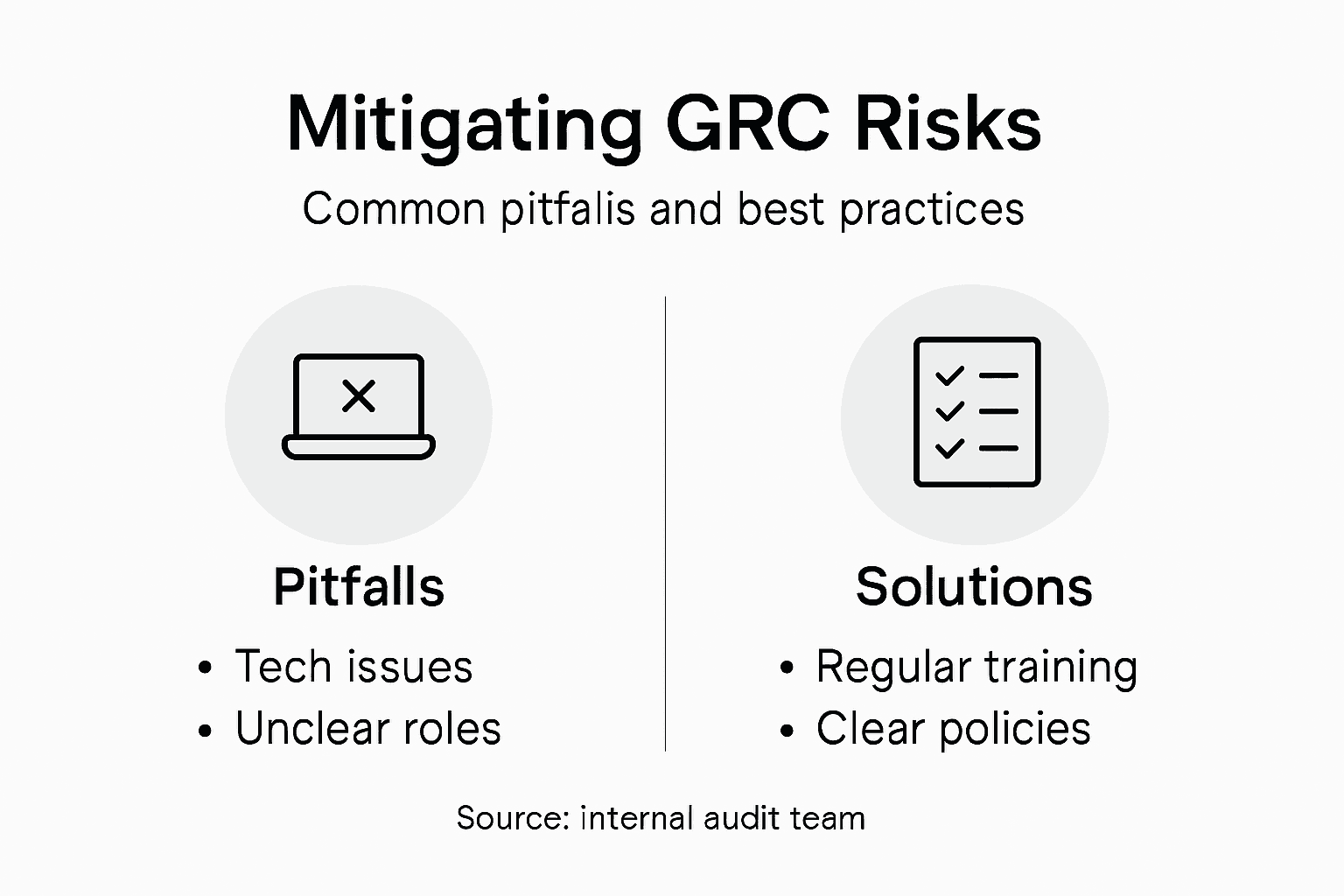
Organizations frequently encounter several recurring pitfalls in their GRC implementations. Technology limitations can create significant barriers, with many companies struggling to integrate comprehensive risk management tools. Insufficient oversight resources often lead to fragmented governance structures, while regulatory complexity creates challenges in maintaining consistent compliance. Common risk mitigation failures include inadequate risk assessment processes, poor communication across departments, and reactive rather than proactive risk management strategies.
Addressing these challenges requires a multifaceted approach. Successful organizations develop robust risk assessment frameworks that continuously monitor potential threats, leverage advanced technological solutions, and create clear communication channels across all organizational levels. This involves implementing comprehensive training programs, developing adaptive compliance mechanisms, and fostering a culture of risk awareness. Technology plays a crucial role, with advanced analytics, artificial intelligence, and integrated risk management platforms enabling more sophisticated and real-time risk detection and mitigation strategies.
Pro tip: Conduct quarterly comprehensive risk assessments that integrate insights from multiple departments and leverage both technological tools and human expertise to identify emerging organizational vulnerabilities.
Streamline Your GRC Efforts With AI-Powered Automation from Skypher
Managing Governance, Risk, and Compliance involves challenging tasks like handling complex security questionnaires and ensuring continuous adherence to evolving frameworks. This article highlights the need for integrated, automated solutions that reduce manual workload while enhancing accuracy and collaboration across teams. Skypher answers this call with its advanced AI Questionnaire Automation Tool designed specifically for medium to large organizations in tech and finance that face high volumes of security reviews and compliance demands.
Skypher’s platform offers:
- Lightning-fast response times for hundreds of questions in under a minute
- Seamless integrations with over 40 third-party risk management platforms such as ServiceNow and OneTrust
- Real-time collaboration features and customizable Trust Centers to centralize governance efforts
- Support for complex enterprise setups including multilingual capabilities and multiple entity management

Ready to transform your GRC compliance workflow and reduce risk management friction? Discover how Skypher’s powerful automation can improve your security questionnaire response process, speed up proof of concept cycles, and build stronger trust with clients. Visit Skypher today to start automating your security reviews and stay ahead in a dynamic regulatory landscape. Experience efficiency and accuracy that empower your GRC strategy now.
Frequently Asked Questions
What is GRC in Governance, Risk, and Compliance?
GRC stands for Governance, Risk, and Compliance, which is a strategic framework that integrates these critical organizational disciplines to enhance operational efficiency and accountability.
Why is Governance important in the GRC framework?
Governance establishes the rules, policies, and structures that guide an organization toward achieving its strategic goals, ensuring alignment and accountability across various departments.
How can automation benefit GRC processes?
Automation can streamline complex regulatory processes, enhance operational efficiency, and maintain continuous compliance by integrating technologies like AI, machine learning, and robotic process automation.
What are common pitfalls in GRC implementation?
Common pitfalls include technology limitations, insufficient oversight resources, and regulatory complexity, which can hinder effective risk management and compliance efforts.