

Security teams spend an average of 30% of their time manually answering risk and compliance questionnaires, putting pressure on even the most advanced American firms. For CISOs and compliance managers, these repetitive workflows drain resources that could be focused on proactive risk reduction strategies. With automation tools for security questionnaires now combining speed with accuracy, you can address third-party risk faster, reduce compliance fatigue, and strengthen your organization’s overall risk management stance.
Table of Contents
- What Are GRC Tools and Their Purpose
- Types of GRC Tools and Core Capabilities
- Key Integrations and Automation Methods
- Real-World Use Cases Across Industries
- Common Pitfalls and Implementation Challenges
Key Takeaways
| Point | Details |
|---|---|
| Purpose of GRC Tools | GRC tools help organizations manage governance, risk, and compliance systematically, reducing operational vulnerabilities and enhancing strategic decision-making. |
| Types of GRC Tools | Key types include risk management platforms, compliance tracking systems, and audit management solutions, each serving distinct functions with integrated capabilities. |
| Integration and Automation | GRC tools utilize advanced integration and automation methods to streamline processes, enhance compliance monitoring, and provide predictive insights. |
| Implementation Challenges | Common challenges include data integration complexity and user adoption barriers; addressing these requires effective change management strategies. |
What Are GRC Tools and Their Purpose
Governance, Risk Management, and Compliance (GRC) tools represent sophisticated software platforms designed to help organizations systematically manage their regulatory requirements, internal policies, and potential business risks. These integrated solutions enable companies to streamline complex compliance processes, reduce operational vulnerabilities, and maintain robust organizational integrity. By centralizing critical governance functions, GRC tools transform how businesses approach strategic risk management.
At their core, GRC tools facilitate comprehensive organizational oversight and coordination across multiple departments including internal audit, legal, finance, information technology, and human resources. They provide a structured framework for tracking regulatory requirements, monitoring potential risks, and ensuring consistent adherence to both external regulations and internal standards. Modern GRC platforms leverage advanced technologies like artificial intelligence and machine learning to automate compliance monitoring, generate real-time risk assessments, and provide predictive insights that help leadership make more informed strategic decisions.
The primary purposes of GRC tools can be categorized into three interconnected domains: governance (establishing organizational policies and oversight mechanisms), risk management (identifying, assessing, and mitigating potential threats), and compliance (ensuring alignment with legal and regulatory requirements). These tools help organizations achieve several critical objectives: reducing potential legal and financial penalties, minimizing operational disruptions, protecting corporate reputation, and creating a culture of transparency and accountability. By integrating previously siloed functions, GRC platforms enable more holistic and proactive approaches to organizational management.
Pro tip: When selecting a GRC tool, prioritize solutions that offer robust integration capabilities, real-time reporting features, and customizable dashboards that align with your specific industry's regulatory landscape.
Types of GRC Tools and Core Capabilities
GRC tools encompass a diverse range of specialized software solutions designed to address the complex landscape of organizational governance, risk management, and compliance. These platforms typically include multiple integrated modules that support comprehensive risk assessment and management strategies. The core categories of GRC tools are strategically engineered to provide organizations with robust capabilities for monitoring, analyzing, and mitigating potential risks across various operational domains.
The primary types of GRC tools include risk management platforms, compliance tracking systems, audit management solutions, policy management frameworks, and integrated reporting dashboards. Each category serves distinct yet interconnected functions. Risk management platforms help organizations identify potential vulnerabilities, assess their potential impact, and develop strategic mitigation strategies. Compliance tracking systems enable real-time monitoring of regulatory requirements, ensuring that organizations remain aligned with industry standards and legal mandates. Audit management solutions facilitate comprehensive internal and external audit processes, providing transparent documentation and evidence of regulatory adherence.

Modern GRC tools leverage advanced technologies such as artificial intelligence and machine learning to enhance their core capabilities. These technologies enable predictive risk analysis, automated compliance monitoring, and intelligent insights generation. Organizations can now access sophisticated tools that not only track and report on risks but also provide proactive recommendations for strategic decision making. Key capabilities often include continuous control monitoring, advanced analytics, customizable reporting interfaces, and seamless integration with existing enterprise systems.
Here's a summary of the main GRC tool types and how they benefit organizations:
| GRC Tool Type | Core Capability | Business Impact |
|---|---|---|
| Risk Management | Vulnerability assessment | Reduces potential losses |
| Compliance Tracking | Monitors regulatory alignment | Avoids fines and penalties |
| Audit Management | Tracks audit processes | Improves transparency and reporting |
| Policy Management | Centralizes policy control | Enhances consistency and oversight |
| Reporting Dashboards | Aggregates risk data | Informs strategic decision making |
Pro tip: When evaluating GRC tools, prioritize solutions that offer flexible configuration options, comprehensive integration capabilities, and scalable architectures that can adapt to your organization's evolving compliance and risk management requirements.
Key Integrations and Automation Methods
GRC tools have revolutionized enterprise security by developing sophisticated integration strategies that enable comprehensive risk management across multiple technological ecosystems. These advanced platforms seamlessly connect with critical enterprise systems, creating a unified approach to governance, compliance, and risk monitoring. By leveraging intelligent automation techniques, organizations can transform complex compliance processes into streamlined, efficient workflows that reduce manual intervention and minimize potential human error.
The primary integration domains for GRC tools include Identity and Access Management (IAM), Security Information and Event Management (SIEM), IT Service Management (ITSM), and Enterprise Resource Planning (ERP) systems. Each integration point serves a specific strategic purpose. IAM integrations enable robust authentication and access control mechanisms, while SIEM connections provide real-time threat detection and comprehensive security event monitoring. ITSM integrations facilitate automated incident management and workflow orchestration, ensuring that compliance issues are tracked and resolved systematically.
Automation methods in modern GRC platforms extend far beyond basic integration capabilities. Advanced tools now employ artificial intelligence and machine learning algorithms to create dynamic, predictive risk management strategies. These technologies enable continuous control monitoring, automated risk assessments, and intelligent reporting mechanisms that can anticipate potential compliance gaps before they emerge. Key automation techniques include automated policy enforcement, real-time compliance tracking, intelligent alert generation, and adaptive risk scoring models that evolve based on emerging organizational and industry-specific challenges.
Compare the typical integrations and automation techniques used by GRC platforms:
| Integration Domain | Strategic Purpose | Automation Method |
|---|---|---|
| Identity & Access Management | Controls authentication | Auto-enforces access policies |
| SIEM (Security Info & Event Mgmt) | Detects security threats | Real-time alert generation |
| IT Service Management | Manages incidents & workflows | Automated compliance tracking |
| ERP Systems | Links to core business data | Adaptive risk scoring |
Pro tip: When implementing GRC tool integrations, prioritize solutions that offer flexible API architectures and support multiple authentication protocols to ensure seamless connectivity across your existing technological infrastructure.
Real-World Use Cases Across Industries
GRC tools have emerged as critical solutions across diverse industries, enabling organizations to transform governance and risk management practices through comprehensive institutional frameworks. Financial services, healthcare, manufacturing, and technology sectors have particularly benefited from these advanced platforms. In financial institutions, GRC tools help manage complex regulatory requirements, detect potential fraud, and ensure compliance with international banking standards. Healthcare organizations leverage these tools to protect sensitive patient data, maintain regulatory compliance, and streamline complex operational workflows.
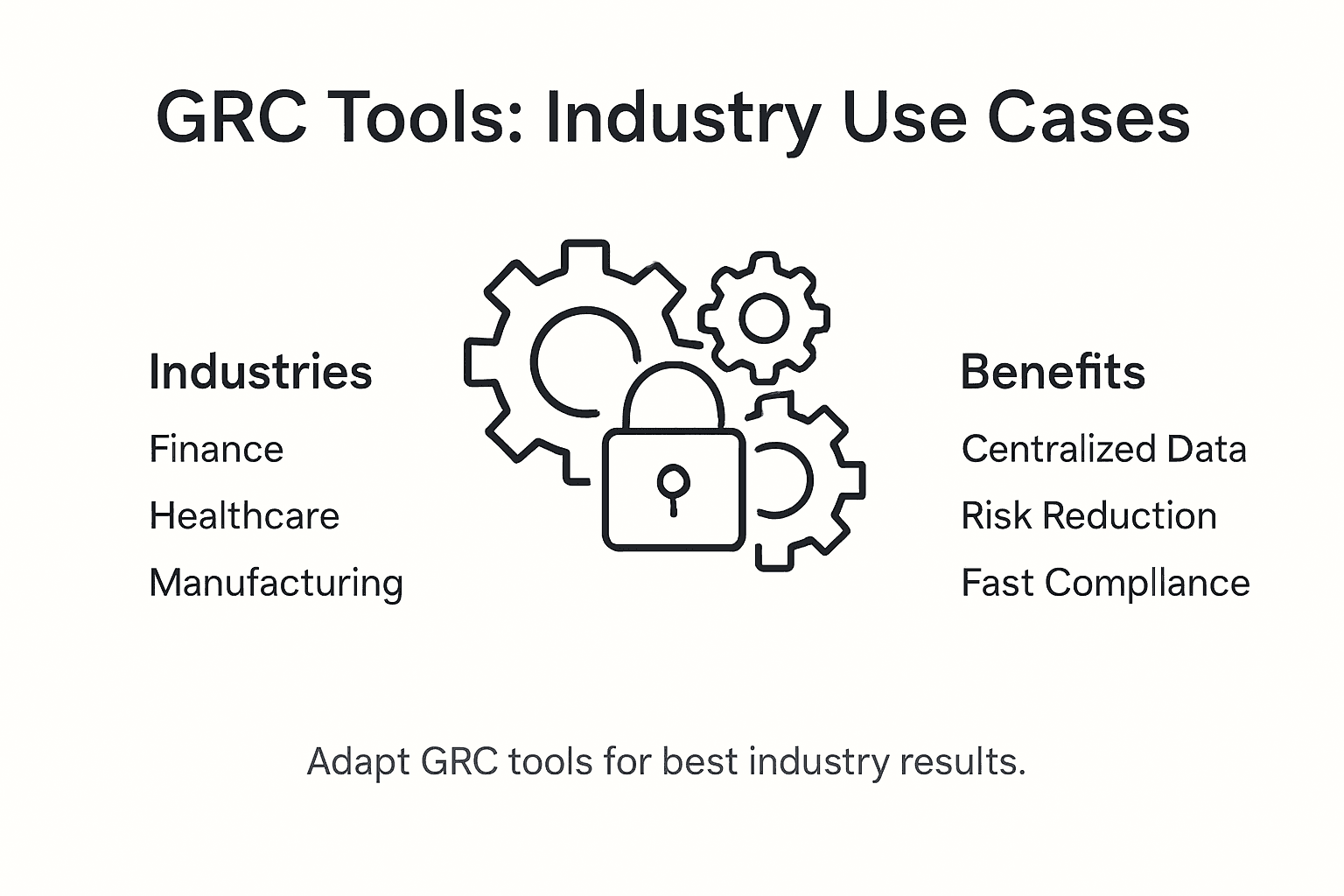
The technology and manufacturing sectors demonstrate particularly sophisticated use cases for GRC tools. Technology companies utilize these platforms to manage cybersecurity risks, track software development compliance, and ensure robust data protection mechanisms. Manufacturing firms apply GRC tools to monitor supply chain risks, maintain quality control standards, and implement comprehensive safety protocols. Cybersecurity risk management and operational resilience emerge as key focus areas, with organizations using advanced analytics to predict and mitigate potential vulnerabilities before they escalate into significant challenges.
Industry-specific implementations reveal the remarkable adaptability of GRC tools. Government agencies use these platforms to enhance transparency and accountability, while energy companies employ them to manage complex regulatory environments and environmental compliance requirements. Financial technology firms integrate GRC tools to balance innovation with stringent regulatory oversight, creating frameworks that support rapid technological advancement while maintaining robust risk management protocols. These tools have become essential for organizations seeking to navigate increasingly complex global regulatory landscapes.
Pro tip: When implementing industry-specific GRC solutions, conduct a comprehensive assessment of your unique regulatory and operational requirements to ensure the selected tool provides targeted, flexible capabilities.
Common Pitfalls and Implementation Challenges
Implementing GRC tools presents complex challenges that organizations must strategically navigate to ensure successful adoption and effectiveness. Organizations frequently encounter significant obstacles in integrating comprehensive governance, risk management, and compliance platforms. These challenges often stem from deeply entrenched organizational structures, technological limitations, and the inherent complexity of aligning sophisticated software with existing business processes. Departmental resistance, inadequate change management strategies, and misaligned expectations can critically undermine the potential benefits of GRC tool implementation.
The most prevalent implementation challenges include data integration complexity, user adoption barriers, and customization difficulties. Many organizations struggle with breaking down existing data silos, which prevent seamless information sharing across different departments and systems. Technical teams frequently encounter resistance from staff who perceive new GRC tools as additional administrative burden rather than strategic enablers. Customization presents another significant hurdle, as organizations require highly tailored solutions that can adapt to unique regulatory environments, industry-specific requirements, and complex operational frameworks.
Cybersecurity and regulatory compliance introduce additional layers of complexity during GRC tool implementation. Organizations must balance sophisticated technological requirements with evolving legal landscapes, ensuring that their chosen platforms can dynamically respond to emerging threats and regulatory changes. Advanced GRC implementations demand comprehensive training programs, robust change management strategies, and continuous organizational learning. Leaders must foster a culture of compliance and risk awareness, transforming GRC tools from mere technological solutions into strategic business enablers that drive operational excellence and organizational resilience.
Pro tip: Create a cross-functional implementation team with representatives from IT, legal, compliance, and operations to ensure comprehensive perspective and reduce potential resistance during GRC tool deployment.
Elevate Your Enterprise Security Compliance with Skypher
Managing GRC complexities means facing challenges like fragmented data, slow compliance cycles, and the need for real-time risk insights. If your organization grapples with expensive manual processes, cross-departmental collaboration hurdles, or struggles to keep pace with evolving regulatory demands, Skypher offers a transformative solution. Our AI-powered Questionnaire Automation Tool is designed specifically for sectors like tech and finance that demand speed, accuracy, and seamless integration with existing risk management platforms.

Experience the efficiency of answering hundreds of security questions in under a minute, backed by 30+ API connectors including integrations with OneTrust and ServiceNow. Empower your teams with real-time collaboration through Slack and Microsoft Teams, while maintaining full control with a customizable Trust Center. Discover how Skypher’s platform can reduce compliance bottlenecks, strengthen your cybersecurity posture, and accelerate sales cycles by visiting Skypher’s homepage. Start streamlining your governance and compliance processes today and stay ahead with smart automation and comprehensive support. Learn more and get started now at https://skypher.co.
Frequently Asked Questions
What are GRC tools?
GRC tools, or Governance, Risk Management, and Compliance tools, are software platforms that help organizations manage regulatory requirements, internal policies, and business risks systematically by providing integrated solutions for governance and compliance processes.
How do GRC tools benefit organizations?
GRC tools benefit organizations by streamlining compliance processes, reducing operational vulnerabilities, ensuring adherence to regulations, minimizing financial penalties, and fostering a culture of accountability and transparency.
What types of GRC tools are available?
Available types of GRC tools include risk management platforms, compliance tracking systems, audit management solutions, policy management frameworks, and integrated reporting dashboards. Each serves distinct functions related to governance and risk management.
What are some common implementation challenges when using GRC tools?
Common challenges include data integration complexity, user adoption barriers, and difficulties in customization. Organizations must navigate entrenched structures and ensure that employees perceive these tools as strategic enablers rather than administrative burdens.