

HIPAA compliance in healthcare IT might sound like a maze of rules and acronyms. Yet over 94 percent of healthcare organizations have experienced at least one data breach in the past two years. Most people expect the biggest danger comes from hackers using fancy tools. Actually, the greatest risk often starts with gaps in your own tech setup and staff habits.
Table of Contents
- Step 1: Assess Your Current IT Infrastructure
- Step 2: Identify and Classify Protected Health Information
- Step 3: Implement Necessary Security Measures
- Step 4: Conduct Regular Risk Assessments
- Step 5: Train Staff on Compliance Protocols
- Step 6: Review and Update Compliance Policies Regularly
Quick Summary
| Key Point | Explanation |
|---|---|
| 1. Assess IT Infrastructure Thoroughly | Conduct a comprehensive evaluation of your technological environment, identifying vulnerabilities and compliance gaps to establish a safety baseline. |
| 2. Identify and Classify PHI Effectively | Create a detailed inventory of all patient-related data, categorizing it based on sensitivity and access requirements to ensure proper protection. |
| 3. Implement Strong Security Measures | Establish administrative, physical, and technical safeguards to actively protect ePHI, ensuring compliance and reducing risk of unauthorized access. |
| 4. Conduct Regular Risk Assessments | Assemble a dedicated team to evaluate and prioritize vulnerabilities continuously, ensuring proactive risk management and compliance. |
| 5. Train Staff on Compliance Protocols | Develop an engaging training program that transforms HIPAA rules into practical actions, fostering a culture of compliance and security awareness. |
Step 1: Assess Your Current IT Infrastructure
Assessing your current IT infrastructure is the foundational step in developing a robust HIPAA compliance strategy. This critical initial phase involves a comprehensive examination of your organization's technological ecosystem to identify potential vulnerabilities and establish a baseline for security improvements. The goal is to create a detailed map of your current technological landscape that reveals potential risks and compliance gaps.
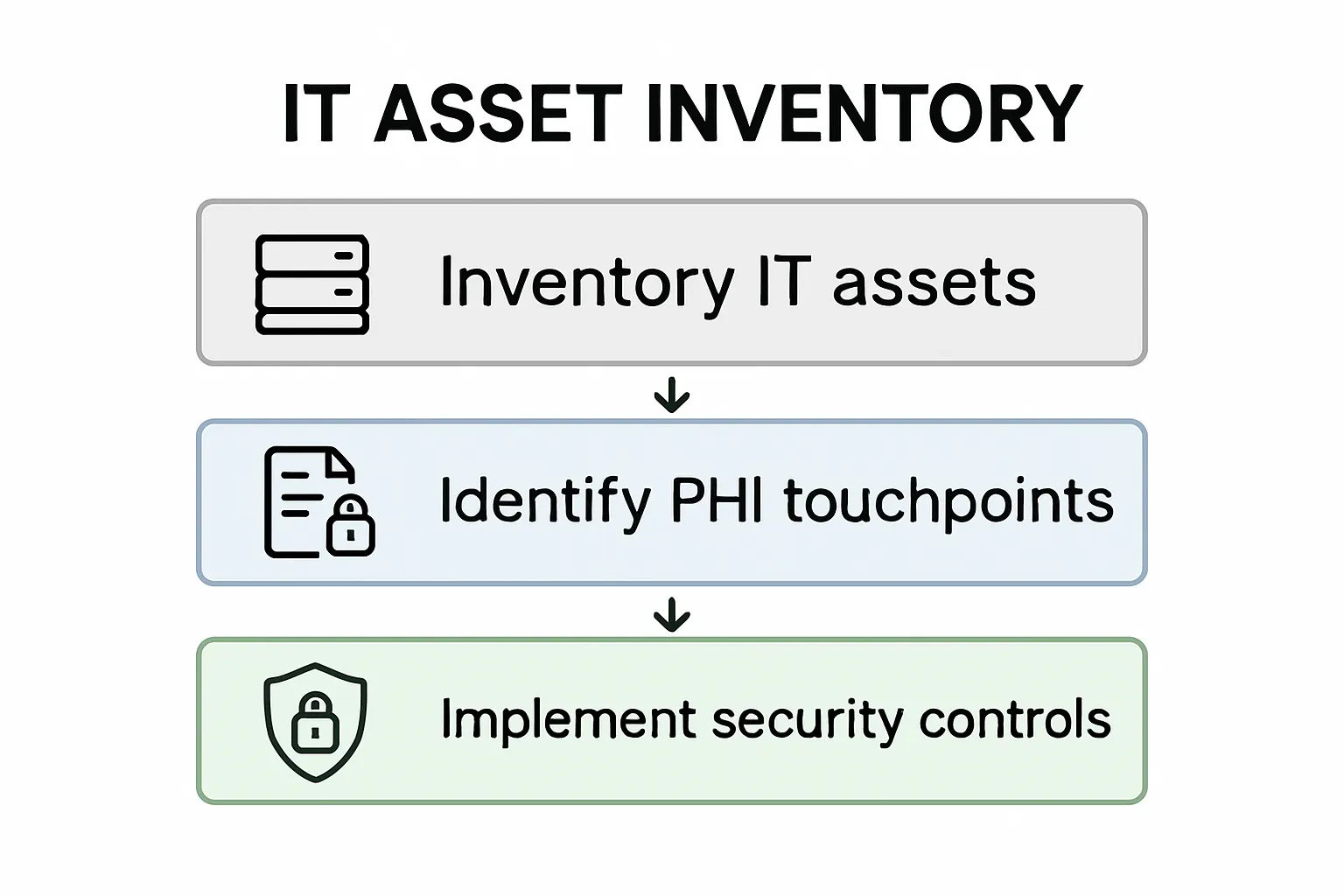
Begin by conducting a thorough inventory of all hardware, software, networks, and systems that interact with protected health information (PHI). This means documenting every device, from servers and workstations to mobile devices and cloud storage platforms. Pay special attention to how data moves through your organization, tracking each point where electronic protected health information (ePHI) is created, stored, transmitted, or accessed.
Your assessment should include a deep dive into existing security controls and network configurations. Learn more about comprehensive vendor risk assessment to understand how external connections might impact your overall security posture. Examine network segmentation, access controls, encryption methods, and current authentication protocols. Look for potential weak points where unauthorized access could occur, such as outdated software, unpatched systems, or inconsistent user access management.
Critical components to document during this assessment include:
- All hardware and software systems handling PHI
- Network infrastructure and communication channels
- User access levels and authentication mechanisms
- Current data storage and transmission methods
- Existing security and backup systems
Successful completion of this assessment means you have a comprehensive, detailed report that maps out your entire IT infrastructure. This document should clearly highlight potential compliance risks, unauthorized access points, and areas requiring immediate security improvements.
To help streamline your assessment process, here is a checklist table summarizing the critical elements to document during the IT infrastructure evaluation for HIPAA compliance.
| Assessment Item | Description |
|---|---|
| Hardware/Software Inventory | List all devices, servers, computers, and applications. |
| Network Infrastructure | Map out communication channels and network configurations. |
| User Access and Authentication | Review user roles, permissions, and authentication controls. |
| Data Storage and Transmission Methods | Identify where and how PHI is stored and transmitted. |
| Security and Backup Systems | Document existing safeguards and backup routines. |
| Remember, a thorough assessment is not just about identifying problems – it's about creating a strategic roadmap for HIPAA compliance that protects patient data and minimizes organizational risk. |
Document everything meticulously. Your assessment will serve as the foundation for subsequent compliance efforts, guiding your approach to implementing security controls, updating systems, and training personnel. The more detailed and honest your initial assessment, the more effective your HIPAA compliance strategy will be.
Step 2: Identify and Classify Protected Health Information
Identifying and classifying protected health information (PHI) is a critical step in your HIPAA compliance journey that transforms abstract regulatory requirements into concrete organizational practices. This process goes beyond simply recognizing what constitutes PHI – it involves creating a comprehensive data mapping strategy that protects sensitive patient information at every touchpoint.
Start by conducting a meticulous inventory of all patient-related data within your organization. This means examining every system, application, database, and communication channel where health information might exist. Dive deeper into HIPAA security requirements to understand the nuanced definitions of protected information. Look beyond obvious medical records to include emails, billing information, appointment schedules, and even metadata that could potentially identify an individual.
Classification requires a systematic approach that categorizes PHI based on sensitivity, access requirements, and potential risk. Create data classification tiers that reflect the level of protection needed. Highly sensitive information like diagnostic details or genetic data should receive the most stringent protection, while less critical administrative information might have more flexible access protocols. Consider developing a color-coded or numerical ranking system that quickly communicates the confidentiality level of different data types.
Critical elements to document during PHI identification include:
- Patient names and contact information
- Medical record numbers
- Diagnostic and treatment details
- Insurance and billing information
- Electronic communication containing personal health details
Successful completion means generating a comprehensive PHI inventory document that maps all sensitive information across your organization. This document should clearly outline where each type of PHI is stored, who has access, and what specific protections are currently in place. The goal is not just compliance, but creating a proactive framework that anticipates and mitigates potential data exposure risks.
Remember that PHI identification is an ongoing process. Regularly review and update your classification system as new technologies, data storage methods, and organizational processes emerge. Treat this step as a living document that evolves with your healthcare technology infrastructure.
Step 3: Implement Necessary Security Measures
Implementing security measures is the critical transformation point where your HIPAA compliance strategy moves from planning to active protection. This step requires a comprehensive approach that addresses administrative, physical, and technical safeguards across your entire organizational infrastructure. According to HIPAA security guidance, these measures must work together to create a robust shield around protected health information.
Administrative safeguards form the foundation of your security strategy. Begin by developing clear, documented policies that define user access protocols, employee training requirements, and incident response procedures. Create a security management team responsible for ongoing risk assessment, policy enforcement, and continuous improvement. This team should establish role-based access controls that limit system access to only those employees who absolutely require specific information to perform their job functions.
Technical safeguards demand a multi-layered approach to electronic protected health information (ePHI) security. Implement strong encryption for data at rest and in transit, ensuring that patient information remains protected across all communication channels and storage systems. Install comprehensive access control systems that require multi-factor authentication, automatically log user activities, and provide mechanisms for immediate access revocation. Consider deploying advanced monitoring tools that can detect and alert your security team to unusual access patterns or potential security breaches in real-time.
Critical security implementation elements include:
- Robust firewall and network segmentation configurations
- Endpoint protection and advanced threat detection systems
- Comprehensive data encryption protocols
- Secure remote access mechanisms
- Regular system vulnerability scanning and patch management
Verification of successful security measure implementation requires a thorough documentation process. Create detailed records of all security configurations, access controls, and protective mechanisms. Conduct regular internal audits that test the effectiveness of your security measures, simulating potential breach scenarios to identify and address any vulnerabilities. The ultimate goal is not just compliance, but creating a proactive security environment that anticipates and neutralizes potential threats before they can compromise patient data.
Remember that security is an ongoing process. Continuously update your security measures, provide regular staff training, and remain adaptable to emerging technological and regulatory challenges.
Step 4: Conduct Regular Risk Assessments
Conducting regular risk assessments is the proactive heartbeat of HIPAA compliance, transforming potential vulnerabilities from hidden threats into manageable challenges. This critical step moves beyond passive security monitoring to actively identifying, analyzing, and mitigating potential risks to protected health information. According to HIPAA security guidance, these assessments are not a one-time event but an ongoing process of organizational vigilance.
Begin by assembling a dedicated risk assessment team with cross-functional expertise. This group should include IT professionals, compliance officers, and key stakeholders who understand both technological infrastructures and regulatory requirements. Explore essential strategies for GRC analysts to enhance your risk assessment approach. Your team will systematically evaluate every potential point of vulnerability in your electronic protected health information (ePHI) ecosystem, from network configurations to user access protocols.
The risk assessment process requires a comprehensive and methodical approach. Start by creating a detailed inventory of all systems, applications, and networks that interact with sensitive patient data. Evaluate each system's potential vulnerabilities, considering factors like outdated software, insufficient access controls, and potential points of unauthorized data transmission. Develop a scoring mechanism that quantifies risks based on likelihood of occurrence and potential impact, allowing you to prioritize remediation efforts strategically.
Critical components of a thorough risk assessment include:
- Comprehensive system and network vulnerability scanning
- Analysis of historical security incidents
- Evaluation of current security control effectiveness
- Identification of potential external and internal threat vectors
- Assessment of data transmission and storage security
Successful risk assessment goes beyond mere documentation. Create actionable remediation plans for each identified vulnerability, with clear timelines, responsible parties, and measurable outcomes. Implement a continuous monitoring system that allows real-time tracking of potential security risks and immediate response mechanisms. The goal is not perfection, but continuous improvement and proactive risk management.
Remember that risk assessments are living documents. Schedule regular reviews, at minimum annually, but preferably quarterly, to ensure your security measures evolve alongside emerging technological landscapes and potential threat environments.
Step 5: Train Staff on Compliance Protocols
Training staff on HIPAA compliance protocols transforms regulatory requirements from abstract concepts into practical, actionable workplace behaviors. This step is the critical human firewall that transforms your technical security measures into a comprehensive protection strategy. According to HIPAA training guidelines, every team member plays a crucial role in maintaining patient data confidentiality.
Develop a comprehensive training program that goes beyond standard compliance presentations. Create engaging, scenario-based learning experiences that help staff understand the real-world implications of HIPAA violations. Interactive workshops should simulate potential security breach situations, teaching employees how to recognize, report, and prevent unauthorized information disclosures. The most effective training connects abstract rules to concrete, everyday workplace interactions.
Your training program must be thorough and adaptable. Design modular training content that addresses different roles within your organization, recognizing that a billing specialist and a healthcare provider will have distinct compliance responsibilities. Implement a mix of training formats including online modules, in-person workshops, written materials, and periodic refresher courses. Ensure that training covers not just the technical aspects of data protection, but also the ethical implications of maintaining patient confidentiality.
Critical elements of an effective compliance training program include:
- Comprehensive coverage of HIPAA Privacy and Security Rules
- Role-specific data protection protocols
- Incident reporting and response procedures
- Real-world scenario-based learning exercises
- Periodic knowledge assessment and verification
Verification of successful training goes beyond simple attendance tracking. Develop rigorous assessment mechanisms that test employees' understanding through practical scenarios, written examinations, and ongoing competency checks. Maintain detailed documentation of each staff member's training history, including dates, content covered, and individual performance metrics.
Remember that HIPAA training is not a one-time event but an ongoing process. Schedule regular refresher courses, update training materials to reflect technological and regulatory changes, and create a culture of continuous learning and security awareness. The most robust HIPAA compliance strategy recognizes that human understanding and vigilance are just as critical as technological safeguards.
The following table provides a concise overview of critical elements to cover in a HIPAA compliance training program, ensuring thorough education for all staff roles.
| Training Topic | Key Focus |
|---|---|
| HIPAA Privacy and Security Rules | Understanding fundamental regulatory requirements |
| Role-Specific Data Protection Protocols | Tailoring guidance to job-specific responsibilities |
| Incident Reporting and Response Procedures | Steps for recognizing and reporting breaches |
| Scenario-Based Learning Exercises | Practicing real-life situations and challenges |
| Periodic Knowledge Assessment | Testing comprehension and reinforcing learning |
Step 6: Review and Update Compliance Policies Regularly
Regularly reviewing and updating compliance policies is the strategic heartbeat of maintaining a robust HIPAA security framework. This step transforms static documentation into a dynamic, responsive protection mechanism that adapts to evolving technological landscapes and regulatory requirements. Explore essential GRC strategies to enhance your approach to policy management and continuous improvement.
Establish a structured policy review process that goes beyond annual checkbox exercises. Create a cross-functional review team comprising IT professionals, compliance officers, legal experts, and key stakeholders who can comprehensively evaluate existing policies. According to research on regulatory compliance, systematic policy reviews are crucial for identifying potential gaps and emerging risks before they become critical vulnerabilities.
Develop a systematic approach to policy updates that considers multiple input streams. This means integrating insights from recent risk assessments, staff feedback, technological changes, and emerging regulatory guidance. Your policy review should be a proactive process that anticipates potential future challenges rather than merely reacting to past incidents. Schedule quarterly comprehensive reviews with interim check-ins to ensure your compliance strategy remains agile and responsive.
Critical components of an effective policy review process include:
- Comprehensive documentation of all policy modifications
- Clear change management protocols
- Verification of regulatory alignment
- Staff training on updated policies
- Technical infrastructure compatibility assessment
Successful policy review goes beyond mere documentation. Implement a robust communication strategy that ensures every team member understands policy updates. Create clear, accessible documentation that translates complex regulatory language into practical, actionable guidelines. Develop a centralized policy management system that tracks version history, provides instant access to current guidelines, and maintains a transparent record of all modifications.
Remember that policy review is not a administrative burden but a strategic opportunity. Treat each review as a chance to strengthen your organization's security posture, improve operational efficiency, and demonstrate a commitment to protecting patient information.
 Cultivate a culture of continuous improvement where policy updates are seen as a proactive approach to safeguarding sensitive data.
Effortless HIPAA Readiness: Let Skypher Do the Heavy Lifting for You
Are you struggling to maintain airtight HIPAA compliance across your growing IT environment? After reading about complex IT assessments, risk analysis, and the need for continuous policy updates, it is clear how overwhelming manual tracking and documentation can be. Missing just one vulnerability or failing to keep meticulous records may put your organization at risk of costly breaches or regulatory penalties. That is exactly where Skypher can transform your compliance process.
Experience automated efficiency in responding to security questionnaires and tracking IT safeguards, so your team can focus on core operations. Our AI-driven platform not only accelerates security reviews but also provides real-time collaboration and document management by integrating with the tools you already use. Stay ahead of audits and vendor risk assessments with confidence. Get started with Skypher's advanced questionnaire automation today and see how seamless compliance feels. Your path to total HIPAA readiness starts now.
Frequently Asked Questions
What is the first step in developing a HIPAA compliance strategy?
Assessing your current IT infrastructure is the foundational step. This involves a comprehensive examination of your organization's technology to identify vulnerabilities and establish a baseline for security improvements.
How should protected health information (PHI) be classified?
PHI should be classified based on sensitivity, access requirements, and potential risk. Develop a data classification system that reflects the level of protection needed for different types of information.
Why are regular risk assessments important for HIPAA compliance?
Regular risk assessments help proactively identify vulnerabilities within your electronic protected health information (ePHI) ecosystem. This ongoing process ensures continuous monitoring and improvement of security measures to protect patient data.
What role does staff training play in HIPAA compliance?
Staff training is critical to transform abstract compliance requirements into actionable behaviors. It prepares employees to recognize, report, and prevent unauthorized disclosures of patient information, effectively functioning as a human firewall.