

Companies love to think their security plans are airtight and up to date. Yet a staggering 43 percent of cyber attacks target small and midsize businesses that believe they’re prepared. That confidence can be risky because true security is much more than a checklist—it starts with strategies that adapt, improve, and involve your whole team in ways most companies never expect.
Table of Contents
- Step 1: Assess Your Current Security Posture
- Step 2: Identify Critical Data Assets
- Step 3: Deploy Security Save Mechanisms
- Step 4: Train Your Team on Best Practices
- Step 5: Monitor and Verify Security Saves
- Step 6: Evaluate and Enhance Your Strategy
Quick Summary
| Key Point | Explanation |
|---|---|
| 1. Conduct Thorough Security Assessment | Evaluate current cybersecurity infrastructure and identify vulnerabilities by gathering cross-functional team insights. |
| 2. Identify and Categorize Critical Data | Classify high-value data assets to prioritize protection efforts based on sensitivity and regulatory requirements. |
| 3. Deploy Comprehensive Security Mechanisms | Implement advanced encryption, access controls, and threat detection systems to protect critical data effectively. |
| 4. Train Employees on Security Best Practices | Develop tailored training programs to educate all staff about their role in maintaining data security and recognizing threats. |
| 5. Monitor and Continuously Improve Security | Establish a framework for real-time monitoring and routine evaluations to adapt security measures to emerging risks. |
Step 1: Assess Your Current Security Posture
Launching an effective security save strategy requires a comprehensive understanding of your current security landscape. This initial assessment serves as the foundation for identifying vulnerabilities, mapping potential risks, and developing targeted protection mechanisms. Organizations must conduct a thorough internal audit that examines existing cybersecurity infrastructure, data handling protocols, and potential exposure points.
To begin, gather a cross-functional team representing IT, compliance, risk management, and executive leadership. These professionals will provide multifaceted insights into your organization's security framework. Start by compiling an exhaustive inventory of all digital assets, including hardware, software, cloud services, network infrastructure, and data repositories. This mapping process helps identify potential entry points and potential security weaknesses that malicious actors could exploit.
Next, conduct a comprehensive risk assessment using standardized frameworks like the Cyber Security Evaluation Tool by CISA. This systematic approach enables organizations to evaluate their security posture against recognized industry benchmarks. Focus on critical areas such as:
- Access control mechanisms
- Data encryption standards
- Network segmentation protocols
- Incident response capabilities
- Third-party vendor security assessments
Document all findings meticulously, creating a detailed report that highlights current strengths and potential vulnerabilities. Learn more about navigating security questionnaires and challenges to understand how comprehensive assessments can streamline your security strategies.
Successful completion of this step means generating a clear, actionable roadmap that pinpoints precise areas requiring immediate attention or enhancement.
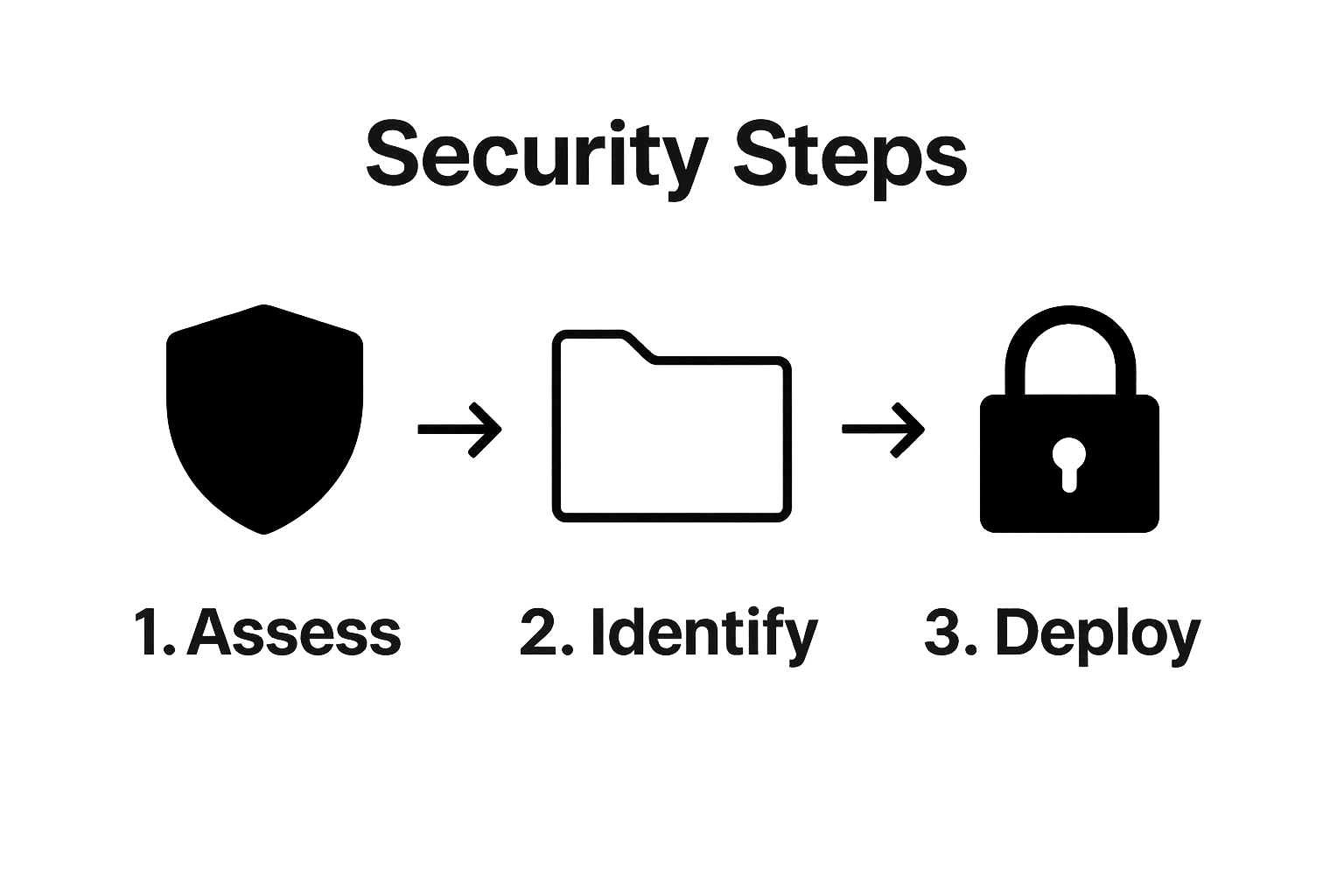 Your security save initiative begins with this critical diagnostic phase, transforming potential vulnerabilities into opportunities for robust, proactive protection.
Step 2: Identify Critical Data Assets
After completing your initial security assessment, the next crucial phase in implementing a robust security save strategy involves precisely identifying and categorizing critical data assets. This step transforms your broad security overview into a targeted protection plan by pinpointing the most sensitive and valuable information within your organizational ecosystem.
Begin by conducting a comprehensive data inventory that goes beyond surface-level documentation. Engage stakeholders from each department to understand the nuanced data landscape. Focus on identifying high-value information such as customer personal identifiable information (PII), financial records, intellectual property, strategic planning documents, and regulatory compliance data. Recognize that not all data carries equal strategic or legal significance, so prioritization becomes key.
Utilize a systematic classification approach recommended by NIST security guidelines to stratify your data assets. Develop a risk matrix that evaluates each data category based on potential impact, sensitivity, and regulatory requirements. Consider creating a structured framework that assigns clear risk levels:
- Critical Assets: Immediate protection required
- High-Value Assets: Significant organizational impact
- Moderate Risk Assets: Standard security protocols
- Low-Risk Assets: Minimal protective measures
Learn more about security questionnaire challenges to understand how precise asset identification can streamline your security processes. This methodical approach ensures you allocate security resources efficiently, protecting what matters most.
Verification of this step involves creating a comprehensive data asset register that maps each information category, its associated risks, and recommended protection strategies. By the conclusion of this process, your organization will have transformed abstract security concepts into a concrete, actionable blueprint for data protection.
Below is a checklist table summarizing key verification steps to confirm completion of each stage in the security save strategy implementation process.
| Stage | Verification Step | Evidence/Outcome |
|---|---|---|
| Assess Security Posture | Complete internal audit and document vulnerabilities | Detailed assessment report |
| Identify Critical Assets | Develop a comprehensive asset register | Mapped, categorized data inventory |
| Deploy Security Mechanisms | Implement encryption, MFA, monitoring, backups | Active protection systems in place |
| Team Training | Launch and evaluate ongoing security awareness training | Training records and assessments |
| Monitor & Verify | Execute routine monitoring, penetration tests, and audits | Security logs and compliance reports |
| Evaluate & Enhance | Conduct strategic reviews and implement improvements | Updated strategy and action plan |
Step 3: Deploy Security Save Mechanisms
With your critical data assets now identified, the next phase involves strategically deploying comprehensive security save mechanisms that protect your organization's most valuable information. This step transforms theoretical protection strategies into practical, actionable security infrastructure that actively shields your digital ecosystem.
Implement multi-layered encryption protocols that secure data both at rest and in transit. Begin by selecting enterprise-grade encryption technologies that align with your specific organizational needs. Advanced encryption standards should cover database systems, cloud storage, email communications, and portable device repositories. Focus on creating a holistic encryption framework that provides granular access controls, ensuring that sensitive information remains protected even if initial perimeter defenses are compromised.
According to NIST security guidelines, your security save deployment should incorporate several critical protective layers:
- Network segmentation to isolate critical data environments
- Multi-factor authentication for all system access points
- Real-time monitoring and threat detection systems
- Automated backup and recovery mechanisms
- Endpoint protection across all organizational devices
Learn more about navigating security questionnaires and challenges to understand how robust security mechanisms can streamline your compliance efforts. Integrate continuous monitoring tools that provide real-time insights into potential vulnerabilities, enabling proactive threat mitigation.
Successful deployment means establishing a dynamic, adaptive security infrastructure that can rapidly respond to emerging technological risks. Your security save mechanisms should not only protect current data landscapes but also remain flexible enough to evolve with changing technological environments.
The table below outlines critical security mechanisms to deploy, along with their primary purpose, as highlighted in the deployment step of the guide.
| Security Mechanism | Primary Purpose | Application Area |
|---|---|---|
| Multi-layered Encryption | Secure data at rest and in transit | Databases, email, cloud, devices |
| Network Segmentation | Isolate critical data environments | Internal networks |
| Multi-factor Authentication | Prevent unauthorized access | All system access points |
| Real-time Monitoring (SIEM) | Detect and respond to threats immediately | Organization-wide |
| Automated Backups | Enable rapid recovery and minimize loss | Data repositories |
| Endpoint Protection | Defend devices from malware and breaches | Laptops, tablets, smartphones |

Step 4: Train Your Team on Best Practices
Transforming technical security mechanisms into a resilient organizational defense requires comprehensive team training that empowers every employee to become an active participant in data protection. This critical step moves beyond traditional compliance checklists, creating a culture of security awareness that acts as a human firewall against potential breaches.
Develop a robust, multifaceted training program that addresses the unique security challenges across different organizational roles. Customize training modules to reflect each department's specific interactions with sensitive data. For instance, finance teams require different security protocols compared to customer service representatives. Implement interactive workshops, realistic simulation exercises, and scenario-based learning that demonstrate practical application of security principles.
According to NIST security guidelines, effective security training should cover several fundamental areas:
- Social engineering recognition
- Password management techniques
- Incident reporting protocols
- Data handling best practices
- Remote work security guidelines
Learn more about best practices for automating security questionnaire responses to understand how continuous education strengthens your overall security posture. Implement a quarterly training refresh to ensure team members remain updated on emerging technological threats and evolving protection strategies.
Successful training deployment means creating measurable behavioral changes. Conduct periodic assessment tests, track engagement metrics, and develop a feedback mechanism that allows employees to contribute insights about potential security improvements. Your goal is transforming security from a technical mandate into a shared organizational responsibility.
Step 5: Monitor and Verify Security Saves
The final crucial stage of implementing a security save strategy involves continuous monitoring and rigorous verification of your protective mechanisms. This step transforms your security infrastructure from a static defense into a dynamic, adaptive system that proactively identifies and mitigates potential vulnerabilities.
Establish a comprehensive monitoring framework that provides real-time insights into your organizational data protection landscape. Implement advanced security information and event management (SIEM) systems that aggregate and analyze data from multiple sources, creating a holistic view of your security ecosystem. These tools should generate immediate alerts for suspicious activities, unauthorized access attempts, and potential data breaches, enabling rapid response and mitigation.
According to NIST security guidelines, effective security verification requires systematic testing and validation processes:
- Quarterly penetration testing
- Regular vulnerability assessments
- Comprehensive backup integrity checks
- Incident response simulation exercises
- Continuous compliance auditing
Learn more about security questionnaire challenges to understand how ongoing monitoring can streamline your risk management strategies. Develop a structured verification protocol that includes periodic review of encryption mechanisms, access controls, and data recovery capabilities.
Successful implementation means creating a self-improving security ecosystem that learns and adapts from each monitoring cycle. Establish clear metrics for measuring the effectiveness of your security save mechanisms, such as mean time to detect and respond to potential threats. Your ultimate goal is building a resilient, proactive defense that anticipates and neutralizes security risks before they can compromise your organization's critical data assets.
Step 6: Evaluate and Enhance Your Strategy
The final stage of implementing a comprehensive security save strategy involves systematic evaluation and strategic enhancement of your organizational data protection framework. This critical step transforms your security approach from a static defense mechanism into a dynamic, adaptive system that continuously improves and responds to emerging technological challenges.
Conduct a comprehensive post-implementation review that analyzes the performance of your security mechanisms across multiple dimensions. Gather quantitative data from monitoring tools and qualitative insights from team members to create a holistic assessment. Examine key performance indicators such as incident response times, false positive rates, training effectiveness, and overall system resilience. This multifaceted evaluation provides a nuanced understanding of your security infrastructure's strengths and potential improvement areas.
According to NIST security guidelines, effective strategy enhancement requires a structured approach:
- Comprehensive gap analysis
- Technology stack reassessment
- Risk tolerance recalibration
- Emerging threat landscape review
- Resource allocation optimization
Learn more about best practices for automating security questionnaire responses to understand how continuous improvement can streamline your security processes. Develop a quarterly strategic enhancement protocol that allows for agile modifications to your security save mechanisms.
Successful evaluation means creating an organizational culture of continuous learning and adaptation. Establish clear feedback loops that enable rapid integration of new insights, technological advancements, and lessons learned from potential security incidents. Your ultimate goal is building a resilient, forward-thinking security strategy that anticipates and neutralizes risks before they can impact your organization.
Transform Security Assessment into Real Data Protection Success
Have you accomplished every step in building a security save strategy yet still face stress from slow, repetitive security questionnaires or inconsistent risk reviews? Many organizations spend valuable time on manual security processes and data mappings, only to get stalled by inefficient response methods and unclear collaboration. What if you could turn all that hard work—risk assessments, asset mapping, controls documentation—into real-time savings and greater trust?

Unlock effortless security reviews. Skypher's AI Questionnaire Automation Tool picks up exactly where your strategic security initiatives leave off. Our platform automates questionnaire responses, works with over 40 top risk platforms, and brings your documentation, team, and compliance together with record speed. Ready to prove your security excellence without the usual bottlenecks? Visit Skypher today and see how you can save hours on every security questionnaire and strengthen client trust right now.
Frequently Asked Questions
What is the first step in implementing a security save strategy for data protection?
The first step involves assessing your current security posture by conducting a comprehensive internal audit to identify vulnerabilities and potential risks within your cybersecurity landscape.
How do I identify critical data assets in my organization?
To identify critical data assets, conduct a comprehensive data inventory involving stakeholders from each department. Focus on high-value information and use a systematic classification approach to prioritize data based on its impact and sensitivity.
What are some effective security mechanisms to deploy for data protection?
Effective security mechanisms include multi-layered encryption protocols, network segmentation, multi-factor authentication, real-time monitoring, and automated backups, enhancing your organization's defense against data breaches.
How can I ensure ongoing employee engagement in data protection practices?
To ensure ongoing engagement, develop a robust training program tailored to different roles within the organization, implement scenario-based learning, and conduct regular refreshers and assessments to reinforce security awareness and best practices.