

Introduction to Information Security Questionnaires
Hey there, fellow cybersecurity enthusiasts! Let me guess—you've either been asked to fill out an information security questionnaire or you're the one sending them out, desperately trying to make sense of your organization's security posture. Either way, I feel your pain!
These questionnaires have become the unsung heroes of modern business relationships. They're essentially the awkward first date of the corporate world—where one party nervously asks, "So... how do you handle sensitive data?" while the other scrambles to impress with their security controls.
In all seriousness, an information security risk assessment questionnaire serves as a comprehensive tool for evaluating how well an organization protects its critical information assets. Whether you call it a cyber security questionnaire, IT security assessment questionnaire, or simply an infosec questionnaire, the goal remains the same: to identify potential vulnerabilities before the bad guys do.
"A well-designed security assessment questionnaire can reveal more about an organization's security posture in an hour than weeks of technical scanning," notes Javvad Malik, security awareness advocate and industry expert.
These questionnaires aren't just bureaucratic paperwork—they're your first line of defense in understanding whether your vendors, partners, or internal teams have appropriate safeguards in place. Throughout this guide, I'll walk you through everything you need to know about creating, responding to, and analyzing these crucial security tools.
Key Takeaways
| Key Point | Details |
|---|---|
| Purpose of Questionnaires | These tools assess the security posture of an organization and identify vulnerabilities before they can be exploited. |
| Risk Visibility | Comprehensive questionnaires highlight security blind spots, enabling organizations to address potential risks proactively. |
| Compliance Necessity | Many regulations require these assessments, documenting the security processes organizations have in place. |
| Third-Party Risk Management | Evaluating vendors through these questionnaires helps in understanding their security practices related to sensitive data. |
| Awareness Raising | Completing a security questionnaire increases awareness across departments regarding best practices for handling sensitive information. |
Importance of Information Security Questionnaires

Let's be real—nobody wakes up in the morning excited about filling out a security questionnaire. But here's the thing: these seemingly tedious documents might just save your organization from becoming tomorrow's data breach headline.
I remember working with a client who thought cybersecurity questionnaires were just another box-ticking exercise until a third-party vendor suffered a massive breach. Suddenly, having documentation proving they'd at least attempted due diligence became worth its weight in gold (or Bitcoin, if you prefer).
Why are these questionnaires so crucial? Let me count the ways:
-
Risk Visibility: A comprehensive information security questionnaire shines a light on blind spots you didn't even know existed. It's like turning on the kitchen light at midnight and seeing all the creepy crawlies scurrying away—disturbing but necessary!
-
Regulatory Compliance: From GDPR to HIPAA to PCI DSS, regulations practically demand these assessments. As security expert Bruce Schneier puts it, "Security is not a product; it's a process," and questionnaires document that process.
-
Third-Party Risk Management: Your security is only as strong as your weakest vendor. An IT security assessment questionnaire helps you evaluate if that accounting software provider is treating your financial data with the same care you would.
-
Security Awareness: Simply going through an information security risk assessment questionnaire raises awareness across departments. People start asking "Should we really be storing passwords in that spreadsheet?" (Spoiler alert: no, you absolutely should not).
-
Baseline Creation: You can't improve what you don't measure. These questionnaires establish your security baseline, making future progress trackable and demonstrable to executives who love pretty graphs showing improvement.
In our increasingly interconnected digital ecosystem, these assessments aren't just administrative hurdles—they're essential tools for survival.
Types of Information Security Questionnaires

Not all information security questionnaires are created equal, and thank goodness for that! Can you imagine if we used the same exhaustive 500-question assessment for both a small bakery and a multinational bank? Talk about overkill (or underkill, depending on which way you're looking).
In my years navigating the wonderfully complex world of cybersecurity, I've encountered various flavors of these questionnaires, each serving a specific purpose:
Vendor Security Questionnaires
These are the MVPs of the questionnaire world. When you're entrusting your precious data to a third party, a vendor security questionnaire template helps determine if they're treating your information like the crown jewels or like yesterday's newspaper. They typically cover everything from encryption practices to physical security controls.
Internal Security Assessment Questionnaires
Looking inward? An IT security assessment questionnaire helps organizations take that uncomfortable but necessary look in the mirror. These are particularly helpful during annual security reviews or before implementing new systems.
Compliance-Specific Questionnaires
These are the specialized tools in your arsenal, designed to assess alignment with specific frameworks or regulations. Think PCI DSS for payment processing, HIPAA for healthcare, or SOC 2 for service organizations. A well-designed security assessment questionnaire here can save countless hours during formal audits.
Application Security Questionnaires
Zooming in even further, an application security questionnaire focuses specifically on software security practices. As someone who once discovered an app storing passwords in plain text (I still have nightmares), I can't stress enough how important these are!
Risk-Focused Questionnaires
A cyber security risk assessment questionnaire prioritizes identifying potential threats and vulnerabilities. These are particularly valuable for organizations beginning their security journey or performing gap analyses.
"The key is matching the questionnaire type to your specific objective," says Caroline Wong, Chief Strategy Officer at Cobalt.io. "Otherwise, you risk collecting mountains of irrelevant data while missing critical security insights."
Choosing the right type ensures you're asking the right questions—and more importantly, getting answers that actually matter.
Creating a Vendor Security Questionnaire Template
Oh, the joy of creating your very own vendor security questionnaire template! It's like cooking without a recipe—exciting but potentially disastrous if you don't know what you're doing. Let me save you from serving up a half-baked security assessment.

I once spent weeks crafting what I thought was the perfect security questionnaire, only to receive answers so vague they could have been generated by a Magic 8-Ball. "Outlook not so good" would have been more insightful than some of the responses I got.
Here's how to create a questionnaire that actually gets you useful information:
1. Start with the Core Security Domains
Every solid information security questionnaire should cover these fundamental areas:
- Data Protection: How is your data encrypted, stored, and disposed of?
- Access Controls: Who can access what, and how is this controlled?
- Network Security: Firewalls, intrusion detection, monitoring practices
- Incident Response: What happens when things go wrong?
- Business Continuity: How will they keep operations running during a crisis?
- Security Governance: Do they have documented policies and regular assessments?
2. Tailor Questions to Your Specific Needs
A one-size-fits-all approach is about as effective as a screen door on a submarine. Your cyber security assessment questionnaire should reflect the specific services the vendor provides. A cloud storage provider needs different scrutiny than an office cleaning service.
3. Use a Mix of Question Types
Include yes/no questions for straightforward controls: "Do you require multi-factor authentication for all admin accounts?" But also include open-ended questions: "Describe your process for conducting regular security awareness training."
4. Make it Actionable
Frame your IT security assessment questionnaire to produce answers you can actually use. Ask for evidence where appropriate: "Please provide a redacted screenshot of your password policy configuration."
"The best questionnaires create a conversation, not an interrogation," explains Chris Romeo, CEO of Security Journey. "They should open doors to deeper security discussions, not just check regulatory boxes."
Remember, your goal isn't to create the world's most comprehensive information security risk assessment questionnaire—it's to gather meaningful data that helps you make informed risk decisions about your vendors.
Key Components of a Security Assessment Questionnaire
Let's dive into the secret sauce that makes a security assessment questionnaire actually useful. After sending and receiving hundreds of these beauties, I've learned exactly what separates the insightful assessments from the paperweights.
Last year, I received an information security questionnaire that was essentially just "Do you do security stuff? Yes/No." Needless to say, I wasn't particularly reassured by their affirmative response. Let's do better, shall we?
Administrative Controls
Start with questions about security governance and policies. This section of your cyber security questionnaire should cover:
- Security policies and their review frequency
- Organizational structure (Who's the CISO, and do they have actual authority?)
- Employee background checks and onboarding/offboarding procedures
- Security awareness training programs (Because Bob from accounting clicking on phishing emails is often your biggest vulnerability)
Technical Controls
This is where your IT security assessment questionnaire gets into the nitty-gritty of how data is actually protected:
- Authentication mechanisms and password policies
- Encryption standards for data at rest and in transit
- Patch management processes (Is that server running Windows XP? Run away!)
- Network security architecture and monitoring capabilities
- Endpoint protection solutions
Physical Controls
Even in our cloud-obsessed world, physical security remains crucial in any comprehensive information security risk assessment questionnaire:
- Data center security measures
- Visitor management procedures
- Environmental controls (Is your data protected from fire, flood, or that guy who spills coffee everywhere?)
Operational Procedures
"Security is what you do, not what you buy," as the saying goes. Your security risk assessment questionnaire should probe into:
- Incident response procedures and testing
- Change management processes
- Business continuity and disaster recovery planning
- Regular vulnerability scanning and penetration testing cadence
Compliance and Third-Party Management
Finally, don't forget to include questions about:
- Regulatory compliance relevant to your industry
- Results of recent audits or assessments
- How they manage their own vendors (it's third-party risk all the way down!)
Remember, the goal of your infosec questionnaire isn't to create a document so intimidating that vendors run for the hills—it's to start meaningful conversations about security practices that affect your data.
Implementing an Information Security Risk Assessment Questionnaire
So you've crafted the perfect information security risk assessment questionnaire. Congratulations! Now comes the fun part—actually implementing it without causing mass panic or getting your emails filtered directly to spam.
I once sent out a 200-question security questionnaire to a critical vendor and received a one-word response: "Seriously?" Lesson learned! Implementation requires as much strategy as creation.
Here's my battle-tested approach to successfully rolling out your questionnaire:
1. Establish Clear Objectives
Before sending a single question, be crystal clear about what you're trying to achieve. Are you conducting initial vendor screening? Annual compliance checks? Or responding to a specific security concern? Your cyber security risk assessment questionnaire should have a defined purpose—not just exist because "security said so."
2. Prioritize Based on Risk
Not all vendors or systems require the same level of scrutiny. I use a simple tiering approach:
- Tier 1: Handles sensitive data or critical systems? They get the full information security questionnaire treatment.
- Tier 2: Limited access to important (but not crown jewel) systems? Send a moderately detailed assessment.
- Tier 3: Minimal security impact? A streamlined IT assessment questionnaire will do.
3. Prepare Your Recipients
"Surprise security assessments" rank just below "surprise tax audits" on the popularity scale. Set expectations early:
- Explain why you're conducting the assessment
- Provide a realistic timeframe for completion
- Identify who should be involved in responding
- Offer assistance for technical questions
4. Use Technology Wisely
Spreadsheets are so 2005. Consider dedicated GRC (Governance, Risk, and Compliance) platforms or specialized security questionnaire tools that can automate distribution, follow-up, and analysis.
5. Establish a Review Process
Collecting responses is only half the battle. You need a consistent methodology for evaluating answers to your IT security assessment questionnaire. Develop a scoring system that flags high-risk responses for deeper investigation.
"The most common mistake organizations make is failing to close the loop," notes Dr. Rebecca Wynn, global CISO and privacy expert. "An assessment without action is just expensive paperwork."
Remember, implementing an effective cybersecurity questionnaire process is a marathon, not a sprint. Start small, refine your approach, and gradually expand as your program matures.
Cyber Security Risk Assessment Questionnaires Explained
Let's get one thing straight—a cyber security risk assessment questionnaire is not just a fancy name to make your IT team sound important at budget meetings. These specialized tools help organizations identify, analyze, and prioritize cybersecurity risks in a structured way.
I still remember my first exposure to a vendor security questionnaire—it was printed on actual paper and faxed (yes, I'm dating myself here). Today's digital transformation is pushing these tools into exciting new territories.
At its core, a cyber security risk assessment questionnaire differs from general security questionnaires by focusing specifically on identifying threats and vulnerabilities, estimating their impact, and evaluating existing controls. Here's what makes them unique:
Threat-Centric Approach
Unlike standard security questionnaires that might focus broadly on policies and procedures, risk assessments zero in on what could actually go wrong. Questions typically follow a pattern of:
- What assets do we have that attackers might want?
- What vulnerabilities exist in our current environment?
- What threats could exploit those vulnerabilities?
- What would the impact be if they did?
Quantitative and Qualitative Elements
A comprehensive information security risk assessment questionnaire often includes both:
- Quantitative questions: "On a scale of 1-5, rate the sensitivity of data stored in this system."
- Qualitative questions: "Describe the potential business impact if this system were unavailable for 24 hours."
Contextual Relevance
"The most effective risk assessments are contextualized to your business," explains Tony Turner, CISO at Fortress Information Security. "A questionnaire that doesn't reflect your organization's unique threat landscape will miss critical risks."
This explains why generic IT risk assessment questionnaires often fall short—they can't capture the nuances of your specific business operations.
Risk Calculation Framework
What truly sets these questionnaires apart is how they support risk calculation. Well-designed cybersecurity questionnaires feed directly into a risk scoring methodology, helping translate subjective responses into actionable risk metrics that executives can understand and prioritize.
Remember, the goal isn't just identifying every possible risk (you'd never sleep again); it's about focusing your limited resources on the risks that matter most to your organization.
Best Practices for IT Security Assessment Questionnaires
Over the years, I've seen IT security assessment questionnaires that could make a grown CISO cry—either from frustration (300+ questions asking for screenshots as evidence) or from dangerous simplicity ("Is your data secure? Yes/No").
Let me share some hard-earned wisdom on creating questionnaires that actually work:
1. Right-Size Your Approach
The one-size-fits-all approach is the enemy of effective security assessment. I learned this lesson the hard way after sending a 150-question information security questionnaire to a small vendor who provided office plants. (Yes, really. Not my finest moment.)
Tailor your questionnaire depth based on:
- The sensitivity of data being accessed
- The criticality of services provided
- The integration level with your systems
2. Ask Clear, Actionable Questions
Vague questions get vague answers. Compare these approaches:
- Bad: "Do you have good security?"
- Better: "Does your organization implement multi-factor authentication for all administrative access?"
Your security risk assessment questionnaire should leave little room for interpretation.
3. Provide Context Where Needed
Some technical questions require explanation. When asking about complex controls in your cyber security questionnaire, include brief explanations of why you're asking and what good looks like.
4. Balance Depth with Completion Rate
"The perfect questionnaire that nobody completes provides zero security value," says Chris Cronin, Partner at HALOCK Security Labs. This might be my favorite security quote ever.
Find the sweet spot where your IT assessment questionnaire is thorough enough to be meaningful but not so overwhelming that it ends up in the "I'll get to this later" folder (narrator: they never got to it later).
5. Update Regularly
Cybersecurity evolves faster than fashion trends. Your security assessment questionnaire should too. Schedule annual reviews to add emerging threats and remove questions about outdated technologies.
6. Leverage Standardized Frameworks
Don't reinvent the wheel! Base your information security risk assessment questionnaire on established frameworks like NIST CSF, ISO 27001, or CIS Controls. This approach ensures comprehensive coverage and gives your assessment credibility.
7. Follow Through
The most critical best practice: actually do something with the responses! I've seen too many companies collect mountains of data from infosec questionnaires only to file them away never to be seen again. Establish a clear process for reviewing, scoring, and addressing identified gaps.
Security Questionnaire Examples and Their Applications
Throughout my cybersecurity career, I've encountered more security questionnaire examples than I care to remember. Some were brilliant, others made me question my career choices, and a few were so confusing I'm pretty sure they were actually encrypted messages.
Let's examine some common types of questionnaires and when they're most effective:
SIG (Standardized Information Gathering)
The SIG is like the Swiss Army knife of information security questionnaires—comprehensive but potentially overwhelming. With 500+ questions covering 18 security domains, it's the heavyweight champion of vendor assessments.
Best for: Large enterprises assessing critical vendors who handle sensitive data. I've used the SIG Lite (a condensed version) for mid-tier vendors with great success.
CAIQ (Consensus Assessment Initiative Questionnaire)
Developed by the Cloud Security Alliance, this security assessment questionnaire is specifically designed for evaluating cloud providers.
Best for: Assessing SaaS, PaaS, or IaaS vendors. A client once used this to evaluate five competing cloud storage providers, and the differences in responses were eye-opening!
VSAQ (Vendor Security Assessment Questionnaire)
VSAQs are typically custom-built vendor security questionnaire templates designed by individual organizations based on their specific risk profiles.
Best for: Organizations with unique regulatory requirements or industry-specific concerns. A healthcare company I worked with created a brilliant VSAQ that incorporated both HIPAA requirements and industry best practices.
Basic IT Security Self-Assessment
Short-form IT security questionnaires are designed for internal teams to quickly evaluate their own security posture.
Best for: Departmental security check-ins or as a precursor to more comprehensive assessments. They're perfect for raising awareness without causing panic.
Application Security Assessment
Focused specifically on software development practices, this type of application security questionnaire dives deep into coding standards, testing practices, and vulnerability management.
Best for: Evaluating software vendors or internal development teams. I once used one to assess a critical application and discovered they weren't conducting any security testing whatsoever (yikes!).
"The key is matching the questionnaire to your specific purpose," advises Katie Moussouris, founder and CEO of Luta Security. "Using an overly complex questionnaire for a simple assessment wastes everyone's time, while an overly simplistic one for critical systems creates dangerous blind spots."
Remember, even the best cybersecurity questionnaire template requires customization to fit your specific needs—think of them as starting points, not final products.
Conclusion: The Future of Security Questionnaires
We've come a long way from the days when an information security questionnaire might have been a single page with "Do you have a firewall? Yes/No" as its only question. As cyber threats evolve faster than teenagers' slang, so too must our assessment methods.
I still remember my first exposure to a vendor security questionnaire—it was printed on actual paper and faxed (yes, I'm dating myself here). Today's digital transformation is pushing these tools into exciting new territories.
Here's where I see security questionnaires heading in the near future:
Continuous Assessment
The annual cybersecurity questionnaire will increasingly be supplemented by continuous monitoring tools. Rather than asking "Do you patch your systems regularly?" once a year, automated tools will continuously verify external-facing security postures.
AI-Driven Analysis
Machine learning is already being applied to analyze responses to information security risk assessment questionnaires. These systems can identify inconsistencies, flag suspicious answers, and even suggest follow-up questions based on risk patterns.
Industry Standardization
The proliferation of different security assessment questionnaire formats creates massive inefficiency. Initiatives like the Shared Assessments Program and NIST CSF are pushing toward standardization that will allow organizations to "assess once, report many."
Integration with Supply Chain Risk Management
As one CISO friend recently told me, "The questionnaire is just the beginning of the conversation." Future IT security assessment questionnaires will be more deeply integrated with broader supply chain risk management programs, creating a more holistic view of third-party risk.
"We're moving toward a trust but verify model," explains Adam Shostack, author and security consultant. "Questionnaires provide the trust element, while automated validation provides the verification."
Despite all this evolution, the fundamental purpose of these security questionnaire examples remains unchanged: to help organizations make informed decisions about risk. Whether you're creating your first vendor assessment or refining your established program, remember that the goal isn't perfect security (which doesn't exist), but appropriate security given your unique risk profile.
Now go forth and questionnaire with confidence! Just maybe avoid sending that 200-question assessment to your office plant vendor. Trust me on this one.
Frequently Asked Questions
What is an information security questionnaire?
An information security questionnaire is a tool used to assess how well an organization protects its critical information assets and identifies potential vulnerabilities.
Why are information security questionnaires important?
These questionnaires are crucial for gaining visibility into security risks, ensuring regulatory compliance, and managing third-party risk effectively, ultimately helping organizations protect sensitive data from breaches.
What types of information security questionnaires exist?
Common types include vendor security questionnaires, internal security assessment questionnaires, compliance-specific questionnaires, application security questionnaires, and risk-focused questionnaires.
How do I create a vendor security questionnaire template?
Start by covering core security domains such as data protection and access controls, tailor questions to specific vendor services, use a mix of question types, and make sure your questions are actionable and relevant.
Transform Your Questionnaire Process with Skypher
Feeling overwhelmed by the intricacies of information security questionnaires? You’re not alone! Many organizations face challenges with efficiently managing these detailed assessments, leading to unnecessary delays and ineffective communication. With increasing regulatory demands and the ever-evolving threat landscape, addressing vulnerabilities proactively is not just essential—it’s crucial for your organization's reputation and security posture.
!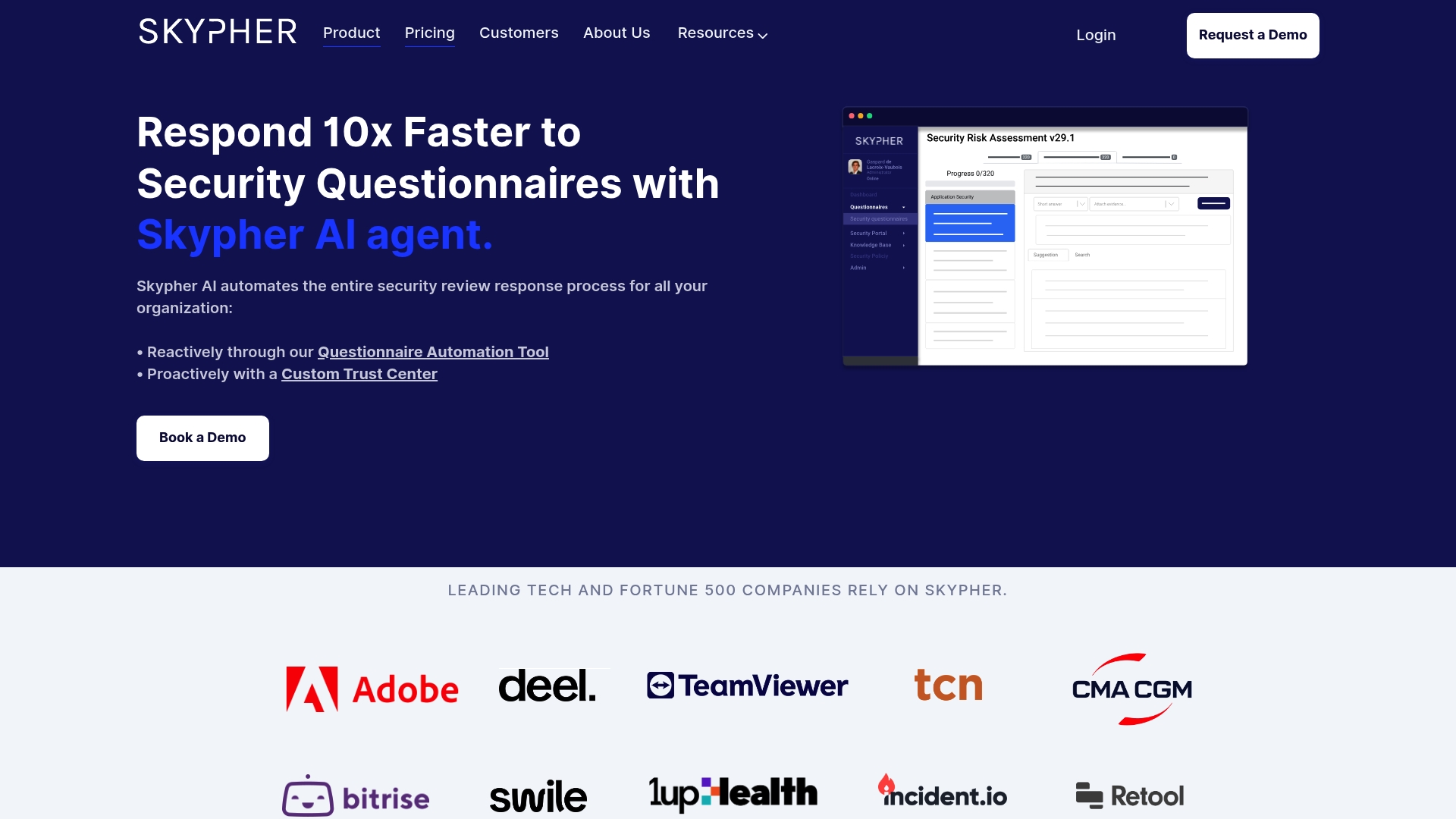
Imagine a world where you can streamline the questionnaire response process, drastically reducing response times while enhancing accuracy. Skypher offers just that! Our AI Questionnaire Automation Tool empowers you to tackle security reviews swiftly, transforming a tedious task into a manageable one. Enjoy features like:
- Real-time collaboration to boost team efficiency
- Seamless integration with over 40 third-party risk management platforms
- A customizable Trust Center that builds client confidence
Don’t wait for vulnerabilities to exploit your organization; take charge of your cybersecurity journey today! Visit https://skypher.co to revolutionize your security questionnaire process and ensure you’re prepared for any challenge ahead.