

Juggling complex security protocols and relentless compliance checks can feel overwhelming for even the most seasoned IT security manager. The stakes are high in protecting sensitive digital assets while keeping regulatory requirements in check across multinational tech and finance firms. By embracing advances such as Information Security Management System frameworks and automated assessments supported by the NIST Cybersecurity Framework, organizations can reduce operational risks and pave the way for smarter, AI-driven questionnaire automation.
Table of Contents
- Defining Information Security System Management
- Key Components and Common Frameworks
- Types of Information Security Controls
- Implementing and Automating Security Processes
- Legal, Regulatory, and Compliance Considerations
- Risks, Costs, and Operational Challenges
Key Takeaways
| Point | Details |
|---|---|
| Holistic Approach to ISMS | Effective Information Security System Management integrates technology, people, and processes for a comprehensive security strategy. |
| Core Objectives | The fundamental goals of ISMS are confidentiality, integrity, and availability of organizational data. |
| Key Frameworks | Organizations should leverage multiple frameworks like ISO/IEC 27001 and NIST to enhance their cybersecurity governance. |
| Automate Security Processes | Implementing security process automation can enhance efficiency and improve incident response while reducing human error. |
Defining Information Security System Management
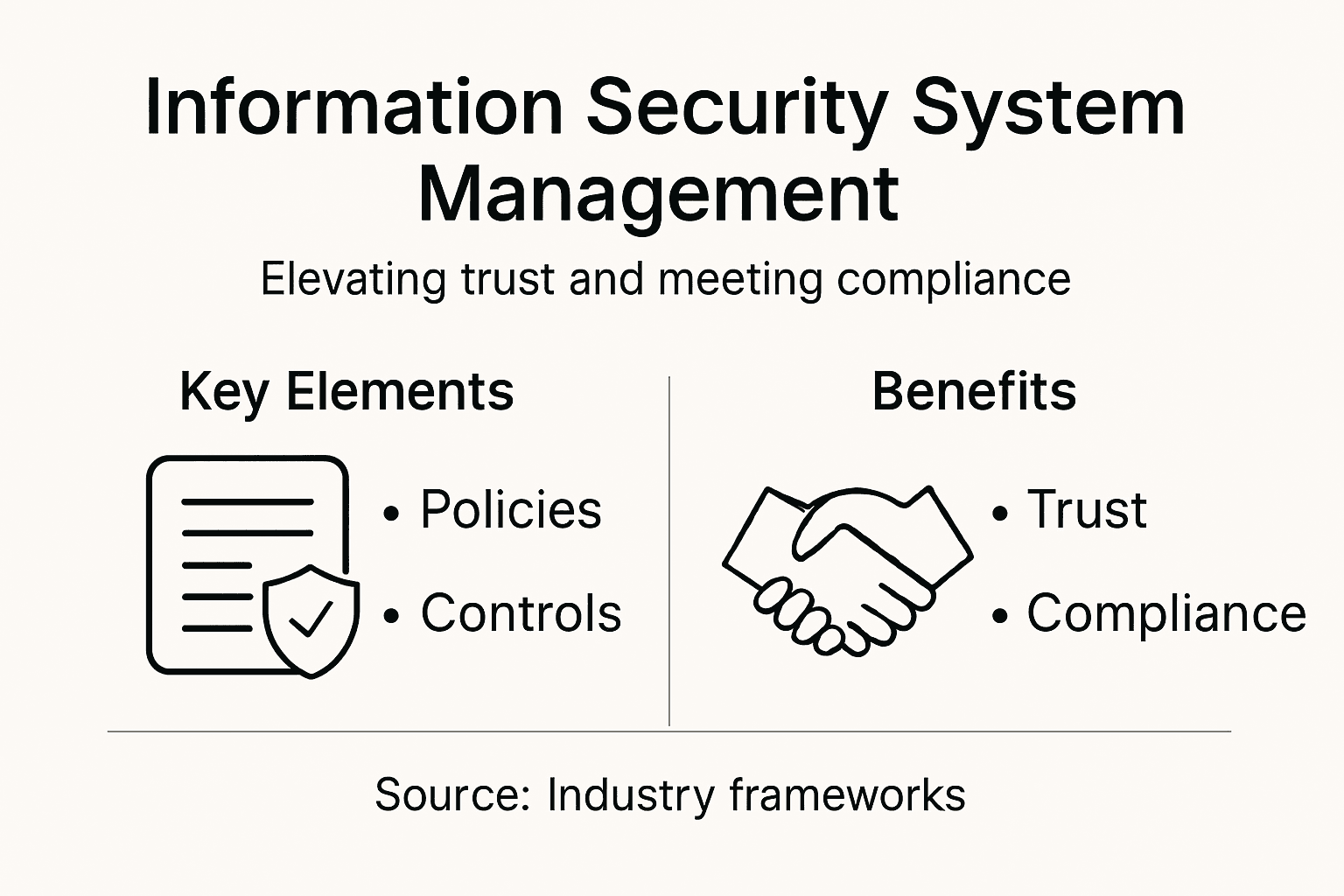
Information Security System Management (ISMS) represents a comprehensive framework designed to protect an organization's critical digital assets through strategic governance and risk mitigation. At its core, information security management studies the intricate processes of safeguarding organizational data by establishing robust policies, procedures, and control mechanisms.
The fundamental objectives of an ISMS revolve around three critical dimensions:
- Confidentiality: Ensuring sensitive information remains accessible only to authorized personnel
- Integrity: Protecting data from unauthorized modifications or tampering
- Availability: Guaranteeing information systems remain operational and accessible when needed
Organizational implementation of an ISMS typically follows a structured approach known as the Plan-Do-Check-Act (PDCA) cycle. Information security risk management involves systematic processes that enable organizations to:
- Identify potential security vulnerabilities
- Develop comprehensive mitigation strategies
- Implement protective controls
- Continuously monitor and improve security measures
Successful Information Security System Management goes beyond technical solutions, encompassing human factors, organizational culture, and strategic alignment. It requires a holistic approach that integrates technology, people, and processes to create a resilient security ecosystem.
Pro tip: Develop a cross-functional security awareness program that transforms every employee into an active participant in your organization's information protection strategy.
Key Components and Common Frameworks
Information Security System Management relies on several critical frameworks that provide structured approaches to cybersecurity governance. NIST Cybersecurity Framework stands out as a comprehensive guide that enables organizations to effectively manage and reduce cybersecurity risks through a systematic approach.
The primary components of modern Information Security Management Systems typically include:
- Risk Assessment: Systematic identification and evaluation of potential security vulnerabilities
- Policy Development: Creating comprehensive security guidelines and protocols
- Access Control: Managing user permissions and authentication mechanisms
- Incident Response: Establishing protocols for addressing and mitigating security breaches
- Continuous Monitoring: Implementing ongoing surveillance of security infrastructure
Organizations often adopt multiple frameworks to create a robust security strategy. Key international standards and frameworks include:
- ISO/IEC 27001: International standard for information security management
- NIST Cybersecurity Framework: Providing detailed guidance for risk management
- CIS Controls: Prioritized set of actions to protect organizational systems
- COBIT: Governance framework for enterprise information technology
Successful implementation requires a holistic approach that integrates technological solutions with human expertise. Security frameworks are not one-size-fits-all solutions but adaptable guidelines that must be tailored to an organization's specific needs and risk profile.

Here's a comparison of leading information security frameworks and their core areas of focus:
| Framework | Primary Focus | Typical Use Case |
|---|---|---|
| ISO/IEC 27001 | Holistic ISMS development | Global enterprise security governance |
| NIST Cybersecurity Framework | Cyber risk management | U.S. critical infrastructure, private sector |
| CIS Controls | Actionable security best practices | Small to medium organizations |
| COBIT | IT governance and management | Enterprise-level IT compliance |
Effective Information Security Management transcends technological implementations, requiring a comprehensive approach that balances technical controls with organizational culture and human behavior.
Pro tip: Regularly conduct cross-functional security framework assessments to ensure your ISMS remains adaptive and aligned with evolving technological landscapes and emerging threat vectors.
Types of Information Security Controls
Organizations implement a comprehensive approach to protecting digital assets through multiple categories of security controls. These controls are strategically designed to address different aspects of information security and mitigate potential risks across technological, administrative, and physical domains.
The primary categories of information security controls include:
- Administrative Controls: Policy-based guidelines and procedures that define organizational security standards
- Technical Controls: Software and hardware-based mechanisms that directly protect information systems
- Physical Controls: Tangible safeguards that protect physical infrastructure and hardware assets
Moreover, security controls can be further classified based on their specific functions:
- Preventive Controls: Proactively stop potential security incidents before they occur
- Detective Controls: Identify and report security events after they happen
- Corrective Controls: Minimize damage and restore systems after a security breach
- Compensating Controls: Alternative measures implemented when standard controls cannot be applied
Effective information security requires a multilayered approach that integrates these different control types. No single control mechanism can provide comprehensive protection, making a holistic strategy essential for robust cybersecurity.
Security controls are not just technological solutions, but a strategic ecosystem of protection that requires continuous adaptation and refinement.
IT Security Management System implementation demands a nuanced understanding of how these control types interact and complement each other.
Pro tip: Conduct regular security control audits to ensure your organization's control mechanisms remain aligned with evolving technological landscapes and emerging threat vectors.
Below is a summary of major security control categories and their real-world business examples:
| Control Category | Example | Business Benefit |
|---|---|---|
| Administrative | Employee security training | Reduces human error risk |
| Technical | Multi-factor authentication | Prevents unauthorized access |
| Physical | Secure server room access | Protects hardware from theft |
Implementing and Automating Security Processes
Security process automation represents a critical strategy for organizations seeking to enhance their cybersecurity efficiency and responsiveness. By systematically transforming manual security workflows into automated, intelligent processes, businesses can significantly reduce human error and accelerate their incident response capabilities.
Successful security process automation requires a strategic approach that encompasses several key components:
- Risk Assessment: Comprehensive evaluation of potential vulnerabilities
- Workflow Design: Creating repeatable, standardized security procedures
- Technology Integration: Implementing advanced tools that support continuous monitoring
- Stakeholder Engagement: Ensuring cross-functional alignment and understanding
- Continuous Improvement: Regular review and optimization of automated processes
Organizations can implement automation across multiple security domains:
- Continuous Security Monitoring
- Threat Detection and Response
- Compliance Verification
- Access Management
- Incident Reporting and Documentation
Critical considerations for effective implementation include selecting robust automation technologies, defining clear performance metrics, and maintaining flexibility to adapt to emerging security challenges.
Automation is not about replacing human expertise, but augmenting it through intelligent, scalable technological solutions.
Security Questionnaire Automation provides an excellent example of how targeted process automation can streamline complex security workflows.
Pro tip: Develop a phased automation strategy that starts with low-risk processes and gradually expands, allowing your team to build confidence and demonstrate incremental value.
Legal, Regulatory, and Compliance Considerations
Navigating the complex landscape of legal and regulatory requirements is fundamental to effective Information Security System Management. Global information security standards establish critical frameworks that guide organizations in protecting sensitive data and maintaining robust cybersecurity practices.
Key legal and regulatory considerations encompass multiple critical domains:
- Data Privacy Regulations: Ensuring compliance with regional and international data protection laws
- Cybersecurity Standards: Adhering to industry-specific security requirements
- Contractual Obligations: Meeting specific security commitments outlined in business agreements
- Ethical Compliance: Maintaining transparency and accountability in information handling
Organizations must address several essential compliance dimensions:
- Understanding jurisdiction-specific legal requirements
- Implementing comprehensive risk management protocols
- Documenting security control effectiveness
- Conducting regular compliance audits
- Maintaining transparent reporting mechanisms
Compliance Risk Management represents a strategic approach to integrating legal requirements with organizational security practices, ensuring a proactive and comprehensive defense strategy.
Legal compliance is not a checkbox exercise, but a continuous journey of adapting to evolving technological and regulatory landscapes.
Pro tip: Develop a cross-functional compliance team that includes legal, IT, and security professionals to create a holistic approach to regulatory adherence.
Risks, Costs, and Operational Challenges
Information security risk management represents a critical strategic imperative for organizations navigating increasingly complex technological landscapes. Understanding and mitigating potential vulnerabilities requires a comprehensive approach that balances technological, financial, and operational considerations.
Key operational challenges in information security management include:
- Financial Constraints: Limited budgets for comprehensive security infrastructure
- Technological Complexity: Rapid evolution of threat landscapes
- Skills Gap: Shortage of qualified cybersecurity professionals
- Compliance Burden: Navigating multifaceted regulatory requirements
- Resource Allocation: Balancing security investments with business objectives
Organizations face multiple dimensions of risk and cost management:
- Direct security infrastructure expenses
- Potential financial losses from security breaches
- Compliance and regulatory penalty risks
- Reputational damage from security incidents
- Ongoing training and skill development costs
Risk Management Tips provide critical guidance for technology leaders seeking to optimize their security strategies and resource allocation.
Effective risk management transcends technical solutions, requiring a holistic approach that integrates people, processes, and technology.
Pro tip: Develop a dynamic, adaptable risk assessment framework that continuously evaluates and adjusts security strategies based on emerging technological trends and organizational changes.
Elevate Your Information Security System Management with Skypher
Information Security System Management demands precise, scalable solutions to manage complex security questionnaires and ensure compliance across your organization. Challenges like maintaining confidentiality, integrity, and availability while streamlining risk assessment and incident response require more than manual effort. Skypher’s AI Questionnaire Automation Tool addresses these pain points by automating the entire security review process, drastically reducing human error and accelerating your compliance workflows.

Discover how integrating Skypher’s AI Questionnaire Automation Tool with your existing security frameworks can transform your information security controls and compliance management. Benefit from real-time collaboration, robust API integrations with over 40 third-party platforms, and a customizable Trust Center to build trust with stakeholders faster. Take control of your security process automation and risk management today by exploring Skypher now.
Frequently Asked Questions
What is Information Security System Management (ISMS)?
Information Security System Management (ISMS) is a comprehensive framework that protects an organization's critical digital assets through governance and risk mitigation. It includes establishing policies, procedures, and control mechanisms to safeguard data.
What are the key objectives of an ISMS?
The key objectives of an ISMS center around three dimensions: confidentiality (protecting sensitive information), integrity (ensuring data is not modified without authorization), and availability (ensuring information systems are accessible when needed).
What frameworks are commonly used for Information Security Management?
Common frameworks include ISO/IEC 27001, the NIST Cybersecurity Framework, CIS Controls, and COBIT. Each framework provides structured approaches to managing cybersecurity risks according to an organization's specific needs.
How can organizations automate their security processes effectively?
Organizations can effectively automate their security processes by evaluating risks, designing standardized workflows, integrating technology for continuous monitoring, engaging stakeholders, and regularly reviewing and optimizing automated processes.