

Did you know that cybercrime will cost the world over $10 trillion annually by 2025? For any organization handling sensitive data, protecting that information is no longer optional. ISO 27001 certification is rapidly becoming the trusted benchmark for information security across every industry. Understanding what it takes to achieve this standard—and the true costs involved—can help you safeguard your business against rising threats and avoid unexpected financial surprises.
Table of Contents
- What is ISO 27001 certification?
- Major Cost Components and Factors
- Cost Breakdown by Organization Size
- Hidden Fees and Savings Strategies
- Budgeting Mistakes to Avoid
Key Takeaways
| Point | Details |
|---|---|
| ISO 27001 Overview | ISO 27001 certification establishes an effective Information Security Management System (ISMS) for organizations to manage sensitive data and mitigate information security risks. |
| Cost Considerations | The total investment for certification ranges from €12,000 to €55,000, with key costs arising from external consulting, audits, and ongoing maintenance. |
| Budgeting Strategies | Organizations should anticipate hidden costs and engage in proactive planning to avoid financial pitfalls commonly associated with certification. |
| Ongoing Commitment | Maintaining ISO 27001 certification involves continuous improvement and recurring expenses, making it a strategic investment in long-term information security. |
What Is ISO 27001 Certification?
ISO 27001 is the globally recognized information security management standard that helps organizations systematically manage sensitive data and protect critical information assets. According to ISO, this international standard defines comprehensive requirements for establishing and maintaining an effective Information Security Management System (ISMS).
At its core, ISO 27001 certification provides a structured approach for businesses to identify, assess, and mitigate information security risks across their entire operational landscape. The standard applies universally - whether you're a small startup or a multinational enterprise, it offers a scalable framework for protecting digital and physical information assets against potential cybersecurity threats.
Key characteristics of ISO 27001 include:
- Comprehensive risk management methodology
- Systematic approach to information security
- Adaptable framework for organizations of all sizes
- Recognition across global business environments
- Continuous improvement mechanism for security practices
The certification process involves a rigorous multi-stage audit conducted by accredited bodies. Organizations must demonstrate they have implemented robust security controls, documented their information security policies, and established processes that continuously monitor and improve their security posture. Successfully achieving ISO 27001 certification signals to stakeholders, clients, and partners that an organization takes information security seriously and has implemented world-class protective measures.
Major Cost Components and Factors
Achieving ISO 27001 certification involves multiple financial considerations that vary based on your organization's unique characteristics. According to research from PCG, the total investment can range significantly, with companies typically spending between €12,000 and €55,000 throughout the certification process.
The primary cost components break down into several critical areas. External consulting expenses represent a substantial portion of the budget, with professional services ranging from €5,000 to €30,000. These consultants help organizations design and implement their Information Security Management System (ISMS), conduct gap analysis, and prepare documentation required for certification.
Here's a summary of key cost components and typical price ranges:
| Cost Component | Typical Range | Description |
|---|---|---|
| External Consulting | €5,000 - €30,000 | ISMS design, gap analysis, documentation |
| Certification Audit | €5,000 - €15,000 | Initial audit by accredited body |
| ISMS Software | €2,000 - €10,000/yr | Tools for management and compliance |
| Internal Resources | Varies | Staff time, training, prep work |
| Surveillance Audits | ~30%/yr of initial | Recurring annual audit fees |
| Corrective Actions | Varies | Post-audit fixes, potential extra consulting |
Key cost factors include:
- Company size and operational complexity
- Current information security maturity level
- Number of organizational sites and systems
- Extent of existing cybersecurity infrastructure
- Internal resource allocation for certification preparation
Additional significant expenses involve certification audit costs and ISMS software implementation. Initial certification audits typically cost between €5,000 and €15,000, with ongoing surveillance audits required annually to maintain certification. Organizations should also budget for specialized ISMS software, which can range from €2,000 to €10,000 annually. Smart companies view these expenses not as pure costs, but as strategic investments in robust cybersecurity risk management that can potentially prevent far more expensive data breaches and compliance failures.

Cost Breakdown by Organization Size
ISO 27001 certification costs dramatically fluctuate based on an organization's size, complexity, and existing security infrastructure. According to research from Tracy NAR, organizations can expect significantly different investment levels depending on their scale.
Small Organizations (1-50 employees) typically face the most straightforward certification journey. These companies can anticipate total certification expenses ranging from $25,000 to $50,000. The investment covers essential components like gap analysis, documentation preparation, implementation of security controls, and the actual certification audit process.
Organizational Size Cost Breakdown:
- Small Companies (1-50 employees): $25,000 - $50,000
- Medium Companies (51-250 employees): $50,000 - $100,000
- Large Enterprises (250+ employees): $100,000 - $250,000
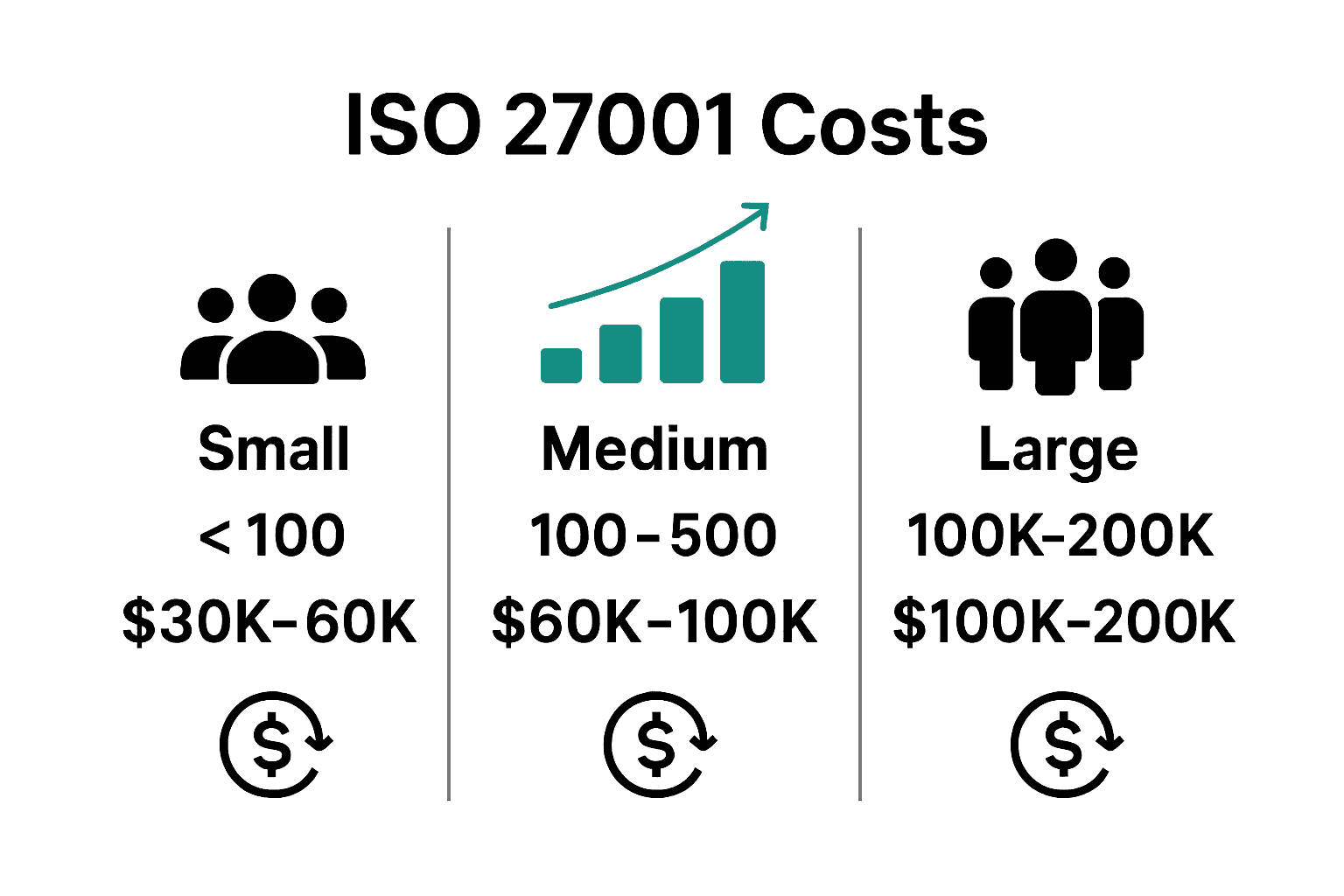
Research from PM Docs highlights that ongoing maintenance also varies by size. Surveillance audits typically cost approximately 30% of the initial certification fee annually, with a comprehensive recertification audit at the three-year mark running 60-70% of the original investment. Medium to large organizations should budget for more complex implementation processes, including multiple site assessments, more intricate documentation, and broader stakeholder engagement, which incrementally increase overall certification expenses.
Hidden Fees and Savings Strategies
ISO 27001 certification often comes with unexpected expenses that can catch organizations off guard. According to research from PCG, many companies underestimate the total investment required, particularly when it comes to internal resource allocation and post-audit corrective actions.
Hidden costs can emerge through multiple channels during the certification process. These typically include extensive staff training, additional consulting hours needed to address audit findings, software upgrades to meet security standards, and the time-consuming process of documenting and standardizing information security practices. Organizations might also face unexpected expenses related to implementing new security controls, conducting risk assessments, and managing compliance documentation.
Savings strategies to mitigate these potential financial pitfalls include:
- Conduct a thorough internal gap analysis before engaging external consultants
- Leverage existing IT and security infrastructure
- Train internal teams to reduce external consulting hours
- Implement a phased certification approach
- Use open-source or cost-effective security management tools
- Consolidate certification efforts across multiple departments
Proactive planning is the most effective way to control costs. By anticipating potential hidden expenses, creating a comprehensive budget, and developing a strategic implementation roadmap, organizations can significantly reduce the financial burden of ISO 27001 certification. Remember that while upfront costs might seem substantial, the long-term benefits of improved security, enhanced stakeholder trust, and potential risk mitigation far outweigh the initial investment.
Budgeting Mistakes to Avoid
Navigating the financial landscape of ISO 27001 certification requires strategic planning and awareness of common budgeting pitfalls. According to research from PCG, organizations frequently underestimate the complexity and resource demands of the certification process.
Costly misconceptions can derail your certification journey and inflate expenses unexpectedly. The most critical errors include failing to account for comprehensive internal preparation time, overlooking potential corrective action costs, and neglecting the recurring expenses associated with maintaining certification. Many organizations mistakenly view ISO 27001 as a one-time expense, when in reality it requires ongoing investment and continuous improvement.
Common budgeting mistakes to watch for:
- Underestimating internal resource allocation
- Neglecting staff training and awareness program costs
- Failing to budget for potential audit remediation
- Overlooking recurring surveillance audit expenses
- Insufficient contingency funds for unexpected compliance requirements
- Not considering technology upgrade and security tool investments
Successful budgeting demands a holistic approach that extends beyond initial certification costs. Organizations should develop a multi-year financial strategy that accounts for initial implementation, ongoing maintenance, potential technology upgrades, and continuous staff training. By anticipating these expenses and creating a comprehensive, flexible budget, companies can transform ISO 27001 certification from a financial challenge into a strategic investment in robust information security.
Simplify Your ISO 27001 Certification Journey with Skypher
Navigating the complex and costly process of ISO 27001 certification requires meticulous attention to documentation, risk assessments, and continuous compliance management. The article highlights how hidden costs like internal resource allocation and extensive staff training can escalate your budget unexpectedly. If you want to streamline these challenges and reduce time spent on security questionnaires and audits, Skypher offers a powerful solution tailored for organizations like yours.
Skypher's AI Questionnaire Automation Tool accelerates the completion of security reviews and helps manage the extensive documentation required for ISO 27001 certification. With seamless integrations to over 40 third-party risk management platforms and real-time collaboration features, your team can tackle the certification process more efficiently while staying aligned on compliance tasks. This means fewer surprises and better cost control during your certification journey.
Don’t let the complexity of ISO 27001 certification inflate your costs or drain your resources. Discover how Skypher’s platform can lighten your workload, boost accuracy, and improve stakeholder trust today by visiting our website. Explore comprehensive features like the AI Questionnaire Automation Tool and the customizable Trust Center to accelerate your security compliance efforts and secure your investment now.
Frequently Asked Questions
What is ISO 27001 certification?
ISO 27001 certification is an international standard that helps organizations manage sensitive data and protect critical information assets through an effective Information Security Management System (ISMS).
How much does ISO 27001 certification cost?
The total cost for ISO 27001 certification generally ranges from €12,000 to €55,000, depending on factors such as company size, operational complexity, and existing security infrastructure.
What are the main cost components of ISO 27001 certification?
Key cost components include external consulting fees, certification audit costs, ISMS software, internal resource expenses, and ongoing surveillance audits required to maintain certification.
What are common budgeting mistakes to avoid when pursuing ISO 27001 certification?
Common mistakes include underestimating internal resource allocation, neglecting staff training costs, failing to budget for audit remediation, and overlooking ongoing surveillance audit expenses.