

More than 80 percent of organizations report increased cyber threats each year, putting sensitive data at constant risk. Protecting information is no longer just an IT concern but a business priority that impacts trust, compliance, and profitability. ISO 27001 certification sets a high standard for managing these risks, giving companies a clear framework to secure their data and strengthen credibility in the eyes of clients and partners.
Table of Contents
- Defining ISO 27001 Certification and Its Importance
- Breakdown of ISO 27001 Certification Costs
- Key Factors Influencing Price Variations
- Cost Comparison: DIY, Consultants, and SaaS
- Cutting Costs With Automation and AI Tools
- Common Costly Mistakes and How to Avoid Them
Key Takeaways
| Point | Details |
|---|---|
| ISO 27001 Certification Significance | ISO 27001 is crucial for systematic information security management, ensuring the protection of sensitive data and reducing cyber risks. |
| Cost Considerations | Certification costs vary significantly based on organization size and complexity, requiring thorough budgeting for initial and ongoing expenses. |
| Approaches to Certification | Organizations can pursue ISO 27001 certification through DIY methods, professional consultants, or SaaS solutions, each with different cost and resource implications. |
| Leveraging Technology | Automation and AI can drastically reduce compliance costs and timelines, enhancing efficiency in the certification process. |
Defining ISO 27001 Certification and Its Importance
ISO 27001 is a globally recognized standard for information security management that provides organizations a systematic approach to protecting sensitive data and managing cyber risks. ISO defines this certification as a framework that specifies requirements for establishing, implementing, maintaining, and continuously improving an information security management system (ISMS).
At its core, ISO 27001 certification helps organizations comprehensively manage the security of critical assets like financial information, intellectual property, employee details, and third-party data. Wikipedia explains that the standard enables businesses to approach information security risks systematically, ensuring the confidentiality, integrity, and availability of information across all operational levels.
The importance of ISO 27001 cannot be overstated in today's interconnected digital landscape. Key benefits include:
- Establishing a structured approach to information security
- Demonstrating commitment to protecting sensitive data
- Reducing potential financial and reputational risks from security breaches
- Providing a competitive advantage in industries requiring robust security practices
- Creating a framework for continuous security improvement
Businesses pursuing this certification signal to customers, partners, and stakeholders that they take information security seriously. By implementing the ISO 27001 standard, organizations develop a proactive stance toward identifying, assessing, and mitigating potential security threats before they can cause significant damage. Check out our guide on ISO 27001 Consulting to understand how professional support can streamline your certification journey.
Breakdown of ISO 27001 Certification Costs
Understanding the financial investment required for ISO 27001 certification is critical for organizations planning to enhance their information security management. IT Governance provides insights into the cost structure, which varies significantly based on organizational size and complexity.
For small businesses, certification costs can range dramatically. A company with just 5 employees might expect certification expenses around £6,250, while a mid-sized organization of 46 employees could face costs approaching £12,500. These estimates typically cover the essential Stage 1 and Stage 2 audits, but important considerations remain.
The total cost of ISO 27001 certification encompasses multiple components:
- Initial gap analysis and readiness assessment
- Internal resource time and potential training expenses
- Documentation development and system implementation
- External consultant fees (if utilized)
- Certification audit fees
- Ongoing surveillance audits
- Annual recertification costs
Organizations should budget not just for the initial certification, but for the continuous maintenance and improvement of their Information Security Management System (ISMS).
 While the upfront investment might seem substantial, the long-term benefits of reduced security risks and enhanced organizational credibility often outweigh the initial expenses. For businesses seeking to understand how to navigate this complex certification process efficiently, explore our guide on SOC Type II Reports for additional compliance insights.
Key Factors Influencing Price Variations
ISO 27001 certification costs are not uniform and can vary substantially depending on multiple organizational factors. CyberPulse highlights that key influencing elements include organization size, Information Security Management System (ISMS) scope, current security infrastructure, and the specific certification body chosen.
PM Docs provides concrete examples demonstrating the wide cost range. A small tech startup with approximately 15 employees might invest between AUD 28,000 and AUD 42,000 in the first year, while a medium-sized financial services company with 75 employees could face expenses between AUD 63,000 and AUD 92,000.
Critical factors that impact certification pricing include:
- Organization Size: Larger organizations require more extensive audits
- Operational Complexity: More intricate business processes increase assessment time
- Current Security Maturity: Less developed existing security frameworks demand more comprehensive preparation
- Geographic Location: Regional audit and consulting rates differ
- Certification Body Selection: Pricing varies between different certification providers
Understanding these variables helps organizations budget more accurately and develop a strategic approach to achieving ISO 27001 certification.
VIDEO:video_content] The investment is not just a cost, but a structured pathway to robust information security management. For businesses seeking deeper insights into compliance strategies, [explore our guide on SOC Type II Reports to complement your certification journey.
Cost Comparison: DIY, Consultants, and SaaS
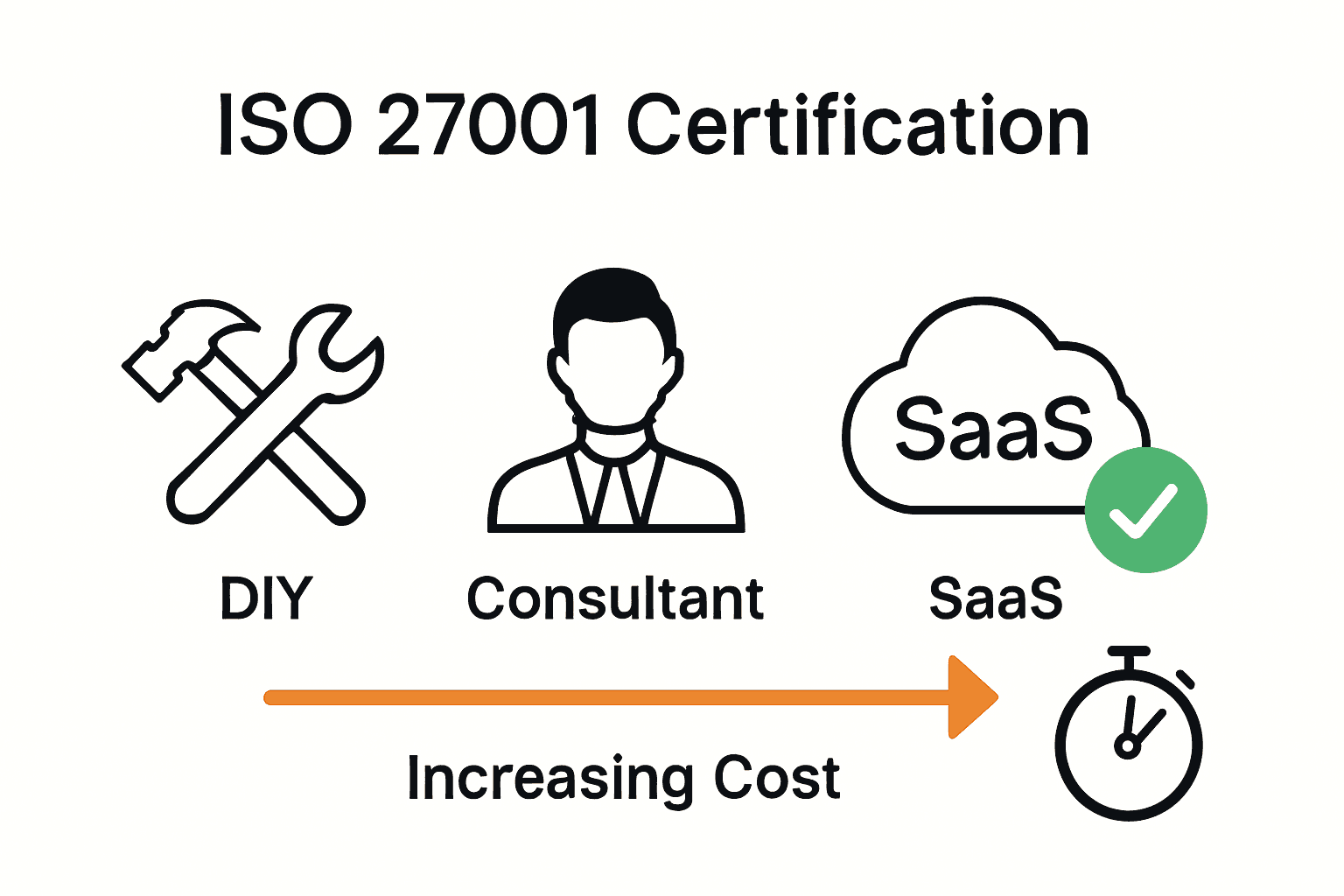
ISO 27001 certification approaches vary significantly in cost and complexity, offering organizations multiple pathways to achieve compliance. TechMagic reveals that organizations can choose between do-it-yourself (DIY) methods, professional consultants, or leveraging SaaS platforms, each with distinct financial implications.
PCG highlights the trade-offs between these approaches. DIY methods might seem cost-effective initially, ranging around $10,450–$12,220 for the readiness stage, but require substantial internal resources and expertise. Professional consultants, while more expensive and potentially charging up to $30,000, can expedite the process and provide specialized guidance.
Key considerations for each approach include:
DIY Approach:
- Lowest upfront financial investment
- Requires significant internal time and technical knowledge
- High risk of overlooking critical compliance requirements
- Best for organizations with robust internal security expertise
Consultant Approach:
- Highest direct cost
- Fastest path to certification
- Expert guidance and reduced implementation risk
- Ideal for organizations lacking internal compliance expertise
SaaS Platform Approach:
- Moderate investment
- Automated templates and streamlined processes
- Reduced implementation time
- Consistent guidance and structured methodology
Ultimately, the most cost-effective strategy depends on your organization's specific resources, expertise, and compliance maturity. For businesses looking to optimize their vendor risk management strategies alongside certification efforts, explore our guide on implementing vendor management programs to complement your ISO 27001 journey.
Cutting Costs With Automation and AI Tools
Automation and AI technologies are transforming the ISO 27001 certification landscape, offering organizations unprecedented opportunities to streamline compliance processes and dramatically reduce expenses. TechMagic reveals the remarkable potential of these technologies, demonstrating how intelligent tools can compress implementation timelines and slash associated costs.
Traditionally, ISO 27001 certification was a time-consuming and resource-intensive process. However, cutting-edge automation solutions can reduce implementation time from four months to just four weeks, simultaneously decreasing costs from $39,333 to an astounding $4,720. This radical transformation is achieved through several key technological innovations that simplify and accelerate the certification journey.
Key strategies for leveraging automation and AI include:
-
Automated Evidence Collection
- Instantly gather and categorize compliance documentation
- Reduce manual review time by up to 80%
- Minimize human error in document management
-
Intelligent Workflow Streamlining
- AI-powered process mapping
- Automatic identification of compliance gaps
- Real-time risk assessment and mitigation recommendations
-
Prebuilt Template Utilization
- Access to industry-standard compliance frameworks
- Rapid customization for specific organizational needs
- Consistent and comprehensive documentation
For businesses looking to understand how AI can further enhance operational efficiency, explore our insights on AI advantages in B2B sales to complement your technology strategy.
Common Costly Mistakes and How to Avoid Them
ISO 27001 certification can quickly become an expensive endeavor if organizations fail to plan strategically. PCG reveals that the most significant financial risks stem from common mistakes that can dramatically inflate implementation costs and derail compliance efforts.
CyberPulse highlights that organizations frequently underestimate the complexity of maintaining an Information Security Management System (ISMS). These oversights can transform what should be a streamlined certification process into a costly, time-consuming nightmare.
Top costly mistakes to avoid include:
Resource Miscalculation:
- Underestimating internal time commitments
- Failing to allocate dedicated personnel
- Not budgeting for ongoing training and maintenance
- Overlooking hidden costs of continuous compliance
Scope and Planning Errors:
- Poorly defined certification boundaries
- Incomplete risk assessment processes
- Inadequate documentation and evidence collection
- Lack of comprehensive implementation strategy
Maintenance and Sustainability Pitfalls:
- Treating certification as a one-time event
- Neglecting continuous improvement processes
- Failing to update security frameworks regularly
- Ignoring emerging technological and regulatory changes
Successful ISO 27001 certification requires a holistic, proactive approach. For businesses seeking to enhance their strategic planning and risk management capabilities, explore our guide on implementing vendor management programs to complement your compliance journey.
Streamline Your ISO 27001 Certification with Skypher’s AI-Powered Solution
Navigating the complex and costly process of ISO 27001 certification can be overwhelming. The article highlights challenges like resource miscalculation, documentation overload, and the need for continuous compliance. These pain points often lead to inflated costs and delayed certification. With Skypher’s AI Questionnaire Automation Tool, you can effortlessly automate responses to security questionnaires, drastically cutting down the time and errors involved in managing your Information Security Management System documents.
Don’t let the certification process drain your resources. Experience how Skypher’s platform with real-time collaboration, customizable Trust Center, and seamless integrations with over 40 third-party risk management platforms can make your ISO 27001 journey efficient and risk-free. Explore how our solution supports medium to large organizations in tech and finance to accelerate compliance efforts today by visiting Skypher. Learn more about leveraging AI to reduce costs and complexity at Skypher’s AI Questionnaire Automation Tool, and strengthen your compliance strategy by checking out our guides on vendor management and SOC Type II reports. Take control of your certification process now and build lasting trust with your clients.
Frequently Asked Questions
What is ISO 27001 certification?
ISO 27001 certification is a globally recognized standard for information security management that provides organizations with a framework for establishing, implementing, maintaining, and improving an Information Security Management System (ISMS).
How much does ISO 27001 certification cost?
The cost of ISO 27001 certification varies significantly based on organization size and complexity. Small businesses might spend around £6,250, while mid-sized organizations can expect costs up to £12,500, covering initial audits and other expenses.
What factors influence the price of ISO 27001 certification?
Key factors influencing the price include organizational size, the scope of the ISMS, current security infrastructure, geographic location, and the chosen certification body, as these can all affect the audit requirements.
Can automation and AI tools reduce the cost of ISO 27001 certification?
Yes, leveraging automation and AI tools can greatly reduce the time and expenses associated with ISO 27001 certification. These technologies streamline processes and enable faster compliance implementations, potentially cutting costs significantly.