

Protecting sensitive information in a fast-moving tech firm is never a simple box-ticking exercise. Choosing a recognized framework is vital, but many CISOs and compliance managers face constant pressure to balance effective cybersecurity with business growth. ISO 27001 provides a flexible, risk-based standard that guides organizations in securing data, aligning people, policies, and technology for real protection. This overview explains why ISO 27001 stands apart for tech companies and how it supports smarter risk management alongside efficient security questionnaire workflows.
Table of Contents
- ISO 27001 Compliance Explained for Tech Firms
- Certification Process and Key Requirements
- Benefits for Security Questionnaire Automation
- Risks of Non-Compliance in Organizations
- Integrating Compliance With Enterprise Workflows
Key Takeaways
| Point | Details |
|---|---|
| ISO 27001 Offers Flexibility | Tech firms can tailor their security measures using a risk-based framework that adapts to their specific threat landscape. |
| Certification Process Requires Commitment | Achieving ISO 27001 certification involves a structured journey, beginning with management commitment and clear scope definition. |
| Automate Security Responses | Automation of security questionnaire responses saves time, reduces errors, and improves operational efficiency for organizations pursuing compliance. |
| Non-Compliance Risks Are Significant | Failing to comply with ISO 27001 increases exposure to legal and financial risks, while also damaging customer trust and market opportunities. |
ISO 27001 Compliance Explained for Tech Firms
ISO 27001 is the global standard that defines how organizations establish, implement, and maintain information security management systems. For tech firms specifically, this standard cuts through the noise and provides a structured approach to managing cybersecurity risks. Rather than prescribing a rigid checklist of controls, ISO 27001 offers a flexible, risk-based framework that lets your organization tailor security measures to match your actual threat landscape and business needs.
The standard works by having your organization systematically identify information assets, evaluate vulnerabilities and threats, and implement controls that reduce risk to acceptable levels. This sounds straightforward on the surface, but the execution matters enormously. You'll need to define clear roles and responsibilities across teams, establish policies that actually guide behavior, invest in technology solutions that protect data, and create a culture where security is everyone's job. The beauty of this approach is that it works whether you're a 50-person startup or a multinational tech corporation. A flexible, risk-based framework lets you determine which controls apply to your specific situation rather than forcing unnecessary overhead.
For tech companies operating in cloud services, SaaS, or infrastructure roles, ISO 27001 addresses a particular pain point: managing shared security responsibilities across your supply chain. When your customers ask about your security posture, certification demonstrates that you've implemented systematic processes to protect their data. This visibility and transparency can significantly accelerate sales cycles and reduce the friction in procurement conversations. Beyond the business benefits, the standard forces you to think holistically about how people, processes, and technology interact to create actual security outcomes.
Most tech firms discover that achieving ISO 27001 certification requires addressing gaps across multiple domains simultaneously. You can't just focus on technology controls and ignore access management policies. You can't implement strong authentication without training teams on why it matters. This interconnected view of security, combined with tailored cybersecurity measures for your specific context, is what makes the standard both challenging and genuinely valuable.
Pro tip: Start your ISO 27001 journey by conducting a gap assessment against your current state rather than trying to implement all controls simultaneously; prioritize based on your highest-impact risks first.
Certification Process and Key Requirements
The path to ISO 27001 certification isn't a one-time checkbox exercise. It's a structured journey that requires genuine organizational commitment from the moment you decide to pursue it. Your journey starts with management commitment and a clear definition of your Information Security Management System (ISMS) scope. What data does your organization handle? Which business processes depend on that data? Which systems and departments fall within your compliance scope? These decisions shape everything that follows. Once your scope is locked down, you'll conduct a comprehensive risk assessment to identify vulnerabilities and threats specific to your environment. Then comes the critical step: selecting and implementing controls that address your identified risks. This risk-driven approach means you're not implementing generic security theater—you're implementing what actually matters for your organization.
The certification itself involves two distinct audit stages that feel very different. The Stage 1 audit evaluates documented policies and organizational readiness before you go live with controls. Think of it as a dress rehearsal where an accredited third-party auditor reviews your documentation, confirms your scope is realistic, and identifies obvious gaps. This happens before your controls are fully operational. Then comes the Stage 2 audit, which is the real test. Your auditor now evaluates whether your controls actually work in practice. Are employees following the access management policies you documented? Is the encryption you implemented functioning as designed? Are your incident response procedures actually being followed when incidents occur? This assessment of real-world effectiveness determines whether you earn certification.

Here's a summary of ISO 27001 certification stages and their focus:
| Audit Stage | Main Purpose | Sample Activities |
|---|---|---|
| Stage 1 Audit | Documentation and scope review | Policy analysis, gap identification |
| Stage 2 Audit | Operational effectiveness verification | Control testing, employee interviews |
| Ongoing | Continuous improvement and surveillance | Annual audits, control updates |
Once certified, the work doesn't stop. Organizations must maintain their certification through ongoing assessments and continuous improvement cycles. Most certifications last three years, with surveillance audits conducted annually to verify you're maintaining your controls. Your ISMS must evolve as threats change and your business transforms. New tools get implemented, teams expand into different markets, regulatory requirements shift—your security program must adapt accordingly. This is why many tech firms find that the real value of ISO 27001 certification comes not from the audit itself but from the discipline it creates around systematic risk management.
For medium to large tech firms, the certification journey typically takes six to twelve months from initial scoping to audit readiness. The timeline depends heavily on your starting point. If you already have documented security policies and incident response procedures, you're ahead. If you're building this from scratch, you'll need more time. Budget for both internal resources and potentially external consulting support. The investment pays dividends beyond the certification itself—you'll have documented processes, trained teams, and a framework that makes your security program comprehensible and scalable.
Pro tip: Conduct your Stage 1 audit when you're 80 percent ready rather than waiting for perfection; this gives you auditor feedback while you still have time to address gaps before your Stage 2 certification audit.
Benefits for Security Questionnaire Automation
Manual security questionnaire responses consume extraordinary amounts of time. A single detailed questionnaire can demand 40 to 60 hours of cross-functional effort, pulling your security team away from actual security work. When you're fielding ten questionnaires per quarter from vendors, partners, and customers, that's hundreds of hours spent typing the same answers repeatedly. Automation changes this equation fundamentally. Instead of starting from scratch each time, your team answers questions once, stores those responses systematically, and reuses them across multiple questionnaires. This alone frees up significant capacity that your security team can redirect toward threat detection, incident response, and proactive risk management. Beyond time savings, automation dramatically reduces human error. When responses are pulled from a centralized knowledge base rather than retyped manually, inconsistencies disappear. You avoid the frustrating scenario where one department answers a question differently than another, creating confusion during audits or customer reviews.
For organizations pursuing ISO 27001 certification, automation delivers compounding benefits. Automating security questionnaires supports structured risk identification and enables you to maintain continuous assessments aligned with your control framework. Rather than treating questionnaires as discrete compliance exercises, automation integrates them into your ongoing risk management process. Each questionnaire response becomes an opportunity to verify that your controls are functioning as documented. You gain real-time visibility into compliance status rather than discovering gaps during formal audits. This continuous monitoring approach creates a feedback loop where you're constantly validating that your security investments are delivering actual protection.
Customer trust accelerates when you can respond to security questionnaires quickly and consistently. In competitive procurement processes, speed matters. Organizations that can provide comprehensive, accurate security documentation in days rather than weeks win more deals. Automation enables your sales team to include security certifications and questionnaire responses in proposals faster, reducing proof-of-concept timelines. For tech firms operating in regulated industries, this capability becomes a genuine competitive advantage. Your ability to demonstrate enhanced resilience to cyber-attacks through comprehensive ISO 27001 controls backed by rapid, consistent questionnaire responses gives customers confidence in your security posture.
The operational maturity that automation brings extends beyond questionnaires. When your organization documents security controls, assessment procedures, and evidence systematically, you build institutional knowledge that survives personnel changes. New team members onboard faster. Audits proceed more smoothly. Your security program becomes comprehensible and scalable rather than existing as tribal knowledge scattered across individuals. This foundation supports not just ISO 27001 compliance but your organization's ability to adapt to emerging threats and evolving regulatory requirements.
Pro tip: Automate your responses to the top 20% of questions first (the ones that appear across most questionnaires), then gradually expand coverage; this lets you capture immediate time savings while building momentum for comprehensive automation.
Risks of Non-Compliance in Organizations
Skipping ISO 27001 compliance isn't a cost-saving measure. It's a gamble with your organization's viability. Organizations that fail to implement proper information security management systems expose themselves to escalating financial and operational consequences. A data breach hits differently when you haven't documented your security controls or demonstrated reasonable care. Regulators, courts, and customers all factor in whether you made a genuine effort to protect information. Without ISO 27001 compliance, you're essentially admitting you didn't have a systematic approach to information security. This creates legal vulnerability that extends far beyond the immediate breach costs. You face regulatory penalties, lawsuits from affected parties, and potential criminal liability for executives in jurisdictions with strict data protection laws.
The damage to customer relationships often exceeds the direct financial impact. When a breach occurs and customers discover you lacked documented security controls or proper risk management processes, trust evaporates. Enterprise customers increasingly require ISO 27001 certification as a procurement prerequisite. If you're not compliant, you're simply excluded from major deals. Sales teams can't move forward. Business development becomes impossible with Fortune 500 companies. The revenue impact compounds over quarters as you lose access to markets that demand certification. Beyond customer trust, non-compliance creates operational chaos. Without proper risk management frameworks and governance structures, your organization lacks visibility into where threats exist. You can't prioritize security investments effectively. You don't know which systems contain the most critical data. When incidents occur, you lack documented incident response procedures, which means your team is improvising while the breach spreads.
The financial consequences are staggering. Non-compliance with ISO 27001 exposes organizations to data breaches, cyber-attacks, loss of customer trust, legal sanctions, and operational disruptions. A single major breach costs organizations millions in forensics, notification, credit monitoring, regulatory fines, and remediation. These aren't abstract concerns. The average cost of a data breach in 2024 exceeds $4.45 million according to industry reports. For mid-market tech firms, this represents a year's worth of profit. For startups, it's existential. Regulatory penalties add another layer. The European Union's GDPR imposes fines up to 20 million euros or 4 percent of global annual revenue, whichever is higher. California's CCPA provides for statutory damages. These aren't theoretical risks. Regulators are actively investigating organizations without proper information security frameworks and imposing substantial penalties.
The competitive disadvantage accelerates over time. Organizations with ISO 27001 certification capture market share from non-compliant competitors. Enterprise procurement teams build compliance requirements into their vendor selection criteria. You're not just losing individual deals. You're losing entire customer categories. Your organization becomes trapped serving smaller, less regulated customers who don't require certification. Meanwhile, compliant competitors scale into the profitable enterprise segment. The gap widens annually.
The following table highlights main risks of non-compliance versus compliance advantages:
| Risk Without Compliance | Advantage With ISO 27001 Certification |
|---|---|
| Higher breach costs and lawsuits | Reduced legal exposure |
| Missed enterprise sales opportunities | Accelerated procurement cycles |
| Operational confusion during crises | Documented, repeatable procedures |
| Lack of trust and market exclusion | Enhanced reputation and trust |
Pro tip: Start ISO 27001 compliance immediately if you handle any customer data or operate in regulated industries; waiting for a breach forces compliance under crisis conditions with significantly higher costs and reputational damage.
Integrating Compliance With Enterprise Workflows
Compliance feels like an obstacle when it exists outside your normal business processes. Your security team maintains one set of documentation. Your operations team runs things differently. Your finance team uses separate approval workflows. When these systems don't talk to each other, compliance becomes theater that happens in parallel to actual work rather than something embedded in how the organization operates. This disconnect creates friction, slows decision-making, and ultimately weakens security because people find workarounds to get their jobs done. The real transformation happens when ISO 27001 compliance becomes woven into the fabric of how your organization actually works. Instead of asking teams to follow security procedures in addition to their regular jobs, you design workflows that make compliance the path of least resistance.
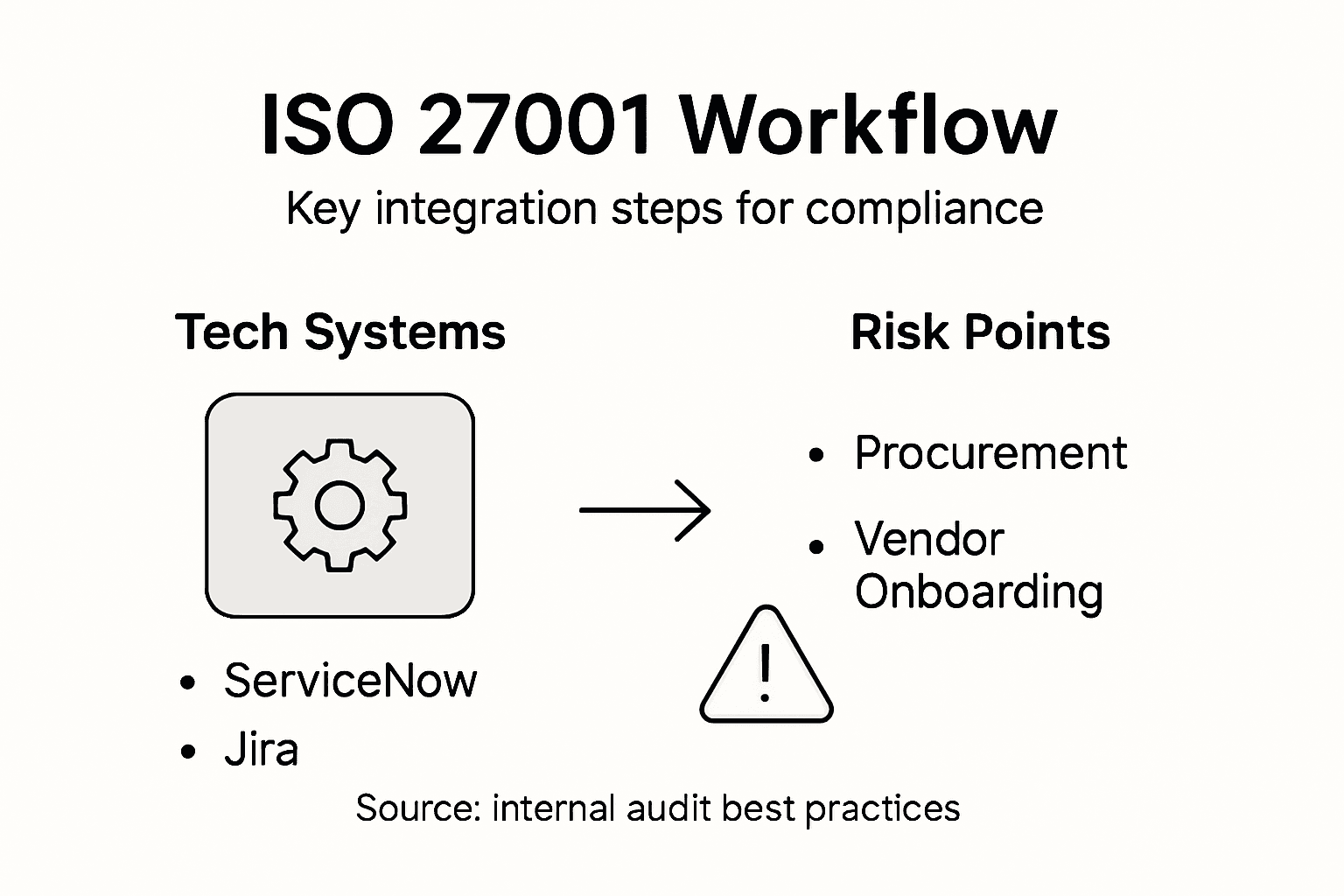
Integration starts by mapping where risk decisions happen in your business. When your procurement team evaluates new vendors, that's a risk decision. When your engineering team deploys infrastructure, that's a risk decision. When your product team designs data handling, that's a risk decision. Rather than treating these as separate from compliance, you embed risk assessment and control verification into those existing approval workflows. A vendor evaluation process becomes one that automatically pulls security questionnaire responses, checks control effectiveness, and documents risk acceptance. An infrastructure deployment process becomes one that verifies encryption, access controls, and monitoring are configured before approval. Integrating risk management and control monitoring into existing business systems means compliance happens as a natural consequence of doing business, not as an afterthought.
Technology plays a critical role in making integration seamless. Your enterprise systems, whether ServiceNow, Jira, Salesforce, or custom platforms, should exchange information with your security management systems. When a new employee joins, their onboarding workflow should automatically trigger access provisioning reviews. When a system gets classified as critical, your monitoring tools should automatically increase surveillance. When a control failure is detected, your incident management system should automatically create a ticket. These connections transform compliance from a quarterly audit exercise into continuous, real-time visibility. Your security team shifts from firefighting during audit season to maintaining systems that continuously validate control effectiveness. Aligning cybersecurity risk management with business strategy means security investments directly support business objectives rather than competing with them for resources.
The cultural shift matters as much as the technical integration. When compliance is embedded in workflows, people stop viewing it as something imposed by security. They experience it as normal business practice. An engineer doesn't perceive encryption as a compliance burden when it's a standard configuration option in the deployment template. A manager doesn't resent access reviews when they receive a simple monthly summary rather than an intrusive manual audit. This shift transforms your organization's security culture from compliance-driven to risk-aware. Teams understand how their decisions affect overall risk. They make better choices because they have visibility into the tradeoffs. This creates the conditions for genuine security maturity rather than checkbox compliance.
Pro tip: Start integration by identifying the three processes where your organization makes the most significant risk decisions, then embed security controls into those workflows first; success there will create momentum for broader integration.
Accelerate Your ISO 27001 Compliance With Skypher's Automated Security Questionnaire Solutions
Managing security questionnaires is a major challenge highlighted in the article, especially for tech firms pursuing ISO 27001 certification. The process is time-consuming and prone to inconsistent answers that hinder efficient risk management and delay audits. Skypher addresses these pain points head-on by offering an AI-powered Questionnaire Automation Tool that drastically cuts down response times and ensures consistent, compliant answers aligned with your ISMS framework.
With Skypher you can
- Automate answers to hundreds of questions in under a minute
- Integrate seamlessly with over 40 third-party risk management platforms like ServiceNow and OneTrust
- Collaborate in real-time across teams to maintain up-to-date security documentation
- Customize your own Trust Center to showcase your security posture and speed up procurement

Unlock fast, accurate security questionnaire responses that transform your ISO 27001 certification journey from a months-long burden into a streamlined process. Visit Skypher today to learn how our AI-driven platform aligns perfectly with the continuous improvement cycles and operational maturity your compliance efforts demand. Start automating your security questionnaires now and secure customer trust faster with AI Questionnaire Automation Tool and robust API Integrations with TPRM Platforms.
Discover a smarter way to manage your ISO 27001 compliance and make security questionnaire automation your competitive advantage.
Frequently Asked Questions
What is ISO 27001 compliance?
ISO 27001 compliance refers to adhering to the international standard for information security management systems (ISMS). It outlines a framework for organizations to manage and protect their information assets effectively.
How does automating security questionnaires benefit organizations pursuing ISO 27001 certification?
Automating security questionnaires reduces the time spent on repetitive tasks, minimizes human errors, and allows teams to focus on more critical security activities. It also ensures consistency in responses and aligns with ongoing risk management practices.
What are the key stages in the ISO 27001 certification process?
The ISO 27001 certification process includes two main audit stages: Stage 1, which involves a documentation and scope review, and Stage 2, which assesses the operational effectiveness of implemented controls. Ongoing assessments are also required to maintain certification.
How can organizations integrate ISO 27001 compliance into their existing workflows?
Organizations can integrate ISO 27001 compliance by embedding risk assessment and control verification directly into existing processes, such as procurement and deployment. This creates a seamless compliance experience that aligns with everyday business operations.
Recommended
- The Case for Security Questionnaire Automation
- ISO 27001: Impact on Tech Security Compliance
- How to Answer Security Questionnaires Effectively
- The ever growing number of security questionnaires and what you and your company can do to face it
- GDPR Compliance in Testing: Practical Guide for Marketers 2025