

ISO 27001 certification is making waves in the world of information security, especially as companies fight to protect their data like never before. Here is the surprise. There is no direct ISO 27001 individual certification at all. Most people get this wrong and waste time searching for something that does not exist. Instead, the real doors open through specialized credentials like Lead Implementer and Lead Auditor, and that detail could completely change your career path in 2025.
Table of Contents
- What is ISO 27001 individual certification?
- Who Can Apply and Eligibility Criteria
- Certification Process and Exam Overview
- Career Benefits and Opportunities in 2025
Quick Summary
| Takeaway | Explanation |
|---|---|
| ISO 27001 individual certification is not directly available | Instead of direct certification, professionals pursue specialized credentials like Lead Implementer, Lead Auditor, or Foundation Level certification to validate their expertise in implementing and auditing information security management systems (ISMS). |
| Eligibility criteria vary by certification level | Candidates need specific educational backgrounds, professional experience, and technical competencies, with different requirements for Foundation, Lead Implementer, and Lead Auditor levels. |
| The certification process involves rigorous training and examination | Professionals must complete accredited training programs and pass a structured examination, which tests theoretical and practical knowledge of information security principles and practices. |
| Career opportunities are expanding with ISO 27001 certification | As cybersecurity roles grow, certified professionals can pursue advanced positions with higher salaries across various industries, including financial services, healthcare, and technology. |
| Continuous professional development is essential | Maintaining certification requires ongoing learning and participation in industry events, highlighting the importance of commitment to staying current in the field. |
What Is ISO 27001 Individual Certification?
Understanding ISO 27001 individual certification requires clarity about its unique professional landscape. While many professionals assume direct individual certification exists, the reality is more nuanced. ISO 27001 focuses on organizational information security management systems (ISMS), with specialized credentials for professionals demonstrating expertise in implementing and auditing these systems.
Professional Certification Pathways
Contrary to common misconception, individuals cannot obtain a direct ISO 27001 certification. Instead, professionals can pursue specialized certifications that validate their knowledge and skills related to the standard. International Electrotechnical Commission and ISO offer multiple professional development tracks for information security experts.
Three primary certification paths exist for professionals interested in demonstrating ISO 27001 competence:
- Lead Implementer Certification: Validates an individual's ability to guide organizations through ISO 27001 implementation processes
- Lead Auditor Certification: Confirms expertise in conducting comprehensive information security management system audits
- Foundation Level Certification: Provides fundamental understanding of ISO 27001 principles and requirements
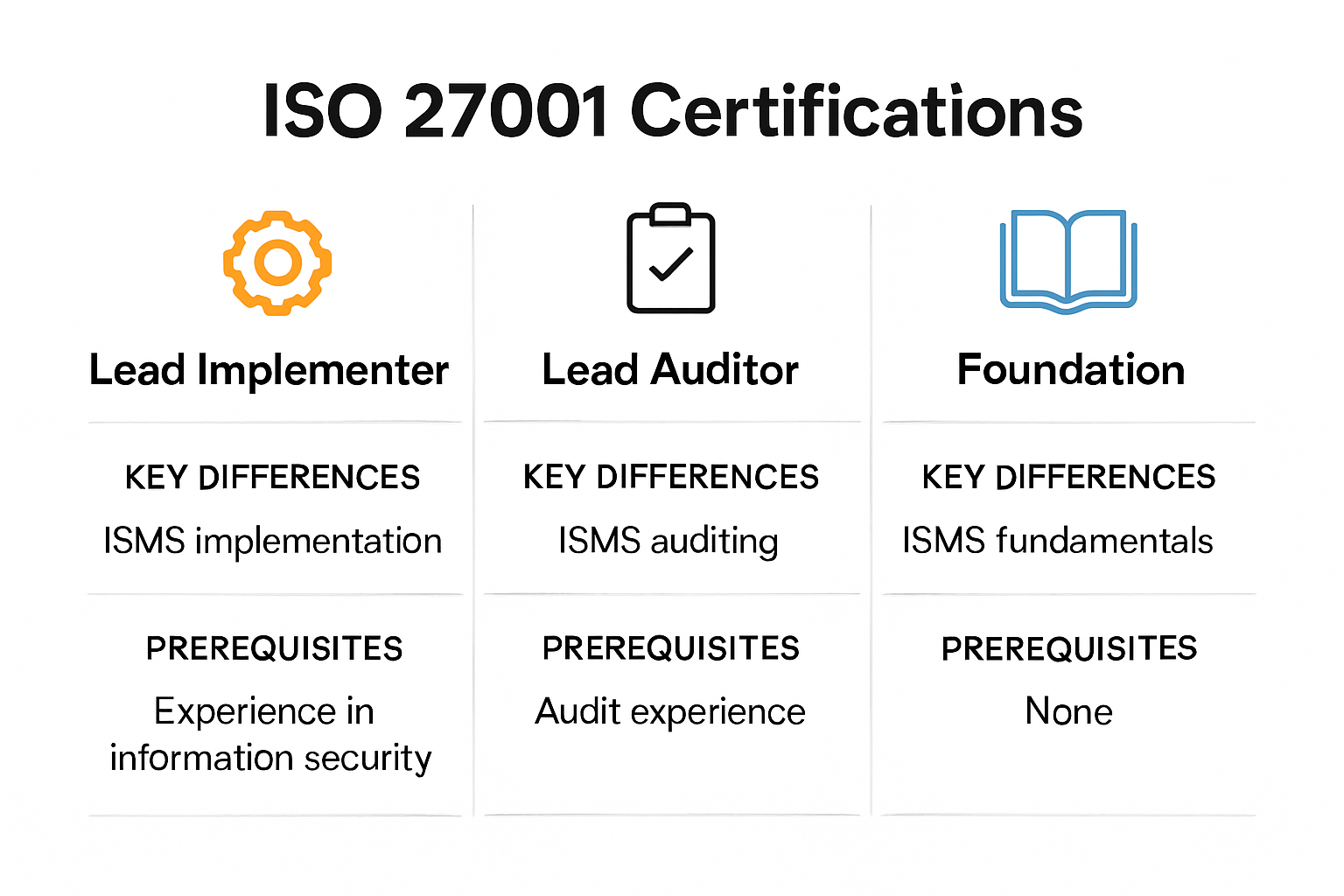
Here's a table summarizing the main ISO 27001-related professional certification paths and the focus of each credential:
| Certification Path | Focus Area | Ideal For |
|---|---|---|
| Lead Implementer | ISMS implementation, process guidance | Managers, Consultants |
| Lead Auditor | Auditing and assessing ISMS compliance | Auditors, Compliance |
| Foundation Level | Basic ISO 27001 concepts and terminology | Entry-level Professionals |
Professional Credentialing Mechanisms
Professional bodies and authorized training organizations provide these credentials through rigorous examination processes. According to PECB, certification typically involves:
- Completing specialized training programs
- Passing comprehensive knowledge assessment
- Demonstrating practical understanding of information security management principles
- Maintaining ongoing professional development requirements
These certifications represent significant professional achievements. International Register of Certificated Auditors notes that such credentials demonstrate an individual's commitment to maintaining high standards of information security knowledge and practice.
Professionals seeking these certifications often come from diverse backgrounds including:
- Information technology departments
- Cybersecurity teams
- Risk management divisions
- Compliance and governance roles
While not a direct ISO 27001 certification, these professional credentials serve as powerful indicators of an individual's expertise in managing and implementing robust information security frameworks. They provide tangible proof of specialized knowledge that organizations worldwide recognize and value.
The evolving digital security landscape continues to emphasize the importance of such professional credentials. As cyber threats become increasingly sophisticated, professionals with validated ISO 27001 related certifications are becoming critical assets for organizations seeking to protect their information infrastructure.

Who Can Apply and Eligibility Criteria
Navigating the application process for ISO 27001 professional certifications requires understanding specific eligibility requirements and professional backgrounds. While these credentials are not universally applicable to every professional, they target specific roles and expertise levels within information security management.
Professional Background Requirements
Eligibility for ISO 27001 related certifications depends on a combination of educational qualifications, professional experience, and technical knowledge. International Certification of Information Security Professionals recommends that candidates typically possess:
- Academic Background: Degree in computer science, information technology, cybersecurity, or related technical disciplines
- Professional Experience: Minimum of 2-4 years in information security roles
- Technical Competencies: Strong understanding of risk management, security frameworks, and organizational governance
According to PECB Certification Guidelines, candidates must demonstrate:
- Comprehensive understanding of information security principles
- Practical experience in implementing security management systems
- Knowledge of risk assessment and mitigation strategies
- Ability to develop and maintain organizational security protocols
Certification Level Specific Requirements
Different certification levels impose varying prerequisites. International Register of Certificated Auditors outlines specific requirements for distinct certification tiers:
- Foundation Level: Minimal professional experience required, ideal for entry-level professionals
- Lead Implementer: Minimum 4 years information security experience
- Lead Auditor: Minimum 5 years comprehensive security management experience
Professionals from multiple domains can apply, including:
- Information technology managers
- Cybersecurity specialists
- Risk management professionals
- Compliance officers
- Security consultants
- IT governance experts
Certification bodies like ISACA emphasize that while technical skills are crucial, candidates must also demonstrate:
- Strong analytical capabilities
- Exceptional problem-solving skills
- Comprehensive understanding of organizational security frameworks
- Ability to communicate complex security concepts effectively
Beyond technical qualifications, successful candidates typically exhibit:
- Commitment to continuous learning
- Proactive approach to identifying security vulnerabilities
- Strategic thinking in risk management
- Adaptability to evolving technological landscapes
Professionals considering these certifications should carefully review specific requirements from authorized certification bodies, as prerequisites can vary slightly between different organizations. Thorough preparation, relevant experience, and a genuine passion for information security form the foundation of a successful certification journey.
Certification Process and Exam Overview
The ISO 27001 certification process demands meticulous preparation and comprehensive understanding of information security management principles. Professionals seeking these credentials must navigate a structured pathway involving training, examination, and continuous professional development.
The following table provides an overview of key steps and requirements in the ISO 27001 individual certification process across various certification levels:
| Step | What It Involves |
|---|---|
| Select Accredited Training Program | Choose authorized course covering exam domains |
| Attend Training Sessions | 3-5 day in-depth instruction with practical workshops |
| Study Official Materials | Review guides, practice tests, online resources |
| Pass Written Examination | Multiple choice, scenarios, 2–3 hour time limit |
| Meet Experience Requirements | Varies by level (2–5 years in security roles) |
| Ongoing Professional Development | Maintain certification through further learning |
Training and Preparation Requirements
Successful certification begins with selecting an accredited training program. PECB recommends comprehensive training courses that cover essential knowledge domains. Typical preparation involves:
- Attending authorized training sessions
- Studying official course materials
- Participating in practical workshops
- Understanding detailed implementation strategies
According to International Certification of Information Security Professionals, training programs typically range from 3-5 days and cover critical areas such as:
- Information security management system principles
- Risk assessment methodologies
- Implementation strategies
- Audit techniques
- Compliance requirements
Examination Structure and Assessment
The certification examination represents a rigorous assessment of professional competence. ISACA highlights that exams typically include:
- Multiple choice questions
- Scenario-based problem solving
- Comprehensive knowledge testing
- Time-limited assessment (usually 2-3 hours)
Examination scoring varies across certification bodies. International Register of Certificated Auditors notes typical passing requirements include:
- Minimum score of 70% on written examination
- Demonstration of practical understanding
- Comprehensive knowledge verification
Different certification levels demand varying examination complexities:
- Foundation Level: Basic knowledge assessment
- Practitioner Level: Deeper technical understanding
- Lead Implementer/Auditor: Advanced professional competency evaluation
Professionals must prepare extensively, utilizing:
- Official study guides
- Practice examinations
- Specialized training materials
- Professional study groups
- Online learning resources
Beyond the initial examination, maintaining certification requires ongoing professional development. ISO Professional Certification Board recommends continuous learning through:
- Annual professional training
- Attending industry conferences
- Participating in specialized workshops
- Completing continuing education credits
The certification journey demands commitment, technical expertise, and a strategic approach to information security management. Successful candidates demonstrate not just theoretical knowledge but practical application of complex security frameworks.
Professionals should approach certification as a comprehensive professional development opportunity, viewing the examination as a milestone in their ongoing information security career trajectory.
Career Benefits and Opportunities in 2025
The rapidly evolving cybersecurity landscape in 2025 positions ISO 27001 certification as a critical differentiator for professionals seeking advanced career opportunities. As organizations increasingly prioritize robust information security frameworks, certified professionals find themselves at the forefront of strategic technological defense.
Emerging Career Trajectories
Gartner Research indicates significant growth in information security roles, with ISO 27001 certification providing a competitive edge across multiple professional domains. Potential career paths include:
- Information Security Manager: Overseeing comprehensive organizational security strategies
- Cybersecurity Risk Consultant: Developing advanced risk mitigation frameworks
- Compliance and Governance Specialist: Ensuring regulatory adherence across complex technological ecosystems
- Security Auditor: Conducting comprehensive organizational security assessments
According to Cybersecurity Ventures, the global cybersecurity job market is projected to reach 3.5 million unfilled positions by 2025, creating unprecedented opportunities for certified professionals.
Salary and Professional Advancement
Indeed Salary Insights reveals significant financial benefits for ISO 27001 certified professionals. Typical salary ranges demonstrate substantial premium for certified expertise:
- Entry-level positions: $75,000 - $95,000 annually
- Mid-level security professionals: $110,000 - $135,000 annually
- Senior security leadership roles: $150,000 - $220,000 annually
Key factors driving career opportunities include:
- Increasing global regulatory requirements
- Complex cybersecurity threat landscapes
- Growing organizational dependency on robust security frameworks
Industry-Specific Opportunities
Certification opens doors across diverse sectors, including:
- Financial services
- Healthcare technology
- Government and public sector
- Technology and software development
- Cloud computing and infrastructure
- Telecommunications
International Information System Security Certification Consortium emphasizes that ISO 27001 certification represents more than a credential. It demonstrates:
- Advanced technical expertise
- Strategic thinking capabilities
- Comprehensive understanding of global security frameworks
- Commitment to professional excellence
Professionals should view certification as a strategic investment in their career trajectory. The credential signals to employers a proactive approach to information security, translating into enhanced job prospects, increased earning potential, and opportunities for accelerated professional growth.
As digital transformation continues to reshape organizational infrastructure, ISO 27001 certified professionals will remain critical in developing, implementing, and maintaining secure technological ecosystems. The certification serves not just as a professional milestone but as a strategic passport to advanced career opportunities in an increasingly complex digital world.
Frequently Asked Questions
What is ISO 27001 individual certification?
ISO 27001 individual certification does not exist directly. Instead, professionals can obtain specialized credentials like Lead Implementer, Lead Auditor, or Foundation Level certifications to demonstrate their expertise in information security management systems (ISMS).
Who is eligible to apply for ISO 27001 professional certifications?
Eligibility varies by certification level but generally requires a combination of educational background in related fields, professional experience in information security, and specific technical competencies.
What is the certification process for ISO 27001 credentials?
The certification process involves selecting an accredited training program, completing comprehensive training, passing a structured examination, and fulfilling ongoing professional development requirements to maintain certification.
What are the career benefits of obtaining ISO 27001 certification in 2025?
ISO 27001 certification opens up diverse career opportunities, increases earning potential, and positions professionals favorably in the growing cybersecurity job market, where demand for expertise continues to rise.
Turn Your ISO 27001 Expertise Into Real Results for Your Team
Completing your ISO 27001 Lead Implementer or Lead Auditor training shows commitment to security and compliance. But facing endless security questionnaires and requests during sales, audits, and due diligence? That is where many professionals lose time and get overwhelmed. Even with your new certification, managing security review processes efficiently is a major challenge, especially as organizations expect fast and accurate responses to complex requirements.
Skypher is built to solve exactly this problem. Our AI Questionnaire Automation Tool speeds up security reviews, increases accuracy, and helps certified professionals maintain trust with clients and internal teams. Experience seamless integration with your TPRM systems, real-time collaboration, and a customizable Trust Center that puts your credentials and security documentation front and center. Make your expertise count right away. Visit Skypher’s platform now to see how fast and confidently you can handle your next security questionnaire.