
Compliance risk keeps B2B software companies on edge. One misstep can lead to regulatory penalties reaching millions and a loss of customer trust almost overnight. Most teams scramble to keep up with policies and tech updates while dreading audits. What hardly anyone talks about is how a proactive compliance strategy can actually turn your team into an engine for long-term growth and credibility rather than just a shield against fines.
Table of Contents
- Understanding Compliance Risks in Software Companies
- Best Practices to Manage Compliance Risk
- Leveraging Technology for Compliance Management
- Empowering Teams to Sustain Compliance Success
Quick Summary
| Takeaway | Explanation |
|---|---|
| Understand your compliance risks thoroughly | Identify potential legal and reputational risks that may impact your business. This proactive awareness is key for effective management. |
| Implement a robust governance framework | Establish clear policies and accountability structures to ensure compliance responsibilities are well-defined and monitored. |
| Leverage technology for compliance monitoring | Utilize AI and automated systems for real-time tracking of regulatory changes and compliance performance, enhancing efficiency. |
| Foster a culture of compliance within teams | Engage employees at all levels by promoting open communication and continuous education, making compliance a collective responsibility. |
| Invest in ongoing training and education | Regularly update your team's knowledge on compliance standards to adapt to evolving regulations and maintain an effective compliance posture. |
Understanding Compliance Risks in Software Companies
Compliance risk represents a critical challenge for B2B software companies, encompassing potential legal, financial, and reputational consequences of failing to adhere to regulatory requirements. Software organizations operate in an increasingly complex regulatory environment where a single misstep can trigger substantial penalties and erode customer trust.
The Regulatory Landscape for Software Companies
Modern software companies must navigate a multifaceted compliance ecosystem that spans multiple domains. Research from the FDIC emphasizes the critical importance of due diligence in software selection, particularly for financial technology platforms. Companies must systematically assess their software's functionality and compliance capabilities to mitigate potential regulatory risks.
Key regulatory frameworks impacting software companies include data protection regulations like GDPR, industry-specific compliance standards such as HIPAA for healthcare technologies, and financial reporting requirements. Each regulation presents unique challenges that demand proactive management and comprehensive understanding.
To clarify the key regulatory frameworks discussed for B2B software companies, the following table summarizes major regulations and their relevance:
| Regulatory Framework | Applicability/Industry | Key Compliance Challenge |
|---|---|---|
| GDPR (General Data Protection Regulation) | All companies handling EU data | Data protection, privacy management |
| HIPAA (Health Insurance Portability and Accountability Act) | Healthcare technology | Patient data privacy, security |
| Financial Reporting Standards | Financial services | Accurate financial disclosures |
| NIST Cybersecurity Standards | Technology, suppliers | Cybersecurity, supply chain risk |
This table provides a quick reference for understanding which regulations may impact B2B software firms and the main compliance areas they cover.
Data Protection and Privacy Compliance Challenges
A study on GDPR compliance in open-source software reveals the intricate challenges software companies face in managing user data. These challenges encompass complex implementation processes, substantial compliance costs, and the continuous need for thorough assessment of data handling practices.
Effective compliance risk management requires a holistic approach that integrates legal, technical, and operational strategies. Software companies must develop robust internal mechanisms to track regulatory changes, implement comprehensive training programs, and create adaptive compliance frameworks that can quickly respond to evolving legal requirements.
The consequences of non-compliance extend far beyond monetary penalties. Organizations risk losing customer trust, experiencing significant reputational damage, and potentially facing legal actions that could compromise their market position. Proactive compliance management is not just a regulatory requirement but a strategic imperative for sustainable business growth.
To successfully manage compliance risks, B2B software companies need to:
- Develop comprehensive compliance monitoring systems
- Implement regular internal audits and assessments
- Create clear documentation and training protocols
- Invest in technology that supports regulatory adherence
By understanding the multifaceted nature of compliance risks and adopting a strategic, integrated approach, software companies can transform regulatory challenges into opportunities for building trust and demonstrating organizational excellence.
Best Practices to Manage Compliance Risk
Managing compliance risk requires a strategic and comprehensive approach that goes beyond mere procedural checklists. B2B software companies must develop robust frameworks that proactively identify, assess, and mitigate potential regulatory vulnerabilities across their entire operational ecosystem.
Comprehensive Risk Assessment and Mapping
The National Institute of Standards and Technology emphasizes the critical importance of systematic risk assessment in managing compliance challenges. Software companies need to conduct thorough and periodic evaluations of their regulatory landscape, identifying potential risks across multiple domains including data protection, cybersecurity, and industry-specific regulations.
Effective risk mapping involves creating detailed documentation that tracks potential compliance vulnerabilities, assesses their potential impact, and develops targeted mitigation strategies. This process requires cross-functional collaboration between legal, technology, and operational teams to ensure a holistic understanding of regulatory requirements.
Implementing Robust Governance Frameworks
NIST's publication on Cybersecurity Supply Chain Risk Management Practices provides comprehensive guidance for developing strong governance mechanisms. Organizations must establish clear policies, create transparent accountability structures, and implement continuous monitoring systems that can quickly detect and respond to potential compliance deviations.
Key elements of an effective governance framework include:
- Establishing clear compliance ownership and responsibilities
- Developing comprehensive documentation and policy protocols
- Creating scalable reporting and escalation mechanisms
- Implementing technology-enabled compliance tracking systems
Below is a summary chart outlining essential elements of an effective compliance governance framework as described in the article:
| Governance Element | Description |
|---|---|
| Compliance Ownership | Assign clear roles and responsibilities |
| Policy Documentation | Develop detailed and up-to-date protocols |
| Reporting Mechanisms | Enable scalable incident and escalation paths |
| Technology Tracking | Use systems to monitor and document compliance |
This table helps visualize the action points for building a robust governance system to manage compliance risks efficiently.
Continuous Learning and Adaptive Compliance Strategies
Compliance is not a static concept but a dynamic process requiring ongoing education and adaptation. NIST's report on Key Practices in Cyber Supply Chain Risk Management highlights the importance of maintaining a flexible and responsive compliance approach that can rapidly evolve with changing regulatory requirements.
Software companies should invest in regular training programs, maintain updated compliance documentation, and leverage technology solutions that provide real-time regulatory insights. This approach transforms compliance from a reactive obligation into a strategic organizational capability.
By adopting these best practices, B2B software companies can develop a proactive compliance risk management strategy that not only mitigates potential regulatory challenges but also demonstrates organizational maturity and commitment to maintaining the highest standards of operational excellence.
Leveraging Technology for Compliance Management
Technology has emerged as a powerful ally in managing compliance risks for B2B software companies. Advanced technological solutions now offer unprecedented capabilities to streamline, automate, and enhance compliance monitoring and management processes.
Artificial Intelligence and Machine Learning in Compliance
Research from the National Institutes of Health reveals the transformative potential of artificial intelligence and machine learning in compliance management. These technologies enable software companies to develop more sophisticated, adaptive, and proactive compliance monitoring systems that can quickly identify potential risks and vulnerabilities.
AI-powered tools can analyze vast amounts of regulatory data, track changes in compliance requirements, and provide real-time insights that would be impossible through manual processes. Machine learning algorithms can detect patterns, predict potential compliance breaches, and recommend preemptive actions before issues escalate.
Automated Compliance Monitoring and Reporting Systems
Modern compliance management platforms integrate multiple technological capabilities to create comprehensive monitoring ecosystems. These systems can:
- Automatically track regulatory changes
- Generate real-time compliance reports
- Flag potential risk areas instantly
- Provide comprehensive audit trails
By automating complex security assessment processes, organizations can significantly reduce human error and increase the efficiency of their compliance management strategies. Technology enables continuous monitoring that transcends traditional periodic review approaches.
Integration and Scalable Compliance Technologies
Successful compliance management requires technologies that can seamlessly integrate across different organizational systems. Cloud-based platforms and API-driven solutions allow companies to create interconnected compliance management infrastructures that can adapt and scale with organizational growth.
Key technological strategies include implementing:
- Centralized compliance dashboards
- Automated workflow management systems
- Real-time notification and escalation mechanisms
- Comprehensive documentation and tracking tools
As regulatory environments become increasingly complex, technology provides B2B software companies with the agility and precision needed to navigate compliance challenges effectively. By embracing advanced technological solutions, organizations can transform compliance from a potential liability into a strategic advantage.
The future of compliance management lies in intelligent, adaptive technologies that can predict, prevent, and proactively address regulatory risks. Software companies that invest in robust technological infrastructure will be better positioned to maintain regulatory excellence and build trust with their stakeholders.
Empowering Teams to Sustain Compliance Success
Sustaining compliance success requires more than technological solutions and strategic frameworks. It demands a comprehensive approach to team empowerment that transforms compliance from an administrative burden into a core organizational value.
Creating a Culture of Compliance Awareness
Research from the Harvard Law School Forum emphasizes the critical importance of re-evaluating compliance functions and ensuring teams have adequate resources and authority. Successful organizations recognize that compliance is not a siloed responsibility but a collective commitment that requires active engagement from every team member.
Building a robust compliance culture involves developing clear communication channels, providing continuous education, and establishing transparent expectations. Leaders must demonstrate a genuine commitment to compliance principles, modeling the behaviors and attitudes they wish to see throughout the organization.
Psychological Safety and Compliance Engagement
Research on psychological safety in software engineering teams reveals that creating an environment where team members feel safe to voice concerns and ask questions is fundamental to maintaining high performance standards. In the context of compliance, this means cultivating an atmosphere where employees can proactively identify potential risks without fear of retribution.
Key strategies for fostering psychological safety include:
- Encouraging open dialogue about compliance challenges
- Recognizing and rewarding proactive risk identification
- Implementing non-punitive approaches to compliance education
- Creating multiple channels for reporting potential issues
Continuous Training and Skill Development
Compliance is an evolving landscape that requires ongoing learning and adaptation. Organizations must invest in comprehensive training programs that go beyond traditional compliance checklists. Learn more about streamlining security assessment processes to understand how technology can support continuous learning.
Effective compliance training should be:
- Interactive and engaging
- Tailored to specific organizational roles
- Regularly updated to reflect changing regulatory requirements
- Supported by practical, real-world scenarios
Team empowerment in compliance management is about creating a holistic ecosystem where regulatory adherence is seen as a collective responsibility. By investing in team development, fostering a culture of transparency, and providing the right tools and support, B2B software companies can transform compliance from a potential liability into a strategic advantage.
Ultimately, the most successful compliance strategies are those that view team members not as passive recipients of rules, but as active participants in protecting the organization's integrity and reputation. Empowered teams become the most powerful mechanism for sustained compliance excellence.
Frequently Asked Questions
What are compliance risks for B2B software companies?
Compliance risks refer to the potential legal, financial, and reputational consequences that B2B software companies may face if they fail to adhere to regulatory requirements.
How can software companies implement a robust governance framework for compliance?
Software companies can establish clear compliance ownership, develop comprehensive documentation, create scalable reporting mechanisms, and implement technology-enabled tracking systems to enhance their governance framework for compliance.
What technologies can help in managing compliance risks?
Technologies such as artificial intelligence and machine learning can facilitate real-time monitoring and reporting of compliance requirements. Automated compliance monitoring systems track regulatory changes and streamline compliance management processes.
Why is fostering a culture of compliance awareness important?
Fostering a culture of compliance awareness ensures that all team members understand their responsibilities related to compliance. It encourages open communication, proactive identification of risks, and collective engagement in compliance efforts.
Turn Compliance Risk Into Competitive Advantage With Skypher
Managing compliance risk for B2B software companies is a nonstop challenge. Between complex regulations and demanding security assessments, your team cannot afford to juggle manual processes or risk costly errors. You want a proven way to streamline your compliance response, especially when the pressure is on to complete security reviews with accuracy and speed.
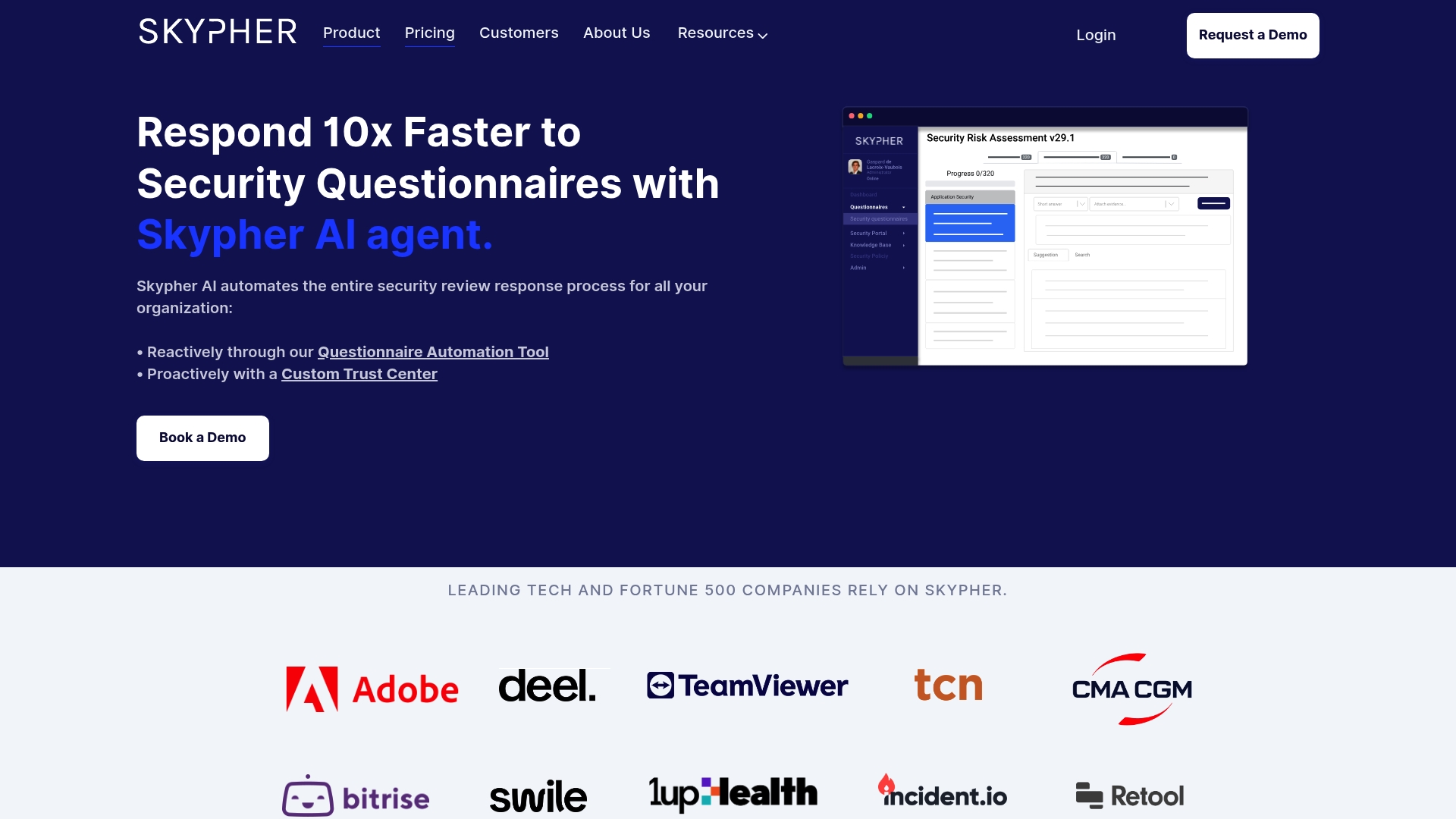
Skypher automates the painful parts of the compliance process using advanced AI tools built specifically for security questionnaire automation. That means faster turnaround on security assessments, fewer human errors, and stronger evidence for your next customer or audit. Boost your operational productivity and make compliance your team's strength. Start today by visiting Skypher and discover how our AI Questionnaire Automation Tool can help you take control of compliance risk right now.
Recommended
- The different formats & mistakes made when writing or answering security questionnaires
- The ever growing number of security questionnaires and what you and your company can do to face it
- The Case for Security Questionnaire Automation
- Increasing company efficiency: boosting collaboration with widespread adoption
- Steps to comply CCPA compliance by Bista Solutions
- Document Version Control for Businesses in 2025: Best Practices and Adobe Solutions - Mapsoft