

Manual security questionnaire processing creates a hidden drain on tech and finance organizations, with contract timelines extending 40-60% longer due to repetitive data entry and fragmented workflows. CISOs and compliance managers face mounting pressure to accelerate vendor onboarding while maintaining rigorous security standards. AI-driven automation transforms this bottleneck into a competitive advantage by reducing response times from hours to under a minute while cutting errors by up to 75%.
Table of Contents
- Understanding Security Questionnaire Challenges
- How AI And Automation Transform Questionnaire Responses
- Frameworks And Best Practices For Managing Security Questionnaires
- Common Misconceptions About Security Questionnaire Automation
- Integrating Automation With Risk Management Platforms
- Measurable Benefits And Real-World Outcomes
- Practical Steps To Implement Questionnaire Automation
- Streamline Your Security Questionnaire Responses With Skypher
- Frequently Asked Questions
Key takeaways
| Point | Details | |-------|---------|| | Manual processes cause major delays | Traditional workflows extend contract completion by 40-60% through repetitive entry and siloed systems. | | AI reduces response times dramatically | Advanced automation answers 200+ questions in under 60 seconds with higher accuracy. | | Integration drives efficiency | Connecting with 40+ risk management and collaboration platforms eliminates data silos. | | Automation enhances security posture | Standardized responses and validated content reduce compliance risks by 50-75%. | | Multilingual support enables global operations | AI handles diverse formats and languages for seamless international vendor management. |
Understanding security questionnaire challenges
Security questionnaires represent a critical yet time-consuming component of vendor risk management in tech and finance sectors. Organizations receive hundreds of these assessments annually, each requiring detailed responses about security controls, compliance certifications, and data protection practices. The manual processing of security questionnaires causes an average delay of 40-60% in contract completion timelines in tech and finance sectors due to repetitive data entry and fragmented workflows.
Three primary factors create this operational bottleneck:
- Repetitive manual data entry forces security teams to answer identical questions across different vendor portals, wasting hundreds of hours annually on duplicative work that adds no strategic value.
- Format diversity and multilingual requirements complicate standardization efforts as questionnaires arrive in Excel spreadsheets, Word documents, PDF forms, and proprietary online portals, each demanding unique handling approaches.
- Siloed workflows without real-time collaboration leave subject matter experts waiting for approvals, creating cascading delays as questionnaires bounce between legal, IT, and compliance teams without visibility into status or dependencies.
These challenges compound in regulated industries where accuracy directly impacts audit outcomes and client trust. A single error in a security questionnaire can trigger extended due diligence reviews or disqualify your organization from procurement consideration. The need for effective security questionnaire responses grows more urgent as vendor ecosystems expand and regulatory scrutiny intensifies.
Pro Tip: Track the hours your team spends on questionnaire responses over one month to quantify the true cost of manual processes before evaluating automation solutions.
How AI and automation transform questionnaire responses
AI-driven automation fundamentally reimagines how organizations handle security assessments by applying machine learning to pattern recognition, answer validation, and intelligent content matching. Modern AI-driven automation tools analyze incoming questionnaires, identify question intent rather than exact wording, and retrieve validated responses from your knowledge base in seconds.
The transformation delivers measurable improvements across three dimensions:
- Speed increases of 95%+ occur when AI processes questionnaires in under one minute compared to manual workflows requiring 8-12 hours, enabling security teams to handle 50x more vendor assessments without additional headcount.
- Error reduction of 50-75% results from standardized, pre-approved responses that eliminate transcription mistakes and ensure consistency across all vendor interactions, reducing compliance risk substantially.
- Multilingual and multi-format support allows organizations to respond to questionnaires in any language or file type without manual reformatting, critical for global operations spanning multiple regulatory jurisdictions.
Advanced AI models parse questions with contextual understanding, recognizing that "Do you encrypt data at rest?" and "What encryption methods protect stored information?" require the same core answer with slight customization. This semantic matching capability exceeds simple keyword searches, adapting responses to match each vendor's specific requirements.
The technology handles complexity that would overwhelm manual processes. Organizations with multiple products, regional entities, or compliance frameworks can configure AI systems to pull appropriate answers based on questionnaire context. For example, a question about GDPR compliance automatically retrieves EU-specific privacy controls rather than generic data protection statements.

Pro Tip: Pilot AI automation on your highest-volume questionnaire types first to demonstrate ROI quickly and build organizational confidence in the technology before expanding to complex assessments.
Implementing these systems requires thoughtful automation workflows that balance speed with accuracy, ensuring human oversight on sensitive or ambiguous questions while letting AI handle routine items.
Frameworks and best practices for managing security questionnaires
Successful automation requires a structured approach that combines technology capabilities with organizational processes. A comprehensive framework ensures consistent, compliant responses while maximizing efficiency gains.
Follow this proven implementation approach:
- Establish standardized response templates by auditing your most frequent questionnaire topics and creating master answers that legal, security, and compliance teams validate once for reuse across all vendor assessments.
- Implement AI-driven answer reuse systems that match incoming questions to your approved response library using semantic analysis, automatically populating 70-80% of typical questionnaires without manual intervention.
- Enable real-time collaboration features allowing multiple team members to review, edit, and approve responses simultaneously, accelerating workflows by 35% compared to sequential email-based review cycles.
- Configure multilingual processing to automatically detect questionnaire language and retrieve responses in the appropriate locale, essential for organizations operating across Europe, Asia, and the Americas.
- Integrate version control and audit trails that document who approved each response and when, creating defensible records for regulatory examinations and internal quality reviews.
The difference between manual and automated approaches becomes clear when comparing key metrics:
| Metric | Manual Process | AI Automation |
|---|---|---|
| Average completion time | 8-12 hours | Under 1 minute |
| Error rate | 15-25% | 3-5% |
| Team members required | 4-6 reviewers | 1-2 reviewers |
| Annual questionnaire capacity | 50-75 | 2,500+ |
| Consistency across responses | Low | High |
This framework works best when you designate response owners for each security domain (network security, access controls, incident response) who maintain master content and review AI-generated answers for accuracy. Their expertise ensures technical precision while automation handles the mechanical work of formatting and delivery.
Pro Tip: Create a feedback loop where your team flags AI mismatches or unclear questions, using these examples to continuously refine your knowledge base and improve automation accuracy over time.
Organizations following these best practices guide principles report dramatic improvements in both speed and quality, transforming security questionnaires from a bottleneck into a streamlined operation.
Common misconceptions about security questionnaire automation
Decision makers often hesitate to adopt automation based on outdated assumptions about technology limitations or security risks. Understanding the reality behind these misconceptions helps you make informed choices.
Three myths persistently obstruct automation adoption:
- "Automation reduces control over responses" misunderstands modern systems that require human approval for any answer before submission, with AI serving as an intelligent assistant that drafts responses for review rather than autonomously communicating with vendors.
- "Automated systems create security vulnerabilities" ignores that AI platforms typically offer enterprise-grade encryption, role-based access controls, and compliance certifications (SOC 2, ISO 27001) that exceed the security of spreadsheet-based manual processes vulnerable to email interception and version confusion.
- "AI cannot match human accuracy on complex questions" overlooks evidence showing automated systems achieve 50-75% fewer errors than manual responses by eliminating transcription mistakes, ensuring consistency, and flagging ambiguous questions for expert review rather than allowing rushed approximations.
The accuracy advantage stems from AI's ability to cross-reference responses against your validated knowledge base, preventing contradictory answers that occur when different team members respond to similar questions without coordination. Manual processes cannot maintain this consistency across hundreds of questionnaires.
Security concerns actually favor automation when properly implemented. AI systems create comprehensive audit trails showing exactly which approved content appeared in each response, when reviews occurred, and who authorized submission. Manual workflows relying on email attachments and verbal approvals lack this documentation.
Control increases rather than decreases with automation. You define exactly which questions require human review based on sensitivity, novelty, or strategic importance. The system routes these items to appropriate experts while handling routine questions about certifications, standard policies, and technical controls that rarely change.
Integrating automation with risk management platforms
Automation delivers maximum value when seamlessly connected to your existing technology ecosystem. Integration eliminates duplicate data entry and enables real-time synchronization across tools your team already uses daily.
Critical integration capabilities include:
- TPRM platform connectivity supporting 40+ systems like OneTrust, ServiceNow, Archer, and ProcessUnity allows automated questionnaire responses to flow directly into vendor risk assessments without manual exports and imports that introduce errors and delays.
- Collaboration tool integration with Slack and Microsoft Teams enables chatbot interfaces where team members request questionnaire status updates, approve responses, or flag issues without leaving their primary communication environment, reducing context switching.
- Document repository connections to Confluence, Notion, Google Drive, OneDrive, and SharePoint let AI systems automatically retrieve supporting evidence like SOC 2 reports, penetration test summaries, or policy documents when vendors request attachments, maintaining version accuracy.
These integrations create a unified workflow where questionnaire arrival triggers automated notifications in Slack, AI drafts responses using content from SharePoint, subject matter experts review via collaborative interfaces, and final answers sync automatically to your vendor risk platform for downstream analysis.
Real-time data exchange prevents the information silos that plague manual processes. When your security team updates an encryption standard in your knowledge base, that change immediately applies to all future questionnaire responses without requiring manual updates across multiple systems or notification emails to stakeholders.
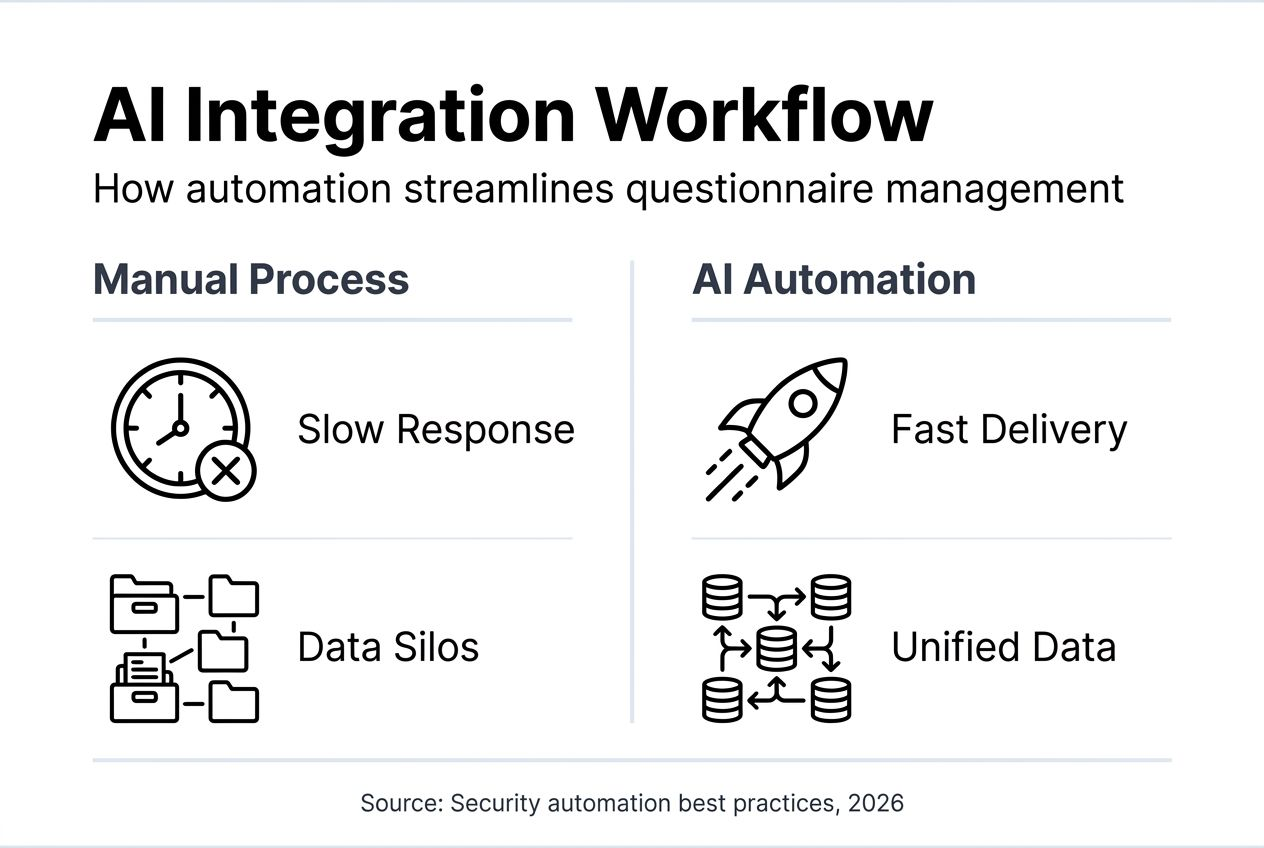
The breadth of integration options matters significantly. Organizations using niche or legacy TPRM platforms need automation tools offering API flexibility beyond pre-built connectors. Custom integration capabilities ensure your automation investment remains valuable even as your technology stack evolves.
These integration best practices ensure automation enhances rather than disrupts existing workflows, driving adoption and maximizing ROI.
Measurable benefits and real-world outcomes
Quantifiable results validate the business case for automation, demonstrating impact beyond anecdotal efficiency gains. Organizations across tech and finance sectors report consistent improvements in speed, accuracy, and client satisfaction.
Key performance improvements include:
- Contract cycle reduction of 70% occurs when finance firms using AI automation eliminate questionnaire bottlenecks, shortening vendor onboarding from 45-60 days to 12-18 days and accelerating revenue recognition for sales teams.
- Error rates dropping 50-75% strengthen compliance posture by ensuring consistent, validated responses that withstand audit scrutiny and reduce the risk of misrepresentation that could trigger regulatory penalties or contract disputes.
- Trust Center deployment creating self-service security documentation that prospects access 24/7 reduces inbound questionnaire volume by 40% as vendors find answers independently, freeing your team for high-value strategic work.
One global technology company processing 800+ security questionnaires annually reduced average completion time from 11 hours to 47 minutes while improving answer consistency across regional teams. Their compliance director noted:
"AI automation transformed security questionnaires from our biggest operational headache into a competitive differentiator. We now respond faster and more accurately than competitors, shortening our sales cycle and winning deals we previously lost to delays."
The financial impact extends beyond time savings. Organizations calculate ROI by multiplying hours saved by fully loaded employee costs, typically recovering automation investment within 4-6 months for teams handling 100+ questionnaires annually. Additional value accrues from faster contract closure, reduced compliance risk, and improved customer experience.
| Outcome Category | Traditional Approach | With Automation |
|---|---|---|
| Annual questionnaires completed | 75 | 2,000+ |
| Average response accuracy | 78% | 96% |
| Sales cycle length | 52 days | 18 days |
| Compliance incidents | 4-6/year | 0-1/year |
These results reflect experiences of mid-market and enterprise organizations implementing security questionnaire automation with proper change management and stakeholder buy-in.
The competitive advantage grows as vendor ecosystems expand and procurement teams demand faster response times. Organizations still using manual processes increasingly lose opportunities to competitors who respond within hours rather than weeks.
Beyond operational metrics, automation enables strategic transformation. Security teams shift focus from repetitive data entry to proactive risk management, threat analysis, and security architecture improvements that strengthen organizational resilience. This AI security implementation approach aligns technology capabilities with business objectives.
Practical steps to implement questionnaire automation
Successful implementation requires methodical planning that balances technical capabilities with organizational readiness. Following a structured approach minimizes disruption while accelerating time to value.
Execute these sequential steps:
- Assess your current questionnaire landscape by documenting annual volume, average completion time, formats received, languages required, and team members involved to establish baseline metrics for ROI calculation.
- Evaluate automation platforms based on integration breadth (40+ TPRM connectors), AI accuracy for your question types, multilingual support matching your markets, collaboration features, and vendor security certifications meeting your standards.
- Conduct a focused pilot with 15-20 questionnaires representing your typical mix of complexity, starting with medium-difficulty assessments rather than the easiest or hardest to accurately gauge real-world performance.
- Build your knowledge base by uploading existing security documentation, policies, certifications, and previous questionnaire responses, then having AI systems analyze and structure this content for semantic matching.
- Train your team on collaboration workflows, review processes, and escalation procedures, emphasizing that automation handles mechanical tasks while humans provide expert judgment on nuanced questions.
- Integrate with existing tools connecting your automation platform to TPRM systems, communication channels, and document repositories to eliminate manual handoffs and enable seamless data flow.
- Establish governance processes defining approval workflows, response ownership by domain, quality review cadences, and continuous improvement mechanisms that refine AI accuracy over time.
- Scale gradually expanding from pilot questionnaires to full production based on demonstrated accuracy and user confidence, adding complexity like multi-entity support or advanced customization as proficiency grows.
Timeline expectations should span 6-12 weeks from platform selection through full deployment, with pilot results visible within 2-3 weeks. Rushing implementation undermines accuracy and user adoption, while excessive delays allow questionnaire backlogs to accumulate.
Pro Tip: Designate an internal automation champion who understands both security content and change management to bridge technical and organizational considerations, resolving concerns and evangelizing benefits across stakeholder groups.
These implementation best practices have proven effective across hundreds of deployments in organizations ranging from 500 to 50,000 employees.
Success requires executive sponsorship that positions automation as strategic rather than tactical. When leadership frames questionnaire efficiency as enabling faster revenue growth and stronger security posture, adoption accelerates and resistance diminishes.
Streamline your security questionnaire responses with Skypher
Transforming security questionnaire workflows from manual bottlenecks into automated efficiency requires purpose-built technology that understands your challenges. Skypher's AI security questionnaire automation tool delivers the capabilities discussed throughout this article, processing even 200-question assessments in under one minute with proprietary AI models that exceed generic chatbot accuracy.

Our platform integrates with 40+ risk management systems and collaboration tools, supporting multilingual questionnaires across diverse formats while maintaining enterprise-grade security. Organizations implementing Skypher's best practices for automation report 70% faster contract cycles and 50-75% fewer response errors. Explore the compelling case for security questionnaire automation and discover how leading tech and finance organizations are gaining competitive advantage through intelligent automation.
Frequently asked questions
What are the main challenges in managing security questionnaires?
Manual data entry, diverse formats, and siloed workflows create the primary obstacles. Teams waste hours on repetitive responses while questionnaires languish in approval queues. Lack of standardization leads to inconsistent answers that confuse vendors and create compliance risk.
How does AI automation improve questionnaire response accuracy?
AI standardizes responses by matching questions to pre-approved answers in your knowledge base, eliminating transcription errors. Semantic understanding ensures consistent responses even when vendors phrase identical questions differently. Automated systems achieve 50-75% fewer errors than manual processes.
What integration capabilities should I look for in automation tools?
Prioritize platforms supporting 40+ TPRM systems like OneTrust and ServiceNow, plus collaboration tools like Slack and Teams. Document repository connections to SharePoint, Confluence, and Google Drive enable seamless evidence retrieval. API flexibility ensures compatibility with custom or legacy systems.
Can automation tools handle multilingual and multi-format questionnaires?
Advanced platforms automatically detect questionnaire language and format, processing Excel, Word, PDF, and online portal assessments without manual conversion. Multilingual support retrieves responses in appropriate locales for global operations. This capability proves essential for organizations serving international markets with diverse vendor requirements.