

PCI compliance can seem overwhelming for service providers, especially when payment card data touches so many parts of your business. Think every company is dodging these rules for now? Not even close. Last year, PCI non-compliance penalties hit as high as $100,000 per month for some organizations. The real surprise is how avoiding these standards does not just cost money. It can put your entire company’s reputation and processing privileges at risk overnight.
Table of Contents
- Who Needs PCI Compliance as a Service Provider
- Key PCI DSS Requirements for Service Providers
- Best Practices to Achieve and Maintain Compliance
- Common PCI Compliance Challenges and Solutions
Quick Summary
| Takeaway | Explanation |
|---|---|
| Evaluate your organization's PCI compliance needs. | Determine if your service processes payment data to define compliance obligations. |
| Implement fundamental PCI DSS requirements. | Ensure network security, access controls, and data protection to secure payment information. |
| Conduct ongoing compliance assessments. | Regularly evaluate security controls and update documentation to maintain compliance. |
| Address common compliance challenges proactively. | Use strategies like cost-effective solutions and improved data management to tackle compliance barriers. |
| Foster a culture of continuous security improvement. | Treat compliance as a dynamic process, encouraging ongoing employee training and response strategies. |
Who Needs PCI Compliance as a Service Provider
PCI compliance is not a one-size-fits-all requirement but a critical security standard for specific service providers handling payment card data. Understanding who needs to comply helps organizations protect sensitive financial information and avoid substantial financial penalties.
Types of Service Providers Requiring PCI Compliance
Service providers processing, storing, or transmitting credit card information must adhere to PCI DSS standards. This includes a broad range of businesses across multiple sectors. PCI Security Standards Council identifies several key categories of service providers mandated to maintain compliance:
- Payment Processors: Companies directly handling credit card transactions and financial data
- Cloud Service Providers: Hosting platforms storing payment-related information
- Managed Security Services: Organizations offering security infrastructure supporting payment systems
- Third-Party Technology Vendors: Software and technology companies interfacing with payment ecosystems
Specific Industries with Mandatory PCI Compliance
Certain industries have heightened requirements for PCI compliance due to their extensive interaction with payment systems. Verizon's Payment Security Report highlights sectors with the most stringent compliance needs:
- Retail and ecommerce platforms
- Financial technology (fintech) companies
- Healthcare billing and payment systems
- Telecommunications service providers
- Hospitality and travel reservation networks
Determining Your Compliance Requirements
Determining whether your organization needs PCI compliance involves evaluating several critical factors. Companies must assess their annual transaction volume, the type of card data processed, and their role in the payment ecosystem. Small businesses processing fewer than 20,000 transactions annually might have simplified compliance paths, while larger enterprises face more comprehensive requirements.
The compliance landscape is nuanced. Not all service providers will need identical levels of certification. Some may qualify for self-assessment questionnaires, while others require full on-site audits by qualified security assessors. Explore our guide on streamlining security questionnaires to understand the intricate compliance verification processes.
Failing to meet PCI DSS standards can result in significant consequences. Penalties can range from monthly fines of $5,000 to $100,000, potential loss of card processing privileges, and severe reputational damage. Proactive compliance is not just a regulatory requirement but a critical business protection strategy.
Key takeaway: If your service handles any form of payment card data, assume you need PCI compliance. Consult with a qualified security professional to determine your specific obligations and develop a robust compliance strategy.
To summarize which types of service providers and industries must comply with PCI DSS, consult the table below:
| Service Provider Type | Example Roles | Representative Industries |
|---|---|---|
| Payment Processors | Handle credit card transactions and financial data | Retail, E-commerce, Fintech |
| Cloud Service Providers | Host/store payment information or platforms | SaaS, Hosting, Healthcare, Hospitality |
| Managed Security Services | Manage security for payment systems | Telecommunications, Payment Networks |
| Third-Party Technology Vendors | Software/tech interfacing with payment data | Healthcare, Hospitality, Fintech |
Key PCI DSS Requirements for Service Providers
PCI DSS requirements represent a comprehensive framework designed to protect payment card data across complex digital environments. Service providers must navigate these standards meticulously to ensure robust cybersecurity and maintain customer trust.
Fundamental Security Control Requirements
The Payment Card Industry Data Security Standard (PCI DSS) mandates stringent security controls that service providers must implement. National Institute of Standards and Technology emphasizes that these requirements are not merely checkboxes but holistic security strategies.
Key fundamental requirements include:
- Network Security: Implement and maintain firewalls to protect cardholder data environments
- Access Control: Restrict system access through unique user IDs and strong authentication mechanisms
- Data Protection: Encrypt transmission of cardholder data across open networks
- Vulnerability Management: Develop and maintain secure systems and applications
- Regular Monitoring: Track and log all system access and network activities
Technical and Operational Compliance Standards
Service providers must demonstrate comprehensive technical and operational compliance across multiple domains. Cybersecurity and Infrastructure Security Agency recommends a multi-layered approach to meeting these complex requirements:
- Maintain secure network architectures
- Protect stored cardholder data through advanced encryption techniques
- Implement robust access control mechanisms
- Conduct regular vulnerability assessments and penetration testing
- Develop and maintain comprehensive security policies
- Create incident response and business continuity plans
Ongoing Compliance and Documentation
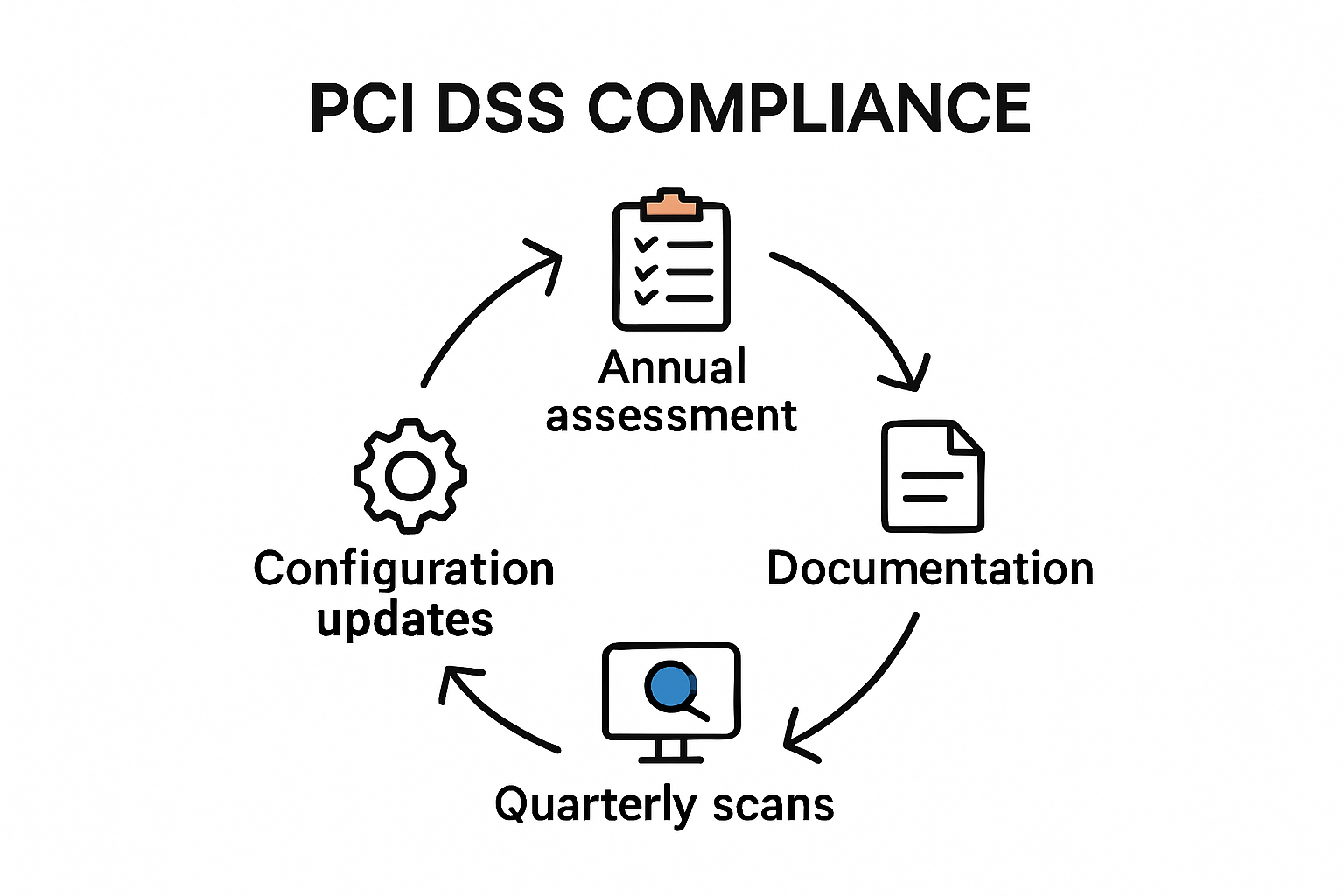 Compliance is not a one-time achievement but a continuous process of assessment, improvement, and documentation. Service providers must:
- Conduct annual PCI DSS assessments
- Maintain detailed documentation of security controls
- Perform quarterly network scans and vulnerability assessments
- Update security configurations regularly
- Train employees on security protocols and best practices
The consequences of non-compliance extend beyond potential financial penalties. Organizations risk losing their ability to process payment cards, facing significant reputational damage, and potentially compromising customer trust.
Discover how our security questionnaire automation can simplify your compliance journey, helping you navigate these complex requirements more efficiently.
Remember that PCI DSS requirements are not static. They evolve continuously to address emerging cybersecurity threats. Staying informed and proactive is crucial for maintaining robust payment card data protection.
Below is a summary table detailing essential PCI DSS requirements and ongoing obligations for service providers:
| Requirement Area | Key Actions/Standards |
|---|---|
| Network Security | Maintain firewalls; secure network architectures |
| Access Control | Unique user IDs; strong authentication; role-based permissions |
| Data Protection | Encrypt cardholder data in transit and at rest |
| Vulnerability Management | Regular vulnerability scans; maintain secure applications |
| Monitoring & Logging | Track all system/network access; maintain audit logs |
| Compliance Assessments | Annual reviews; quarterly scans; documentation upkeep |
| Employee Training | Ongoing security and best practices education |
Best Practices to Achieve and Maintain Compliance
Achieving and maintaining PCI DSS compliance requires a strategic and comprehensive approach that goes beyond simple checklist completion. Service providers must develop a proactive security culture that consistently prioritizes data protection and regulatory adherence.Comprehensive Security Risk Assessment
Effective PCI compliance begins with a thorough and continuous security risk assessment. SANS Institute recommends a systematic approach to identifying, evaluating, and mitigating potential vulnerabilities in payment card data environments. This process involves:
- Conducting detailed network mapping and infrastructure analysis
- Identifying all systems that interact with cardholder data
- Performing regular vulnerability scans and penetration testing
- Documenting potential security gaps and developing remediation strategies
- Establishing a risk prioritization framework
Implementing Robust Security Controls
Strong security controls are the foundation of PCI DSS compliance. National Cyber Security Centre emphasizes the importance of multi-layered security approaches that protect data at every potential point of vulnerability:
- Deploy advanced encryption technologies for data at rest and in transit
- Implement multi-factor authentication mechanisms
- Use network segmentation to isolate cardholder data environments
- Develop comprehensive access control policies
- Maintain up-to-date security patches and software updates
- Create and enforce strong password management protocols
Continuous Monitoring and Improvement
Compliance is an ongoing process that requires constant vigilance and adaptation. Service providers must establish robust monitoring and improvement mechanisms:
- Conduct regular internal and external security audits
- Implement real-time security monitoring systems
- Develop incident response and breach notification procedures
- Provide continuous security awareness training for employees
- Stay informed about emerging cybersecurity threats and PCI DSS updates
The most successful organizations treat PCI compliance as a dynamic security strategy rather than a static regulatory requirement. This means creating a culture of security that goes beyond mere technical controls.
Learn how to streamline your security assessment processes and reduce the complexity of maintaining compliance. By adopting a proactive and comprehensive approach, service providers can not only meet regulatory requirements but also build trust with customers and protect their most sensitive financial data.
Remember that PCI DSS compliance is more than a checkbox exercise. It represents a commitment to protecting your customers, your business, and the integrity of payment card ecosystems. Invest time, resources, and strategic thinking into developing a robust compliance framework that adapts to evolving technological and security landscapes.
Common PCI Compliance Challenges and Solutions
PCI DSS compliance presents numerous complex challenges for service providers. Navigating these obstacles requires strategic planning, advanced technological solutions, and a comprehensive understanding of potential roadblocks.
Data Complexity and Scope Management
One of the most significant challenges service providers face is managing the extensive scope of cardholder data environments. Verizon's Payment Security Report highlights that organizations often struggle with accurately identifying and protecting all systems that interact with payment card data.
Key challenges in this domain include:
- Mapping complex network infrastructures
- Identifying all systems that touch cardholder data
- Managing legacy systems with potential security vulnerabilities
- Controlling data proliferation across multiple platforms
Solutions involve implementing comprehensive data discovery tools, conducting regular network segmentation assessments, and developing robust data flow mapping strategies. Organizations must create a precise inventory of all systems and connections to minimize compliance risks.
Technology and Resource Constraints
Small to medium-sized service providers often face significant barriers in implementing comprehensive PCI DSS requirements. Gartner Research indicates that resource limitations can create substantial compliance challenges:
- Limited budgets for advanced security technologies
- Insufficient internal cybersecurity expertise
- Challenges in maintaining continuous monitoring capabilities
- Difficulty keeping pace with evolving security standards
Effective strategies to overcome these constraints include:
- Leveraging cloud-based security solutions
- Implementing cost-effective security automation tools
- Investing in employee training and skill development
- Considering managed security service partnerships
Emerging Technology and Compliance Complexity
Rapidly evolving technological landscapes create ongoing compliance challenges. Service providers must continuously adapt to new security threats and technological innovations. This dynamic environment requires:
- Constant vigilance in identifying new vulnerabilities
- Flexible compliance strategies
- Proactive technology updates
- Adaptive security frameworks
Learn how to streamline your security assessment processes and address these complex compliance challenges more effectively. The key is developing a proactive approach that anticipates potential obstacles and creates scalable solutions.
Successful PCI compliance is not about perfect implementation but about demonstrating consistent effort, continuous improvement, and a genuine commitment to protecting sensitive financial data. Service providers must view compliance as a strategic business process rather than a mere regulatory requirement.
Organizations that transform compliance challenges into opportunities for enhancing their security posture will ultimately create more robust, trustworthy payment card ecosystems. By embracing a holistic approach to PCI DSS requirements, service providers can turn potential obstacles into competitive advantages.

Frequently Asked Questions
What is PCI compliance and who needs it?
PCI compliance refers to the Payment Card Industry Data Security Standard (PCI DSS), a set of security standards designed to protect payment card information. Any service provider that processes, stores, or transmits credit card information must comply with these standards.
What are the penalties for PCI non-compliance?
Penalties for PCI non-compliance can range from monthly fines between $5,000 to $100,000, potential loss of card processing privileges, and significant reputational damage for organizations that fail to meet the requirements.
How can a service provider determine their PCI compliance requirements?
To determine PCI compliance requirements, service providers should assess their annual transaction volume, the type of card data they process, and their role in the payment ecosystem. Consulting with a qualified security professional can also help clarify specific obligations.
What are some best practices for maintaining PCI compliance?
Best practices for maintaining PCI compliance include conducting comprehensive security risk assessments, implementing robust security controls, training employees on security protocols, and engaging in continuous monitoring and improvement of security measures.
Ready to Simplify PCI DSS Compliance Challenges?
If PCI compliance feels overwhelming, you are not alone. The article highlights how managing complex security requirements, handling security questionnaires, and keeping up with ongoing documentation can slow down your business and add stress to your team. Service providers like you need confidence that risk assessments, audits, and questionnaire responses are done right the first time. Every delay or manual error not only threatens compliance, but could also impact your client trust and future revenue.
Let Skypher help you take control of the process right away. Our AI-driven platform streamlines security questionnaire completion, automates repetitive PCI documentation, and supports real-time collaboration among your teams. With support for over 40 third-party risk management platforms, you can prepare for any assessment or audit with total confidence. Learn how you can cut compliance workload and speed up security reviews by streamlining your security questionnaires. Visit Skypher today and start simplifying PCI compliance before the next audit cycle. Your business and your customers deserve this level of efficiency.
Recommended
- The different formats & mistakes made when writing or answering security questionnaires
- The ever growing number of security questionnaires and what you and your company can do to face it
- Features
- The Case for Security Questionnaire Automation
- Data Privacy Best Practices for Small Businesses in 2025 - Loft Legal