

Decoding the Risk Compliance Definition: Core Concepts Explored
Risk compliance definition encompasses the systematic process of identifying, assessing, and mitigating potential risks related to regulatory requirements, industry standards, and internal policies. At its core, compliance risk management involves establishing controls to prevent violations that could result in financial penalties, reputational damage, or operational disruptions.
The compliance risk definition extends beyond mere regulatory adherence to include:
- Legal compliance risks: Penalties from regulatory bodies (e.g., GDPR violations averaging €15.7 million per major case)
- Operational compliance risks: Business disruptions from non-compliance
- Financial compliance risks: Monetary losses from penalties or remediation costs
- Reputational compliance risks: Brand damage from public disclosure of violations
According to a 2023 Deloitte survey, organizations with integrated compliance risk frameworks experienced 63% fewer regulatory incidents compared to those with fragmented approaches. This underscores the importance of developing comprehensive compliance strategies rather than siloed responses to individual regulations.
Understanding the types of compliance risks relevant to your industry creates the foundation for effective risk management. For financial institutions, these often include anti-money laundering and data privacy requirements, while healthcare organizations must navigate HIPAA and patient safety regulations.
Key Takeaways
| Key Point | Details |
|---|---|
| Comprehensive Compliance Strategies | Organizations with integrated compliance risk frameworks see significantly fewer regulatory incidents (63% less) than those using fragmented approaches. |
| Types of Compliance Risks | Compliance risk management must address legal, operational, financial, and reputational risks, each with specific implications for organizations. |
| Importance of Industry-Specific Considerations | Different sectors, such as finance and healthcare, face unique compliance risks that necessitate tailored risk management strategies. |
Key Components and Frameworks in Effective Risk Compliance

Implementing robust risk compliance requires several interconnected components working in harmony. Effective compliance risk management frameworks typically include structured approaches that organizations can adapt to their specific needs and regulatory environments.
A comprehensive compliance risk framework incorporates:
- Risk identification and assessment processes that systematically catalog potential compliance exposures
- Clear policies and procedures that translate regulatory requirements into operational controls
- Training and awareness programs ensuring staff understand compliance obligations
- Monitoring and testing mechanisms that verify ongoing adherence
- Reporting structures that provide visibility to leadership and regulators
The Committee of Sponsoring Organizations (COSO) framework remains one of the most widely adopted approaches, with 76% of Fortune 500 companies using it as their primary compliance risk management definition foundation. This framework emphasizes the integration of compliance controls with broader enterprise risk management.
For regulated industries, sector-specific frameworks provide tailored guidance. Healthcare organizations often implement compliance programs based on the Office of Inspector General (OIG) guidelines, while financial institutions may follow the Basel Committee's compliance risk framework, which defines compliance risk as "the risk of legal or regulatory sanctions, financial loss, or reputational damage."
Regardless of industry, the definition of compliance risk should be operationalized through documented processes that assign clear ownership and accountability for risk mitigation.
Addressing Common Challenges: FAQs and Pain Points in Compliance
Organizations frequently encounter obstacles when implementing compliance risk management. Addressing these pain points proactively can transform compliance from a burden into a business advantage.
What is compliance risk in practical terms?
Compliance risk represents the potential consequences of failing to comply with laws, regulations, or internal policies. In practice, this manifests as regulatory fines, legal penalties, remediation costs, and reputational damage. A manufacturing company faced this reality when non-compliance with environmental regulations resulted in $4.3 million in fines and a 22% stock value decline.
How do organizations manage evolving regulatory landscapes?
Regulatory change management presents a significant challenge, with companies receiving an average of 257 regulatory alerts daily across jurisdictions. Successful compliance programs employ dedicated regulatory tracking systems, cross-functional impact assessments, and automated compliance controls that adapt to changing requirements.
Common compliance challenges include:
- Resource constraints limiting compliance monitoring capabilities
- Siloed compliance functions creating visibility gaps across departments
- Difficulty quantifying compliance risk in monetary terms
- Balancing compliance requirements with business objectives
- Inconsistent risk assessment methodologies across business units
The most effective organizations address these challenges by integrating compliance risk management into their overall governance framework. This integrated approach enables compliance risks to be evaluated alongside strategic and operational risks, ensuring proportionate resource allocation and executive visibility.
Implementing Practical Risk Compliance Strategies for Business Success
Translating compliance risk definition into actionable strategies requires a systematic approach that balances regulatory demands with business objectives. Organizations that excel in compliance risk management typically follow these proven implementation strategies:
- Conduct comprehensive compliance risk assessments that quantify potential impacts using consistent methodology
- Develop risk-based compliance programs that allocate resources proportionately to highest-risk areas
- Implement technology solutions that automate routine compliance monitoring and testing
- Establish key risk indicators (KRIs) that provide early warning of developing compliance issues
- Create a documented compliance risk appetite statement aligned with overall enterprise risk tolerance
Technology plays an increasingly crucial role in managing compliance risks effectively. A 2022 Thomson Reuters survey found organizations using compliance technology solutions reduced compliance failures by 47% compared to manual approaches. Regulatory technology (RegTech) solutions now offer capabilities from automated regulatory change management to AI-powered transaction monitoring.
Financial services firm Capital One demonstrates effective compliance risk management through its three lines of defense model. Business units own compliance risks directly, a dedicated compliance function provides oversight and guidance, while internal audit independently tests controls. This approach reduced compliance incidents by 35% over three years while supporting business growth.
Successful compliance frameworks emphasize prevention rather than detection, integrating compliance considerations into business processes rather than applying them retrospectively. By embedding compliance into operations, organizations transform what could be viewed as a cost center into a competitive advantage.
Leveraging Technology: Automating and Enhancing Risk Compliance
Technology has revolutionized how organizations approach compliance risk management, transforming manual, paper-based processes into sophisticated, automated systems. Modern compliance technology solutions directly address the compliance risk definition by providing tools that systematically identify, monitor, and mitigate regulatory exposures.
Advanced compliance technologies include:
- Regulatory change management platforms that track updates across jurisdictions
- Automated risk assessment tools that standardize compliance risk evaluation
- Workflow systems that document compliance activities and approvals
- AI-powered monitoring solutions that detect anomalies and potential violations
- Data analytics tools that identify patterns indicating compliance weaknesses
GRC (Governance, Risk, and Compliance) platforms have become central to effective compliance risk frameworks. According to Gartner research, organizations implementing integrated GRC solutions experience a 55% reduction in compliance-related incidents and 25% lower compliance costs compared to organizations using fragmented solutions.
A notable example comes from JPMorgan Chase, which invested $600 million in compliance technology after facing regulatory penalties. Their machine learning systems now review 12,000 transactions per second against compliance parameters, identifying potential issues that would be impossible to detect manually.
When selecting compliance technology, organizations should prioritize solutions that integrate with existing business systems, provide real-time monitoring capabilities, and generate comprehensive audit trails. The return on investment typically manifests through reduced compliance failures, more efficient resource allocation, and improved regulatory relationships.
Future Trends and Regulatory Insights Shaping Risk Compliance
The compliance risk landscape continues to evolve, requiring organizations to anticipate emerging requirements rather than merely reacting to established regulations. Several trends are reshaping how businesses approach compliance risk management definition and implementation.
Data privacy regulations represent the fastest-growing area of compliance risk, with 65% of the world's population expected to have their personal data protected under modern privacy regulations by 2023, according to Gartner. Organizations must develop compliance strategies that address increasingly stringent requirements across jurisdictions.
Emerging trends in compliance risk management include:
- ESG (Environmental, Social, Governance) compliance requirements becoming mandatory rather than voluntary
- Increased regulatory focus on operational resilience and third-party risk management
- Growing expectations for real-time compliance monitoring rather than periodic assessments
- Regulatory convergence across jurisdictions creating more standardized compliance frameworks
- AI governance regulations establishing new compliance obligations for organizations using artificial intelligence
Regulators themselves are adopting technology to enhance supervision capabilities. The SEC's Advanced Analytics program uses AI to detect potential market manipulation and compliance failures. This trend toward "SupTech" (Supervisory Technology) means compliance programs must evolve to match regulators' increasingly sophisticated detection capabilities.
Forward-thinking organizations are responding by integrating compliance considerations into product development and strategic planning rather than treating compliance as an afterthought. This proactive approach aligns with the expanding definition of compliance risk to encompass operational, reputational, and strategic dimensions beyond mere regulatory adherence.
Frequently Asked Questions
What is the definition of compliance risk?
Compliance risk refers to the potential consequences of failing to adhere to laws, regulations, or internal policies, which can result in regulatory fines, legal penalties, and reputational damage.
How can organizations effectively manage compliance risks?
Organizations can manage compliance risks by implementing a comprehensive risk framework that includes risk assessments, clear policies, dedicated training, and monitoring processes to handle regulatory requirements proactively.
What are the key components of a successful risk compliance framework?
A successful risk compliance framework typically includes risk identification and assessment, clear operational policies, employee training programs, ongoing monitoring, and reporting to leadership and regulators.
What role does technology play in risk compliance management?
Technology enhances risk compliance management by automating processes, tracking regulatory changes, and enabling real-time monitoring, resulting in improved efficiency and reduced compliance failures.
Transform Your Compliance Challenges into Opportunities with Skypher
Navigating the complexities of compliance risk can feel overwhelming, especially when faced with continuous regulatory changes and operational constraints. As the article highlights, organizations often struggle with resource limitations, siloed compliance functions, and effective risk management strategies. Enter Skypher, your all-in-one solution designed to streamline security questionnaire processes, allowing you to overcome these challenges effortlessly.
With our AI Questionnaire Automation Tool, you can quickly automate your compliance responses, reducing the time and effort spent on managing security reviews by 50%. Imagine transforming compliance risks into operational strength with:
- Real-time collaboration that fosters team communication and transparency
- API integrations with over 40 third-party risk management platforms, ensuring you maintain compliance across all jurisdictions
- A Custom Trust Center that showcases your compliance credentials to clients, enhancing their trust in your organization.
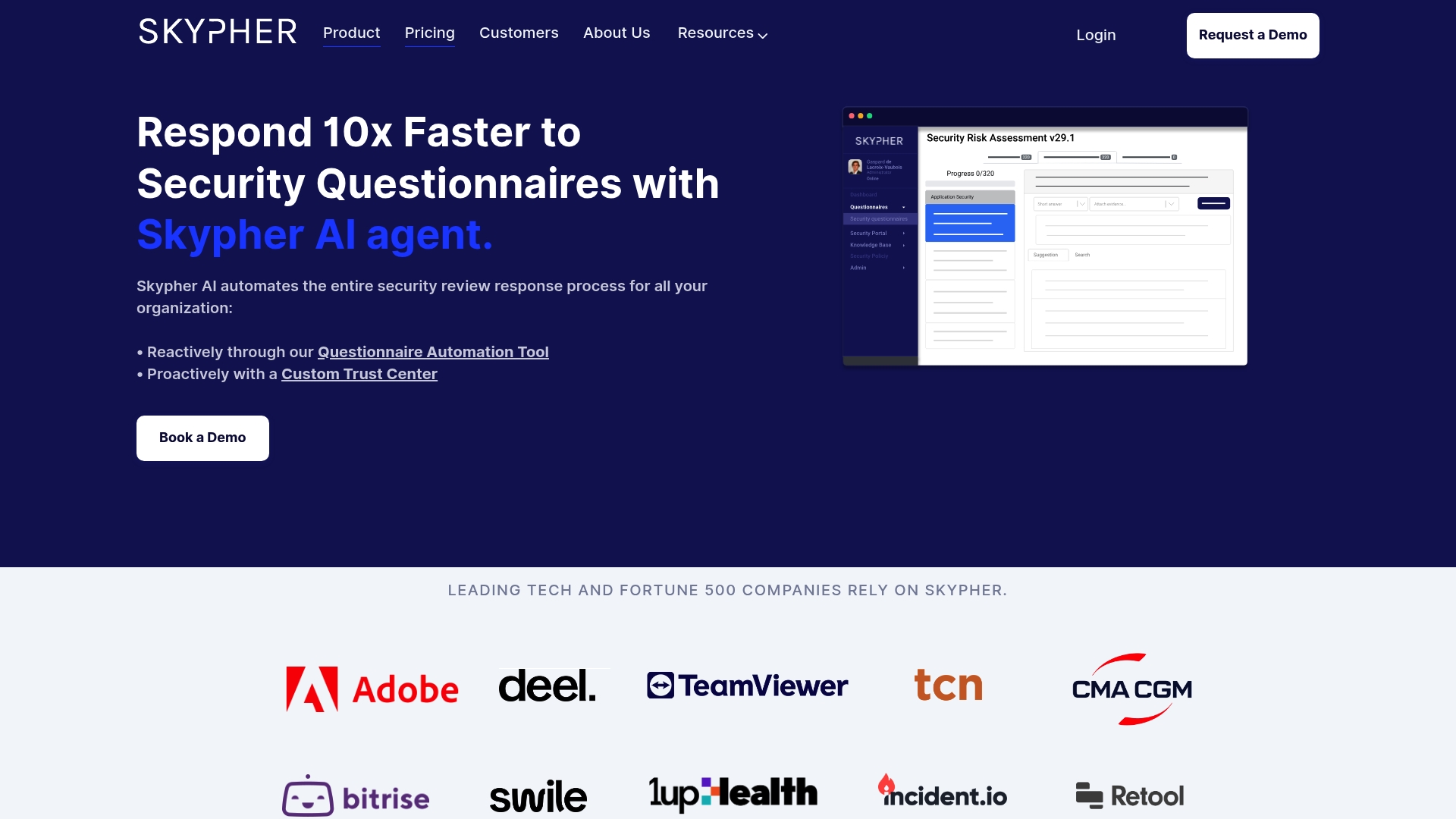
Why wait until compliance becomes a hurdle? Take control of your risk management today. Visit Skypher and unlock the potential of technology to safeguard your organization while promoting operational efficiency. Your response to compliance can be faster and more accurate—let’s make it happen together!