

Every B2B software company depends on the right people making the right moves at the right time. Teams might look similar on paper but research shows that well-defined roles and clear responsibilities can increase organizational effectiveness by up to 30 percent. Most leaders think job titles alone keep the gears turning but the true power is unlocked when every role fits together like a living blueprint. That shift changes how your team delivers results and adapts to challenges.
Table of Contents
- 1: Understand Key Roles in B2B Software Companies
- 2: Define Responsibilities for Each Role
- 3: Set Clear Expectations for Team Members
- 4: Implement Regular Role Assessments and Updates
- 5: Foster Collaboration Between Roles
- 6: Measure the Impact of Each Role on Success
- 7: Adapt Roles as Market Dynamics Change
Quick Summary
| Takeaway | Explanation |
|---|---|
| Understand key roles clearly | Recognize essential roles like Account Executives and Product Managers for effective collaboration. |
| Define responsibilities dynamically | Clearly outline responsibilities to eliminate ambiguity and enhance team performance, adjusting as needed. |
| Set clear, measurable expectations | Establish specific performance metrics and communication protocols to guide team interactions and accountability. |
| Regularly assess and adapt roles | Continuously evaluate roles based on market changes to ensure skills and responsibilities align with business objectives. |
| Foster cross-role collaboration | Implement structured communication channels and shared objectives to enhance teamwork and engagement across different functions. |
1: Understand Key Roles in B2B Software Companies
Navigating the complex landscape of B2B software companies requires a strategic understanding of critical organizational roles that drive success. In these dynamic environments, each professional plays a pivotal part in delivering value, managing client relationships, and achieving business objectives.
According to research from ResearchGate, the core roles in B2B software companies are interconnected and essential for sustainable growth. Understanding these roles is not just about job titles but about comprehending how each position contributes to the overall organizational ecosystem.
The most critical roles in a B2B software company typically encompass:
-
Account Executives: Responsible for identifying potential clients, managing sales pipelines, and closing high-value contracts
-
Solutions Engineers: Technical experts who translate complex software capabilities into tangible business solutions for potential clients
-
Customer Success Managers: Focused on ensuring client satisfaction, managing ongoing relationships, and driving long-term account retention
-
Product Managers: Strategic professionals who define product vision, prioritize feature development, and align technological offerings with market needs
Each role requires a unique skill set and perspective. Account executives must possess exceptional communication and negotiation skills, while solutions engineers need deep technical knowledge and the ability to explain complex concepts simply. Customer success managers require empathy, problem solving abilities, and a customer-centric approach. Product managers must blend technical understanding with strategic thinking and market insights.
Successful B2B software companies recognize that these roles are not isolated functions but interconnected components of a cohesive business strategy. Collaboration, clear communication, and mutual understanding between these roles are fundamental to delivering exceptional value to clients and maintaining a competitive edge in the market.
2: Define Responsibilities for Each Role
Clear role definition represents the backbone of organizational effectiveness in B2B software companies. According to Digital.gov's guide on operational roles, establishing precise responsibilities eliminates ambiguity and drives team performance.
Effective role definition involves more than simply listing job descriptions. It requires a comprehensive understanding of how each team member contributes to the broader organizational objectives. This approach ensures that every professional understands their unique value proposition and how their work intersects with other team members.
Key responsibilities for core B2B software roles include:
-
Account Executives: Develop comprehensive sales strategies
-
Solutions Engineers: Design technical solutions matching client requirements
-
Customer Success Managers: Ensure client satisfaction and retention
-
Product Managers: Drive product development and market alignment
Accountability becomes crucial when defining these responsibilities. Each role must have measurable outcomes that directly contribute to the company's strategic goals. For instance, account executives might be evaluated on quarterly revenue targets, while solutions engineers could be assessed on the technical complexity and effectiveness of proposed client solutions.
The process of defining responsibilities should be dynamic and adaptable. As market conditions evolve and technological landscapes shift, role definitions must remain flexible. Regular performance reviews, cross-functional communication, and periodic role reassessments help organizations maintain alignment between individual contributions and overarching business objectives.
Successful B2B software companies recognize that clear role responsibilities are not about rigid constraints but about creating a framework that empowers professionals to excel. By providing clarity, setting realistic expectations, and maintaining open communication channels, organizations can unlock their teams' full potential and drive sustainable growth.
3: Set Clear Expectations for Team Members
Establishing unambiguous expectations is fundamental to creating a high-performing B2B software team. Research from psychological safety studies demonstrates that clarity of team norms directly correlates with team performance and individual job satisfaction.
Expectations go beyond basic job descriptions. They encompass performance standards, communication protocols, collaborative approaches, and individual accountability. Without clear expectations, teams risk misalignment, reduced productivity, and potential interpersonal conflicts.
Key considerations for setting team expectations include:
-
Performance Metrics: Define quantifiable goals for each role
-
Communication Protocols: Establish preferred communication channels and response times
-
Collaboration Frameworks: Outline how team members interact and support each other
-
Professional Development: Create pathways for skill enhancement and career growth
Transparent communication is crucial in setting these expectations. Team leaders must articulate requirements clearly, provide context for each expectation, and create opportunities for team members to seek clarification. This approach transforms expectations from rigid rules into a collaborative understanding.
Effective expectation setting also requires regular review and adaptation. What works today might need adjustment tomorrow. Regular feedback sessions, performance reviews, and open dialogues help teams refine their expectations dynamically. This flexibility ensures that expectations remain relevant to changing business landscapes and individual team member capabilities.
Moreover, expectations should empower rather than restrict. They should provide a framework that enables team members to excel, innovate, and contribute meaningfully. By creating a supportive environment with clear, achievable expectations, B2B software companies can foster a culture of high performance, mutual respect, and continuous improvement.
4: Implement Regular Role Assessments and Updates
Regular role assessments are critical for maintaining organizational agility and individual professional growth. According to research in performance management, structured evaluation processes can significantly enhance employee engagement and organizational effectiveness.
Role assessments are not annual administrative tasks but strategic opportunities for continuous improvement. They provide a systematic approach to understanding how individual contributions align with evolving business objectives. By regularly reviewing and updating roles, organizations can ensure their talent strategies remain dynamic and responsive.
Key components of effective role assessments include:
-
Performance Metrics: Evaluate individual achievements against predefined goals
-
Skills Gap Analysis: Identify areas for professional development
-
Career Progression Mapping: Create clear pathways for advancement
-
Organizational Alignment: Ensure individual roles support broader business strategies
Transparency is paramount during these assessment processes. Employees should understand the assessment criteria, receive constructive feedback, and have opportunities to provide input about their roles. This collaborative approach transforms assessments from potentially intimidating reviews into meaningful dialogues about professional growth.
Technology can play a significant role in streamlining role assessments. Digital platforms enable real-time performance tracking, skill mapping, and continuous feedback mechanisms. These tools help organizations move beyond traditional annual reviews, creating more dynamic and responsive evaluation systems.
Moreover, role assessments should be forward-looking. They are not just about measuring past performance but about creating future potential. By regularly reassessing roles, organizations can proactively adapt to technological changes, market shifts, and emerging business needs. This approach ensures that team members remain equipped with the skills and responsibilities necessary to drive organizational success.
5: Foster Collaboration Between Roles
Collaboration represents the cornerstone of successful B2B software organizations. Research from collaborative team studies demonstrates that strategic interactions between different roles can dramatically enhance organizational performance and innovation.
Effective collaboration transcends simple communication. It requires creating intentional frameworks that enable meaningful exchanges across different professional domains. When account executives, solutions engineers, customer success managers, and product managers work in synchronization, the entire organization becomes more responsive and dynamic.
Key strategies for fostering cross-role collaboration include:
-
Regular Cross-Functional Meetings: Create structured opportunities for interdepartmental dialogue
-
Shared Digital Collaboration Platforms: Implement tools that enable real-time information sharing
-
Joint Performance Objectives: Design goals that require multiple roles to collaborate
-
Knowledge Exchange Programs: Facilitate learning opportunities between different team segments
Breaking down organizational silos is crucial. Traditional hierarchical structures often impede information flow and create artificial barriers between roles. By promoting a culture of openness, transparency, and mutual respect, organizations can create an environment where professionals feel empowered to share insights, challenge assumptions, and collectively solve complex challenges.
Technology plays a significant role in enabling collaboration. Modern communication tools and project management platforms provide unprecedented opportunities for seamless interaction. These technologies allow team members to share documents, track progress, and maintain context across different roles and projects.
Ultimately, successful collaboration requires a fundamental shift in organizational mindset. It is about creating a unified vision where individual contributions are recognized as interconnected parts of a larger strategic ecosystem. By valuing diverse perspectives and creating channels for meaningful engagement, B2B software companies can unlock their team's full potential and drive sustainable competitive advantage.
6: Measure the Impact of Each Role on Success
Measuring the impact of individual roles is critical for understanding organizational performance and driving strategic improvements. Research on performance measurement systems reveals that systematic evaluation provides insights beyond traditional metrics, enabling more nuanced organizational development.
Impact measurement is not about punitive assessment but strategic optimization. Each role contributes uniquely to the organization's success, and understanding these contributions requires comprehensive, multifaceted evaluation approaches that go beyond simple numerical metrics.
Key metrics for measuring role impact include:
-
Revenue Generation: Direct and indirect financial contributions
-
Client Satisfaction Scores: Measuring relationship quality and retention
-
Efficiency Indicators: Time and resource optimization
-
Innovation Contributions: New ideas and process improvements
Quantitative metrics must be balanced with qualitative assessments. Numbers alone cannot capture the full spectrum of professional contributions. Peer reviews, 360-degree feedback, and narrative evaluations provide deeper insights into how each role drives organizational success.
Technology plays a crucial role in impact measurement. Advanced analytics and performance tracking tools enable real-time monitoring of individual and collective contributions. These systems can identify patterns, highlight potential areas of improvement, and provide data-driven insights for strategic decision making.
Moreover, impact measurement should be a collaborative and transparent process. When team members understand how their roles are evaluated, they become more engaged and motivated. This approach transforms measurement from a potentially intimidating exercise into an opportunity for professional growth and organizational alignment.
Ultimately, measuring role impact is about creating a dynamic, responsive organizational ecosystem. By continuously assessing and understanding each role's unique contributions, B2B software companies can create more agile, effective, and innovative teams that are well-equipped to navigate complex business landscapes.
7: Adapt Roles as Market Dynamics Change
Adapting organizational roles in response to market dynamics is not just a strategic choice but a survival imperative for B2B software companies. Research from organizational adaptation studies demonstrates that businesses must continuously reassess and modify their internal structures to remain competitive.
Role adaptation is a proactive process, not a reactive measure. Successful organizations anticipate market shifts and preemptively adjust their team structures, skill requirements, and professional responsibilities. This approach ensures that the organization remains agile and responsive to emerging technological and business challenges.
Critical considerations for role adaptation include:
-
Skill Mapping: Continuously update required competencies
-
Technology Trend Analysis: Monitor emerging technological shifts
-
Market Demand Evaluation: Assess changing client expectations
-
Competitive Landscape Monitoring: Track industry transformation patterns
Flexibility becomes a core organizational competency. Traditional role definitions are increasingly obsolete in a rapidly evolving technological landscape. Professionals must develop adaptable skill sets that transcend traditional job descriptions, enabling them to pivot quickly as market demands change.
Technology plays a crucial role in facilitating role adaptation. Advanced analytics and predictive modeling tools can help organizations forecast skill requirements and identify potential gaps before they become critical. These technologies enable data-driven decision making, allowing companies to strategically realign their human resources.
Moreover, successful role adaptation requires a cultural commitment to continuous learning and professional development. Organizations must create environments that encourage upskilling, cross-functional training, and innovative thinking. By fostering a culture of adaptability, companies can transform potential disruptions into opportunities for growth and innovation.
Ultimately, adapting roles is about maintaining organizational relevance. **B2B software companies that can quickly and effectively modify their internal structures will be best positioned to navigate the complex, ever-changing technological landscape.
Below is a comprehensive table summarizing the article's main topics, key steps, and takeaways for building B2B team success through critical roles and collaboration.
| Step / Focus Area | Key Actions & Insights | Benefits / Outcomes |
|---|---|---|
| Understand Key Roles | Identify and comprehend the roles (Account Executives, Solutions Engineers, Customer Success Managers, Product Managers) and their unique contributions. | Informed role alignment, stronger collaboration |
| Define Responsibilities | Clearly outline dynamic, measurable responsibilities for each role and adapt as market or business needs evolve. | Reduced ambiguity, increased accountability |
| Set Clear Expectations | Establish transparent performance metrics, communication protocols, and review cycles. | Higher performance, team clarity, reduced conflicts |
| Regular Role Assessments & Updates | Continuously evaluate roles using metrics, skill gap analysis, and feedback; update responsibilities to match business objectives. | Organizational agility, improved professional growth |
| Foster Cross-Role Collaboration | Implement structured meetings, shared objectives, digital platforms, and knowledge exchange to unite diverse professionals. | Enhanced teamwork, innovation, and engagement |
| Measure Role Impact | Track both quantitative (revenue, efficiency) and qualitative (client satisfaction, peer feedback) contributions of each role. | Strategic optimization, improved motivation, data-driven decisions |
| Adapt Roles as Market Dynamics Change | Proactively update roles based on evolving skills, technologies, and market trends; foster continuous learning and flexibility. | Sustained competitiveness, future-readiness |
Transform Your B2B Team's Effectiveness with Automated Security Workflows
Are you struggling to clearly define roles or ensure flawless collaboration when handling complex security questionnaires? The article you just read highlights how critical it is for B2B software companies to bridge communication, speed up processes, and keep everyone aligned. When roles such as account executives, product managers, and solutions engineers are weighed down by manual security reviews, productivity and client trust suffer. That is where automation and real-time integration become essential for your organization's success.
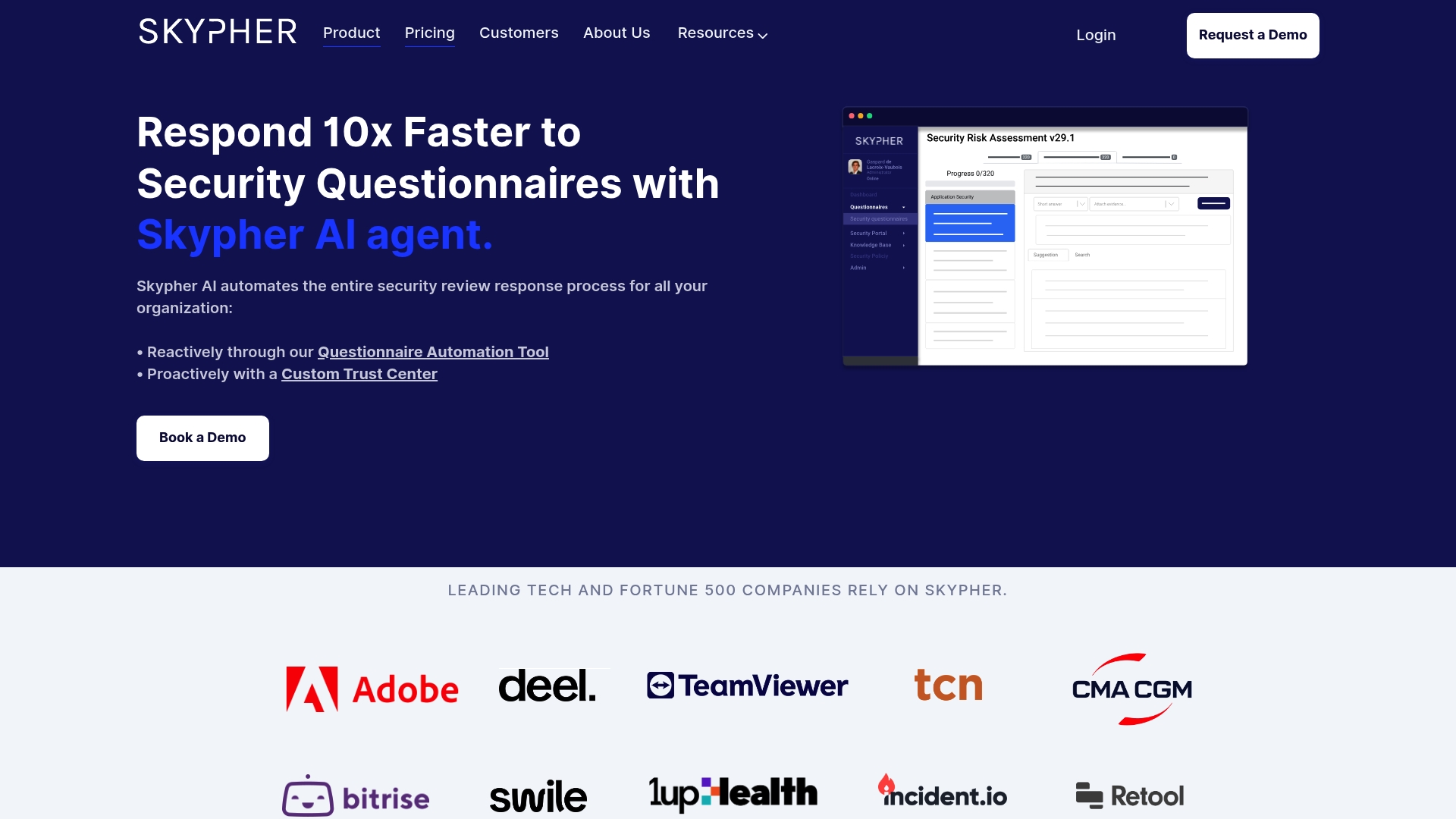
Let Skypher show you how much smoother your B2B operations can run. Our AI Questionnaire Automation Tool enables every team member to contribute efficiently to security reviews, freeing time for higher-value tasks. Take the next step toward better role collaboration, streamlined client onboarding, and improved trust. Visit Skypher today to accelerate your sales cycles, reduce errors, and empower your team to deliver top-tier results. If you are ready to see real improvement in team performance and client relationships, do not wait. Start now and experience the difference.
Frequently Asked Questions
What are the key roles in a B2B software company?
The key roles in a B2B software company typically include Account Executives, Solutions Engineers, Customer Success Managers, and Product Managers. Each role contributes uniquely to client relationships and overall business success.
How can clear role definitions impact team performance?
Clear role definitions help eliminate ambiguity, drive team performance, and ensure everyone understands their contributions to the company's broader objectives. This clarity fosters accountability and enhances collaboration among team members.
Why is it important to measure the impact of each role on organizational success?
Measuring the impact of each role provides insights into contributions beyond traditional metrics, helping organizations optimize their strategies for better performance, client satisfaction, and innovation.
How should B2B software companies adapt roles as market conditions change?
B2B software companies should proactively reassess and modify roles based on skill mapping, technology trends, market demand, and competitive analysis, ensuring agility and responsiveness in their organizational structure.