

Selecting the right security awareness certification can feel overwhelming when compliance requirements and risk profiles vary across industries like Finance and Technology. For CISOs and compliance managers, overlooking role-specific threats or regulatory mandates risks not only audit failures but also organizational security gaps. This guide breaks down how to tailor training to your workforce, compliance standards, and sector threats, ensuring your security awareness program meets both legal obligations and real-world risks.
Table of Contents
- Step 1: Assess Training Requirements and Select a Program
- Step 2: Complete Security Awareness Training Modules
- Step 3: Pass the Certification Exam and Obtain Proof
- Step 4: Validate and Share Your Security Awareness Certificate
Quick Summary
| Important Insight | Explanation |
|---|---|
| 1. Assess Training Needs Carefully | Identify your organization’s specific compliance, risks, and threats to select the right training program tailored to your sector. |
| 2. Engage with Training Modules Actively | Complete training modules thoughtfully and spaced out to enhance retention and apply learned concepts effectively in real scenarios. |
| 3. Prepare Strategically for the Certification Exam | Understand the exam structure, schedule at optimal times, and utilize practice materials to improve your chances of passing on the first attempt. |
| 4. Validate and Share Your Certification | Confirm the authenticity of your certification and share it within your organization to promote a culture of security awareness. |
| 5. Track and Renew Credentials Diligently | Maintain documentation of your certification details and mark renewal dates on your calendar to avoid invalidating your credentials. |
Step 1: Assess Training Requirements and Select a Program
Before you enroll in any security awareness training program, you need to understand what your organization actually requires. This assessment determines which certifications align with your compliance obligations, risk profile, and operational needs.
Start by mapping your regulatory landscape. Your industry likely imposes specific training mandates that vary by role and access level. Finance firms must address PCI-DSS requirements, while healthcare organizations face HIPAA training obligations. Tech companies operating internationally may need to address GDPR, SOC 2, and ISO 27001 standards simultaneously.
Next, evaluate your current threat environment. What types of attacks are targeting your sector right now? Ransomware attacks targeting finance firms differ from social engineering exploits common in tech. Your training program should address the threats you actually face, not generic scenarios.
Consider your workforce composition as well. Effective cybersecurity awareness training requires tailoring programs to employee access rights and organizational risk. A developer handling source code requires different training than an HR specialist managing vendor relationships.
Here's a quick overview of how training selection factors vary by industry:
| Industry | Key Compliance Standard | Typical Threat Focus | Customization Priority |
|---|---|---|---|
| Finance | PCI-DSS | Ransomware, Phishing | High for sensitive roles |
| Healthcare | HIPAA | Data Leakage, Insider Risk | High for patient data access |
| Technology | GDPR, SOC 2, ISO 27001 | Social Engineering, Malware | Moderate for developers, admins |
| Retail | PCI-DSS | Theft, Payment Fraud | Moderate for payment handling |
| Government | FISMA, NIST | State-Sponsored Attacks | High for classified data access |
Use this assessment framework to guide your selection:
- Compliance gaps: Which regulations apply to your organization? What training do they mandate?
- Role-based risks: What access does each employee category have? What vulnerabilities exist in your most sensitive areas?
- Threat priorities: Which attack vectors pose the greatest risk to your operations?
- Measurement capability: Can you track completion, retention, and behavioral change?
When evaluating programs, prioritize those offering customizable content for different security roles and risk profiles. Off-the-shelf generic training rarely addresses your specific vulnerabilities effectively.
Your training program should directly address your organization's actual threat landscape and regulatory requirements, not one-size-fits-all content.
Look for programs that integrate with your existing security infrastructure. If you're managing questionnaire responses through security questionnaire automation, the training program should reinforce the behaviors and knowledge needed to complete those assessments accurately.
Finally, establish baseline metrics before you select a program. How many compliance breaches resulted from employee error last year? What percentage of your workforce fails phishing simulations? These numbers help you measure program effectiveness later.
Pro tip: Schedule assessments during your annual compliance review cycle, not separately. This synchronizes training decisions with audit requirements and reduces duplicate effort across your security and compliance functions.
Step 2: Complete Security Awareness Training Modules
Now that you've selected your program, it's time to work through the modules systematically. Completing these modules effectively means engaging with the content, not just clicking through to mark items complete.

Start with the foundational modules first. Most programs follow a structured sequence that builds knowledge progressively. Begin with privacy and threat identification basics, then move into more specialized content based on your role. Finance professionals might prioritize data protection modules, while developers focus on secure coding practices.
Pace your learning appropriately. Don't attempt to finish everything in one sitting. Your brain retains information better when you space out modules over days or weeks rather than cramming them all at once. Most effective programs recommend completing one or two modules per week.
Engage actively with scenario-based content. These modules present realistic situations like suspicious emails, unusual access requests, or vendor communication that requires judgment calls. Recognizing social engineering tactics and response protocols matters more than memorizing definitions. Take your time answering scenario questions thoughtfully.
Key areas to focus on during module completion:
- Threat recognition: Learn to spot phishing attempts, malware indicators, and social engineering red flags
- Data handling: Understand classification levels and proper storage, transmission, and disposal practices
- Incident reporting: Know exactly how and when to report security concerns in your organization
- Password and access management: Master secure credential practices for your specific systems
- Remote work security: Address vulnerabilities specific to distributed work environments
Take notes as you complete modules. Highlight concepts that apply directly to your role or seem unfamiliar. These notes become valuable reference material when you encounter real situations.
Completing modules hastily defeats the purpose. Your goal is behavioral change, not just certification completion.
Most programs include knowledge checks at module end. Answer these honestly rather than guessing. They reveal gaps in understanding you should review before moving forward. If you score below 80 percent on any knowledge check, revisit that module content.
Track your progress as you advance. Note completion dates and scores. This documentation proves compliance if auditors ask and helps you identify which topics need reinforcement.
Pro tip: Schedule module completion time on your calendar like any other business meeting, ideally during lower-stress periods. Morning sessions often result in better retention than end-of-day rushed completions.
Step 3: Pass the Certification Exam and Obtain Proof
You've completed the training modules and absorbed the knowledge. Now comes the final hurdle: passing the certification exam and securing your credential.
Understand the exam format before test day. Most security awareness certifications use multiple-choice questions that assess your understanding of real-world scenarios rather than memorization. Review your course materials focusing on concepts you struggled with during module knowledge checks.
Plan your exam timing strategically. Schedule the test when you're mentally sharp and have minimal distractions. Many organizations allow test-taking during work hours, but avoid scheduling it during your busiest periods. Give yourself at least three to five days after completing all modules before sitting for the exam.
During preparation, practice with sample questions if your program provides them. These reveal the question style and complexity level. The SANS Security Awareness Professional credential and similar programs often include practice exams that closely mirror actual test conditions.
Prepare your testing environment properly:
- Minimize interruptions: Disable notifications, close unnecessary tabs, and inform colleagues you're unavailable
- Check technical requirements: Test your internet connection, camera, and microphone if proctored
- Gather materials: Have your login credentials and any allowed reference materials ready
- Clear your workspace: Remove potential distractions and prohibited items
During the exam, read each question carefully before answering. Don't rush through questions just to finish quickly. If you're uncertain about an answer, mark it for review and return to it if time permits. Most exams allow you to review answers before submission.
When you pass, your certification provider immediately generates your credential. This proof comes as a digital certificate, badge, or transcript that you can download and share. Some programs provide physical certificates upon request.
Your certification proves you've met rigorous standards for security awareness. Keep this credential accessible for compliance documentation and professional credibility.
Store your certificate securely. Upload it to your professional profiles, email it to your compliance team, and save digital copies in multiple locations. Many organizations track certifications in their HR or compliance systems automatically.
If you don't pass initially, don't be discouraged. Most programs allow retakes after a waiting period, typically 14 days. Review the exam feedback provided, revisit challenging modules, and attempt the exam again.
Pro tip: Request your certificate immediately upon passing and add it to your email signature and LinkedIn profile within 24 hours. This establishes credibility with colleagues and demonstrates your commitment to security awareness across your professional network.
Step 4: Validate and Share Your Security Awareness Certificate
Your certification is now complete, but its value multiplies when others know about it. Validation and sharing transform your credential from a personal achievement into organizational credibility and professional distinction.
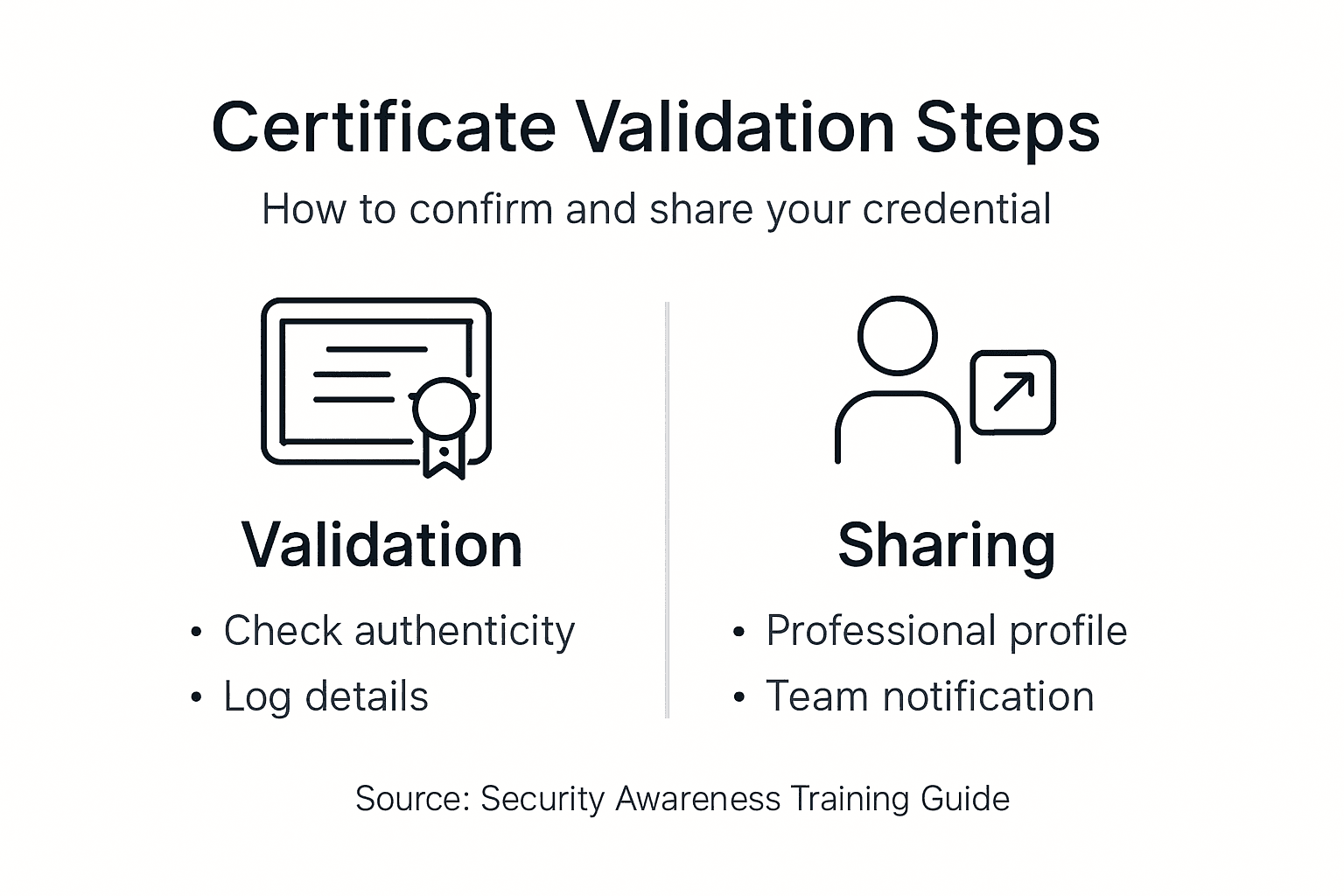
First, verify your certificate's authenticity. Most reputable programs provide a way to validate credentials through their website or a third-party verification service. Check the issuer's website for a certificate lookup tool where you can enter your credential number or name. This verification capability proves your achievement is legitimate when employers or auditors inquire.
Document the details for your records. Store the certificate number, issuance date, expiration date, and any renewal requirements in a secure location. You'll reference these details repeatedly when updating professional profiles or responding to compliance audits.
Now begin sharing strategically. Verifiable security awareness credentials demonstrate validated knowledge and commitment to security culture within your professional circles. Start with internal audiences who benefit from knowing about your expertise.
Optimal sharing channels include:
- Internal communications: Notify your security team, compliance department, and manager of your new credential
- Professional profiles: Add the certification to LinkedIn, your company directory, and professional website
- Email signature: Include the credential title in your professional email signature
- Resume and CV: Update your resume with the certification, including the date achieved
- Company directory: Request that HR update your employee profile with the credential
When sharing on professional networks, include a brief context statement. Don't just list the credential. Write something like, "Earned Security Awareness Professional certification to strengthen organizational cybersecurity culture and compliance posture." This demonstrates intentionality, not vanity.
Compare these credential sharing channels for maximizing recognition:
| Sharing Channel | Audience Reached | Professional Impact | Documentation Value |
|---|---|---|---|
| LinkedIn Profile | External partners, recruiters | High for career visibility | Automatic proof for employers |
| Email Signature | Internal teams, clients | Moderate for daily reminders | Can prompt audit inquiries |
| HR/Compliance Records | Compliance officers, auditors | High for audit readiness | Essential for verification |
| Company Directory | Colleagues, managers | Moderate for internal networking | Shows company expertise |
For organizations with multiple certified professionals, consider creating a certification tracker. This document lists who holds which credentials and renewal dates, proving to auditors that your workforce maintains current security awareness knowledge. This approach also incentivizes colleagues to pursue their own certifications.
Your certificate represents more than personal achievement. It signals to your organization that you're invested in reducing security risk.
Consider your role when determining where to emphasize your credential. CISOs and compliance managers should highlight certifications prominently in external communications with vendors and partners. Individual contributors might note them more subtly within team communications.
If your credential includes renewal requirements, mark renewal dates on your calendar immediately. Missing renewal deadlines invalidates your credential and requires starting the process over.
Pro tip: Create a digital credential folder containing your certificate PDF, verification link, and renewal dates. Share the verification link with your compliance team so they can independently confirm your certification status for audits, eliminating back-and-forth documentation requests.
Simplify Security Certification and Boost Your Organization's Cybersecurity Posture
Earning a Security Awareness Training Certificate requires dedication to mastering key concepts like threat recognition, data handling, and compliance. But organizations especially in tech and finance often face the additional challenge of managing extensive security questionnaires and proving compliance quickly and accurately. This struggle can slow down audit cycles and delay critical partnerships.
Skypher’s AI Questionnaire Automation Tool directly addresses these pain points by streamlining complex security reviews. With powerful AI-driven parsing, seamless real-time collaboration, and integrations with platforms like ServiceNow and Slack, your teams can complete security questionnaires faster and with higher accuracy. This efficiency supports the behavioral change and compliance proof emphasized in security awareness programs, enabling your organization to maintain continuous readiness and demonstrate security commitment.

Take control of your security compliance process now by visiting Skypher. Empower your workforce with automated workflows that complement your training efforts and ensure your certifications translate into measurable operational impact. Experience how simplified questionnaire management leads to faster audits, stronger client trust, and a more secure future.
Frequently Asked Questions
What steps do I need to take to earn a Security Awareness Training Certificate?
To earn a Security Awareness Training Certificate, first assess your organization’s training requirements and compliance needs. Then, complete the training modules systematically and pass the certification exam.
How can I ensure I understand the content before taking the certification exam?
Engage actively with the training modules by taking notes and revisiting areas where you struggled. Complete knowledge checks honestly to identify gaps and reinforce your understanding before the exam.
What if I do not pass the certification exam on my first attempt?
If you don’t pass the certification exam initially, do not be discouraged; many programs allow retakes after a waiting period. Review the feedback provided, revisit the relevant training modules, and try again after 14 days.
How should I share my Security Awareness Training Certificate with others?
Share your Security Awareness Training Certificate internally by notifying your team and adding it to your professional profiles like LinkedIn. Include it in your email signature and update your resume to reflect your achievement.
What should I do if my certificate has renewal requirements?
Mark the renewal deadlines on your calendar immediately to ensure you do not miss them. Staying up-to-date with renewals will keep your certification valid and demonstrate your ongoing commitment to security awareness.
How can I track the effectiveness of my training and certification?
Track your progress by documenting completion dates and scores for each module and exam. Also, review compliance breaches related to employee errors from the previous year to measure improvement and enhance your training focus.