

Security compliance is non-negotiable in today's digital world. With organizations facing potential fines averaging $14.82 million annually for non-compliance, this need has never been more crucial. But here's the kicker: compliance is often seen as a burdensome task, a list of hurdles businesses must jump through. What many don’t realize is that when approached correctly, compliance can actually enhance operational efficiency and build stronger customer trust. Let's dive into how you can turn compliance from a chore into a strategic advantage.
Table of Contents
- Understanding Security Compliance Basics
- Key Compliance Regulations Overview
- Practical Security Compliance Strategies
- Future Trends in Security Compliance
Quick Summary
| Takeaway | Explanation |
|---|---|
| Security Compliance Is Essential | Organizations must prioritize compliance as a critical business objective to protect against potential fines averaging $14.82 million annually for non-compliance. |
| Adopt a Risk-Based Approach | Focusing resources on the most critical assets and highest threats enhances compliance efficiency and effectiveness by balancing threat mitigation with operational considerations. |
| Leverage Technology for Compliance | Utilizing compliance technologies, such as GRC platforms and SIEM systems, can streamline compliance processes, improve risk visibility, and enhance responsiveness to compliance issues. |
| Create a Compliance-Aware Culture | Organizations should foster a culture where every employee understands the importance of compliance through regular training and clear leadership communication, making compliance part of daily operations. |
| Prepare for Future Trends | Staying informed about emerging compliance trends, such as AI regulation and climate-related security measures, will help organizations proactively adapt their compliance strategies to meet evolving challenges. |
Understanding Security Compliance Basics

Security compliance forms the backbone of an organization's protection strategy in today's digital landscape. At its core, security compliance refers to the process of ensuring that an organization adheres to both internal security policies and external regulatory requirements designed to safeguard sensitive information. As cyber threats continue to evolve in sophistication and frequency, understanding the fundamentals of security compliance has become essential rather than optional.
What Is Security Compliance?
Security compliance is a systematic approach to managing an organization's security risks and ensuring protection of data and systems according to established standards, regulations, and best practices. The security compliance definition extends beyond simply checking boxes on a regulatory form—it represents a comprehensive framework that helps organizations maintain appropriate security controls.
The meaning of security compliance can be understood through three core components:
- Risk Management: Identifying, assessing, and mitigating security risks to acceptable levels
- Regulatory Adherence: Following industry-specific and general data protection laws
- Security Control Implementation: Deploying technical and administrative safeguards to protect information
Security compliance requirements vary widely depending on industry, location, and the types of data handled. However, the fundamental goal remains consistent: protecting sensitive information from unauthorized access, ensuring data integrity, and maintaining system availability.
The Stakes of Compliance
The importance of security compliance cannot be overstated in today's digital environment. According to Keepnet Labs, organizations failing to meet compliance requirements face average costs of $14.82 million annually due to fines, legal actions, and reputational damage. These consequences highlight why compliance isn't merely a technical issue but a business-critical priority.
Most organizations must comply with multiple overlapping standards. Common frameworks include:
- GDPR (General Data Protection Regulation)
- HIPAA (Health Insurance Portability and Accountability Act)
- PCI DSS (Payment Card Industry Data Security Standard)
- SOC 2 (Service Organization Control 2)
- ISO 27001 (Information Security Management Standard)
Each of these frameworks establishes specific security compliance requirements that organizations must meet based on their operations and the data they handle.
The Human Element in Security Compliance
While technical controls are critical, the human dimension of security compliance deserves special attention. Research shows that 68% of data breaches in 2024 involve a human element, underscoring that technology alone cannot ensure compliance. Effective security compliance management must include comprehensive employee awareness training and clear policies.
As organizations develop their approaches to security and compliance management, they must recognize that compliance is not a one-time achievement but an ongoing process. Regular assessments, updates to security controls, and adaptation to evolving threats are essential elements of a mature compliance program.
Evolving Compliance Landscape
The requirements for information security compliance continue to evolve as new technologies emerge and threat landscapes shift. According to research, regulatory frameworks are adapting to address new challenges in 2025, including AI security, IoT vulnerabilities, supply chain risks, and the adoption of "Zero Trust" architectures.
Organizations seeking to maintain compliance must stay informed about these changing requirements while integrating principles such as privacy by design into their security posture. As international standardization efforts continue, the global nature of security compliance will only increase in importance.
Understanding security compliance basics provides the foundation upon which organizations can build comprehensive security programs that not only meet regulatory requirements but also effectively protect critical assets, maintain stakeholder trust, and support business objectives.
Key Compliance Regulations Overview
Navigating the complex landscape of security compliance requires familiarity with key regulatory frameworks that govern different industries, regions, and data types. These regulations establish the minimum standards organizations must meet to protect sensitive information and maintain proper security controls. Understanding these frameworks is essential for building an effective security compliance program.
Global Data Protection Regulations
GDPR (General Data Protection Regulation)
The GDPR represents one of the most comprehensive data protection regulations globally. Enforced since 2018, it applies to any organization handling EU citizens' personal data, regardless of where the organization is based. The GDPR emphasizes data subject rights, including the right to access, right to be forgotten, and data portability. It imposes strict requirements for breach notification (within 72 hours) and can levy fines up to 4% of global annual revenue or €20 million, whichever is higher.
CCPA and CPRA (California Consumer Privacy Act and California Privacy Rights Act)
These California regulations establish data privacy rights for state residents, including the right to know what personal information businesses collect, the right to delete personal information, and the right to opt-out of the sale of personal information. The CPRA, which amended and expanded the CCPA in 2020, created a dedicated privacy protection agency and introduced new concepts like sensitive personal information.
Industry-Specific Regulations
HIPAA (Health Insurance Portability and Accountability Act)
HIPAA governs protected health information (PHI) in the United States. It applies to healthcare providers, health plans, healthcare clearinghouses, and their business associates. HIPAA consists of several rules, including the Privacy Rule, Security Rule, and Breach Notification Rule, each addressing different aspects of protecting patient information.
PCI DSS (Payment Card Industry Data Security Standard)
This industry-created standard applies to organizations that process, store, or transmit credit card information. PCI DSS includes requirements for network security, vulnerability management, access control, monitoring, and information security policies. Compliance is validated annually, with requirements varying based on transaction volume.
SOX (Sarbanes-Oxley Act)
Focused on financial reporting and corporate governance, SOX requires public companies to maintain effective internal controls over financial reporting and provide accurate financial disclosures. Section 404 specifically addresses IT systems involved in financial reporting, making it relevant to security compliance.
Emerging Regulatory Frameworks
EU NIS2 Directive
According to Schellman, the Network and Information Security 2 (NIS2) Directive, effective October 2024, significantly expands cybersecurity obligations across the European Union. This directive extends requirements to additional critical sectors and imposes stricter incident reporting frameworks across member states. Organizations must prepare for these enhanced requirements by strengthening their security controls and incident response capabilities.
Digital Operational Resilience Act (DORA)
Set to take effect in early 2025, DORA establishes comprehensive security standards specifically for the EU financial sector. As Schellman reports, this regulation will mandate robust security and incident response protocols for banks, insurance companies, and information and communication technology (ICT) service providers. DORA represents a significant shift toward standardized digital resilience requirements in financial services.
International Standards
ISO/IEC 27001
While not a regulation in the strict sense, ISO/IEC 27001 provides an internationally recognized framework for information security management systems. According to Mailgun, this standard serves as a global baseline that helps organizations navigate diverse regulatory environments while establishing best practices for security. The framework employs a risk-based approach to information security and covers organizational structure, policies, procedures, and technical controls.
NIST Cybersecurity Framework
Developed by the U.S. National Institute of Standards and Technology, this voluntary framework consists of standards, guidelines, and best practices to manage cybersecurity risk. The framework's core functions—Identify, Protect, Detect, Respond, and Recover—provide a structured approach to cybersecurity that aligns with most compliance regulations.
Navigating these diverse regulations requires organizations to adopt a strategic approach to security compliance management. Instead of treating each regulation as a separate challenge, successful organizations identify common requirements across frameworks and implement unified controls that satisfy multiple regulations simultaneously, creating efficiency in their compliance efforts.
Practical Security Compliance Strategies
Implementing effective security compliance isn't just about understanding regulations—it requires practical strategies that balance protection with operational efficiency. Organizations face significant challenges in this area, with PwC research showing that 77% of companies report negative impacts from compliance complexity on growth-driving activities. This section explores actionable approaches to establish and maintain a robust security compliance program.
Risk-Based Compliance Approach
A risk-based approach to security compliance focuses resources on the most critical assets and highest threats rather than treating all systems equally. This strategy begins with a comprehensive risk assessment that identifies:
- Critical data assets and their sensitivity levels
- Potential threats and vulnerabilities specific to your organization
- Regulatory requirements applicable to your industry and operations
- Business impact of potential security incidents
By categorizing assets based on risk, organizations can implement controls proportionate to the potential harm, creating a more efficient compliance program. This allows security teams to focus their attention where it matters most while maintaining baseline protections across all systems.
Integrated Compliance Framework
Rather than managing multiple compliance frameworks separately, leading organizations develop integrated frameworks that address overlapping requirements simultaneously. This approach includes:
- Mapping regulatory requirements across frameworks to identify commonalities
- Developing unified controls that satisfy multiple regulations
- Creating centralized documentation that serves various compliance needs
- Establishing consistent processes for maintaining compliance across regulations
An integrated framework reduces duplication of effort and decreases the overall compliance burden. It creates efficiency while ensuring that all regulatory requirements are addressed systematically.
Leveraging Compliance Technology
Modern compliance technology plays a crucial role in managing complex security requirements. According to PwC, organizations implementing compliance technology report significant benefits: 64% gain better visibility into risks and risk management, 53% identify and respond to compliance issues faster, and 43% achieve increased productivity and cost savings.
Effective compliance technologies include:
- Governance, Risk, and Compliance (GRC) platforms that centralize compliance management
- Security Information and Event Management (SIEM) systems that monitor for security events
- Automated compliance monitoring tools that continuously assess control effectiveness
- Documentation and evidence management systems that streamline audit processes
These technologies transform compliance from a manual, resource-intensive process to a more streamlined, data-driven function.
Creating a Compliance-Aware Culture
Technology alone cannot ensure compliance. Organizations must develop a culture where security compliance is everyone's responsibility. Elements of a compliance-aware culture include:
- Regular, role-specific training on security practices and compliance requirements
- Clear communication from leadership about compliance expectations
- Recognition systems that reward compliance-conscious behaviors
- Processes that make compliance the path of least resistance
When employees understand not just what to do but why it matters, compliance becomes integrated into daily operations rather than viewed as a bureaucratic obstacle.
Continuous Compliance Monitoring
Security compliance isn't a one-time achievement but an ongoing process. Continuous monitoring approaches include:
- Automated vulnerability scanning and assessment
- Regular control testing and validation
- Compliance dashboards that provide real-time status visibility
- Periodic internal audits to identify gaps before external reviewers
This proactive stance helps organizations maintain compliance between formal assessments and quickly address emerging issues before they become significant problems.
Planning for Compliance Transformation

Interestingly, while only 7% of organizations currently consider themselves leaders in compliance, 38% aim to achieve leadership status within three years, according to PwC research. This indicates a growing recognition of the strategic importance of compliance excellence.
Organizations seeking to transform their compliance approach should:
- Develop a multi-year compliance roadmap with clear milestones
- Secure executive sponsorship for compliance initiatives
- Identify opportunities to use compliance as a competitive advantage
- Explore innovative approaches that go beyond minimum requirements
By treating security compliance as a strategic priority rather than a necessary burden, organizations can turn regulatory requirements into opportunities for improvement and differentiation in the marketplace.
Future Trends in Security Compliance
As technology evolves and threat landscapes shift, security compliance frameworks must adapt to remain effective. Organizations need to anticipate these changes to build compliance programs that remain resilient in the face of emerging challenges. Several key trends are reshaping how businesses approach security compliance.
Global Privacy Regulation Expansion
The proliferation of privacy regulations worldwide represents one of the most significant shifts in the compliance landscape. According to Cybersecurity Magazine, by 2025, an estimated 75% of the world's population will have their personal data protected by privacy laws. This dramatic expansion creates unprecedented operational complexity for organizations operating across multiple jurisdictions.
This trend means organizations must:
- Develop scalable compliance frameworks adaptable to diverse regulatory requirements
- Implement data mapping and classification systems that track information across global operations
- Create dynamic consent management processes that accommodate varying regional standards
- Build privacy operations teams with international regulatory expertise
As more countries adopt comprehensive privacy laws inspired by GDPR but with local variations, compliance programs will need greater flexibility and regional customization capabilities.
AI Governance and Compliance
Artificial intelligence presents both opportunities and challenges for security compliance. As AI becomes more integrated into business operations, several compliance considerations emerge:
- Regulatory frameworks specifically addressing AI risks and ethical use
- Requirements for explainability and transparency in AI decision-making
- Controls to prevent algorithmic bias and discrimination
- Standards for AI system security and resilience
Organizations deploying AI technologies will face increasing pressure to demonstrate responsible governance over these systems, including documentation of development practices, testing methodologies, and ongoing monitoring for unintended consequences.
IT/OT Security Convergence
The World Economic Forum's Global Cybersecurity Outlook 2025 identifies the convergence of information technology (IT) and operational technology (OT) security as a key trend impacting future compliance requirements. As industrial systems, critical infrastructure, and IoT devices become more connected, the security boundaries between traditional IT and OT environments are blurring.
This convergence creates new compliance challenges, including:
- Expanded regulatory scope covering physical operational systems
- New security standards specifically addressing connected industrial controls
- Requirements for integrated risk management across IT and OT environments
- Complex incident response obligations for cyber-physical systems
Organizations with significant OT environments will need to evolve their compliance approaches to address these hybrid environments effectively.
Proactive Compliance Approaches
Reactive security approaches focused on periodic assessments and remediation cycles are becoming insufficient. Cybersecurity Magazine notes that organizations must shift toward proactive, adaptable compliance frameworks with real-time monitoring capabilities to remain resilient amid stricter enforcement and advanced threats.
Elements of this proactive approach include:
- Continuous compliance monitoring rather than point-in-time assessments
- Predictive risk analytics to identify emerging compliance issues
- Automated compliance controls that adapt to changing conditions
- Privacy-by-design principles embedded in development processes
This shift transforms compliance from a periodic checkbox exercise to a dynamic, ongoing program that anticipates regulatory changes and adapts accordingly.
Quantum Computing Preparedness
The advent of practical quantum computing will fundamentally challenge existing cryptographic standards that form the backbone of many security compliance controls. Organizations will need to prepare for quantum-safe compliance requirements by:
- Inventorying cryptographic dependencies across systems and applications
- Developing migration plans for post-quantum cryptography
- Creating crypto-agility capabilities to facilitate algorithm transitions
- Addressing quantum computing risks in long-term data protection strategies
Regulatory frameworks will likely begin incorporating quantum readiness requirements well before quantum computers capable of breaking current encryption become widely available.
Climate-Related Security Compliance
An emerging trend is the intersection of climate risk and security compliance. As climate-related disruptions increase, organizations face new compliance considerations:
- Business continuity requirements specifically addressing climate-related threats
- Reporting obligations related to climate impacts on security infrastructure
- Energy efficiency standards for security technologies and data centers
- Supply chain resilience requirements for security services
These trends indicate that security compliance is evolving beyond traditional cybersecurity concerns to encompass broader organizational resilience factors, requiring a more integrated approach to compliance management.
Frequently Asked Questions
What is security compliance?
Security compliance is the process of ensuring that an organization adheres to security standards and regulations in order to protect sensitive information and manage security risks effectively.
Why is security compliance important for organizations?
Security compliance is crucial for organizations because it helps prevent data breaches and protects against potential fines, legal actions, and reputational damage resulting from non-compliance, which can average $14.82 million annually.
How can organizations adopt a risk-based approach to compliance?
Organizations can adopt a risk-based approach by conducting comprehensive risk assessments to identify critical data assets, potential threats, and applicable regulations, allowing them to prioritize security controls based on the greatest risks.
What role does technology play in improving security compliance?
Technology plays a significant role in improving security compliance by utilizing tools such as Governance, Risk, and Compliance (GRC) platforms and automated monitoring systems to streamline compliance processes, enhance risk visibility, and facilitate real-time reporting.
Streamline Your Security Compliance with Skypher
Navigating the complex landscape of security compliance can feel like an uphill battle, especially as penalties for non-compliance continue to rise—averaging an astonishing $14.82 million annually. But what if you could transform this daunting task into a streamlined, efficient process?
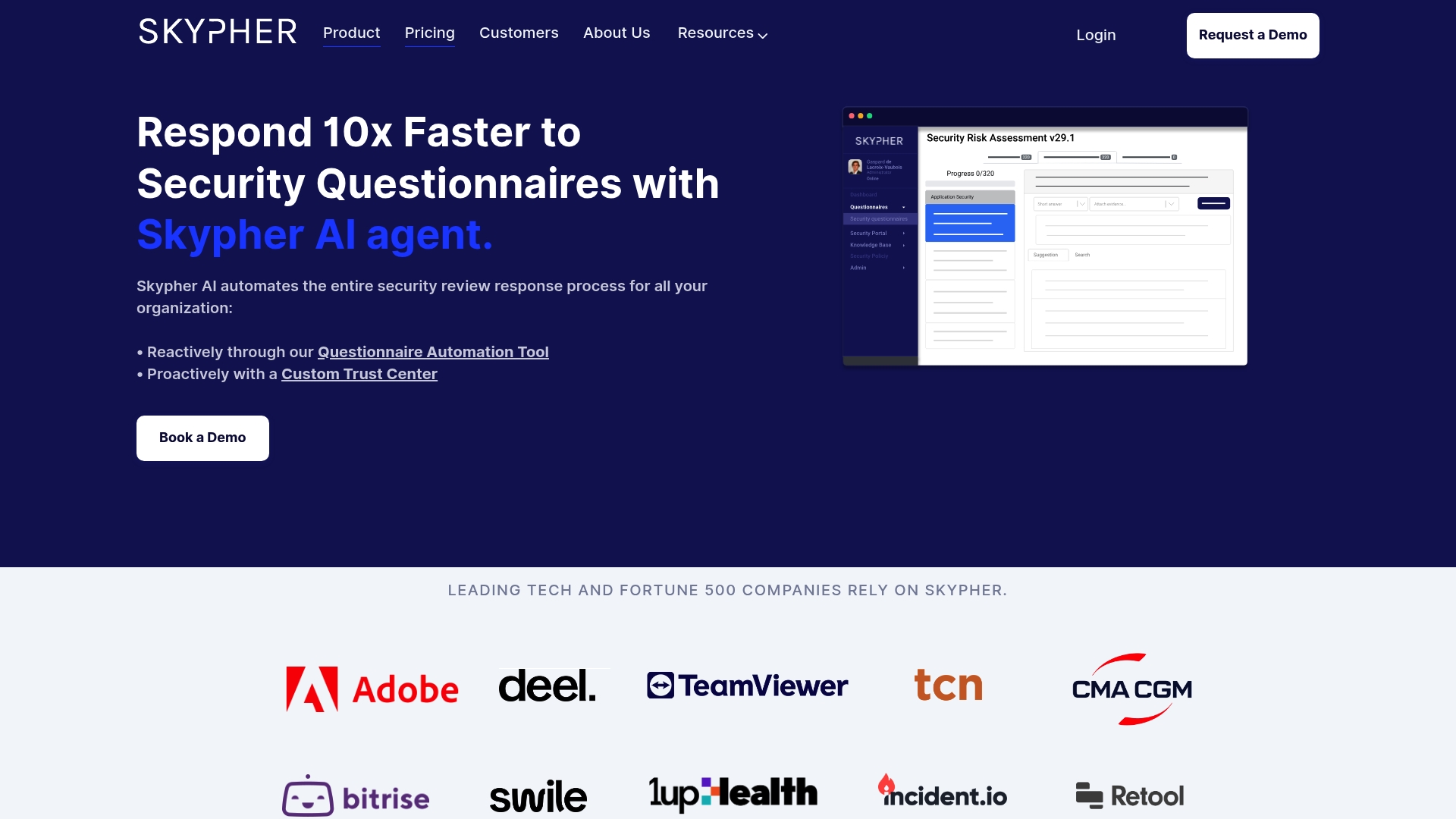
With Skypher's AI-driven Questionnaire Automation Tool, you can tackle the challenges of security compliance head-on. Our platform helps organizations like yours to:
- Accelerate the completion of security questionnaires, reducing time spent on proof of concepts (POCs) and contracts.
- Enhance collaboration and communication among teams, ensuring a unified approach to compliance efforts.
- Create a customizable Trust Center that builds client confidence and trust, while supporting integrations with over 40 third-party risk management platforms.
Don’t let compliance hold your organization back! Visit Skypher today and discover how you can boost your cybersecurity posture while improving operational productivity. The future of compliance is here—act now to stay ahead of evolving regulations!