

Security reviews are often dismissed as bureaucratic checkboxes, yet they represent your organization's frontline defense against evolving cyber threats. Many security professionals underestimate how structured review processes can transform compliance burdens into strategic advantages. This guide reveals the procedural frameworks, automation techniques, and proven methodologies that tech and finance companies use to turn security reviews into powerful risk management assets. You'll discover how defined workflows, established frameworks like the AWS Well-Architected Security Pillar, and intelligent automation can accelerate your review cycles while strengthening your overall cybersecurity posture.
Table of Contents
- Understanding Security Reviews: Purpose And Scope
- Procedural Framework And Roles In Security Reviews
- Security Frameworks And Best Practices Including Aws Well-Architected Security Pillar
- Applying Automation And Optimization In Security Review Processes
- Leverage Skypher To Streamline Your Security Reviews
- FAQ
Key takeaways
| Point | Details |
|---|---|
| Structured procedures define success | Security reviews require clearly defined roles, workflows, and accountability mechanisms to ensure thorough evaluation and compliance. |
| Frameworks standardize evaluation | Applying established frameworks like the AWS Security Pillar organizes reviews into actionable domains for consistent, comprehensive assessments. |
| Automation accelerates accuracy | AI-driven tools reduce manual effort in questionnaire management, minimize errors, and deliver faster cycle times. |
| Clear roles improve outcomes | Assigning specific responsibilities to reviewers, architects, and compliance officers enhances accountability and audit readiness. |
| Efficient reviews strengthen security | Optimized processes transform reviews from administrative tasks into strategic tools that proactively identify vulnerabilities. |
Understanding security reviews: purpose and scope
Security reviews are systematic evaluations of your organization's technical architecture, policies, and controls designed to identify vulnerabilities before they become exploitable weaknesses. Unlike ad hoc security checks that respond to specific incidents, structured security reviews follow documented procedures that ensure consistent, repeatable assessments across your entire technology stack. This proactive approach is critical in tech and finance sectors where regulatory scrutiny and sophisticated threat actors create constant pressure.
The heightened regulatory environment in 2026 demands that organizations demonstrate not just compliance, but continuous improvement in their security posture. Financial institutions face requirements from regulators like the SEC and FINRA, while technology companies must navigate frameworks including SOC 2, ISO 27001, and industry-specific mandates. Security reviews provide the documented evidence these regulators require while simultaneously uncovering gaps that could lead to breaches.
Security reviews take multiple forms depending on organizational needs and context:
- Architecture reviews evaluate system designs, network configurations, and technology choices before deployment
- Questionnaire-based reviews assess vendor security practices and third-party risk exposure
- Control assessments verify that implemented security measures function as intended
- Compliance audits confirm adherence to regulatory requirements and industry standards
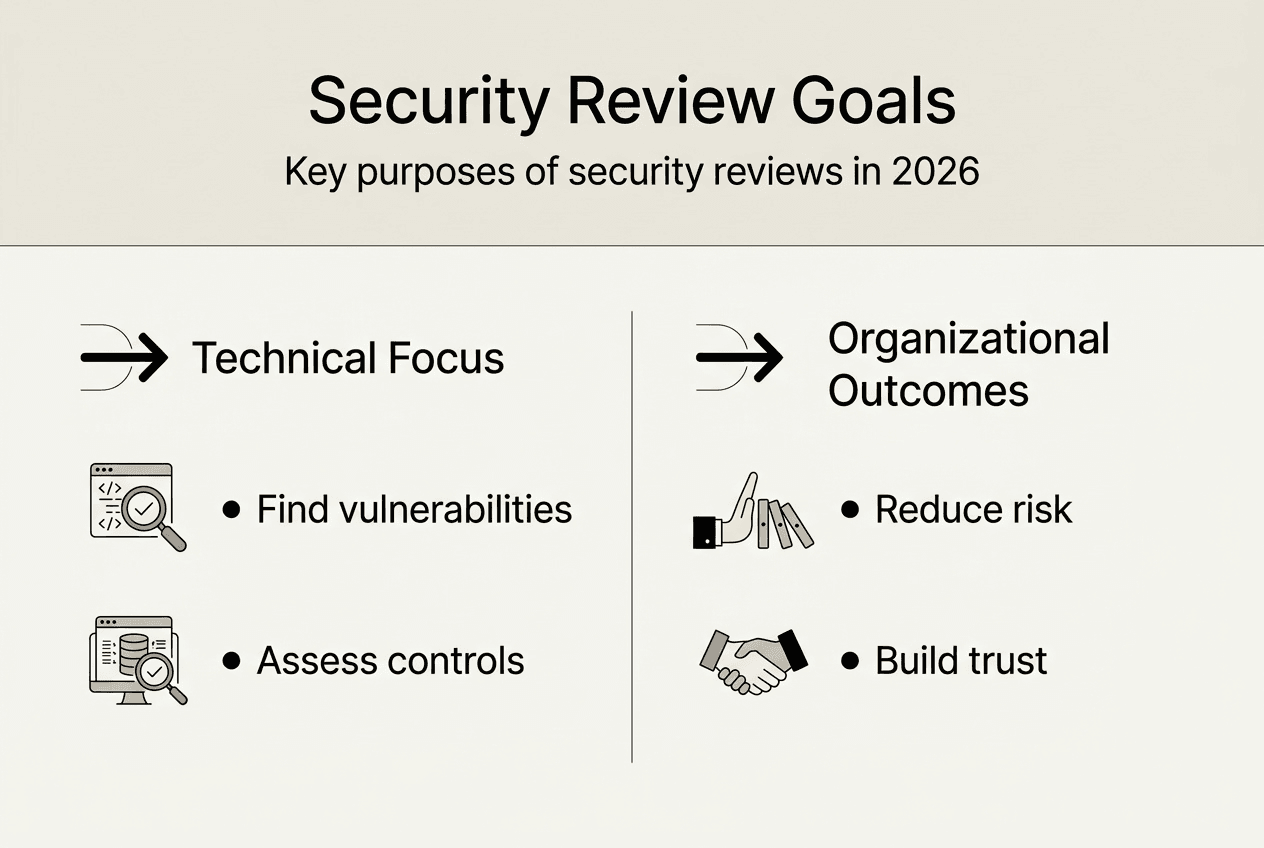
The primary goals driving these reviews include identifying technical vulnerabilities in applications and infrastructure, ensuring policy compliance across teams and systems, and verifying that security controls operate effectively under real-world conditions. Success requires more than technical expertise. You need defined workflows that specify who reviews what, when reviews occur, and how findings translate into actionable remediation plans. Without this structure, reviews become inconsistent exercises that miss critical risks while consuming excessive time.
Establishing clear procedures transforms security reviews from burdensome obligations into strategic activities that protect your organization while enabling secure team collaboration across departments. The investment in structured processes pays dividends through faster reviews, better risk identification, and stronger compliance documentation.
Procedural framework and roles in security reviews
Effective security reviews follow documented workflows that move systematically from initiation through conclusion, ensuring nothing falls through the cracks. The procedural framework defines specific roles and responsibilities, creating accountability at every stage while enabling efficient handoffs between team members. This structure is essential for organizations managing multiple concurrent reviews or operating under strict compliance timelines.
Key roles in the security review process include security reviewers who conduct technical assessments and identify vulnerabilities, security architects who evaluate system designs against best practices, compliance officers who verify regulatory alignment and maintain audit trails, and stakeholders who provide context about business requirements and risk tolerance. Each role carries distinct responsibilities that must be clearly documented to avoid gaps in coverage or duplicated effort.
Document preparation and evidence collection form the foundation of credible reviews. Teams must gather architecture diagrams, configuration files, policy documents, and control implementation records before assessments begin. Version control becomes critical here, as reviewers need confidence they're evaluating current systems rather than outdated documentation. Maintaining comprehensive audit trails demonstrates due diligence to regulators and provides historical context for future reviews.
A proven seven-step workflow model structures the review process:
- Review initiation and scope definition identifying systems, timelines, and success criteria
- Documentation gathering and preliminary assessment to understand the environment
- Technical evaluation against security frameworks and organizational standards
- Gap identification and risk classification based on potential impact
- Findings documentation with specific remediation recommendations
- Stakeholder review and remediation planning to address identified issues
- Follow-up verification confirming that remediation actions resolve identified gaps
Clear handoffs between these stages prevent delays and ensure accountability. When security reviewers complete their technical assessment, they formally transfer findings to compliance officers who verify regulatory implications. Stakeholders then receive structured reports that enable informed decision making about remediation priorities and resource allocation.
The benefits of this structured approach extend beyond individual reviews. Organizations build institutional knowledge about common vulnerabilities, develop standardized remediation playbooks, and create metrics that track security improvement over time. Teams can perform secure reviews more efficiently as procedures become familiar, reducing the time burden while improving thoroughness.
Security frameworks and best practices including AWS Well-Architected Security Pillar
Security frameworks provide the organizational structure that transforms ad hoc reviews into systematic evaluations covering all critical domains. The AWS Well-Architected Security Pillar exemplifies this approach by organizing security into seven best practice areas that guide comprehensive assessment. These domains include security foundations covering identity and access management, detective controls for monitoring and alerting, infrastructure protection through network and host-level defenses, data protection mechanisms including encryption and classification, incident response capabilities and procedures, and application security practices throughout the development lifecycle.
Applying an established framework like AWS Security Pillar standardizes both the scope and depth of your reviews. Rather than relying on individual reviewer judgment about what to assess, teams follow documented criteria that ensure consistent coverage across all systems and projects. This consistency proves invaluable when demonstrating compliance to auditors or comparing security posture across different business units.
| Security Domain | Traditional Focus | Framework Approach |
|---|---|---|
| Identity Management | User authentication | Comprehensive IAM including federation, MFA, least privilege |
| Network Security | Firewall rules | Layered defenses with segmentation, monitoring, DDoS protection |
| Data Protection | Encryption at rest | Lifecycle management including classification, access control, retention |
| Monitoring | Log collection | Detective controls with automated alerting and threat intelligence |
| Incident Response | Reactive procedures | Proactive planning with defined runbooks and regular testing |
Frameworks help organizations meet regulatory and industry requirements by mapping security controls to specific compliance mandates. When auditors request evidence of data protection measures, you can point to comprehensive assessments conducted against framework criteria rather than assembling documentation reactively. This preparation reduces audit cycles and demonstrates mature security practices.
Pro Tip: Integrate automation tools early when implementing security frameworks to maintain consistency as your environment scales. Manual framework application becomes unsustainable as system complexity grows, but automated review cycles ensure every component receives thorough evaluation against all framework domains.
The synergy between frameworks and defined roles amplifies effectiveness. Security architects use framework domains to structure their evaluations, compliance officers map framework controls to regulatory requirements, and stakeholders understand risk exposure through the lens of framework categories. This shared vocabulary improves communication and ensures everyone understands both what was assessed and what the findings mean for the organization.
Frameworks also evolve to address emerging threats and technologies. The AWS Security Pillar receives regular updates reflecting new attack vectors, cloud service capabilities, and industry lessons learned. Organizations that anchor their review processes to established frameworks benefit from this continuous improvement without rebuilding their entire approach.
Applying automation and optimization in security review processes
Manual security reviews and questionnaire management create significant pain points that undermine effectiveness. Teams spend countless hours copying information between systems, struggle to maintain consistency across similar questions, face delays waiting for subject matter experts to respond, and lack visibility into review status and bottlenecks. These challenges compound as organizations scale, leading to review backlogs that slow sales cycles and create compliance risks.

Automation addresses these pain points through intelligent tools that handle repetitive tasks while enabling human experts to focus on judgment and strategy. The benefits include dramatically faster cycle times, with some organizations completing questionnaires in minutes rather than weeks, improved consistency through centralized knowledge bases that ensure accurate responses, enhanced data accuracy by eliminating manual transcription errors, and actionable insights from analytics that identify trends and improvement opportunities.
When evaluating automation tools for security reviews, prioritize features that align with your documented workflows and framework requirements:
- Duplicate detection that identifies similar questions across multiple questionnaires
- Import and export workflows supporting various formats and integration points
- AI-powered response suggestions based on your organization's approved content
- Collaboration features enabling real-time teamwork and approval chains
- Integration capabilities connecting to your existing security and compliance tools
- Version control and audit trails maintaining compliance documentation
- Analytics dashboards providing visibility into review metrics and bottlenecks
Implementing automation successfully requires thoughtful planning and change management. Start with high-volume, repetitive workflows where automation delivers immediate value, such as standard security questionnaires from customers. Train teams thoroughly on new tools, emphasizing how automation enhances rather than replaces their expertise. Establish clear governance around automated responses, ensuring human review for sensitive or novel questions.
Pro Tip: Implement automation incrementally, beginning with a pilot program covering one questionnaire type or business unit. This approach allows you to refine processes, build internal expertise, and demonstrate value before scaling across the organization.
Integration with existing frameworks and workflows maximizes return on investment. Automated compliance and security reviews should align with your chosen framework domains, automatically flagging gaps against established criteria. Connect automation tools to your ticketing systems, collaboration platforms, and document repositories to create seamless workflows that eliminate context switching and data silos.
The most sophisticated automation platforms use AI to learn from your organization's historical responses, approved content, and security policies. These systems suggest increasingly accurate responses over time while maintaining consistency with your established positions. They also identify opportunities to update outdated content or fill gaps in your knowledge base, continuously improving your review capabilities.
Leverage Skypher to streamline your security reviews
Skypher's AI-driven platform transforms how organizations handle security questionnaire automation, turning what once consumed weeks into tasks completed in minutes. Our proprietary AI models parse every questionnaire format with exceptional accuracy, far exceeding generic solutions that struggle with complex documents. The platform supports the structured workflows and framework alignments discussed throughout this guide, ensuring your reviews remain thorough while accelerating dramatically.

With over 30 API connectors to platforms like OneTrust and ServiceNow, Skypher integrates seamlessly into your existing ecosystem. The AI-powered recommendation engine learns from your approved responses, suggesting accurate answers that maintain consistency across all questionnaires. Easy import and export workflows support various formats, while real-time collaboration features enable your team to work together efficiently. Explore how Skypher can elevate your security review management and accelerate your path to compliance.
FAQ
What are the main challenges in conducting security reviews efficiently?
The primary challenges include managing extensive documentation across multiple systems, coordinating input from diverse stakeholders with competing priorities, and ensuring thorough coverage without creating bottlenecks that delay projects. Many organizations also struggle with maintaining consistency across similar reviews and tracking remediation progress effectively. Automation tools and clearly defined workflows help overcome these barriers by standardizing processes, centralizing information, and providing visibility into review status.
How does the AWS Well-Architected Security Pillar framework improve security reviews?
The AWS Security Pillar organizes security into seven comprehensive domains that ensure reviewers evaluate all critical aspects of system security rather than focusing narrowly on familiar areas. This structured approach improves communication between technical and business stakeholders by providing a shared vocabulary for discussing security posture. The framework aligns reviews with industry best practices and regulatory expectations, making it easier to demonstrate compliance and identify gaps that might otherwise be overlooked.
What are best practices for implementing automation in security review workflows?
Start with a focused pilot program targeting high-volume, repetitive workflows where automation delivers immediate measurable value, such as standard vendor questionnaires. Invest in comprehensive training to ensure teams understand how to use automation tools effectively and trust the AI-generated suggestions. Establish clear governance defining when human review is required versus when automated responses are acceptable. The documented workflow approach ensures automation enhances rather than disrupts your established processes.
How do security reviews differ from security audits?
Security reviews are typically internal, proactive assessments conducted regularly to identify and address vulnerabilities before they're exploited, while audits are often external, compliance-focused examinations verifying adherence to specific standards or regulations. Reviews emphasize continuous improvement and risk reduction, whereas audits focus on demonstrating compliance at a point in time. Both serve important but distinct purposes in a comprehensive security program, with reviews informing ongoing improvements and audits providing formal compliance validation.
What metrics should organizations track to measure security review effectiveness?
Key metrics include average time to complete reviews by type, number of critical and high-severity findings identified, percentage of findings remediated within target timeframes, and review coverage across systems and applications. Organizations should also track the time from finding identification to remediation completion, the recurrence rate of similar findings across reviews, and stakeholder satisfaction with the review process. These metrics help identify bottlenecks, demonstrate security program maturity, and justify investments in automation or additional resources.