

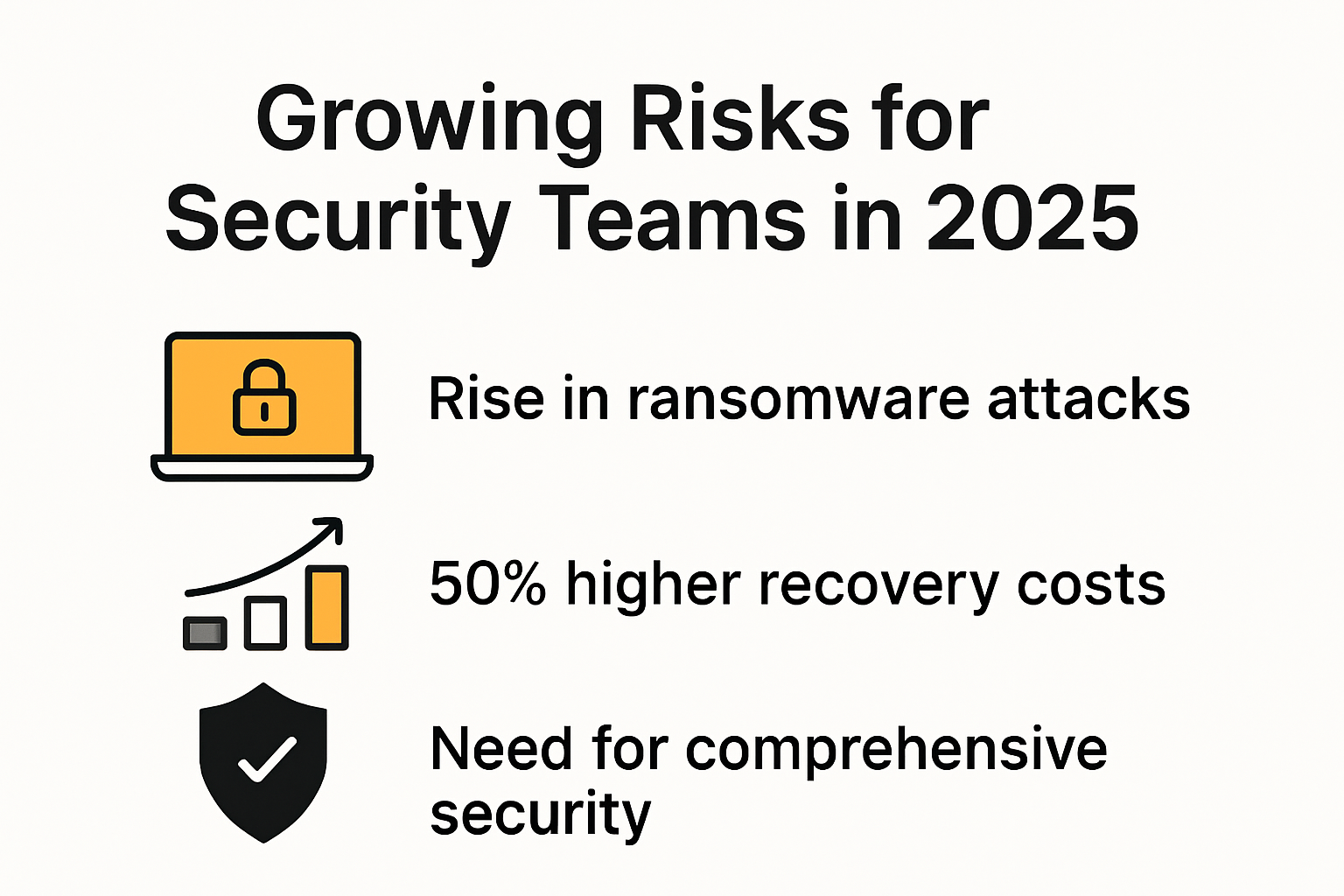
Cyberattacks are not slowing down. In fact, ransomware now makes up 35 percent of all cyberattacks in 2025 and the average recovery bill hits $2.73 million. You might think adding more software and monitoring solves everything. Surprisingly, the real weak link is often human error, which continues to expose even the best-secured companies. The real game lies in combining smart tech with smarter people. Here’s how security teams are rewriting the rules.
Table of Contents
- Common Risks Security Teams Face Today
- Effective Strategies for Threat Detection and Response
- Best Practices for Compliance and Data Protection
- Tools and Technologies That Empower Security Teams
Quick Summary
| Takeaway | Explanation |
|---|---|
| Ransomware poses a critical risk | Ransomware attacks account for 35% of all cyberattacks in 2025, with an average recovery cost of $2.73 million, necessitating comprehensive backup and incident response strategies. |
| Human error remains a significant vulnerability | Despite technological advances, human mistakes like weak passwords and misconfigured cloud sharing greatly expose organizations; continuous training and clear security guidelines are essential. |
| Adopt AI-powered threat detection | Utilizing AI-driven analytics combined with human oversight enhances threat detection capabilities, allowing for rapid anomaly detection, predictive analysis, and automated data correlation. |
| Emphasize compliance as a strategic opportunity | Evolving regulations require adaptive compliance strategies, including comprehensive regulatory mapping and flexible frameworks to transform compliance into a competitive advantage. |
| Leverage advanced tools to reduce team burnout | Investing in integrated security platforms and AI Cyber Assistants can automate repetitive tasks, support team well-being, and enhance overall operational efficiency. |
Common Risks Security Teams Face Today
Security teams are navigating an increasingly complex threat environment that demands unprecedented vigilance and strategic response. The cybersecurity landscape in 2025 presents multifaceted challenges that require sophisticated approaches to risk management and threat mitigation.
Ransomware: The Persistent Organizational Threat
Ransomware attacks have emerged as a critical risk for organizations across industries. Research from SentinelOne reveals a staggering statistic: ransomware now accounts for 35% of all cyberattacks in 2025, representing an 84% increase from the previous year. The financial implications are profound, with the average cost of recovering from a ransomware incident reaching $2.73 million.
Security teams must develop comprehensive strategies that go beyond traditional defensive mechanisms. This includes implementing robust backup systems, conducting regular vulnerability assessments, and creating detailed incident response plans that can minimize potential damage and recovery time.
Human Error: The Persistent Vulnerability
Despite technological advancements, human error remains the most significant vulnerability for security teams. Cybersecurity research highlights that attackers consistently exploit basic human mistakes such as misconfigured cloud sharing, weak passwords, and insufficient security awareness.

Addressing this challenge requires a multifaceted approach. Security teams must invest in continuous employee training, implement strong authentication protocols, and create intuitive security frameworks that reduce the likelihood of human-induced vulnerabilities. This means developing clear, accessible security guidelines and fostering a culture of security awareness within the organization.
Expanding Threat Landscape: Vulnerability Management
The complexity of modern technology infrastructure presents an ongoing challenge for security teams. Industry data indicates that the number of reported Common Vulnerabilities and Exposures (CVEs) surged to 22,254 by mid-2024, representing a 30% year-over-year increase. This exponential growth demands sophisticated patch management and proactive vulnerability remediation strategies.
Effective security teams must adopt a risk-based approach to vulnerability management. This involves:
- Prioritization: Rapidly assessing and ranking vulnerabilities based on potential impact
- Continuous Monitoring: Implementing real-time tracking of potential security gaps
- Advanced Patch Management: Developing automated systems for quick and efficient vulnerability resolution
The evolving threat environment requires security teams to be agile, informed, and technologically sophisticated. By understanding these core risks and developing comprehensive mitigation strategies, organizations can build resilient defense mechanisms that protect critical digital assets and maintain operational integrity.
Effective Strategies for Threat Detection and Response
In the rapidly evolving cybersecurity environment, security teams must adopt sophisticated and dynamic approaches to threat detection and response. The traditional reactive models are no longer sufficient to address the complex and sophisticated cyber threats organizations face in 2025.
AI-Powered Threat Hunting and Analytics
Research indicates that AI-based analytics combined with human-led threat hunting is becoming increasingly prevalent. This hybrid approach allows security teams to leverage advanced technologies for quicker threat detection while maintaining critical human insights and contextual understanding.
AI-driven threat hunting enables organizations to:
- Rapid Anomaly Detection: Quickly identify unusual patterns and potential security breaches
- Predictive Analysis: Anticipate potential threat vectors before they manifest
- Automated Correlation: Connect disparate data points to reveal complex threat landscapes
By integrating machine learning algorithms with experienced security professionals, teams can significantly reduce breach detection times and minimize potential damage.
Collaborative Intelligence and Information Sharing
Industry experts emphasize that threat actors collaborate extensively, sharing tools and strategies. Security teams must adopt a similar approach by creating robust information sharing networks and collaborative platforms.
Effective collaborative strategies include:
- Cross-Organizational Threat Intelligence: Establishing networks to share real-time threat information
- Industry-Wide Security Forums: Participating in platforms that aggregate and disseminate threat insights
- Open-Source Security Tools: Leveraging community-developed solutions and frameworks
Cloud Security and Proactive Access Management
Emerging research reveals a critical insight: 99% of cloud security breaches through 2025 are expected to result from preventable misconfigurations and inadequate access controls. This underscores the urgent need for proactive cloud security strategies.
Key approaches for robust cloud security include:
- Least-Privilege Access: Implementing strict access controls that limit user permissions
- Continuous Identity Verification: Regularly validating user identities and access rights
- Advanced Multi-Factor Authentication: Deploying sophisticated verification mechanisms
By adopting these comprehensive strategies, security teams can create a more resilient and adaptive threat detection and response framework. The combination of advanced technologies, collaborative intelligence, and proactive management approaches will be crucial in staying ahead of emerging cyber threats.
Best Practices for Compliance and Data Protection
In the complex regulatory environment of 2025, security teams must navigate increasingly stringent data protection requirements while maintaining robust organizational security frameworks. Compliance is no longer a checkbox exercise but a critical strategic imperative that demands comprehensive and proactive approaches.
Evolving Regulatory Landscape
Global Cybersecurity Outlook research emphasizes the growing complexity of managing cybersecurity regulations across different jurisdictions. Organizations must develop adaptive compliance strategies that can respond quickly to changing legal requirements.
Key considerations for navigating the regulatory environment include:
- Comprehensive Regulatory Mapping: Tracking and understanding requirements across multiple jurisdictions
- Flexible Compliance Frameworks: Creating adaptable systems that can quickly integrate new regulatory mandates
- Continuous Compliance Monitoring: Implementing real-time tracking and assessment mechanisms
Privacy and Data Protection Standards
Emerging regulatory trends highlight significant shifts in data protection requirements. The General Data Protection Regulation (GDPR) is expected to introduce more stringent rules for data handling, emphasizing transparency, explicit consent, and organizational accountability.
Effective privacy protection strategies should focus on:
- Privacy by Design: Embedding data protection principles into every stage of system development
- Consent Management: Implementing robust mechanisms for obtaining and managing user consent
- Data Minimization: Collecting and retaining only essential information
- Transparent Data Practices: Providing clear communication about data collection and usage
Specialized Compliance Frameworks
Industry standards are becoming more sector-specific and rigorous. For instance, the Cybersecurity Maturity Model Certification (CMMC) 2.0 will become mandatory for companies working with the U.S. Department of Defense, introducing simplified compliance tiers with more stringent auditing requirements.
Organizations must develop specialized approaches that include:
- Tailored Compliance Strategies: Creating frameworks specific to industry and regulatory requirements
- Advanced Audit Capabilities: Implementing sophisticated tracking and verification mechanisms
- Comprehensive Documentation: Maintaining detailed records of security practices and compliance efforts
Successful security teams will view compliance not as a burden but as an opportunity to demonstrate organizational maturity and commitment to protecting stakeholder interests. By developing proactive, flexible, and comprehensive compliance strategies, organizations can transform regulatory requirements into competitive advantages.
Tools and Technologies That Empower Security Teams
In the rapidly evolving cybersecurity landscape, security teams require advanced technological solutions that can help them stay ahead of sophisticated threats. The right tools and technologies can transform how security professionals detect, respond to, and mitigate potential risks.
Integrated Security Platforms and AI Analytics
Research from Microsoft highlights a significant breakthrough in security technologies. Organizations using AI-powered security platforms that integrate Security Information and Event Management (SIEM), Extended Detection and Response (XDR), Security Orchestration and Automated Response (SOAR), and threat intelligence have reported a 30% reduction in mean time to respond (MTTR).
Key features of these integrated platforms include:
- Comprehensive Threat Correlation: Connecting data points across multiple security domains
- Automated Incident Triage: Quickly prioritizing and addressing potential security events
- Intelligent False Positive Reduction: Minimizing unnecessary alerts and focusing on genuine threats
AI Cyber Assistants and Automation Tools
Emerging technologies are revolutionizing how security teams manage their workload. AI Cyber Assistants are becoming increasingly sophisticated, providing support across multiple critical areas:
- Incident Review Automation: Streamlining initial threat assessment processes
- End-User Upskilling: Providing real-time security awareness and training
- Cross-Platform Threat Detection: Monitoring communication channels like email and instant messaging
These AI-driven tools help security teams manage increasingly complex threat landscapes while reducing individual workload and potential human error.
Addressing Team Burnout Through Technology
Cybersecurity insights emphasize the critical importance of investing in tools that not only enhance security but also support team well-being. The right technologies can help break the cycle of burnout by:
- Automating Repetitive Tasks: Reducing manual workload and cognitive strain
- Providing Advanced Analytical Capabilities: Enabling more strategic and meaningful work
- Supporting Continuous Learning: Offering integrated training and skill development resources
By implementing these advanced technologies, security teams can create more resilient, efficient, and sustainable operational models. The future of cybersecurity lies not just in advanced detection capabilities, but in empowering human professionals with intelligent, supportive technological ecosystems that enhance their natural capabilities and reduce unnecessary stress.
Frequently Asked Questions
What are the top challenges for security teams in 2025?
Security teams in 2025 face several challenges, including an increase in ransomware attacks, human error leading to vulnerabilities, and an expanding threat landscape requiring effective vulnerability management.
How can organizations combat ransomware threats?
Organizations can combat ransomware by implementing robust backup systems, conducting regular vulnerability assessments, and creating comprehensive incident response plans to minimize potential damage and recovery time.
What role does AI play in threat detection and response?
AI plays a critical role in threat detection and response by enabling rapid anomaly detection, predictive analysis, and automated correlation of data, which enhances the speed and efficiency of identifying potential security threats.
How can organizations ensure compliance with evolving regulations?
Organizations can ensure compliance by developing adaptive compliance strategies that include comprehensive regulatory mapping, creating flexible compliance frameworks, and continually monitoring and assessing their adherence to legal requirements.
Ready to Cut Through Security Questionnaire Overload?
Are repetitive security questionnaires draining your team's time and energy while you race to keep up with fast-moving threats and compliance demands? In the race to outsmart cyber risk, manual processes and human errors can put your security posture and business deals at stake. You already know from the article that human error and time-consuming manual work are the real vulnerabilities in today’s high-pressure security environment. Now imagine what you could accomplish with an automated way to streamline this entire process.
Take control and empower your team with Skypher's AI-Powered Questionnaire Automation Tool for lightning-fast, accurate responses and seamless collaboration across departments. Build trust with clients by sharing your security posture through a custom Trust Center and accelerate proof of concepts or contracts by integrating with over 40 third-party risk platforms. Don’t let slow reaction times limit your success when you could be leading the charge—discover how Skypher can transform your security workflow today.