

Managing compliance questionnaire responses often drains valuable time and increases the risk of human error for IT security teams in large global organizations. As regulations evolve and audits intensify, automating these processes is no longer optional. By focusing on clear, actionable data collection and powerful automation tools, your team can turn a once tedious routine into a reliable source of compliance intelligence ready for any audit.
Table of Contents
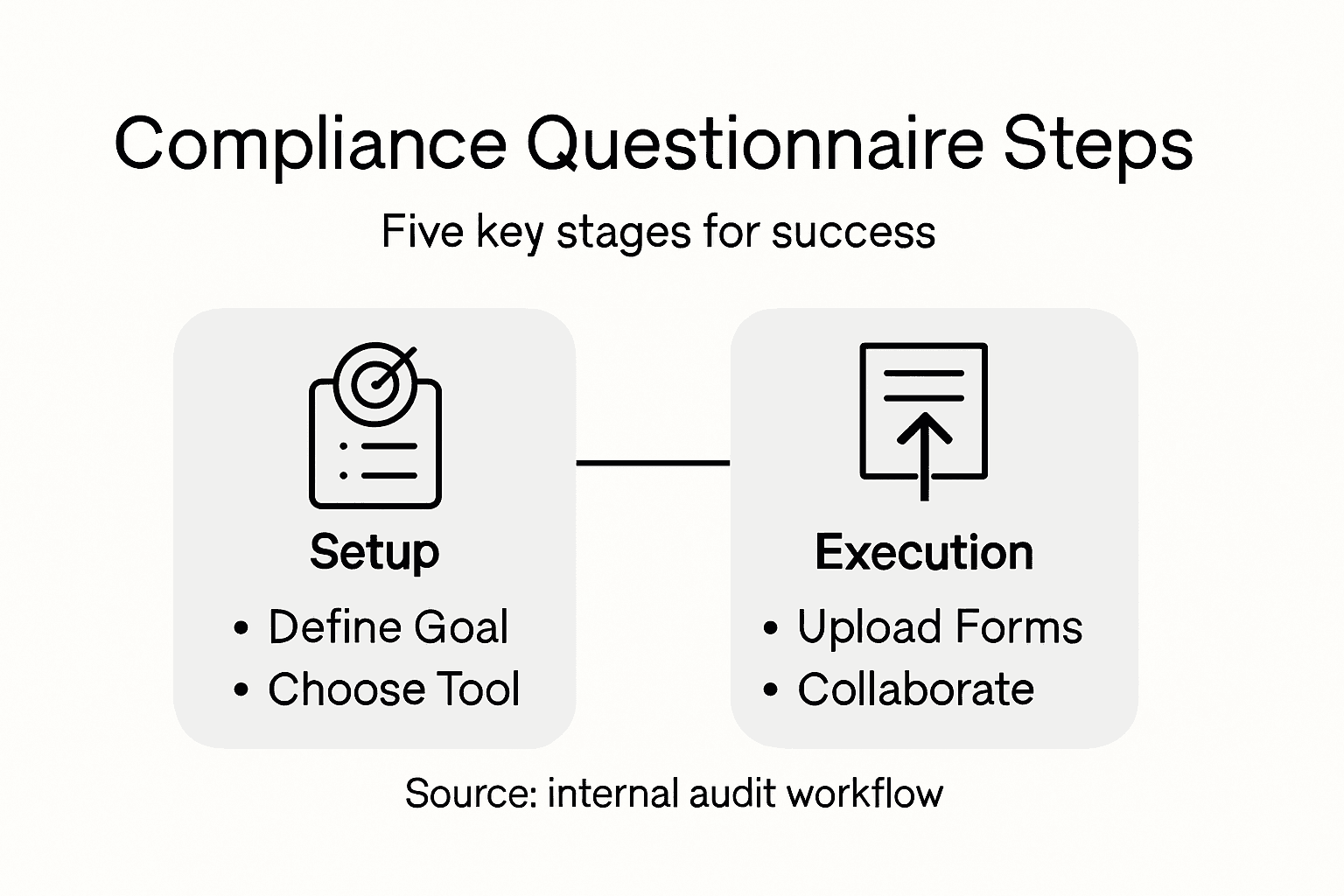
- Step 1: Define questionnaire objectives and requirements
- Step 2: Select appropriate formats and tools for automation
- Step 3: Upload and parse existing questionnaires efficiently
- Step 4: Collaborate to gather accurate responses
- Step 5: Verify and finalize questionnaire completion
Quick Summary
| Key Point | Explanation |
|---|---|
| 1. Clearly Define Objectives | Establish precise research goals to guide questionnaire design, ensuring relevant data collection aligned with compliance needs. |
| 2. Choose Automation Tools Wisely | Select platforms that integrate well, are user-friendly, and have strong reporting features to enhance your compliance processes. |
| 3. Streamline Document Uploading | Standardize and verify existing questionnaires for efficient digital transformation, allowing for quick parsing and data extraction. |
| 4. Foster Collaborative Responses | Utilize structured collaboration and feedback mechanisms to gather diverse inputs, improving the accuracy and richness of responses. |
| 5. Conduct Thorough Verification | Implement a multi-stage review of the questionnaire to ensure clarity, consistency, and alignment with objectives before deployment. |
Step 1: Define questionnaire objectives and requirements
Successfully designing a self-assessment questionnaire begins with crystal-clear objectives that guide every aspect of your evaluation process. Defining precise requirements ensures you collect meaningful, actionable data that directly supports your compliance goals.
Establishing robust questionnaire objectives involves several critical strategic considerations. Best practice in questionnaire design requires meticulous planning around these core elements:
- Identify specific research questions your questionnaire must answer
- Determine measurement goals for each section
- Create unbiased question phrasing
- Ensure single-concept questions
- Select appropriate response formats
The most effective questionnaires start by understanding exactly what information you need. Are you tracking performance metrics? Evaluating compliance readiness? Assessing risk management protocols? Each objective demands a tailored approach to question design and data collection.
Questionnaire objectives should align precisely with your organization's strategic compliance requirements and provide clear, actionable insights.
When defining requirements, consider both quantitative and qualitative data needs. This means crafting questions that not only capture numerical ratings but also allow for nuanced, contextual feedback. Avoid agree-disagree scales that can introduce respondent bias, and instead focus on specific, measurable response options.
Pro tip: Create a detailed objective map before drafting any questions, outlining exactly what insights you need and how each question will help you achieve those goals.
Step 2: Select appropriate formats and tools for automation
Navigating the complex landscape of compliance questionnaire automation requires strategic tool selection that aligns with your organization's unique requirements. Understanding how to choose the right platforms can dramatically transform your assessment processes from manual and error-prone to streamlined and efficient.
Compliance automation tools provide critical features that simplify regulatory management, offering organizations unprecedented control over their assessment workflows. When evaluating potential solutions, consider these essential selection criteria:
- Integration capabilities with existing systems
- Regulatory coverage across your industry
- Scalability of the automation platform
- User interface ease of use
- Reporting and tracking functionality
The most advanced automation solutions go beyond simple digitization. They create intelligent systems that can automatically parse responses, assign responsibilities, and generate audit-ready documentation. By leveraging sophisticated software frameworks, you can transform traditionally time-consuming processes into rapid, accurate assessments.
Modern compliance automation isn't just about speed—it's about creating a robust, intelligent system that adapts to your organization's evolving needs.
Prioritize tools that offer flexible question formats, support multiple response types, and provide real-time collaboration features. Look for platforms that can handle complex, multidimensional questionnaires while maintaining data integrity and supporting comprehensive analysis.
To clarify key differences, here’s how traditional manual and automated compliance questionnaire processes stack up:
| Criteria | Manual Process | Automated Process |
|---|---|---|
| Data Accuracy | Prone to errors | Highly reliable |
| Review Speed | Slow, labor-intensive | Fast, streamlined |
| Audit Readiness | Difficult, inflexible | Effortless, built-in |
| Collaboration | Limited, inefficient | Real-time, structured |
| Scalability | Challenging with growth | Easily handles expansion |
Pro tip: Request detailed demonstrations and trial periods from potential automation tools to ensure they genuinely meet your specific compliance assessment requirements.
Step 3: Upload and parse existing questionnaires efficiently
Transforming your existing questionnaires into streamlined, automated tools requires strategic digital conversion and intelligent parsing techniques. By leveraging advanced technologies, you can quickly convert legacy documents into powerful, data-rich assessment instruments.
Web crawlers and parsing tools enable organizations to extract, standardize, and centralize questionnaire data with unprecedented efficiency. When preparing to upload and parse your existing questionnaires, focus on these critical strategies:
- Standardize document formats before uploading
- Validate question structures for consistency
- Map existing questions to new digital templates
- Clean and normalize response data
- Verify metadata integrity
Successful questionnaire parsing involves more than simple file transfer. You need intelligent systems that can recognize question types, extract meaningful metadata, and transform unstructured content into actionable insights. Advanced platforms can automatically detect question formats, assign appropriate response types, and create machine-readable versions of your existing assessment tools.
Effective questionnaire automation transforms static documents into dynamic, intelligent assessment instruments that adapt to your organizational needs.
Prioritize platforms that support multiple file types and offer robust question bank integration. Look for solutions that can handle complex question structures, support multilingual content, and provide seamless export options for further analysis.

Pro tip: Conduct a comprehensive audit of your existing questionnaires before digital conversion to ensure maximum compatibility and minimal manual intervention.
Step 4: Collaborate to gather accurate responses
Successful compliance questionnaires rely on sophisticated collaboration strategies that transform individual inputs into comprehensive, reliable assessments. By creating a structured yet flexible approach to gathering responses, you can significantly enhance the accuracy and depth of your information collection.
Collaborative self-assessment processes enable organizations to integrate multiple perspectives and contextualize complex compliance information. When designing your collaborative response strategy, implement these key techniques:
- Establish clear evaluation criteria
- Create confidential feedback channels
- Define specific response expectations
- Implement peer review mechanisms
- Provide training for assessment participants
The most effective collaboration goes beyond simple data collection. It involves creating an environment where team members feel empowered to share nuanced insights while maintaining accountability. Advanced platforms can support this by enabling real-time collaboration, tracking individual contributions, and providing structured frameworks for response validation.
Collaborative assessments transform compliance questionnaires from static documents into dynamic, intelligent knowledge-gathering instruments.
Focus on developing transparent communication protocols that encourage honest, comprehensive responses. Integrate mechanisms that allow participants to provide contextual information, highlight potential risks, and offer expert commentary without fear of retribution.
Pro tip: Rotate assessment responsibilities among team members to ensure diverse perspectives and prevent response fatigue.
Here’s a summary of effective collaboration tactics for accurate compliance assessments:
| Collaboration Tactic | Intended Outcome | Example Benefit |
|---|---|---|
| Peer Review | Ensures validity | Uncovers inconsistencies |
| Confidential Channels | Encourages honesty | Reduces reporting bias |
| Rotating Roles | Diversifies input | Prevents response fatigue |
| Training Sessions | Improves quality | Elevates response reliability |
Step 5: Verify and finalize questionnaire completion
Compiling a high-quality compliance questionnaire requires meticulous verification and strategic finalization to ensure data accuracy, reliability, and actionable insights. Your final review process is the critical checkpoint that transforms a draft document into a precision instrument for gathering essential organizational information.
Questionnaire verification involves multiple quality assurance stages that address potential sampling, measurement, and response errors. When finalizing your assessment, focus on these comprehensive validation techniques:
- Confirm alignment with research objectives
- Review question clarity and comprehensibility
- Validate response scale consistency
- Eliminate potential ambiguity in language
- Ensure comprehensive answer options
Successful verification goes beyond surface-level corrections. Advanced platforms can help you systematically evaluate each question's effectiveness, identifying potential biases, redundancies, or gaps in your assessment strategy. The goal is creating a robust instrument that captures nuanced, actionable insights while maintaining participant engagement.
A well-verified questionnaire transforms raw data collection into strategic intelligence gathering.
Prioritize multi-stage review processes that involve different stakeholders, including subject matter experts, potential respondents, and compliance professionals. This collaborative approach helps uncover subtle issues that might compromise your data quality or misrepresent critical organizational information.
Pro tip: Conduct a pilot test with a small, representative group to simulate real-world responses and identify potential refinement opportunities before full deployment.
Accelerate Your Compliance Success with Skypher’s AI Automation
Navigating the complexities of self-assessment questionnaires for compliance demands precision, speed, and collaboration. The article highlights challenges like defining clear objectives, ensuring data accuracy, and managing multiple stakeholders efficiently. Skypher’s AI-driven Questionnaire Automation Tool directly addresses these pain points by transforming lengthy, error-prone processes into fast, reliable workflows. Benefit from powerful AI parsing that can answer hundreds of questions in under a minute, integrate seamlessly with over 30 platforms including OneTrust and ServiceNow, and empower your team through real-time collaboration.

Ready to move beyond manual questionnaire juggling and achieve compliance with confidence? Explore how our customizable Trust Center and extensive API integrations can streamline your security reviews and enhance your organization’s risk management strategy today. Visit Skypher’s platform to see how leading tech and finance companies are accelerating their compliance processes and improving operational productivity. Don’t wait to experience greater accuracy, efficiency, and trust with Skypher’s end-to-end automation solutions.
Frequently Asked Questions
What are the key objectives in designing a self-assessment questionnaire for compliance?
To effectively design a self-assessment questionnaire for compliance, it is vital to identify specific research questions and measurement goals. Start by mapping out what insights you need, such as tracking performance or evaluating compliance readiness, to guide your question design.
How can I select the right tools for automating my compliance questionnaire process?
Choosing the right tools involves evaluating their integration capabilities, regulatory coverage, and user-friendliness. Review available automation platforms and prioritize those that facilitate real-time collaboration and support complex question formats to enhance your assessment workflows.
What steps should I follow to upload and parse existing questionnaires?
Begin by standardizing document formats and validating question structures before uploading. Focus on ensuring that your data is clean and normalized, allowing for efficient parsing into a digital format that maintains data integrity and accuracy.
How can I enhance collaboration during the response gathering process of my compliance questionnaire?
To improve collaboration, establish clear evaluation criteria and create confidential channels for feedback. Encourage diverse input through peer reviews and consider rotating assessment responsibilities to mitigate response fatigue and improve data quality.
What are the best practices for verifying and finalizing a compliance questionnaire?
Implement a multi-stage review process that confirms alignment with your objectives and validates question clarity. Conduct a pilot test with a small representative group to identify potential improvements before full deployment, ensuring your questionnaire is effective and comprehensive.
Recommended
- Understanding SOC 1 Compliance: Key Concepts Explained
- 7 Essential Steps for a Security Compliance Checklist
- 7 Steps to Create a Complete SOC 2 Compliance Checklist
- The ever growing number of security questionnaires and what you and your company can do to face it
- Why Sales Skills Assessment Drives Consistent Growth