
SOC 1 certification is crucial for service organizations that impact their clients' financial reporting. It provides assurance about the effectiveness of controls that could affect user entities' financial statements. In fact, nearly 80 percent of businesses report improved client trust after achieving SOC 1 certification. But here’s the kicker: many organizations underestimate the strategic advantage that comes from this certification. Because, beyond compliance, SOC 1 can streamline client interactions and enhance operational efficiency in ways you might not expect.
Table of Contents
- Understanding SOC 1 Certification
- SOC 1 Compliance Process
- SOC 1 vs SOC 2 Differences
- Best Practices for SOC 1 Certification
Quick Summary
| Takeaway | Explanation |
|---|---|
| Understand the Importance of SOC 1 Certification | SOC 1 certification is essential for service organizations that affect clients' financial reporting, demonstrating their commitment to maintaining robust controls that protect financial data integrity. |
| Differentiate Between SOC 1 Report Types | Organizations can choose between SOC 1 Type 1, which assesses control design at a specific point in time, and SOC 1 Type 2, which evaluates the operating effectiveness of controls over a period of time, typically 6-12 months. |
| Implement Continuous Improvement in Compliance | Following the SOC 1 compliance process should be viewed as an ongoing journey where organizations not only achieve certification but also enhance their overall control environment for sustained effectiveness. |
| Establish a Solid Control Framework and Documentation | Organizations should develop a well-defined control framework and rigorously document control activities, ensuring clarity on objectives, performance frequency, and evidence retention to support SOC 1 compliance. |
| Foster a Culture of Compliance Throughout the Organization | For successful SOC 1 certification, a compliance culture is vital—employees should be trained on controls' importance, and compliance performance should be incorporated into evaluations and onboarding processes. |
Understanding SOC 1 Certification
SOC 1 certification represents a critical benchmark for service organizations that impact their clients' financial reporting. This specialized attestation provides assurance about the effectiveness of controls that could affect user entities' financial statements. Let's break down what SOC 1 certification truly means and why it matters in today's business landscape.
The Foundation of SOC 1
At its core, SOC 1 is an examination of controls at a service organization that are likely to be relevant to user entities' internal control over financial reporting, as defined by the American Institute of Certified Public Accountants (AICPA). These reports are designed for service providers whose services could impact their clients' financial reporting processes.
For example, payroll processors, loan servicing companies, and data center providers all handle information that directly affects their clients' financial statements. When these organizations obtain SOC 1 certification, they demonstrate their commitment to maintaining proper controls that protect the integrity of financial data.
Sometimes called SSAE 18 reports (referencing the professional standard under which they're conducted), SOC 1 reports focus specifically on controls relevant to financial reporting, unlike other SOC reports that may have broader security focuses.
Types of SOC 1 Reports
Soc 1 certification comes in two distinct varieties, each serving different purposes:
-
Type 1 Reports: These assess the suitability of control design at a specific point in time. Think of a Type 1 report as a snapshot—it tells you whether controls were appropriately designed on a particular date, but doesn't verify their effectiveness over time.
-
Type 2 Reports: More comprehensive than Type 1, these reports evaluate both the design and operating effectiveness of controls over a period (typically 6-12 months). A SOC 1 Type 2 attestation is performed under SSAE No. 18 and follows the standards for "Reporting on an Examination of Controls at a Service Organization Relevant to User Entities' Internal Control Over Financial Reporting," according to Microsoft Compliance documentation.
Key Components of SOC 1 Reports
A proper SOC 1 report contains several essential elements. At minimum, SOC 1 reports require a system description detailing the services provided, policies, procedures, and personnel involved, as well as a written statement of assertion from the management team, as noted by IS Partners.
Additionally, SOC 1 reports typically include:
-
Management Assertion: A statement from the service organization confirming they've presented their system fairly and designed appropriate controls.
-
Independent Auditor's Opinion: The CPA firm's assessment of whether controls are suitably designed and operating effectively (for Type 2).
-
Description of Controls: Detailed information about the control environment, risk assessment processes, monitoring activities, and specific control activities.
-
Test Results: For Type 2 reports, documentation of how controls were tested and whether they operated effectively throughout the reporting period.
Business Value of SOC 1 Certification
Organizations don't pursue SOC 1 certification merely for compliance reasons. This certification delivers tangible business value by:
- Building trust with clients who rely on your services for their financial reporting
- Reducing the burden of multiple client audits by providing a standardized report
- Identifying control weaknesses before they lead to material misstatements
- Creating competitive advantage in industries where financial data handling is sensitive
James Wilson, Partner at a leading accounting firm, notes: "Many organizations underestimate how SOC 1 certification can streamline their client relationships. Rather than responding to dozens of different security questionnaires, they can simply provide their SOC 1 report, saving significant time while offering greater assurance."
Understanding SOC 1 certification is just the beginning. For organizations handling financial data, pursuing this certification demonstrates commitment to maintaining proper controls and builds the foundation for trusted client relationships.
SOC 1 Compliance Process
Achieving SOC 1 certification isn't a one-time event but rather a structured journey requiring thoughtful preparation and execution. Organizations seeking this certification must navigate several crucial phases to demonstrate their controls are properly designed and operating effectively.
Preparation Phase
Before diving into the formal audit, organizations must lay the groundwork for success. This preparation phase is where you build the foundation for your SOC 1 compliance.
First, determine which business processes impact your clients' financial reporting. Not every aspect of your operation requires scrutiny under SOC 1. Focus on services that directly or indirectly affect your customers' financial statements.
Next, assemble your compliance team. This typically includes representatives from IT, operations, finance, and management who understand both the technical controls and business processes involved.
Control Design and Documentation
The SOC 1 compliance process requires organizations to define, design, and operate effective internal controls across five major categories: control environment, risk assessment, control activities, information and communication, and monitoring activities, according to IS Partners. These controls must be tailored to the organization's specific risk profile and services.
Key steps in this phase include:
- Identifying control objectives relevant to financial reporting
- Designing specific controls to meet those objectives
- Documenting control activities with clear owners and frequencies
- Creating policies and procedures that support these controls
An example of a control might be: "All changes to customer financial data require two-level approval and are logged in the system audit trail." Each control should be documented with its purpose, implementation details, and how it will be tested.
Pre-Audit Assessment
Before engaging an external auditor, conduct a gap analysis or readiness assessment. This internal review helps identify and address potential issues before the formal audit begins.
During this assessment:
- Test your controls as an auditor would
- Identify and remediate any control gaps
- Strengthen documentation where needed
- Ensure controls are consistently performed
Some organizations choose to work with compliance consultants during this phase to provide an objective assessment of their readiness.
Formal Audit Process
For a SOC 1 Type 1 report, management must identify internal controls relevant to financial reporting, and an independent auditor (typically a CPA) evaluates the fairness of the system description and the suitability of control design as of a specific date, with limited testing performed for each control, as noted by Warren Averett.
For Type 2 audits, the process extends over a period (typically 6-12 months) and involves:
- Initial planning meetings with your auditor
- System description review and validation
- Control testing throughout the observation period
- Evidence collection and interviews with key personnel
- Findings review and remediation opportunities
- Report drafting and finalization
During this process, auditors will request evidence of control operation, such as approval logs, system configurations, access reviews, and change management documentation.
Addressing Findings and Continuous Improvement
Few organizations achieve perfect results in their first SOC 1 audit. Findings typically fall into categories:
- Control exceptions (instances where a control failed to operate as designed)
- Design deficiencies (controls that, even when operating as designed, don't adequately address risks)
- Documentation weaknesses (insufficient evidence of control operation)
The audit report will include management's response to any exceptions or deficiencies, along with remediation plans. These responses demonstrate your commitment to continuous improvement.
After receiving your SOC 1 report, implement a cycle of ongoing monitoring and improvement. Controls must remain effective between audit periods, and control owners should regularly verify and document that controls continue to function as intended.
Renewal and Recertification
SOC 1 certification isn't permanent. For continuing assurance to clients, organizations typically renew their SOC 1 reports annually. This means establishing a cadence of preparation, testing, and formal audits that becomes part of your operational rhythm.
By embracing the SOC 1 compliance process as a continuous improvement journey rather than a checkbox exercise, organizations not only achieve certification but also strengthen their overall control environment—delivering greater value to both their business and their clients.
SOC 1 vs SOC 2 Differences
When navigating the landscape of service organization controls reports, understanding the distinct differences between SOC 1 and SOC 2 is crucial for selecting the right compliance path. While both reports fall under the SOC framework developed by the AICPA, they serve fundamentally different purposes and audiences.
Core Focus and Purpose
The most fundamental difference lies in what each report examines. SOC 1 focuses specifically on an organization's financial controls, while SOC 2 addresses information security controls relevant to the Trust Services Criteria, as highlighted by Secureframe. This distinction shapes everything from the audit scope to the intended audience.
Starting January 2025, this separation of concerns becomes even more defined—SOC 1 reports will specifically target controls influencing financial reporting, while SOC 2 will emphasize broader operational and security measures designed for diverse business needs, according to Aprio.
Intended Audience and Distribution
The intended readers of these reports differ significantly:
-
SOC 1 Reports: Primarily designed for user entities' financial auditors, CFOs, controllers, and other stakeholders concerned with financial reporting integrity.
-
SOC 2 Reports: Aimed at management, regulators, business partners, prospective customers, and others concerned with security, availability, processing integrity, confidentiality, and privacy of systems.
This audience difference affects how the reports are distributed. SOC 1 reports typically have restricted distribution limited to management, user entities, and their auditors. SOC 2 reports, while still confidential, can be shared more broadly with potential customers under non-disclosure agreements.
Criteria and Control Frameworks
Another key difference lies in the frameworks used to evaluate controls:
-
SOC 1: Based on control objectives developed by management that are relevant to financial reporting. The criteria are largely custom to each organization's specific services affecting financial reporting.
-
SOC 2: Based on the AICPA's Trust Services Criteria, which include five core principles:
- Security (the Common Criteria)
- Availability
- Processing Integrity
- Confidentiality
- Privacy
Organizations pursuing SOC 2 can choose which trust principles are relevant to their services, with Security being mandatory.
Report Types and Timing Considerations
Both SOC 1 and SOC 2 reports come in Type 1 and Type 2 varieties. Type 1 examines controls at a single point in time, while Type 2 assesses operational effectiveness over an extended period, typically 6-12 months, as explained by ZenGRC.
However, the timing considerations often differ in practice:
-
SOC 1 reports frequently align with fiscal year-ends of user organizations to support their financial statement audits.
-
SOC 2 report timing is more flexible and often determined by business needs, such as sales cycles or regulatory requirements.
Testing Methodologies
While both reports involve control testing, the nature and focus of testing differs:
-
SOC 1 Testing: Concentrates on controls that could impact the accuracy of financial transactions and reporting. Examples include segregation of duties in financial systems, reconciliation processes, and transaction processing controls.
-
SOC 2 Testing: Focuses on controls related to the selected Trust Services Criteria. This might include testing of access controls, change management, risk assessment processes, encryption practices, and incident response procedures.
Choosing Between SOC 1 and SOC 2
Many organizations struggle with determining which SOC report they need. The decision primarily depends on the nature of your services:
-
When to pursue SOC 1: If your services directly impact your clients' financial statements or financial reporting controls. Examples include payment processing, billing services, payroll processing, and loan servicing.
-
When to pursue SOC 2: If your services involve storing, processing, or transmitting customer data, particularly if security, availability, processing integrity, confidentiality, or privacy are concerns. Examples include cloud service providers, SaaS companies, and data centers.
Some organizations may need both reports if their services affect both financial reporting and involve sensitive data handling.
Business Impact Considerations
The practical business implications of each report differ as well:
-
SOC 1 reports typically address immediate compliance needs for financial audits and may be specifically requested by customers' auditors.
-
SOC 2 reports often serve as competitive differentiators in the marketplace and address broader security concerns from potential customers.
Understanding these key differences ensures organizations pursue the appropriate certification path aligned with their services, customer needs, and strategic objectives.
Best Practices for SOC 1 Certification

Successful SOC 1 certification requires more than simply checking boxes—it demands thoughtful implementation of controls and thorough preparation. Organizations that achieve and maintain SOC 1 certification efficiently typically follow these proven best practices throughout their compliance journey.
Establish a Solid Control Framework
Before diving into specific controls, establish a comprehensive framework aligned with SOC 1 requirements. According to IS Partners, organizations pursuing SOC 1 compliance should focus on five major control categories:
- Control Environment - The foundation that sets the tone for the organization
- Risk Assessment - Processes to identify and manage risks
- Control Activities - Actions established through policies and procedures
- Information and Communication - Methods to capture and exchange relevant information
- Monitoring Activities - Ongoing evaluations to ensure controls function properly
This structured approach ensures no critical aspects of your control environment are overlooked.
Start with Clear Scoping
One common pitfall in SOC 1 certification is an improperly defined scope. Rather than attempting to certify every aspect of your operations:
- Identify specifically which services affect your customers' financial reporting
- Map the systems, processes, and people involved in delivering those services
- Document boundaries between in-scope and out-of-scope elements
- Consider complementary user entity controls your customers need to implement
By focusing your scope appropriately, you'll streamline the certification process and create a more relevant report for your customers and their auditors.
Implement Proper Control Documentation
Detail is crucial when documenting your controls. For each control, clearly document:
- The control objective it addresses
- Who performs the control (role rather than individual)
- How frequently the control is performed
- What evidence is generated and retained
- How exceptions are handled and remediated
Comprehensive documentation serves multiple purposes—it guides your team during implementation, provides clear evidence for auditors, and serves as training material for new employees.
Conduct Regular Control Testing
Don't wait for your auditor to identify control failures. As highlighted by InfoSec Institute, organizations should identify and close any control gaps before engaging an auditor.
Implement a schedule of regular internal testing that mirrors how auditors will assess your controls. This might include:
- Sampling control evidence to verify completeness and accuracy
- Interviewing control owners to confirm understanding
- Testing automated controls through system configurations
- Reviewing exceptions and their resolutions
By catching and addressing issues early, you'll minimize surprises during the formal audit.
Choose the Right Report Type
SOC 1 has two report types: Type 1 provides a snapshot of compliance at a specific point in time, while Type 2 verifies sustained compliance across all controls over a set period (typically six months to a year), according to InfoSec Institute.
For organizations new to SOC 1, consider starting with a Type 1 report to establish your baseline, then progress to a Type 2 report. This approach allows you to address design deficiencies before tackling the more challenging operational effectiveness requirements.
Foster a Culture of Compliance
Successful SOC 1 certification depends on more than documented procedures—it requires a culture where compliance is valued throughout the organization:
- Train employees on the importance of controls and their specific responsibilities
- Include control performance in job descriptions and performance evaluations
- Celebrate compliance successes and address failures constructively
- Make compliance part of your onboarding process for new team members
When employees understand why controls matter and how they connect to customer trust, they're more likely to follow procedures consistently.
Manage Vendor Relationships
Your SOC 1 controls often extend to your vendors and service providers. Establish processes to:
- Evaluate vendors' security and control postures before engagement
- Include compliance requirements in contracts and service level agreements
- Regularly review vendors' own SOC reports or other compliance evidence
- Implement complementary controls where vendor controls may be insufficient
Vendor-related control failures can undermine your entire compliance program, so this area deserves special attention.
Prepare for Continuous Improvement
SOC 1 certification isn't a one-time achievement but an ongoing process. Build mechanisms for continuous improvement:
- Track and analyze control exceptions to identify root causes
- Regularly review control designs against evolving risks
- Incorporate feedback from auditors, customers, and internal stakeholders
- Stay informed about changes to SOC 1 standards and industry practices
By viewing SOC 1 as a journey rather than a destination, you'll maintain effective controls that truly protect your services and your customers' financial reporting.
Frequently Asked Questions
What is SOC 1 certification?
SOC 1 certification is an attestation for service organizations that impact their clients' financial reporting. It assesses the effectiveness of controls relevant to user entities' financial statements, helping to build trust and streamline client interactions.
What are the differences between SOC 1 Type 1 and Type 2 reports?
SOC 1 Type 1 reports assess the design of controls at a specific point in time, while SOC 1 Type 2 reports evaluate both the design and operational effectiveness of controls over a period, typically between 6 to 12 months.
How can our organization prepare for SOC 1 certification?
Preparing for SOC 1 certification involves several steps: identifying business processes that impact financial reporting, assembling a compliance team, designing robust internal controls, documenting procedures, and conducting a pre-audit assessment to identify potential gaps.
Why is SOC 1 certification valuable for businesses?
Achieving SOC 1 certification provides tangible benefits, such as enhancing client trust, reducing the burden of multiple audits, identifying control weaknesses early, and creating a competitive advantage in markets sensitive to financial data handling.
Elevate Your SOC 1 Journey with Skypher
Achieving SOC 1 certification is not just about compliance—it's an opportunity to build trust and streamline client relations! As highlighted in the article, organizations often struggle with the complexities of the SOC 1 compliance process, from control design to documentation and continuous improvement. The challenge is real: nearly 80% of businesses report improved client trust post-certification, but navigating audits and maintaining effective controls can feel overwhelming.
!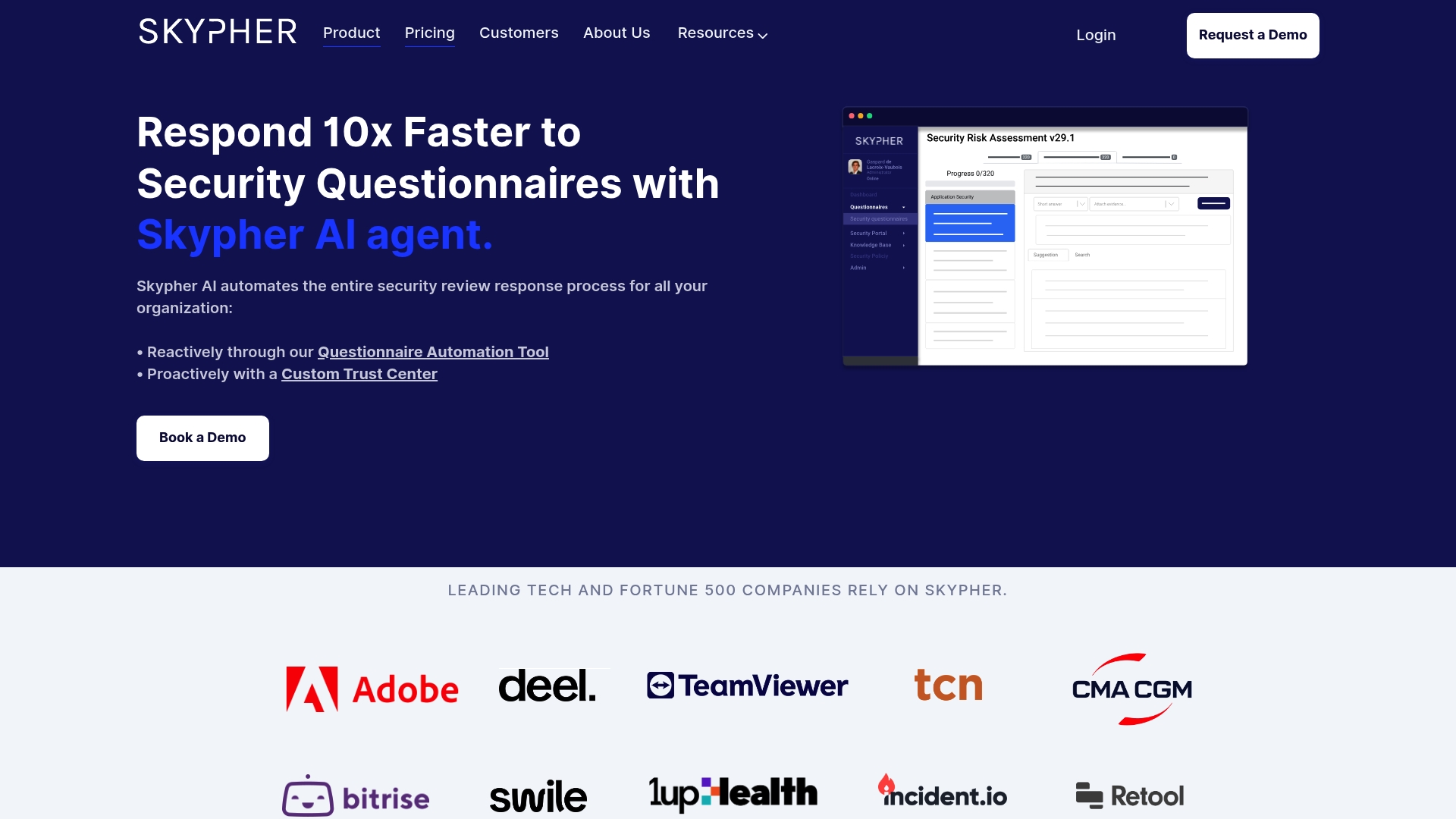
This is where Skypher comes in. Our AI-driven Questionnaire Automation Tool seamlessly integrates with over 40 third-party risk management platforms, making your SOC 1 compliance feel less like a chore and more like a streamlined process. Imagine completing security reviews significantly faster and with higher accuracy—that’s the Skypher promise! Organizations can reduce time spent on security questionnaires, ensuring your team can focus on what truly matters: enhancing operational productivity and fostering client trust.
Ready to transform your compliance journey? Visit Skypher today and discover how we can simplify your SOC 1 certification process and put you on the fast track to success!