

Over seventy percent of tech companies now cite growing client demands for audit proof during security reviews, especially from large American firms. The pressure to show robust financial controls is higher than ever for compliance officers trying to satisfy relentless vendor questionnaires and pass detailed audits. Understanding SOC 1 Type 2 reports helps organizations worldwide answer tough questions with confidence and present proof of reliable internal controls recognized across both American and international markets.
Table of Contents
- SOC 1 Type 2 Reports Explained
- Key Distinctions: Type 1 vs. Type 2
- Core Controls and Audit Process
- Compliance Obligations for Tech Firms
- Risks, Pitfalls, and Best Practices
Key Takeaways
| Point | Details |
|---|---|
| Purpose of SOC 1 Type 2 Reports | They provide assurance about the effectiveness of an organization's internal controls related to financial reporting. |
| Difference Between Type 1 and Type 2 | Type 1 reports assess control design at a specific point, while Type 2 reports evaluate operational effectiveness over time. |
| Importance for Technology Firms | Tech companies must prioritize SOC 1 Type 2 compliance to demonstrate reliable internal controls and build client trust. |
| Best Practices for Compliance | Organizations should maintain clear documentation, implement regular audits, and foster a culture of continuous improvement to mitigate compliance risks. |
SOC 1 Type 2 Reports Explained
SOC 1 Type 2 reports represent a critical compliance mechanism designed to provide comprehensive insights into an organization's internal financial controls and their operational effectiveness. Developed by the American Institute of Certified Public Accountants (AICPA), these reports offer detailed examinations of control systems that impact financial reporting for service organizations.
Unlike Type 1 reports that only assess control design, Type 2 reports conduct extensive testing to evaluate how effectively those controls function over a specific monitoring period. Service auditors meticulously examine control objectives, testing each mechanism's reliability and consistency across multiple transactions and scenarios. These reports typically cover a minimum six to twelve month timeframe, providing stakeholders with an in depth understanding of an organization's control environment.
The primary purpose of SOC 1 Type 2 reports centers on providing assurance to user entities about the integrity and reliability of service organizations' internal controls. These comprehensive audits follow standardized frameworks like COSO and SSAE 18, ensuring a systematic approach to evaluating financial reporting controls. Companies across various industries rely on these reports to demonstrate their commitment to robust risk management and transparent financial operations.
Pro tip: When reviewing a SOC 1 Type 2 report, focus on the auditor's opinion, the description of the service organization's system, and the details of control testing to gain the most comprehensive understanding of the organization's control effectiveness.
Key Distinctions: Type 1 vs. Type 2
SOC 1 compliance reports are divided into two distinct categories: Type 1 and Type 2, each serving unique purposes in assessing an organization's internal financial controls. Type 1 reports focus on evaluating the design of control systems at a specific point in time, essentially providing a snapshot of an organization's control framework. These reports examine whether control mechanisms are appropriately structured and theoretically capable of achieving their intended objectives.
Type 2 reports, in contrast, offer a more comprehensive and dynamic assessment. While Type 1 reports capture control design, Type 2 reports go a critical step further by testing the actual operational effectiveness of those controls. They involve extensive testing over a defined period typically ranging from six to twelve months, providing stakeholders with deeper insights into how consistently and reliably control systems perform in real world scenarios.
The key differences between Type 1 and Type 2 reports can be summarized through several critical dimensions. Type 1 reports are essentially theoretical evaluations that assess control design, whereas Type 2 reports are practical, evidence-based assessments that validate control performance. Type 1 reports are completed in a shorter timeframe and involve less rigorous testing, making them less comprehensive but quicker to obtain. Type 2 reports require more extensive auditing, involve multiple transaction testing, and provide a more robust evaluation of an organization's control environment.
Pro tip: When determining which SOC 1 report type meets your needs, consider the depth of assurance required: choose Type 1 for a quick control design overview, or Type 2 for a thorough, performance-validated assessment.
Here's a quick comparison of SOC 1 Type 1 and Type 2 reports in key dimensions:
| Characteristic | Type 1 Report | Type 2 Report |
|---|---|---|
| Focus | Control design | Design and operational effectiveness |
| Audit Duration | Single point in time | Six to twelve months |
| Depth of Assessment | Theoretical | Practical and evidence-based |
| Value to Stakeholders | High-level assurance | Thorough, performance-validated |
| Testing Frequency | Once | Multiple times over audit period |
Core Controls and Audit Process
SOC 1 Type 2 audits involve a comprehensive examination of an organization's internal controls related to financial reporting. The audit process follows rigorous procedures under SSAE 18 attestation standards, methodically evaluating control effectiveness across multiple critical dimensions. These audits are designed to provide user entities with an independent, professional assessment of a service organization's control environment.

The core audit process typically encompasses several key stages. Initially, the audit begins with a detailed system description prepared by management, which outlines the organization's control objectives and framework. Auditors then conduct extensive testing through multiple methodologies, including sample testing, direct observation, and control re-performance. These techniques allow auditors to validate the design and operational effectiveness of internal controls over a specified reporting period, usually spanning six to twelve months.
Control areas under examination are comprehensive and typically include critical domains such as transaction processing, system access controls, data integrity mechanisms, and overall operational protocols. Auditors meticulously evaluate these control areas to ensure they meet professional standards and provide reliable assurance to user entities. The goal is to generate a detailed report that not only highlights the current state of internal controls but also provides insights into potential improvement areas and risk management strategies.
Pro tip: When preparing for a SOC 1 Type 2 audit, proactively document your control processes, maintain consistent implementation, and ensure clear communication between your internal teams and external auditors to facilitate a smooth and comprehensive review.
Compliance Obligations for Tech Firms
Technology service providers face increasingly complex compliance requirements that make SOC 1 Type 2 reports critical to their operational strategy. Tech firms providing services that impact client financial reporting must demonstrate rigorous internal control mechanisms through comprehensive audit processes, ensuring transparency and accountability in their operational frameworks.
Compliance obligations extend far beyond simple documentation. These reports serve multiple strategic purposes, including enabling critical sales contracts, addressing vendor risk management requirements, and establishing credibility with potential clients. Organizations must systematically document their control environments, proving they maintain consistent, reliable processes that meet industry standards like SSAE 18 and various international frameworks. The SOC 1 Type 2 report becomes a powerful tool for tech firms to differentiate themselves in competitive markets, showcasing their commitment to robust internal governance.
For technology companies, SOC 1 Type 2 compliance is not just a regulatory checkbox but a strategic imperative. Global tech providers increasingly view these compliance efforts as essential to operational integrity and market positioning, recognizing that potential clients and partners demand comprehensive evidence of control effectiveness. These reports provide an independent, professional assessment that can significantly reduce perceived risks and accelerate business relationships by demonstrating a mature, systematic approach to internal control management.
Pro tip: Integrate SOC 1 Type 2 compliance preparation into your ongoing operational processes, treating it as a continuous improvement opportunity rather than an annual administrative burden.
Risks, Pitfalls, and Best Practices
SOC 1 Type 2 compliance introduces complex challenges that organizations must strategically navigate to maintain effective internal controls. Organizations frequently encounter significant risks when inadequately preparing for comprehensive audit processes, particularly through insufficient control documentation and inconsistent implementation. Understanding these potential pitfalls is crucial for developing a robust compliance strategy that goes beyond mere checkbox requirements.
The most prevalent risks emerge from lack of clarity in control objectives and poor documentation practices. Many organizations struggle with maintaining consistent control applications across different operational domains, which can lead to unexpected audit findings. Critical vulnerabilities often stem from fragmented control frameworks, insufficient executive sponsorship, and limited ongoing monitoring mechanisms. Companies must develop comprehensive strategies that integrate continuous assessment, clear communication protocols, and systematic documentation to mitigate these inherent compliance challenges.
Successful SOC 1 Type 2 compliance requires proactive engagement with qualified auditors, periodic self-assessments, and leveraging advanced automation tools for continuous control monitoring. Best practices emphasize creating a culture of continuous improvement, where compliance is viewed as a dynamic, evolving process rather than a static annual requirement. Organizations should focus on developing clear control objectives, maintaining meticulous documentation, and establishing robust internal communication channels that facilitate transparent risk management.
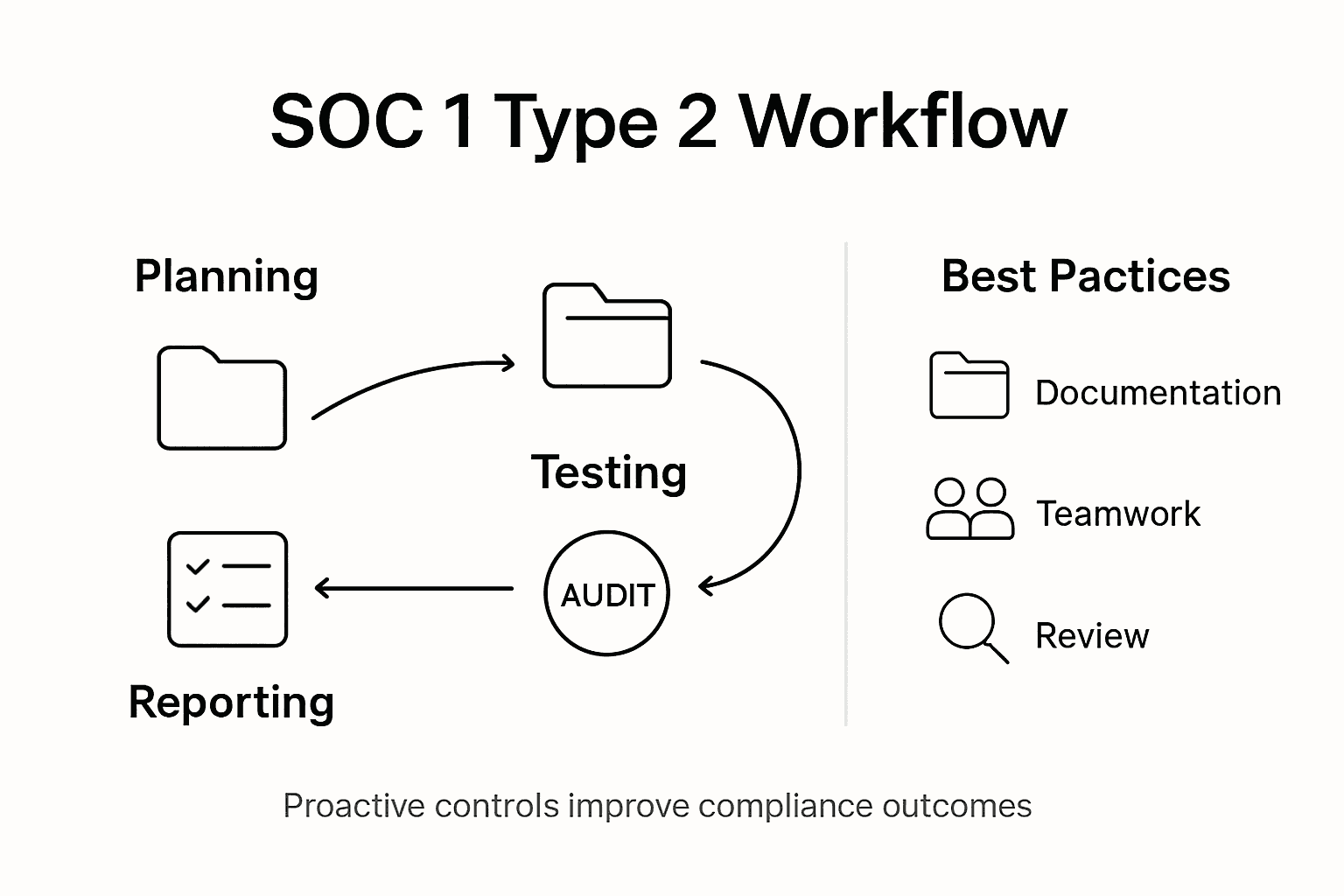
The following table summarizes major risks in SOC 1 Type 2 compliance and suggested best practices:
| Risk Area | Impact on Compliance | Recommended Best Practice |
|---|---|---|
| Poor control documentation | Audit delays or findings | Maintain clear, updated documentation |
| Inconsistent implementation | Control failures detected | Conduct regular internal reviews |
| Limited executive support | Fragmented compliance effort | Secure leadership sponsorship |
| Weak monitoring systems | Missed control deviations | Use automated monitoring tools |
Pro tip: Implement a cross-functional compliance team that meets quarterly to review and update control mechanisms, ensuring your SOC 1 Type 2 preparation remains adaptive and responsive to changing organizational needs.
Accelerate Your SOC 1 Type 2 Compliance Workflow with Skypher
SOC 1 Type 2 reports demand comprehensive documentation, consistent control implementation, and real-time collaboration across multiple teams. Managing security questionnaires and audit responses manually can slow down your compliance process and increase the risk of errors or missed deadlines. Skypher’s AI Questionnaire Automation Tool is designed precisely to eliminate these challenges by streamlining how your organization handles complex security reviews. Benefit from fast, accurate answers powered by advanced AI models and integrations with over 40 third-party risk management platforms like ServiceNow and OneTrust.

Ready to transform your SOC 1 Type 2 audit preparation and reduce compliance friction today? Visit Skypher to explore how our Custom Trust Center, real-time collaboration features, and enterprise-grade support can boost your security posture and save valuable time. Don’t let tedious questionnaire workflows hold back your tech or finance organization—automate smarter and meet compliance with confidence.
Frequently Asked Questions
What is a SOC 1 Type 2 report?
A SOC 1 Type 2 report is an audit that assesses the effectiveness of a service organization's internal controls related to financial reporting over a specific period, typically six to twelve months.
How does a SOC 1 Type 2 report differ from a SOC 1 Type 1 report?
A SOC 1 Type 1 report evaluates the design of controls at a single point in time, while a SOC 1 Type 2 report tests the operational effectiveness of those controls over a defined period.
Why are SOC 1 Type 2 reports important for technology service providers?
SOC 1 Type 2 reports are crucial for technology service providers as they demonstrate the effectiveness of their internal controls, helping to build trust with clients and meet compliance requirements related to financial reporting.
What best practices should organizations adopt for SOC 1 Type 2 compliance?
Organizations should maintain clear documentation of their control processes, establish a culture of continuous improvement, engage qualified auditors, and use automated tools for ongoing monitoring to ensure effective SOC 1 Type 2 compliance.