

Did you know that over 70 percent of SaaS buyers consider security certifications before choosing a provider? With cyber threats rising and regulations tightening, being able to prove your security standards matters more than ever. Understanding a SOC 2 report sample gives your team and clients clear confidence in your ability to safeguard sensitive data and strengthens your reputation in the competitive SaaS market.
Table of Contents
- 1. Understanding the Basics of a SOC 2 Report Sample
- 2. How to Read the Controls Section Effectively
- 3. Key Metrics and What They Reveal About Security
- 4. Linking SOC 2 Requirements to SaaS Operations
- 5. Automating Evidence Collection for SOC 2 Reports
- 6. Enhancing Collaboration in Compliance Reviews
- 7. Leveraging SOC 2 Reports to Build Customer Trust
Quick Summary
| Takeaway | Explanation |
|---|---|
| 1. SOC 2 reports ensure data security | They provide insights into how organizations protect sensitive customer data and demonstrate commitment to cybersecurity. |
| 2. Focus on Trust Services Criteria | Understand security, availability, processing integrity, confidentiality, and privacy in evaluating control effectiveness. |
| 3. Use security metrics for assessments | Analyze metrics like incident response times and patch effectiveness to gauge and improve overall security posture. |
| 4. Automate evidence collection | Streamlined automation reduces errors and saves time, ensuring consistent compliance documentation without manual effort. |
| 5. Build customer trust through transparency | A detailed SOC 2 report showcases your commitment to security, fostering confidence and helping to differentiate your SaaS solution. |
1. Understanding the Basics of a SOC 2 Report Sample
A SOC 2 report is a comprehensive security assessment that evaluates how a company manages and protects customer data. Think of it as a thorough health checkup for your organization's information security practices. This critical document provides transparency about an organization's controls and security protocols.
The report focuses on five key Trust Services Criteria: security, availability, processing integrity, confidentiality, and privacy. Each criterion represents a different aspect of how your organization safeguards sensitive information. For SaaS teams, this means demonstrating robust mechanisms that protect client data throughout its entire lifecycle.
At its core, a SOC 2 report serves two primary purposes. First, it assesses your company's internal controls and security measures. Second, it provides external stakeholders like potential clients and investors with concrete evidence of your commitment to data protection. Learn more in our guide on understanding SOC reports.
For SaaS organizations, obtaining a SOC 2 report is not just a compliance checkbox. It represents a strategic commitment to building trust. Potential customers want assurance that their data will be handled with the highest security standards. By producing a comprehensive SOC 2 report, you demonstrate professionalism and transparency.
Key elements typically included in a SOC 2 report sample are:
- Description of the company's systems and services
- Specific control objectives and activities
- Details about testing and evaluation procedures
- Independent auditor's assessment and opinion
Understanding and preparing a SOC 2 report requires meticulous attention to detail and a proactive approach to security management. It is an ongoing process that reflects your organization's dedication to maintaining the highest standards of data protection.
2. How to Read the Controls Section Effectively
The controls section of a SOC 2 report is your roadmap to understanding an organization's security practices. Think of it as a detailed blueprint that reveals how a company protects sensitive information and manages potential risks.
When examining the controls section, you will want to focus on how specific security mechanisms are implemented and tested. This section provides a comprehensive overview of the control objectives, specific control activities, and the auditor's assessment of their effectiveness. For deeper insights, explore our guide on SOC II Type 1 understanding.
Key Elements to Analyze
Effective reading of the controls section requires a strategic approach. Start by identifying the five Trust Services Criteria:
- Security Controls
- Availability Mechanisms
- Processing Integrity
- Confidentiality Protocols
- Privacy Safeguards
Pay special attention to how each control is described. Look for clear explanations of:
- The specific control activity
- Who is responsible for implementing the control
- How frequently the control is performed
- Evidence of the control's consistent execution
Practical tip: Do not get lost in technical details. Focus on understanding the overall approach to risk management. Are the controls comprehensive? Do they address potential vulnerabilities? Can you see a systematic approach to security?
Reading the controls section is not just about understanding technical details. It is about assessing an organization's commitment to protecting data. A well documented controls section demonstrates transparency, systematic thinking, and a proactive approach to cybersecurity.
Remember, the goal is not to understand every technical nuance but to gain confidence in the organization's security practices. Look for clear, consistent, and comprehensive controls that show a mature approach to risk management.
3. Key Metrics and What They Reveal About Security
Security metrics in a SOC 2 report are like a health diagnostic for your organization's cybersecurity infrastructure. They transform abstract security concepts into tangible, measurable data points that reveal the true effectiveness of your security practices.
When analyzing security metrics, you are essentially looking under the hood of your organization's risk management strategy. These metrics provide concrete evidence of how well your systems protect sensitive information from potential threats. For more insights into cybersecurity frameworks, check out our guide on understanding GRC cyber security.
Key Security Metrics to Examine:
- Number of detected security incidents
- Time to detect and respond to potential threats
- Percentage of systems with current security patches
- Authentication failure rates
- Access control effectiveness
Understanding these metrics requires more than just reading numbers. You need to interpret what they represent about your overall security posture. A low number of detected incidents could mean robust prevention or ineffective monitoring. Context is everything.
Practical interpretation matters most. For instance, a high authentication failure rate might indicate potential brute force attacks or weak password policies. Alternatively, it could signal the need for better user training on creating strong credentials.
Remember that security metrics are not static snapshots but dynamic indicators of your organization's security health. They evolve with your threat landscape, technological changes, and internal processes. Treat them as living documents that require continuous assessment and improvement.
Ultimately, these metrics tell a story about your organization's commitment to protecting data. They demonstrate to stakeholders that you are not just claiming security but actively measuring and improving your defenses.
4. Linking SOC 2 Requirements to SaaS Operations
SOC 2 requirements are not just compliance checkboxes they are strategic blueprints for robust SaaS security operations. These requirements transform abstract security concepts into actionable operational frameworks that protect your most valuable asset customer data.
As the National Institute of Standards and Technology suggests, implementing SOC 2 requirements involves creating systems that are compliant by design. For a comprehensive approach to this process, refer to our guide on SOC 2 AICPA compliance.
Core Operational Integration Points:
- Access Controls: Implement granular user permissions
- Data Encryption: Protect data at rest and in transit
- Continuous Monitoring: Establish real time security tracking
- Incident Response: Create clear protocols for potential breaches
- Vendor Management: Assess and manage third party risk
Practical Implementation Strategies
Translating SOC 2 requirements into operational practices requires a holistic approach. Start by mapping each Trust Services Criteria directly to your existing workflows. This means examining how your current processes align with security, availability, processing integrity, confidentiality, and privacy standards.
For SaaS teams, this translates into practical steps. Develop comprehensive access management protocols that limit user permissions based on organizational roles. Implement multi factor authentication. Create detailed audit logs that track system interactions and potential anomalies.
Remember that SOC 2 compliance is not a one time achievement but an ongoing commitment. Your operational processes should continuously evolve to address emerging security challenges. Regular internal audits and proactive risk assessments become your strategic advantage.
Ultimately, linking SOC 2 requirements to SaaS operations is about building trust. By demonstrating a systematic approach to security, you show potential clients that protecting their data is not just a technical requirement but a core organizational value.
5. Automating Evidence Collection for SOC 2 Reports
Automating evidence collection transforms the complex SOC 2 compliance process from a manual nightmare into a streamlined strategic advantage. Instead of drowning in spreadsheets and manual documentation, your team can leverage technology to capture critical security insights efficiently.
Modern SaaS organizations recognize that manual evidence collection is not just time consuming but prone to human error. By implementing automated systems, you create a more reliable and consistent approach to gathering compliance documentation. Learn more about strategic approaches in our guide on SOC 2 compliance checklists.
Key Areas for Automation:
- Access management logs
- User permission changes
- Security configuration snapshots
- Network traffic monitoring
- Incident response tracking
Practical Implementation Strategies
Successful automation requires selecting the right tools that integrate seamlessly with your existing infrastructure. Look for solutions that can pull data automatically from your current systems creating a comprehensive and real time record of your security practices.
Think of automated evidence collection like having a digital security assistant. These systems continuously monitor your environment capturing detailed logs and generating reports that demonstrate your compliance efforts. This approach not only simplifies the audit process but provides ongoing visibility into your security posture.
The most effective automation strategies go beyond simple data collection. They provide contextual insights that help you understand potential vulnerabilities proactively. By capturing granular details about system interactions access patterns and configuration changes you transform compliance from a reactive checklist to a strategic risk management tool.
Remember that while automation is powerful it is not a complete replacement for human oversight. Your team should still review automated reports interpret complex patterns and make strategic decisions based on the collected evidence.
6. Enhancing Collaboration in Compliance Reviews
Compliance reviews are not solo missions they are team expeditions that require seamless communication and strategic coordination. Effective collaboration transforms complex SOC 2 compliance processes from isolated tasks into integrated organizational strategies.
Successful collaboration starts with breaking down departmental silos and creating transparent communication channels. For strategic insights into building effective teamwork, explore our guide on GRC analyst essential tips.
Key Collaboration Strategies:
- Establish cross functional review teams
- Create centralized documentation repositories
- Define clear roles and responsibilities
- Implement real time communication platforms
- Schedule regular sync meetings
Building a Collaborative Compliance Culture
Think of compliance reviews as a team sport where every player understands their position and contributes to the overall strategy. This means creating an environment where security and compliance are shared responsibilities not isolated departmental functions.
Technological tools play a critical role in enhancing collaboration. Look for platforms that support real time document sharing version control and integrated communication features. These tools transform compliance reviews from static document exchanges into dynamic collaborative experiences.
The most successful organizations view compliance reviews as opportunities for continuous improvement. Encourage open dialogue where team members can provide constructive feedback share observations and collectively develop more robust security practices.
Remember that collaboration is not about eliminating individual expertise but amplifying it. By creating a supportive environment where different perspectives are valued you create a more comprehensive and nuanced approach to SOC 2 compliance.
7. Leveraging SOC 2 Reports to Build Customer Trust
A SOC 2 report is more than a compliance document it is your organization's trust credential in the digital marketplace. When potential customers evaluate your SaaS solution they are not just looking at features they are assessing your commitment to data security and reliability.
In an era where data breaches make headlines daily, a comprehensive SOC 2 report becomes your strongest competitive advantage. For deeper insights into compliance strategies, explore our guide on SOC 1 compliance concepts.
Strategic Trust Building Elements:
- Demonstrate transparent security practices
- Validate comprehensive risk management
- Show proactive compliance commitment
- Highlight independent third party verification
- Provide concrete security performance metrics
Transforming Compliance into Competitive Advantage
Customers view your SOC 2 report as a window into your organizational integrity. It is not just about ticking compliance boxes but showcasing a mature approach to protecting their most sensitive information. When you present a detailed SOC 2 report you are essentially saying "We take your data security seriously" without uttering a word.
Effective trust building goes beyond presenting the report. Train your sales and customer engagement teams to understand and articulate the report's significance. Help them translate technical compliance language into business value that resonates with potential clients.
Remember that trust is built through consistency and transparency. Your SOC 2 report should reflect an ongoing commitment to security not a one time achievement. Regular updates demonstrating continuous improvement will differentiate you in a crowded SaaS marketplace.
Ultimately a well crafted SOC 2 report becomes more than a document. It is a powerful narrative about your organization's values professionalism and unwavering dedication to protecting customer data.
Below is a comprehensive table summarizing the key elements and strategies related to SOC 2 reports discussed in the article.
| Topic | Key Points & Actions | Benefits/Outcomes |
|---|---|---|
| SOC 2 Basics | Focuses on five Trust Services Criteria: security, availability, processing integrity, confidentiality, privacy. Provides transparency in data protection. | Demonstrates commitment to data protection and builds trust. |
| Controls Section | Identifies and assesses security mechanisms, responsibilities, and execution consistency. Evaluates effectiveness of control activities. | Provides insight into organizational commitment to security. |
| Security Metrics | Analyzes metrics like incident detection, response time, and patch updates. Interprets metrics in context for security posture. | Offers measurable insights into security effectiveness. |
| SaaS Operational Link | Aligns SOC 2 requirements with operational practices like access controls, encryption, monitoring, and incident response. | Builds strong and compliant SaaS operations, enhancing customer trust. |
| Automating Evidence | Utilizes technology to automate data collection, supporting real-time monitoring and configuration snapshots. | Streamlines compliance and provides consistent documentation. |
| Collaboration in Reviews | Establishes cross-functional teams and transparent communication for effective compliance reviews. Builds collaborative culture. | Transforms reviews into opportunities for organization-wide improvements. |
| Customer Trust | Uses SOC 2 reports to communicate transparency and maturity in data security to customers. | Differentiates in the marketplace and builds customer confidence. |
Streamline Your SOC 2 Compliance with Skypher's Automation Solutions
Navigating the complex requirements outlined in a SOC 2 report can be overwhelming for SaaS teams striving to demonstrate trust and protect valuable customer data. This article highlights key challenges like managing detailed controls documentation, collecting accurate security evidence, and fostering effective collaboration across teams. Skypher understands these pain points and offers an AI-powered platform designed to automate and simplify the entire SOC 2 response process.
Experience faster, more accurate compliance workflows with:
- AI-driven automation that processes hundreds of security questionnaire items in under a minute
- Real-time collaboration tools to enhance team communication during compliance reviews
- Seamless integration with popular risk management platforms such as OneTrust and ServiceNow
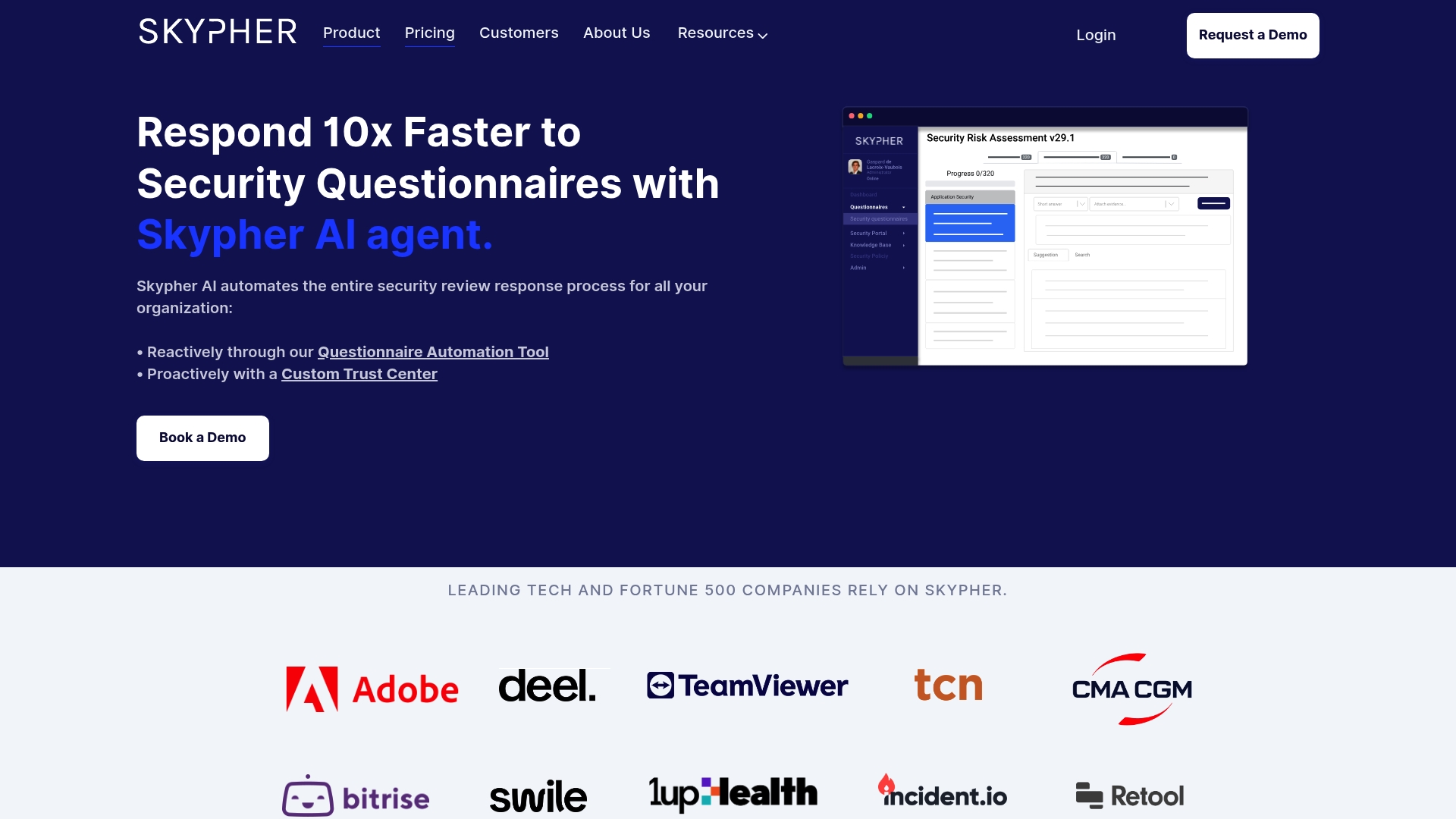
Take control of your SOC 2 compliance journey today. Visit Skypher to explore how our AI Questionnaire Automation Tool and Custom Trust Center can transform your security reporting from a manual burden into a strategic advantage. Don't let compliance slow you down. Let Skypher help you build customer trust through transparent and efficient security management.
Frequently Asked Questions
What are the core components of a SOC 2 report sample for SaaS teams?
A SOC 2 report sample includes key elements such as a description of the company's systems, control objectives, specific security activities, testing methodologies, and the auditor’s assessment. To prepare, outline each of these elements based on your current security practices.
How can I effectively utilize the controls section of a SOC 2 report?
The controls section provides insights into how your organization implements security measures and manages risks. Focus on analyzing the specific control activities and responsibilities, and ensure you can demonstrate their effectiveness through documentation.
What metrics should I include in a SOC 2 report to reflect security performance?
Key metrics to consider are the number of security incidents detected, response times, system patching percentages, and access control effectiveness. Compile these metrics regularly to evaluate and improve your security posture over time.
How do I align SOC 2 requirements with my operational practices?
Link SOC 2 requirements to daily operations by mapping each Trust Services Criteria to specific workflows, like access controls and incident response protocols. Review and update these workflows regularly to ensure ongoing compliance and effectiveness.
What steps can I take to automate evidence collection for SOC 2 compliance?
To automate evidence collection, initiate the implementation of tools that can capture logs from access management, security configurations, and incident responses. Aim to streamline this process so that regular automated reports can be generated, reducing manual errors by about 30%.
How can a SOC 2 report help me build trust with potential customers?
A well-prepared SOC 2 report demonstrates your organization’s commitment to data security and risk management, increasing customer confidence in your services. Focus on highlighting your security practices and independent assessments to reinforce trust with prospects.