

Most enterprise clients demand visible proof of robust security before signing a deal, and SOC 2 Type 1 reports have become a global gold standard for demonstrating trustworthiness. Developed by the American Institute of Certified Public Accountants, this attestation verifies whether organizational controls are designed to protect sensitive data at a single point in time. For compliance officers, understanding this process gives an edge in facilitating smoother contract negotiations and reassuring international partners.
Table of Contents
- Defining SOC 2 Type 1 Attestation
- Key Trust Services Criteria Explained
- SOC 2 Type 1 Audit Steps and Timeline
- Critical Requirements and Eligibility Factors
- SOC 2 Type 1 vs. Type 2: Major Differences
- Common Pitfalls and How to Avoid Them
Key Takeaways
| Point | Details |
|---|---|
| SOC 2 Type 1 Attestation Overview | SOC 2 Type 1 evaluates the design of security controls at a specific moment, offering insight into an organization's data protection commitment. |
| Trust Services Criteria | The five Trust Services Criteria (security, availability, processing integrity, confidentiality, and privacy) serve as the foundation for assessing information security practices. |
| Audit Process | The SOC 2 Type 1 audit is structured to provide a snapshot evaluation, typically completed within 2-6 weeks, focusing on the design of controls rather than their operational effectiveness. |
| Common Pitfalls | Organizations should avoid inadequate documentation and ensure ongoing monitoring and training to maintain compliance and readiness for assessment. |
Defining SOC 2 Type 1 Attestation
A SOC 2 Type 1 attestation is a formal security evaluation process designed to provide critical assurance about an organization's information security controls. Developed by the American Institute of Certified Public Accountants (AICPA), this specialized report examines the design of security controls at a specific point in time, offering a snapshot of an organization's commitment to protecting sensitive data.
Unlike comprehensive security assessments, SOC 2 Type 1 focuses specifically on evaluating the suitability and design of an organization's control environment. Certified auditors meticulously review an organization's systems and processes against the Trust Services Criteria, which encompass five key principles: security, availability, processing integrity, confidentiality, and privacy. This targeted approach allows service providers, particularly SaaS companies, to demonstrate their robust security infrastructure to potential clients and partners.
The attestation process involves a detailed examination of an organization's control mechanisms, policies, and technological safeguards. Auditors assess whether these controls are appropriately designed to mitigate potential security risks, without necessarily testing their operational effectiveness over an extended period. For technology companies and cloud service providers, a successful SOC 2 Type 1 report signals a proactive approach to cybersecurity and builds significant trust with stakeholders.
Pro tip: Prepare comprehensive documentation of your security controls and policies well in advance of a SOC 2 Type 1 audit to streamline the assessment process and demonstrate organizational readiness.
Key Trust Services Criteria Explained
The Trust Services Criteria form the foundational framework for SOC 2 assessments, providing a comprehensive approach to evaluating an organization's information security practices. Developed by the American Institute of Certified Public Accountants, these criteria encompass five critical categories that organizations can leverage to demonstrate their commitment to robust cybersecurity and data protection.
Among these five categories, security stands as the mandatory baseline for all SOC 2 reports. This core criterion requires organizations to implement rigorous controls that protect against unauthorized system access, potential security breaches, and potential damage to digital infrastructure. The remaining four criteria - availability, processing integrity, confidentiality, and privacy - are optional but provide organizations with flexible options to showcase their comprehensive security approach tailored to their specific operational needs.
Each Trust Services Criterion represents a distinct aspect of organizational security and operational excellence. Security controls address risk assessment and access management, availability focuses on system performance and operational continuity, processing integrity ensures accurate data handling, confidentiality protects sensitive information from unauthorized disclosure, and privacy safeguards personal data according to established standards. Organizations strategically select which criteria beyond security align most closely with their business model and client expectations, allowing for a customized approach to demonstrating technological trustworthiness.
Here's how the five Trust Services Criteria compare in focus and examples:
| Criterion | Main Focus | Example Controls |
|---|---|---|
| Security | Protecting against threats | Firewalls, user authentication |
| Availability | System reliability | Uptime monitoring, redundancies |
| Processing Integrity | Accurate and timely data | Input validation, error checks |
| Confidentiality | Sensitive data protection | Data encryption, role access |
| Privacy | Personal data handling | Consent management, auditing |
Pro tip: Conduct a comprehensive internal assessment of your current security practices against each Trust Services Criterion to identify potential gaps and prioritize improvements before formal SOC 2 auditing.
SOC 2 Type 1 Audit Steps and Timeline
Navigating a SOC 2 Type 1 audit requires a strategic approach that systematically prepares organizations for comprehensive security assessment. The audit process follows a structured methodology designed to evaluate an organization's control environment at a specific point in time, providing critical insights into cybersecurity readiness and risk management practices.
Typically, the SOC 2 Type 1 audit encompasses several essential steps that organizations must carefully execute. These include identifying the precise scope of the audit, mapping existing controls against the Trust Services Criteria, conducting a thorough gap analysis, implementing necessary security improvements, and preparing comprehensive documentation. Unlike more extensive Type 2 audits, the Type 1 assessment offers a snapshot evaluation, making it a faster and more streamlined option for organizations seeking to demonstrate their commitment to robust security practices.

The audit timeline can vary depending on organizational complexity, but most SOC 2 Type 1 assessments can be completed within 2-6 weeks. Key milestones typically include an initial scoping meeting, a detailed review of security policies and controls, on-site or remote evidence gathering, and final report compilation by the certified public accountant (CPA) performing the audit. Organizations must proactively prepare by ensuring comprehensive documentation, implementing strong access controls, maintaining continuous system monitoring, and training employees on security protocols to facilitate a smooth audit process.
Pro tip: Develop a dedicated compliance team internally and maintain a centralized repository of security documentation to expedite the SOC 2 Type 1 audit preparation and reduce potential delays.
Critical Requirements and Eligibility Factors
Achieving SOC 2 Type 1 compliance demands a rigorous framework of security controls and organizational readiness. Organizations must demonstrate comprehensive documentation and systematic implementation of security policies that align precisely with the Trust Services Criteria, establishing a robust foundation for potential audit success.
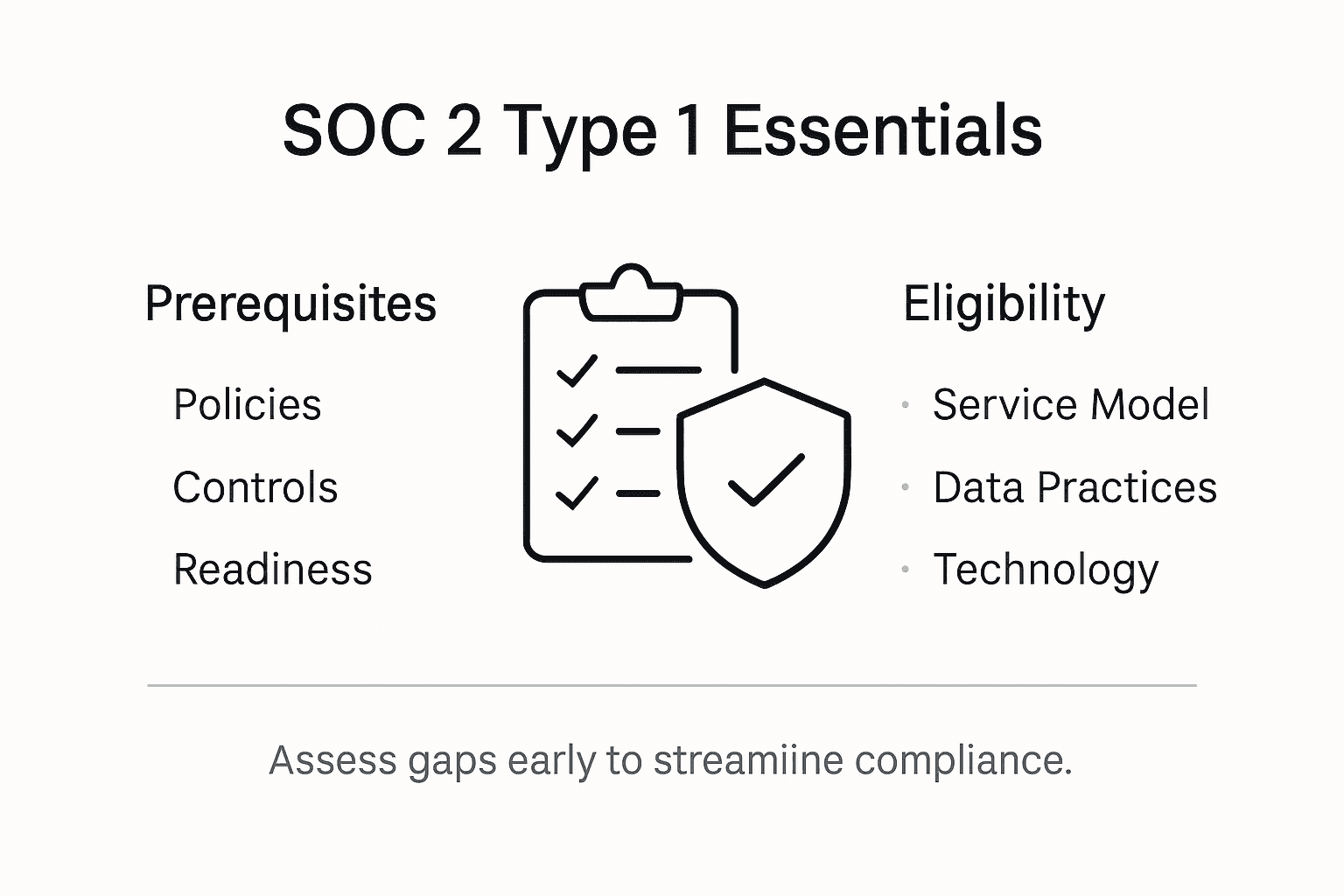
The eligibility criteria for SOC 2 Type 1 extend beyond mere documentation, requiring organizations to showcase well-designed control mechanisms across critical operational domains. Successful candidates must prove they have established formal processes for access control, change management, risk mitigation, and continuous monitoring. These controls must be demonstrably suitable and effectively implemented, with specific emphasis on protecting client data, maintaining system integrity, and preventing unauthorized access or potential security breaches.
Key eligibility factors include the organization's service model, data handling practices, and technological infrastructure. SaaS providers, cloud service platforms, and technology companies that manage sensitive client information are prime candidates for SOC 2 Type 1 certification. The assessment focuses not just on the existence of controls, but their strategic design and alignment with industry best practices. Organizations must be prepared to provide detailed evidence of their security framework, including policy documentation, risk assessment reports, access management protocols, and comprehensive system monitoring mechanisms.
Pro tip: Conduct a comprehensive internal gap analysis against the Trust Services Criteria at least six months before initiating the SOC 2 Type 1 audit to identify and remediate potential control weaknesses.
SOC 2 Type 1 vs. Type 2: Major Differences
Understanding the nuanced differences between SOC 2 Type 1 and Type 2 reports is crucial for organizations seeking comprehensive security assurance. These audit types represent distinct approaches to evaluating an organization's control environment, with significant variations in scope, depth, and the level of confidence they provide to stakeholders.
The primary distinguishing factor between SOC 2 Type 1 and Type 2 lies in their temporal assessment. A Type 1 report serves as a snapshot evaluation, examining the design and suitability of an organization's security controls at a specific moment in time. In contrast, a Type 2 report provides a more comprehensive assessment, testing the operational effectiveness of these controls over an extended period, typically ranging from 3 to 12 months. This fundamental difference means that Type 2 reports offer a more robust and dynamic view of an organization's security posture, demonstrating not just the theoretical design of controls but their consistent implementation and reliability.
This table summarizes the main differences between SOC 2 Type 1 and Type 2 reports:
| Feature | SOC 2 Type 1 | SOC 2 Type 2 |
|---|---|---|
| Duration Assessed | Single point in time | 3-12 month period |
| Focus | Design of controls | Design and operating effectiveness |
| Audit Length | Typically 2-6 weeks | Typically several months |
| Ideal For | Initial validation | Proven, ongoing compliance |
From a practical standpoint, organizations often choose between these audit types based on their specific compliance needs and stakeholder requirements. Type 1 audits are faster, less resource-intensive, and provide an initial validation of control design, making them ideal for organizations beginning their compliance journey or seeking a quick security assessment. Type 2 audits, while more demanding, deliver a higher level of assurance by proving sustained compliance and control effectiveness over time. This makes Type 2 reports particularly valuable for organizations in highly regulated industries or those needing to demonstrate long-term security commitment to complex enterprise clients.
Pro tip: Consider starting with a SOC 2 Type 1 audit as a strategic stepping stone, using its insights to prepare for a more comprehensive Type 2 assessment in subsequent compliance cycles.
Common Pitfalls and How to Avoid Them
Achieving SOC 2 Type 1 compliance involves navigating a complex landscape of potential challenges that can derail an organization's security certification efforts. Organizations frequently encounter critical pitfalls that can compromise their audit readiness and undermine their security assessment outcomes, making proactive strategy essential.
Some of the most significant challenges include inadequate documentation, insufficient understanding of the Trust Services Criteria, and poor control implementation. Many organizations struggle with creating comprehensive, precise documentation that accurately reflects their security processes. This challenge is compounded by a lack of consistent employee training and weak vendor risk management protocols. Auditors meticulously examine these elements, and any gaps can result in delayed certification or potential compliance failures. Successful organizations develop robust documentation frameworks, implement regular training programs, and establish clear, repeatable security processes that demonstrate consistent control effectiveness.
Additionally, organizations often underestimate the importance of continuous monitoring and prompt remediation of identified security gaps. Compliance is not a one-time event but an ongoing commitment that requires dynamic, adaptive security practices. This means developing mechanisms for regular internal assessments, maintaining up-to-date risk management strategies, and creating a culture of security awareness that permeates all organizational levels. Technical teams must work closely with compliance professionals to ensure that security controls are not only well-designed but consistently applied and regularly updated to address emerging technological and regulatory challenges.
Pro tip: Create a dedicated compliance team with cross-functional representation to ensure comprehensive oversight and maintain a proactive approach to identifying and addressing potential SOC 2 compliance vulnerabilities.
Accelerate Your SOC 2 Type 1 Compliance with Skypher
Achieving SOC 2 Type 1 compliance demands precise documentation and rapid responses to complex security questionnaires. If you are aiming to fast-track your security assurance, especially within the demanding tech or finance sectors, you need a partner that understands these challenges deeply. Skypher's AI Questionnaire Automation Tool is designed to help you overcome common pitfalls like inadequate documentation and slow control evidence gathering by delivering fast, accurate, and collaborative security review solutions.

Boost your SOC 2 Type 1 audit readiness with Skypher's platform that supports diverse questionnaire formats and integrates seamlessly with over 40 third-party risk management systems like ServiceNow and OneTrust. Our real-time collaboration and customizable Trust Center empower your team to maintain comprehensive security control evidence effortlessly. Ready to enhance your cybersecurity posture while accelerating compliance cycles? Discover how Skypher can transform your audit process by visiting the main landing page or explore how our AI Questionnaire Automation Tool works. Start reducing your time to compliance and instill greater confidence with every SOC 2 Type 1 audit today.
Frequently Asked Questions
What is a SOC 2 Type 1 attestation?
A SOC 2 Type 1 attestation is a formal security evaluation that assesses the design of an organization's information security controls at a specific point in time, ensuring they meet the Trust Services Criteria set by the AICPA.
How does SOC 2 Type 1 differ from SOC 2 Type 2?
SOC 2 Type 1 is a snapshot evaluation of control design at a single point in time, while SOC 2 Type 2 assesses the operational effectiveness of those controls over a period of 3 to 12 months.
What are the Trust Services Criteria used in a SOC 2 Type 1 audit?
The Trust Services Criteria includes five categories: security (mandatory), availability, processing integrity, confidentiality, and privacy. Organizations can choose which criteria to include beyond security based on their operations.
How long does a SOC 2 Type 1 audit typically take?
A SOC 2 Type 1 audit generally takes between 2 to 6 weeks to complete, depending on the complexity of the organization's controls and the thoroughness of the documentation provided.
Recommended
- Understanding SOC II Type 1: What You Need to Know
- Complete Guide to SOC Type II Reports
- Understanding SOC 1 Compliance: Key Concepts Explained
- Understanding SOC 2 AICPA: Your Guide to Compliance
- Top Security Best Practices for Managed Email Platforms – Atriomail
- Stapsgewijs een beveiligde website realiseren voor bedrijven | BYTE24