

Over half of American companies now make SOC reports a foundational element of their public trust strategy. As cyber threats increase and due diligence expectations rise, CISOs face mounting pressure to communicate strong security practices without exposing sensitive operational details. This article explains how SOC 3 reports offer a unique bridge—enabling organizations to validate their security posture clearly, reduce friction in client relationships, and answer complex security questionnaires with confidence.
Table of Contents
- Defining SOC 3 Report and Its Purpose
- Differences Between SOC 3 and SOC 2 Reports
- How SOC 3 Supports SaaS Security and Trust
- Key Requirements for SOC 3 Attestation
- Benefits and Limitations for Tech Organizations
Key Takeaways
| Point | Details |
|---|---|
| Purpose of SOC 3 Reports | SOC 3 reports provide a high-level overview of an organization's security practices, suitable for general distribution to enhance transparency and trust without revealing sensitive details. |
| Differences from SOC 2 Reports | SOC 3 reports are designed for public audiences, contrasting with SOC 2 reports which are detailed and restricted for internal stakeholders and select clients. |
| Strategic Value for SaaS | For SaaS providers, SOC 3 reports serve as a marketing tool that demonstrates robust security measures, helping to build client trust and differentiate in competitive markets. |
| Trust Services Criteria | Organizations must comply with five Trust Services Criteria to successfully obtain a SOC 3 report, ensuring comprehensive security practices are in place. |
Defining SOC 3 Report and Its Purpose
A SOC 3 report represents a critical compliance instrument designed to communicate an organization's security and privacy controls to a broader audience. Unlike more technical SOC 2 reports, SOC 3 reports provide a high-level assurance statement that can be freely distributed, offering transparency without revealing sensitive operational details.
The primary purpose of a SOC 3 report is to demonstrate an organization's commitment to robust information security practices. Independent assessments from certified public accounting firms evaluate an organization's controls across critical domains including security, availability, processing integrity, confidentiality, and privacy. These reports serve as a public-facing validation of an organization's security posture, enabling businesses to build trust with potential clients, partners, and stakeholders.
Key characteristics of SOC 3 reports distinguish them from other compliance documentation. While maintaining the same rigorous evaluation standards as SOC 2 reports, SOC 3 documents are intentionally more concise and accessible. These reports are designed for general distribution, allowing organizations to showcase their security commitments without exposing intricate technical details or proprietary information. This approach enables companies to communicate their security maturity transparently while protecting sensitive internal processes.
Pro Tip for Compliance Professionals: When preparing for a SOC 3 report, focus on developing clear, consistent security controls that demonstrate your organization's commitment to protecting client data. Treat the report as a strategic communication tool that builds credibility and differentiates your organization in a competitive marketplace.
Differences Between SOC 3 and SOC 2 Reports
SOC 2 and SOC 3 reports share a foundational framework in evaluating an organization's information security controls, but they differ significantly in their intended audience and level of detail. Restricted-use reports like SOC 2 provide comprehensive, confidential documentation that is specifically designed for internal stakeholders and select clients, offering an in-depth examination of an organization's security practices.
The most critical distinction lies in their distribution and transparency. SOC 2 reports contain exhaustive descriptions of control activities, testing procedures, and specific audit findings, making them unsuitable for public dissemination. In contrast, SOC 3 reports are crafted for general distribution, presenting a high-level overview that communicates an organization's security commitment without revealing sensitive operational details. Both report types evaluate controls using the AICPA's Trust Services Criteria, but SOC 3 reports prioritize accessibility and transparency over technical granularity.
From a practical perspective, SOC 3 reports serve as a strategic communication tool, enabling organizations to demonstrate their security maturity to a broader audience, including potential customers, investors, and business partners. While SOC 2 reports remain critical for in-depth security assessments, SOC 3 reports offer a public-facing validation of an organization's commitment to maintaining robust information security standards. This approach allows businesses to build trust and credibility without compromising the confidentiality of their internal control mechanisms.
Pro Tip for Security Professionals: When choosing between SOC 2 and SOC 3 reports, consider your audience and communication objectives. SOC 3 reports are ideal for public marketing and trust-building, while SOC 2 reports provide the detailed insights required for comprehensive security evaluations.
Here is a side-by-side comparison of SOC 2 and SOC 3 reports to clarify their core distinctions:
| Attribute | SOC 2 Report | SOC 3 Report |
|---|---|---|
| Intended Audience | Internal teams, select clients | General public and stakeholders |
| Level of Detail | In-depth technical and audit details | High-level, summarized overview |
| Distribution | Restricted, confidential | Unrestricted, freely distributable |
| Use Case | Detailed assurance for due diligence | Public trust and marketing |
| Technical Granularity | Describes specific controls/test steps | Avoids sensitive operational details |
How SOC 3 Supports SaaS Security and Trust
Security compliance has become a critical differentiator for Software as a Service (SaaS) providers in an increasingly complex digital landscape. SOC 3 reports offer public assurance by demonstrating a service organization's commitment to security standards without exposing sensitive operational details, enabling SaaS companies to build robust trust mechanisms with potential clients and partners.
For SaaS organizations, SOC 3 reports serve as a strategic communication tool that validates their security infrastructure. These reports provide a transparent overview of an organization's control environment, focusing on critical areas such as data protection, system availability, processing integrity, and confidentiality. By generating a general summary of organizational controls, SaaS providers can effectively communicate their security posture to a broader audience, including potential customers who may not have the technical expertise to interpret detailed technical documentation.
The strategic value of SOC 3 reports extends beyond mere compliance documentation. They function as a powerful marketing instrument, signaling to potential clients that an organization has undergone rigorous, independent assessment of its security practices. This third-party validation helps SaaS companies differentiate themselves in competitive markets, where security and trust are paramount. By demonstrating a proactive approach to security management, organizations can reduce potential client hesitations, accelerate sales cycles, and establish themselves as trustworthy technology partners.
Pro Tip for SaaS Security Leaders: Treat your SOC 3 report as more than a compliance document. Use it strategically as a trust-building asset by making it easily accessible to potential clients and highlighting its key assurances during sales and partnership discussions.
Key Requirements for SOC 3 Attestation
SOC 3 attestation represents a rigorous process that demands comprehensive preparation and a demonstrable commitment to robust security practices. Organizations must first complete a SOC 2, Type 2 examination as a foundational prerequisite before pursuing a SOC 3 report, which serves as a public-facing validation of their security controls.
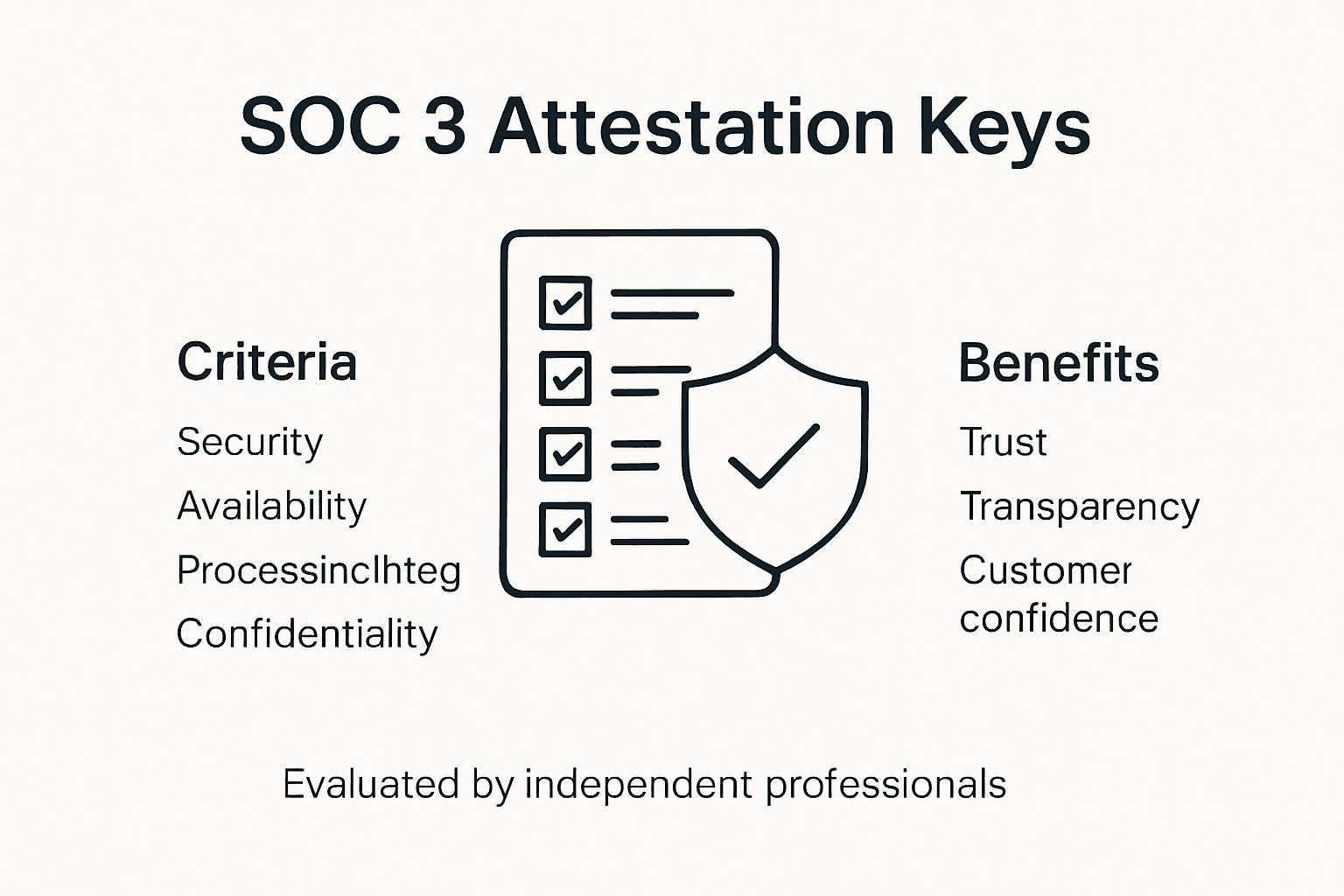
The American Institute of Certified Public Accountants (AICPA) establishes five critical Trust Services Criteria that form the backbone of SOC 3 attestation. These criteria encompass security, availability, processing integrity, confidentiality, and privacy. Organizations must demonstrate robust controls across each of these domains, providing evidence of systematic approaches to protecting client data, maintaining system reliability, ensuring accurate data processing, and safeguarding sensitive information from unauthorized access or disclosure.
To successfully obtain a SOC 3 report, organizations must undergo a comprehensive evaluation by an independent certified public accounting firm. The report is fundamentally derived from the detailed SOC 2 examination findings, but presents a more generalized overview suitable for public distribution. This means companies must have already established and documented consistent, effective security controls that can withstand rigorous third-party scrutiny, demonstrating not just compliance, but a genuine commitment to maintaining high security standards.
Pro Tip for Compliance Teams: Approach SOC 3 attestation as a continuous improvement journey. Regularly review and update your security controls, maintain meticulous documentation, and view the process as an opportunity to strengthen your organization's overall security posture, not just a checkbox compliance exercise.
Below is a summary of the five AICPA Trust Services Criteria that anchor the SOC 3 attestation process:
| Criteria | Purpose | Business Impact |
|---|---|---|
| Security | Protect systems and data from threats | Reduces risk of breaches or disruptions |
| Availability | Ensure systems remain accessible | Supports business continuity |
| Processing Integrity | Maintain accurate and complete processing | Boosts reliability and trust in operations |
| Confidentiality | Safeguard sensitive information | Prevents unauthorized data disclosure |
| Privacy | Protect and manage personal data | Enhances customer and regulatory confidence |
Benefits and Limitations for Tech Organizations
SOC 3 reports offer technology organizations a nuanced approach to demonstrating security credibility, presenting both strategic advantages and inherent constraints. These reports provide a powerful marketing tool for enhancing organizational transparency and competitive positioning, enabling companies to communicate their commitment to robust security practices without revealing sensitive operational details.
The primary benefits for tech organizations include significant improvements in market perception and customer trust. SOC 3 reports serve as a public-facing validation of an organization's security controls, allowing companies to differentiate themselves in competitive markets. By showcasing a third-party assessment of their security infrastructure, technology firms can accelerate sales cycles, reduce client hesitations, and establish themselves as reliable technology partners. The reports signal a proactive approach to security management, which is increasingly critical in industries where data protection and privacy are paramount.

However, SOC 3 reports are not without limitations. These documents provide a high-level overview that lacks the comprehensive details found in more rigorous SOC 2 reports, which may not satisfy potential clients requiring in-depth security assessments. Technology organizations must recognize that while SOC 3 reports are excellent for general marketing and trust-building, they cannot replace more detailed security documentation for clients with stringent due diligence requirements. Some sophisticated clients, particularly in regulated industries, may demand the more exhaustive control descriptions and testing procedures inherent in SOC 2 reports.
Pro Tip for Security Strategists: Balance your compliance strategy by using SOC 3 reports for broad marketing communications while maintaining detailed SOC 2 documentation for clients requiring comprehensive security insights. Think of SOC 3 as your public-facing security billboard and SOC 2 as your detailed security blueprint.
Accelerate Trust and Compliance with Skypher's AI-Driven Solutions
Building and showcasing your SOC 3 Report to enhance SaaS security requires precise, efficient responses to complex security questionnaires. The challenge lies in managing these often time-consuming, detailed processes while maintaining accuracy and consistency across your organization’s security posture. Skypher’s AI Questionnaire Automation Tool directly addresses this pain point by dramatically speeding up how you handle security reviews and compliance documentation.

With Skypher, you unlock powerful features including multi-format uploads, integrations with over 40 third-party risk management platforms, and real-time collaboration across teams. This means your organization can answer hundreds of questions in under a minute with reliable AI assistance — simplifying your path to SOC 3 attestation and boosting client trust. Don’t let lengthy security questionnaires slow your compliance or sales momentum. Take control today and learn how Skypher can transform your security and compliance workflows by visiting Skypher. Explore how our AI Questionnaire Automation Tool and customizable Trust Center support your journey toward transparent, efficient SaaS security assurance.
Frequently Asked Questions
What is a SOC 3 report?
A SOC 3 report is a public-facing compliance document that provides a high-level overview of an organization's security and privacy controls, demonstrating its commitment to information security practices without revealing sensitive details.
How does a SOC 3 report differ from a SOC 2 report?
SOC 2 reports are detailed and intended for internal stakeholders and select clients, providing comprehensive information about security practices, while SOC 3 reports are concise and designed for general distribution to the public, focusing on high-level commitments to security.
What are the benefits of obtaining a SOC 3 report for a SaaS provider?
A SOC 3 report enhances trust with potential clients and partners by providing third-party validation of security controls. It serves as a marketing tool, helping SaaS providers differentiate themselves and communicate their commitment to robust security practices.
What are the key Trust Services Criteria evaluated in a SOC 3 report?
The key Trust Services Criteria evaluated in a SOC 3 report include security, availability, processing integrity, confidentiality, and privacy. These criteria ensure that organizations demonstrate strong controls to protect client data and maintain system reliability.