

SOC 2 audit reports can reduce external audit response time by up to 70%, transforming how organizations approach vendor compliance. For cybersecurity and risk management professionals, understanding SOC audits means unlocking efficiency across regulatory processes, client trust, and operational assurance. This guide explains SOC audit types, criteria, timelines, and practical strategies to elevate your compliance readiness.
Table of Contents
- Introduction to SOC Audits
- Types of SOC Audits and Their Criteria
- Understanding the SOC 2 Trust Service Criteria
- The SOC Audit Process and Timeline
- Common Misconceptions About SOC Audits
- SOC Audits' Role in Risk Management and Compliance
- Preparing for a SOC Audit and Practical Application
- Streamline Your SOC Audit Response with Skypher Solutions
- Frequently Asked Questions About SOC Audits
Key Takeaways
| Point | Details |
|---|---|
| SOC audits verify critical controls | They assess security, availability, privacy, confidentiality, and processing integrity across organizational systems. |
| Three main SOC types serve distinct needs | SOC 1 targets financial reporting, SOC 2 focuses on operational security, and SOC 3 provides public summaries. |
| SOC 2 uses five trust service criteria | Security, availability, processing integrity, confidentiality, and privacy form the evaluation framework. |
| Audit timelines typically span 3 to 6 months | Scoping, readiness, remediation, fieldwork, and reporting phases define the structured process. |
| Readiness assessments improve outcomes | Proactive gap analysis and control documentation reduce delays and strengthen audit performance. |
Introduction to SOC Audits
SOC audits are formal examinations of internal controls related to security, availability, confidentiality, processing integrity, and privacy. AICPA standards govern these audits, standardizing how organizations demonstrate control effectiveness to external parties. For tech and finance sectors, SOC audits are essential compliance mechanisms that satisfy regulatory requirements, build client confidence, and ensure operational integrity.
The primary objectives include verifying that controls are designed appropriately and operating effectively over time. SOC reports support vendor risk management by providing third parties with documented assurance of your control environment. This standardized approach eliminates the need for clients to conduct redundant audits of the same controls.
Key SOC audit objectives:
- Verify control design and operational effectiveness across critical systems
- Support vendor risk assessments by providing standardized attestation reports
- Reduce duplicated compliance efforts when responding to multiple client inquiries
- Build stakeholder confidence through independent third party validation
- Maintain regulatory alignment in industries requiring formal control attestation
By reducing repetitive audit requests, SOC reports allow organizations to respond to client security inquiries faster and with greater consistency. This efficiency gain becomes especially valuable when managing dozens or hundreds of vendor assessments annually.
Types of SOC Audits and Their Criteria
SOC 1 audits assess internal controls over financial reporting relevant to user entities and their auditors. Financial institutions and payroll processors commonly pursue SOC 1 reports because their services directly affect client financial statements. Auditors rely on SOC 1 reports to evaluate whether service organization controls can be trusted when auditing client financials.
SOC 2 audits evaluate controls aligned with five trust service criteria: security, availability, processing integrity, confidentiality, and privacy. Technology companies, cloud service providers, and SaaS platforms typically pursue SOC 2 because clients want assurance about data protection and system reliability. Unlike SOC 1, SOC 2 focuses on operational rather than financial controls.

SOC 3 reports offer a public facing summary with a high level assurance statement but no detailed control descriptions. Organizations use SOC 3 for marketing purposes or when clients need general assurance without access to sensitive control details. SOC 3 reports can be freely distributed, while SOC 2 reports require nondisclosure agreements.
| Audit Type | Scope | Primary Audience | Report Detail |
|---|---|---|---|
| SOC 1 | Financial reporting controls | Auditors, CFOs | Detailed control descriptions and test results |
| SOC 2 | Operational and security controls | Security teams, compliance officers | Detailed control descriptions and test results |
| SOC 3 | Operational and security controls | Public, prospects | High level assurance statement only |
Pro tip: Select your audit type based on stakeholder requirements. If clients need detailed control evidence for vendor risk assessments, pursue SOC 2. If you only need public trust validation, SOC 3 suffices.
Understanding the SOC 2 Trust Service Criteria
The five trust service criteria define how organizations are evaluated during SOC 2 audits. Security controls protect system resources against unauthorized access, including network firewalls, intrusion detection, and access management. Availability ensures systems operate as committed, supported by disaster recovery plans, redundant infrastructure, and incident response protocols.
Processing integrity guarantees that system processing is complete, valid, accurate, timely, and authorized. This criterion applies to data transformation, calculation accuracy, and transaction processing controls. Confidentiality protects information designated as confidential through encryption, data classification, and need to know access restrictions.
Privacy controls ensure personal information is collected, used, retained, disclosed, and disposed of according to the organization's privacy notice and applicable regulations. This criterion aligns with GDPR, CCPA, and other privacy frameworks.
Typical controls under each category:
- Security: Multi factor authentication, role based access control, vulnerability scanning, security awareness training
- Availability: Load balancing, backup systems, monitoring dashboards, business continuity planning
- Processing integrity: Input validation, error handling, reconciliation procedures, change management
- Confidentiality: Data encryption at rest and in transit, nondisclosure agreements, secure disposal
- Privacy: Privacy impact assessments, consent management, data subject rights workflows, retention schedules
To map your controls to trust criteria for audit readiness:
- Document all existing technical and administrative controls across your infrastructure
- Categorize each control by the trust service criteria it addresses
- Identify gaps where criteria lack sufficient control coverage
- Prioritize remediation based on risk severity and audit timeline
- Assign control ownership to specific teams or individuals
- Establish evidence collection processes for each control's operation
Pro tip: Maintain a living control matrix that maps controls to trust criteria year round. This allows you to spot gaps immediately rather than discovering them during audit scoping.
The SOC Audit Process and Timeline
SOC audits typically take three to six months from scoping to final reporting, involving defined roles for auditors and client teams. The process unfolds through five distinct phases, each with specific deliverables and milestones.
Key audit phases in sequence:
- Scoping: Define audit boundaries, select trust service criteria, determine Type I or Type II, and establish the audit period
- Readiness assessment: Conduct internal gap analysis, review control documentation, and test controls informally to identify weaknesses
- Remediation: Address identified gaps, update policies, implement missing controls, and collect evidence of operating effectiveness
- Auditor fieldwork: External auditors review documentation, interview personnel, test control operation, and validate evidence
- Report issuance: Auditors draft findings, management provides responses to exceptions, and the final SOC report is delivered
Auditor responsibilities center on evaluating whether controls are designed appropriately and operating effectively throughout the audit period. They perform walkthroughs, sample transactions, inspect evidence, and interview staff to validate control claims. Auditors maintain independence and professional skepticism throughout their assessment.
Client responsibilities include providing complete documentation, facilitating auditor interviews, remediating identified weaknesses, and responding to auditor inquiries promptly. Your team must collect control evidence continuously during the audit period, not just when auditors request it. Late or incomplete evidence extends timelines and may result in qualified opinions.
Factors influencing audit duration include organizational size, control complexity, evidence availability, staff responsiveness, and whether this is your first audit. Organizations with mature compliance programs and well documented controls complete audits faster than those building control frameworks from scratch.
Common Misconceptions About SOC Audits
SOC reports attest only to control design and operation during the audit period, not absolute security. They represent a point in time or period in time assessment, not a guarantee that breaches cannot occur. This distinction matters because stakeholders sometimes misinterpret SOC reports as security certifications.
SOC 2 reports are attestation reports, not certifications like ISO 27001 or PCI DSS. Certifications involve ongoing surveillance and formal accreditation bodies, while SOC reports are independent auditor opinions issued annually or more frequently. You can be SOC 2 compliant without maintaining a certification mark.
Common false beliefs and corrections:
- Myth: SOC 2 compliance means you are unhackable
- Reality: SOC 2 attests to control effectiveness but cannot eliminate all security risks
- Myth: SOC 3 reports provide the same assurance value as SOC 2
- Reality: SOC 3 lacks detailed control descriptions needed for thorough vendor risk assessments
- Myth: Once you pass a SOC audit, you remain compliant indefinitely
- Reality: Controls must be maintained continuously, and audits repeat annually to verify ongoing effectiveness
- Myth: SOC reports cover all possible security and privacy risks
- Reality: Audits assess only the controls within the defined scope and trust service criteria
SOC audits provide reasonable, not absolute, assurance about control effectiveness. They confirm that controls operated as designed during the audit period but do not predict future performance or guarantee immunity from incidents.
Understanding these limitations helps you set realistic expectations with stakeholders and avoid overreliance on SOC reports as complete security solutions.
SOC Audits' Role in Risk Management and Compliance
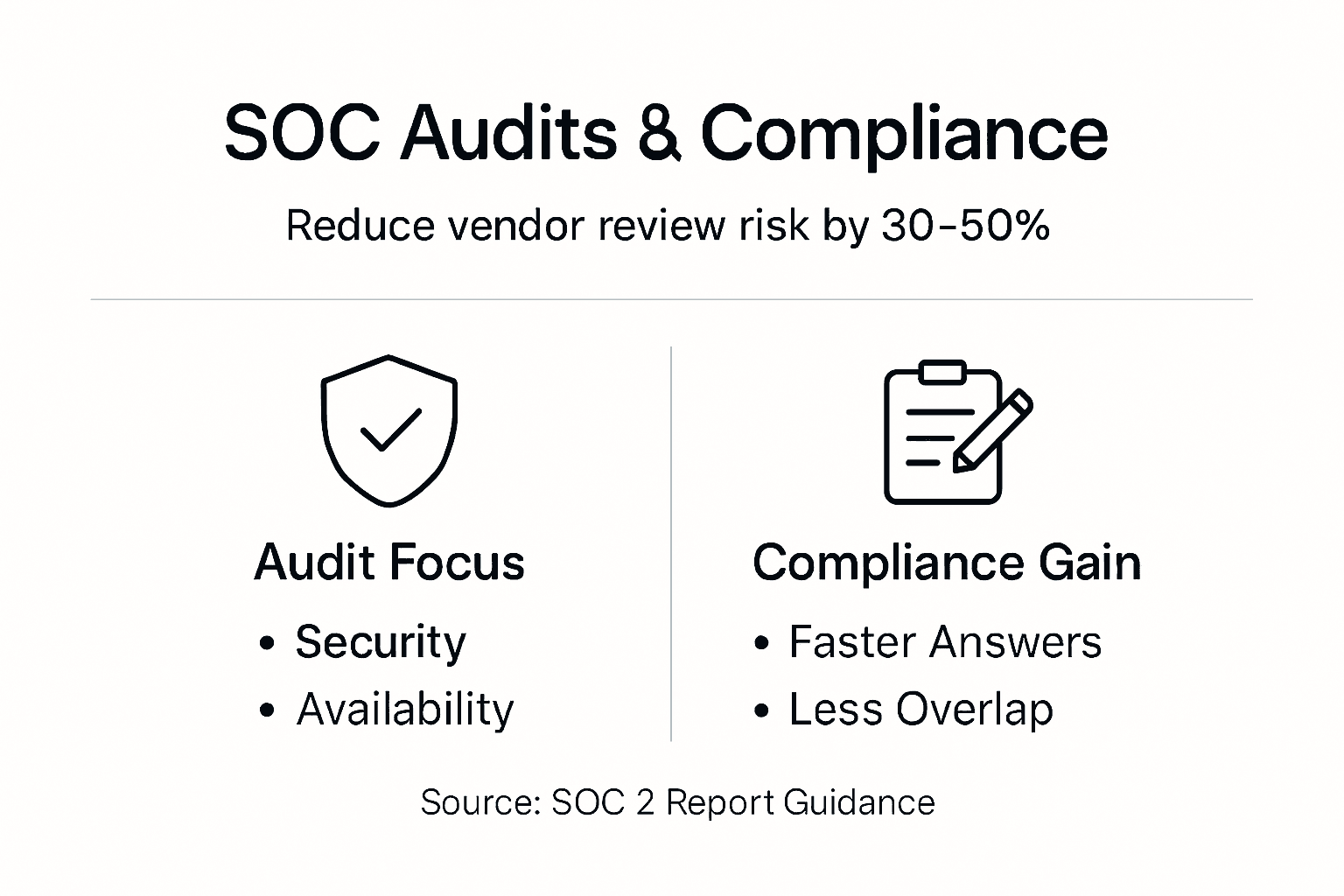
SOC reports reduce client vendor risk review workload by 30 to 50 percent, improving compliance efficiency across third party assessments. When vendors provide SOC 2 reports, clients can rely on independent auditor opinions rather than conducting their own control testing. This mutual benefit streamlines vendor onboarding and ongoing monitoring.
SOC reports build external client trust by demonstrating your commitment to control rigor and transparency. Prospects often require SOC 2 reports before signing contracts, particularly in regulated industries. Having a current SOC 2 report accelerates sales cycles and reduces friction during procurement.
Benefits in cutting redundant compliance efforts:
- Answer security questionnaires faster by referencing audited controls in your SOC report
- Reduce the number of custom audits clients request by providing standardized attestation
- Streamline responses to RFPs that ask for control evidence and third party validation
- Support multiple compliance frameworks simultaneously since SOC 2 criteria overlap with ISO 27001, NIST, and other standards
SOC audits integrate into overall risk frameworks by serving as a control baseline. You can map SOC 2 controls to your enterprise risk register, linking specific controls to identified risks. This integration ensures that audit activities align with broader risk management objectives rather than existing as isolated compliance exercises.
Leveraging SOC reports to enhance audit response efficiency means building a repository of approved answers tied to audited controls. When clients ask about encryption or access management, you can cite specific control numbers from your SOC report with confidence. This consistency reduces response time and increases answer accuracy across all vendor assessments.
Preparing for a SOC Audit and Practical Application
Formal readiness assessments and remediation improve audit outcomes and reduce delays by identifying gaps before auditors begin fieldwork. Organizations that skip readiness assessments often face qualified opinions or extended audit timelines when auditors discover control weaknesses.
Essential sequential steps for audit preparation:
- Define your audit scope by selecting trust service criteria, system boundaries, and the audit period that aligns with business objectives
- Conduct a readiness assessment by comparing existing controls against SOC 2 requirements and documenting gaps
- Remediate identified control weaknesses by implementing missing controls, updating policies, and collecting evidence of operation
- Engage your external auditor early to validate scope decisions, discuss findings, and clarify evidence expectations
- Utilize the SOC report to streamline client questionnaires, RFP responses, and vendor risk assessments post audit
Best practices for gap analysis and personnel training:
- Review previous audit findings or internal assessments to prioritize high risk control areas
- Update information security policies to reflect current practices and regulatory requirements
- Train personnel on their control responsibilities and evidence collection procedures before auditors arrive
- Establish a centralized repository for control evidence to ensure auditors can access documentation efficiently
- Schedule regular internal audits or control testing throughout the year to catch issues early
Pro tip: Deploy audit readiness automation tools to track control status, automate evidence collection, and maintain compliance dashboards. These platforms reduce manual effort and ensure nothing falls through the cracks during busy audit periods.
SOC reports help you answer security questionnaires faster by providing audited evidence for common client inquiries. Instead of describing controls from scratch, reference specific control objectives and auditor conclusions from your report. This approach increases stakeholder confidence and shortens response cycles.
For practical audit preparation tips, consider engaging consultants who specialize in readiness assessments. They bring experience from multiple audits and can benchmark your controls against industry best practices.
Streamline Your SOC Audit Response with Skypher Solutions
Managing SOC audit responses across multiple clients demands efficiency and accuracy. Skypher's AI powered automation platform transforms how you handle security questionnaires after completing your SOC audit. Our tools parse your SOC report and map controls to common questionnaire items, allowing you to answer 200 questions in under one minute.

Implement best practices for automating questionnaires by leveraging Skypher's knowledge base that stores your SOC controls, policies, and evidence. The AI recommendation engine suggests accurate answers based on your documented controls, ensuring consistency across every client interaction. Integration with over 40 third party risk management platforms means your SOC audit investments deliver value throughout your vendor ecosystem.
Frequently Asked Questions About SOC Audits
What is the difference between SOC 2 Type I and Type II reports?
SOC 2 Type I assesses control design at a specific point in time, confirming controls are appropriately designed. Type II evaluates both design and operating effectiveness over a minimum three month period, providing stronger assurance that controls functioned consistently throughout the audit period.
How often should organizations undergo SOC audits?
Most organizations complete SOC audits annually to maintain current reports for clients and prospects. Some high risk or rapidly growing organizations choose six month audit periods to demonstrate continuous control monitoring and respond to increased client scrutiny.
Can SOC reports replace other compliance certifications like ISO 27001?
SOC reports complement but do not replace ISO 27001 or other certifications because they serve different purposes and audiences. ISO 27001 certifies your information security management system, while SOC 2 attests to specific control effectiveness. Many organizations maintain both to satisfy diverse stakeholder requirements.
What happens if a SOC audit identifies control deficiencies?
Auditors document control deficiencies as exceptions in the final report, and management provides written responses describing remediation plans. Clients review these exceptions when assessing risk, so prompt remediation and clear communication about corrective actions are essential to maintain trust.
How do SOC audits affect vendor risk management processes?
SOC reports standardize vendor risk assessments by providing independent third party validation of controls. Organizations can tier vendors based on SOC report availability, requiring SOC 2 Type II for high risk vendors while accepting questionnaires for lower risk relationships, significantly reducing assessment workload.