

Security officers know the challenge of balancing rapid RFP responses with thorough, accurate security verification. When delays can mean lost opportunities, every detail matters from evaluating technical requirements to coordinating large team efforts across time zones. This article highlights how a mix of automation technologies, robust team collaboration strategies, and integrated platforms help CISOs and compliance leaders prepare competitive submissions quickly—without sacrificing compliance or precision.
Table of Contents
- Step 1: Assess RFP Requirements and Gather Key Data
- Step 2: Set Up Automation Tools for RFP Response
- Step 3: Collaborate with Teams to Complete Responses
- Step 4: Integrate with Platforms for Efficient Submission
- Step 5: Review and Verify RFP Response Accuracy
Quick Summary
| Key Insight | Explanation |
|---|---|
| 1. Evaluate RFP Requirements Thoroughly | Assess the RFP in detail to gather necessary data for a precise response strategy. |
| 2. Implement Automation Tools | Use automation technologies to streamline RFP responses, ensuring efficiency and accuracy. |
| 3. Foster Team Collaboration | Establish a centralized workspace for real-time contributions and tracking from multiple team members. |
| 4. Integrate with Submission Platforms | Connect with response management tools to enhance workflow and compliance during submission. |
| 5. Conduct Comprehensive Review Process | Utilize a multi-layered review system to ensure accuracy and compliance before submission. |
Step 1: Assess RFP Requirements and Gather Key Data
Successfully responding to a security questionnaire begins with a strategic assessment of the Request for Proposal (RFP) requirements. Your goal is to map out exactly what information needs to be collected, evaluated, and presented in a comprehensive and precise manner.
Start by carefully reviewing the RFP document and identifying its core components. Agencies typically require specific details about technical capabilities, security protocols, and organizational competencies. Comprehensive RFP evaluation techniques emphasize assembling a diverse team to thoroughly analyze each requirement. Break down the questionnaire into distinct sections like technical standards, mandatory compliance criteria, functional specifications, and budget considerations. Pay special attention to scoring components such as written proposals, functional requirements, cost analysis, potential vendor demonstrations, and reference checks.
Organize your response strategy by creating a detailed tracking matrix that maps each RFP requirement against your organization's existing documentation, policies, and technical capabilities. This approach ensures you can quickly reference and validate information during the response process. Collect relevant security certifications, compliance documents, architecture diagrams, and past performance records that directly address the questionnaire's inquiries.
Pro tip: Develop a centralized repository of pre-approved response templates and standard security documentation to accelerate your RFP response workflow and maintain consistency across submissions.
Step 2: Set Up Automation Tools for RFP Response
Streamlining your RFP response process requires strategic implementation of automation technologies that can dramatically reduce manual effort and increase accuracy. The goal is to transform your approach from time consuming document processing to an efficient intelligent workflow.

Begin by evaluating automation tools that integrate AI and robotic process automation capabilities. Federal RPA technologies demonstrate how agencies can reduce repetitive tasks and improve response compliance. Select solutions that offer intelligent document parsing, automated data extraction, and template matching functionalities. These tools should seamlessly integrate with your existing security documentation systems, allowing rapid retrieval and population of standard response templates. Look for platforms that support multiple document formats and can learn from previous RFP submissions to continuously improve response accuracy.
Implement a systematic approach to tool selection by creating a comprehensive evaluation matrix. Consider factors like integration capabilities, machine learning potential, security compliance features, and scalability. AI powered RFP analysis techniques can help expedite document processing and standardize response generation across different questionnaire formats.
Pro tip: Configure your automation tools to create an intelligent knowledge base that captures and refines response patterns from each successive security questionnaire submission.
Here is a comparison of manual versus automated RFP response processes:
| Aspect | Manual Approach | Automated Approach |
|---|---|---|
| Speed | Slower, labor-intensive | Rapid, minimizes delays |
| Error Risk | Higher, human mistakes occur | Lower, automation flags issues |
| Consistency | Varies by author | High, templates maintained |
| Scalability | Difficult with volume | Easily handles large volumes |
Step 3: Collaborate with Teams to Complete Responses
Successful RFP response requires seamless team collaboration that transforms individual contributions into a cohesive and comprehensive submission. Your primary objective is to create an efficient workflow that enables multiple team members to work simultaneously and effectively.
Team collaboration strategies are critical for managing complex security questionnaire responses. Establish a centralized digital workspace where team members can assign specific sections, track progress, and communicate in real time. Select collaboration platforms that support document coauthoring, integrated task management, and secure file sharing. Designate clear roles for each team member such as technical reviewers, compliance experts, and final approvers. Create a shared dashboard that visualizes task completion status, highlights potential bottlenecks, and enables instant communication through chat or video conferencing tools.
Implement a structured review process that includes multiple verification stages. Schedule regular check ins to discuss progress, address potential gaps, and ensure consistency across different response sections. Develop a standardized template for tracking individual contributions, recording subject matter expert inputs, and maintaining an audit trail of modifications. Encourage open communication and establish clear guidelines for reviewing and incorporating feedback from different team members.
Pro tip: Create a collaborative spreadsheet that maps each team member's expertise to specific questionnaire sections to optimize response accuracy and efficiency.
Step 4: Integrate with Platforms for Efficient Submission
Streamlining your RFP submission process demands strategic integration with powerful response management platforms that can transform complex document workflows into seamless, intelligent systems. Your goal is to leverage technology that accelerates submission speed while maintaining exceptional accuracy and compliance.
RFP response management applications provide critical infrastructure for organizations seeking to optimize their submission processes. Select platforms that offer robust integration capabilities with existing sales force automation, content management systems, and communication tools. Prioritize solutions that support automated document creation, real time requirement tracking, ownership assignment, and comprehensive version control. These platforms should enable intelligent task routing, provide collaborative editing features, and generate detailed analytics about submission performance and team productivity.
Develop a comprehensive integration strategy that maps your current workflow against potential platform capabilities. Evaluate integration depth by assessing how seamlessly the platform connects with your existing documentation repositories, communication channels, and security infrastructure. Look for solutions that offer API connections, single sign on capabilities, and advanced security protocols to ensure smooth data transfer and maintain stringent compliance standards.
Pro tip: Configure platform integrations with automatic notification systems to alert key stakeholders about pending tasks and submission milestones.
Step 5: Review and Verify RFP Response Accuracy
Ensuring the highest level of accuracy in your RFP response requires a meticulous and systematic verification process that goes beyond surface level checks. Your primary objective is to create a comprehensive review mechanism that validates every aspect of your submission.
RFP question response strategies demand a multilayered verification approach. Implement a structured review process that involves multiple stakeholders with different expertise levels. Create a detailed checklist that covers technical accuracy, compliance requirements, consistency in language and formatting, and alignment with the original RFP requirements. Engage technical subject matter experts to validate complex technical responses, compliance officers to verify regulatory adherence, and senior leadership to ensure strategic alignment.
Develop a rigorous cross referencing system that allows systematic verification of each response against source documentation, previous submissions, and organizational standards. Utilize automated tools that can flag potential inconsistencies, detect potential compliance gaps, and highlight areas requiring additional clarification. Schedule multiple review rounds with clear escalation paths for addressing and resolving any identified discrepancies. Ensure that each response undergoes a minimum of three independent review stages technical verification, compliance check, and final executive review.
Pro tip: Create a weighted scoring matrix for response accuracy that assigns different importance levels to various verification criteria, enabling more focused and efficient review processes.
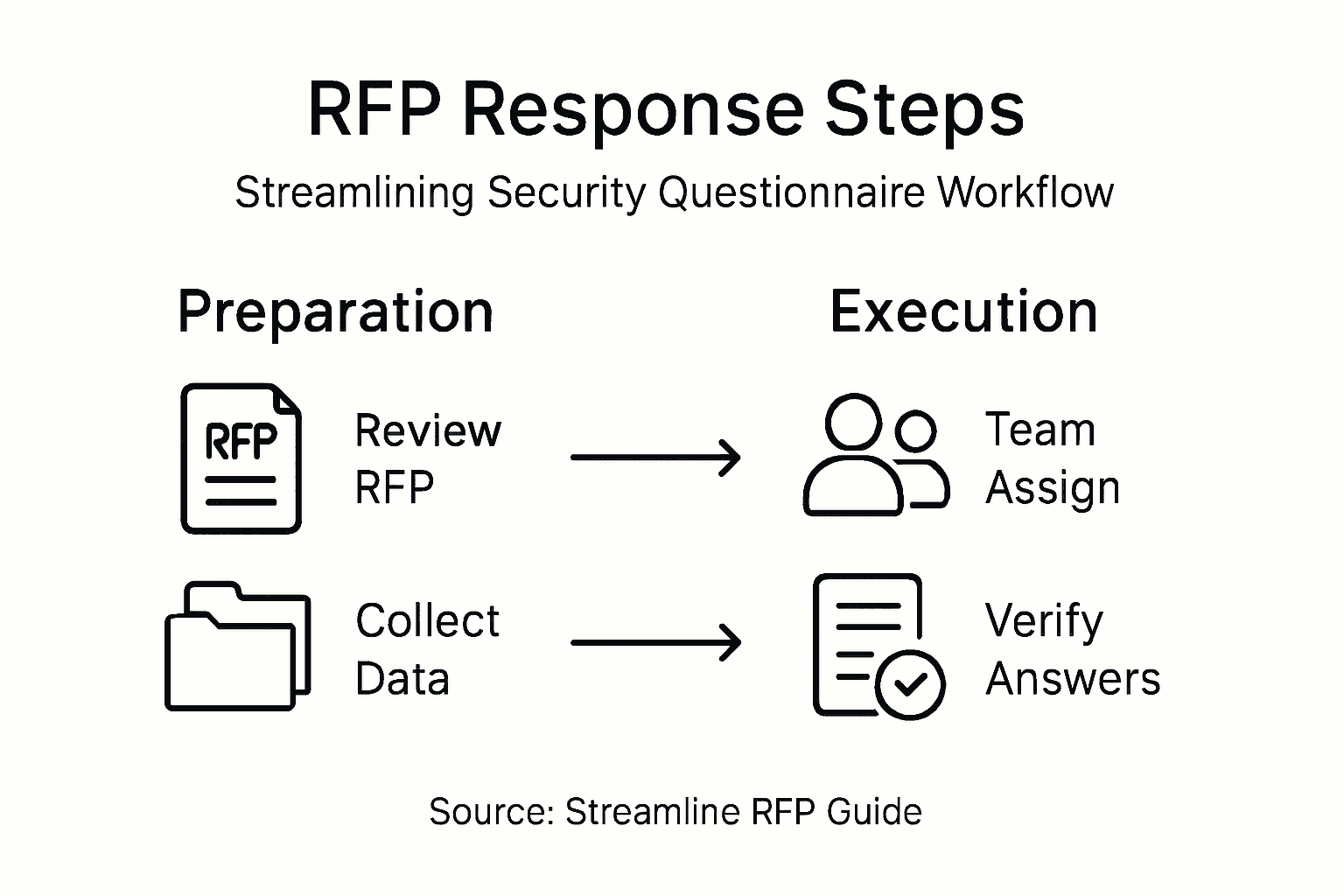
The following table summarizes each step in the RFP security questionnaire response process and highlights its primary objective:
| Step | Main Goal | Key Outcome |
|---|---|---|
| Assess RFP Requirements | Identify required data and documents | Build a comprehensive response plan |
| Set Up Automation Tools | Reduce manual effort using technology | Accelerate and standardize responses |
| Collaborate with Teams | Enable coordinated team input | Ensure consistent, complete answers |
| Integrate with Platforms | Streamline submission workflow | Enhance speed and compliance |
| Review and Verify Accuracy | Validate all response aspects | Ensure precision and alignment |
Transform Your Security Questionnaire Response with Skypher
The challenge of rapidly assessing complex RFP requirements and orchestrating seamless team collaboration often leads to delays and inconsistencies in security questionnaire responses. This article highlights the importance of automating tedious manual processes while maintaining rigorous accuracy and compliance. Skypher answers these needs with its AI Questionnaire Automation Tool, designed to drastically reduce time spent on response preparation, minimize errors, and support integration across multiple platforms your teams already use.

Experience how Skypher elevates your RFP response workflow by enabling real-time collaboration, intelligent document parsing, and scalable automation that adapts to complex enterprise environments. Don’t let manual bottlenecks stall your security reviews—ensure precision and accelerate submissions today. Start enhancing your organization's efficiency and cybersecurity posture now by visiting Skypher to explore our advanced tools and integrations.
Frequently Asked Questions
How can I assess RFP requirements for security questionnaires effectively?
To assess RFP requirements effectively, start by reviewing the RFP document carefully to identify essential components such as technical capabilities and compliance criteria. Create a detailed tracking matrix that matches each requirement with your organization’s documentation, ensuring you can reference the necessary information accurately.
What automation tools should I consider for streamlining RFP responses?
Consider using automation tools that incorporate AI and robotic process automation to enhance efficiency in your RFP response process. Look for features like intelligent document parsing and automated data extraction to reduce manual tasks and increase accuracy in your submissions.
How can I improve collaboration among team members when responding to an RFP?
Enhance collaboration by establishing a centralized digital workspace where team members can assign tasks and track progress in real time. Utilize platforms that support document co-authoring and secure file sharing to enable simultaneous contributions and streamline communication.
What steps should I take to integrate platforms for efficient RFP submission?
Begin by selecting response management platforms that integrate seamlessly with your existing workflow and automation tools. Ensure these platforms offer features like automated document creation and real-time tracking to facilitate a quick and compliant submission process.
How can I ensure the accuracy of my RFP responses?
To ensure accuracy, implement a structured review process involving multiple stakeholders with various expertise. Develop a checklist for verifying technical responses and compliance, and schedule regular cross-referencing sessions to detect inconsistencies and improve the overall quality of submissions.