

More than 60 percent of major data breaches involve third-party vendors with hidden vulnerabilities. For american and global tech and finance organizations, each external partnership opens the door to increasingly sophisticated cyber threats. Understanding the full scope of third-party risk is crucial for cybersecurity professionals who want faster security questionnaire responses and stronger compliance. This guide breaks down the essentials you need to confidently assess and manage risk throughout your complex digital ecosystem.
Table of Contents
- Defining Third-Party Risk in Cybersecurity
- Types of Third-Party Risks and Sources
- How Third-Party Risk Is Assessed
- Legal, Regulatory, and Compliance Demands
- Consequences of Poor Third-Party Risk Management
Key Takeaways
| Point | Details |
|---|---|
| Understanding Third-Party Risk | Third-party risk encompasses vulnerabilities from external interactions, requiring continuous assessment and management. |
| Categories of Risks | Cybersecurity risks can arise from supply chains, cloud services, vendor access, and operational technology, each posing unique challenges. |
| Assessment Framework | Effective third-party risk assessment must include governance, technical vulnerability scanning, compliance verification, and financial stability checks. |
| Compliance Necessities | Organizations must adapt to evolving regulatory demands, requiring real-time monitoring and agile adjustment of third-party risk strategies. |
Defining Third-Party Risk in Cybersecurity
Third-party risk represents the potential vulnerabilities and security challenges introduced when external organizations interact with an organization's digital ecosystem. These risks emerge through complex interconnections between a company and its vendors, suppliers, partners, and service providers who have direct or indirect access to critical systems, networks, or sensitive data.
According to the NIST Cybersecurity Framework, third-party cybersecurity risks are comprehensive enterprise-level challenges that extend far beyond simple technological interactions. They encompass multifaceted potential threats including:
- Technological vulnerabilities in vendor systems
- Potential unauthorized data access points
- Software and hardware supply chain risks
- Inadequate security protocols and practices
- Potential compliance and regulatory exposures
Cybersecurity professionals recognize that modern organizations rarely operate in isolation. Each external connection represents a potential pathway for cyber threats, making rigorous third-party risk management essential. The complexity arises not just from identifying these risks, but from continuously monitoring, assessing, and mitigating them across dynamic technological landscapes.
Pro Tip: Develop a standardized third-party risk assessment questionnaire that covers technical, operational, and compliance dimensions to systematically evaluate potential vendor security risks.
Types of Third-Party Risks and Sources
Third-party cybersecurity risks represent a complex landscape of potential vulnerabilities that extend far beyond traditional security boundaries. These risks emerge through multiple interconnected sources, each presenting unique challenges for organizations seeking to protect their digital assets and sensitive information.
According to cybersecurity threat assessments, third-party risks can be categorized into several critical domains:
- Technology Supply Chain Risks: Vulnerabilities introduced through hardware and software components from external vendors
- Cloud Service Provider Risks: Security gaps in cloud infrastructure and managed services
- Vendor Access Risks: Potential unauthorized network and data access through third-party connections
- Software Development Risks: Vulnerabilities stemming from external software development practices
- Operational Technology Risks: Security challenges in integrated industrial and communication systems
Network interconnectivity has dramatically expanded the potential attack surface for cybersecurity professionals. Supply chain cybersecurity risks now encompass sophisticated threats like malicious functionalities, counterfeit components, and systemic vulnerabilities that can compromise entire organizational ecosystems. These risks are particularly challenging because they often remain hidden until a significant breach occurs, making proactive identification and mitigation critical.

Modern cybersecurity strategies must recognize that third-party risks are not static but continuously evolving. Each external connection represents a potential pathway for cyber threats, requiring ongoing assessment, monitoring, and adaptive security protocols that can respond to emerging technological landscapes.
Here's a quick comparison of key third-party risk categories and their unique business impacts:
| Risk Category | Example Source | Primary Impact |
|---|---|---|
| Technology Supply Chain | External software vendor | System compromise risk |
| Cloud Service Provider | Cloud infrastructure firm | Data exposure vulnerability |
| Vendor Access | Managed IT service partner | Unauthorized access pathway |
| Software Development | Outsourced developer team | Insecure code deployment |
| Operational Technology | Networked industrial system | Disrupted business operations |
Pro Tip: Implement a dynamic vendor risk scoring system that continuously evaluates and ranks third-party providers based on their current security posture and potential risk levels.
How Third-Party Risk Is Assessed
Third-party risk assessment is a systematic approach to evaluating the potential security vulnerabilities and compliance risks introduced by external vendors, partners, and service providers. This critical process goes beyond simple checklist compliance, requiring a comprehensive and dynamic analysis of an organization's entire technological ecosystem.
Cybersecurity risk evaluation frameworks typically involve a multi-dimensional assessment process that includes:
- Governance Analysis: Examining the vendor's internal security policies and management structures
- Technical Vulnerability Scanning: Identifying potential security weaknesses in systems and networks
- Compliance Verification: Ensuring alignment with industry standards and regulatory requirements
- Financial Stability Assessment: Evaluating the vendor's long-term operational sustainability
- Security Control Evaluation: Analyzing the effectiveness of existing security mechanisms
The assessment process requires a nuanced approach that considers multiple risk domains, extending far beyond traditional security evaluations. Cybersecurity professionals must conduct deep-dive assessments that examine not just technological capabilities, but also organizational practices, human factors, and potential indirect risk vectors that could compromise an organization's security posture.
Successful third-party risk assessment demands continuous monitoring and adaptive strategies. Organizations must develop dynamic evaluation frameworks that can quickly identify emerging risks, assess their potential impact, and implement rapid mitigation strategies across complex, interconnected technological environments.
The following table summarizes essential steps for effective third-party risk assessment:
| Assessment Step | Core Objective | Typical Methods |
|---|---|---|
| Governance Analysis | Verify strong oversight | Policy reviews, interviews |
| Technical Vulnerability | Identify security weaknesses | Network scans, audits |
| Compliance Verification | Ensure regulation alignment | Documentation checks |
| Financial Stability | Evaluate long-term partner risk | Credit checks, financials |
| Security Controls Review | Validate protection mechanisms | Control testing, evaluation |
Pro Tip: Create a weighted scoring model that assigns risk levels to vendors based on their potential impact on your organization's critical systems and data assets.
Legal, Regulatory, and Compliance Demands
Regulatory compliance in third-party cybersecurity represents a complex landscape of legal requirements that demand sophisticated, comprehensive risk management strategies. Organizations must navigate an increasingly intricate web of global regulations designed to protect sensitive data and mitigate potential security vulnerabilities introduced by external partnerships.
Cyber risk regulatory frameworks typically encompass critical compliance dimensions including:
- Governance Standards: Establishing clear accountability and oversight mechanisms
- Risk Management Protocols: Implementing systematic risk identification and mitigation processes
- Reporting Requirements: Maintaining transparent documentation of third-party interactions
- Security Control Validation: Conducting rigorous assessments of external vendor security practices
- Incident Response Planning: Developing comprehensive strategies for potential security breaches
U.S. federal guidance emphasizes the critical nature of managing third-party risks across multiple regulatory domains. Banking organizations and financial institutions face particularly stringent requirements that mandate comprehensive risk assessments, ensuring protection of consumer rights, preventing financial crimes, and maintaining operational resilience.
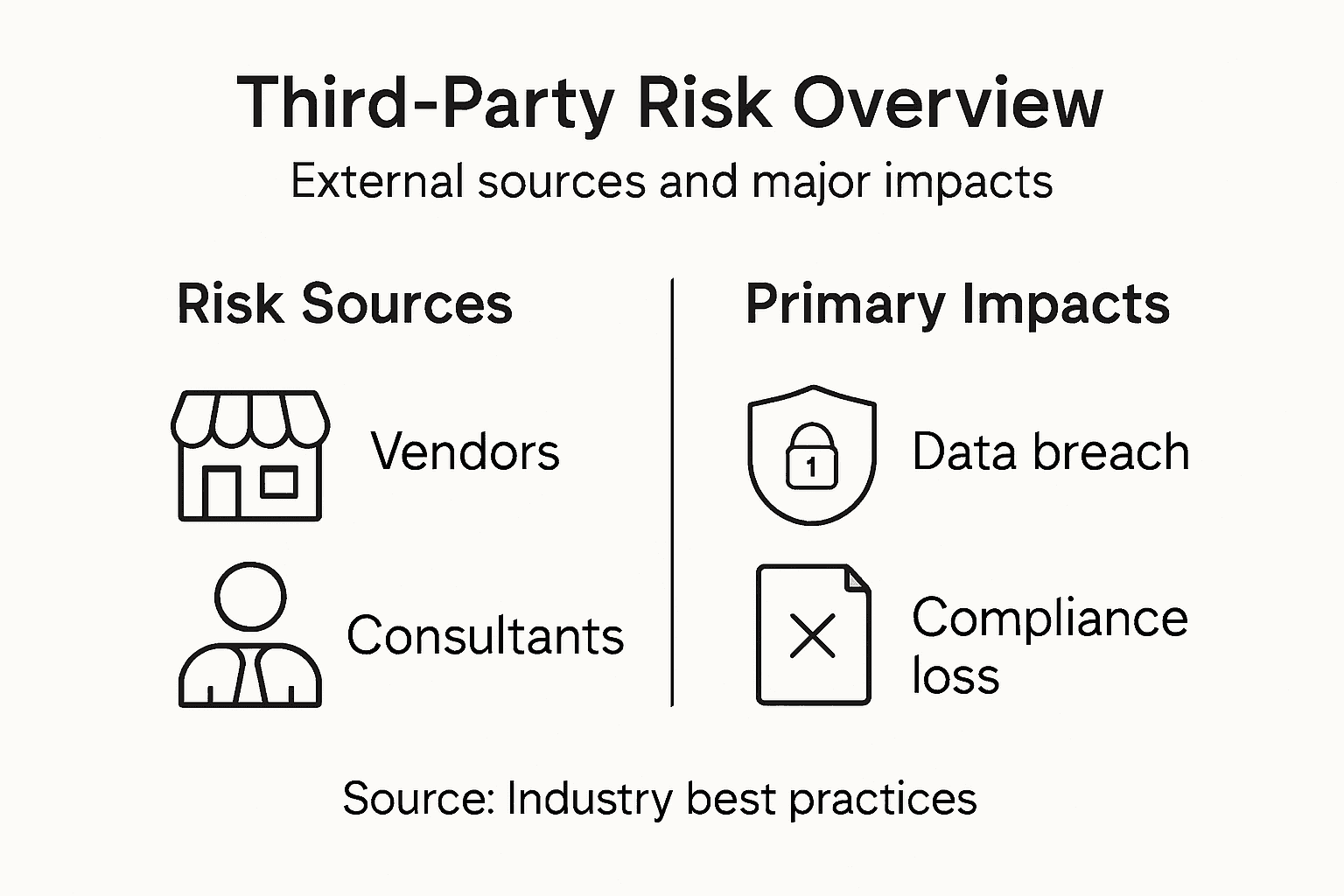
Modern regulatory compliance demands a proactive and dynamic approach. Organizations must develop adaptive frameworks that can quickly respond to emerging regulatory requirements, technological changes, and evolving threat landscapes. This requires continuous monitoring, regular risk assessments, and a commitment to maintaining robust security standards across all third-party relationships.
Pro Tip: Develop a centralized compliance tracking system that maps regulatory requirements against your third-party risk management processes, enabling real-time visibility and rapid adaptation to changing legal landscapes.
Consequences of Poor Third-Party Risk Management
Cybersecurity failures stemming from inadequate third-party risk management can trigger catastrophic organizational consequences that extend far beyond immediate technological vulnerabilities. These risks represent complex, interconnected challenges that can rapidly undermine an entire organization's strategic capabilities and financial stability.
Cybersecurity supply chain vulnerabilities can manifest through multiple devastating channels, including:
- Data Breach Exposure: Compromising sensitive organizational and customer information
- Operational Disruption: Potentially halting critical business functions
- Financial Losses: Incurring significant remediation and recovery expenses
- Regulatory Penalties: Facing substantial legal and compliance consequences
- Reputational Damage: Eroding customer and stakeholder trust
Federal regulatory guidelines underscore the critical importance of comprehensive risk management. In highly regulated sectors like finance, poor third-party risk oversight can trigger severe regulatory actions, potentially resulting in substantial financial penalties, increased scrutiny, and even temporary suspension of operational capabilities.
The most profound consequences emerge from the cascading effects of unchecked vulnerabilities. A single poorly managed third-party relationship can create systemic risks that propagate through complex technological ecosystems, transforming isolated security weaknesses into enterprise-wide catastrophic failures.
Pro Tip: Implement a rigorous vendor risk scoring system that continuously monitors and ranks third-party providers based on their demonstrable security performance and potential risk exposure.
Streamline Your Third-Party Risk Management with Skypher
Managing third-party risks as outlined in this article demands a precise and efficient approach to security questionnaire responses and ongoing vendor assessments. Organizations in tech and finance face growing challenges in completing complex security reviews while ensuring compliance and maintaining operational resilience. Skypher’s AI Questionnaire Automation Tool solves these pain points by automating and accelerating the response process so your teams can focus on true risk management instead of paperwork.

Take control of your third-party risk today by integrating Skypher’s advanced AI-driven platform that supports over 40 TPRM integrations, real-time collaboration features, and a customizable Trust Center that keeps your compliance streamlined and transparent. Experience how your organization can reduce response times dramatically, improve accuracy, and enhance communication all in one place at Skypher.co. Start transforming your security questionnaire workflow now and protect your digital ecosystem with confidence.
Frequently Asked Questions
What is third-party risk in cybersecurity?
Third-party risk in cybersecurity refers to the potential vulnerabilities and security challenges that arise when external organizations, such as vendors and service providers, interact with an organization's digital ecosystem.
Why is third-party risk management important?
Third-party risk management is essential because it helps organizations identify, monitor, and mitigate potential security vulnerabilities introduced by external connections, reducing the risk of data breaches and operational disruptions.
How is third-party risk assessed?
Third-party risk is typically assessed through a systematic approach that includes governance analysis, technical vulnerability scanning, compliance verification, financial stability assessment, and evaluation of existing security controls.
What are the consequences of poor third-party risk management?
Poor third-party risk management can lead to severe consequences, such as data breaches, operational disruptions, significant financial losses, regulatory penalties, and damage to an organization's reputation.
Recommended
- Comprehensive Guide to Third Party Vendor Risk Assessment
- Understanding GRC Cyber Security: Concepts and Importance
- What is Vendor Risk Management? Understanding Its Importance and Implementation
- 7 Essential Risk Management Tips for Tech Leaders
- New Business Risk: What Every Modern Founder Faces | siift