

Did you know that over 60 percent of companies now rely on third-party suppliers for core operations? As businesses grow and processes become more specialized, these external partnerships can mean the difference between success and costly mistakes. Learning how to define, evaluate, and manage third-party suppliers helps organizations maintain efficiency, reduce risk, and stay ahead of industry challenges.
Key Takeaways
| Point | Details |
|---|---|
| Importance of Third-Party Suppliers | Third-party suppliers extend beyond transactional relationships, offering strategic advantages and presenting risks that require diligent management. |
| Types of Arrangements | Organizations engage suppliers through various models—strategic partnerships, transactional contracts, managed services, and more—each with unique implications. |
| Qualification Processes | Effective supplier selection necessitates comprehensive assessments, including industry experience, certifications, and the ability to customize services. |
| Risk Management | Proactive risk evaluation and continuous monitoring are essential for managing potential cybersecurity, compliance, operational, and reputational risks from third parties. |
Table of Contents
- Defining Third Party Suppliers in Business
- Types of Third Party Supplier Arrangements
- Key Characteristics and Qualification Processes
- Compliance Requirements and Industry Standards
- Risk Management and Common Pitfalls
- Integrating Third Party Suppliers in SaaS Workflows
Defining Third Party Suppliers in Business
In the complex world of modern business, third-party suppliers play a critical role beyond simple transactional relationships. According to research from Wikipedia, these external entities are independent organizations that provide goods, services, or support to businesses, functioning outside the core organizational structure.
Third-party suppliers can manifest in various forms, including:
- Vendors supplying critical hardware or software
- Consultants offering specialized expertise
- Contractors executing specific project work
- Service providers managing specific business functions
- Technology partners providing infrastructure or platforms
Understanding these relationships requires recognizing the potential risks and strategic advantages they represent. Read more about third-party vendor risk assessment to comprehensively evaluate potential partners. Effective third-party supplier management involves rigorous assessment, continuous monitoring, and proactive risk mitigation strategies that protect your organization's operational integrity and security posture.
Successful integration of third-party suppliers demands a structured approach that balances operational efficiency with robust risk management. This means conducting thorough due diligence, establishing clear contractual expectations, maintaining ongoing performance evaluations, and implementing comprehensive compliance and security protocols that align with your organization's strategic objectives.
Types of Third Party Supplier Arrangements
In the realm of business partnerships, third-party supplier arrangements are not one-size-fits-all but represent a complex spectrum of strategic collaborations. Organizations can engage external partners through multiple models, each designed to address specific business needs and operational requirements.
The primary types of third-party supplier arrangements include:
Here's a comparison of primary third-party supplier arrangement types:
| Arrangement Type | Typical Duration | Key Characteristics |
|---|---|---|
| Strategic Partnership | Long-term | Shared goals<br>Mutual growth |
| Transactional Contract | Short-term/project | Defined deliverables<br>Fixed timelines |
| Managed Services | Ongoing/outsourced | Specialized providers<br>End-to-end function |
| Technology Integration | Varies | Focus on tech platforms<br>System connectivity |
| Professional Consulting | Temporary/project | Expert knowledge<br>Strategic guidance |
- Strategic Partnership: Long-term collaborative relationships focused on shared goals and mutual growth
- Transactional Contract: Short-term, project-specific agreements with clearly defined deliverables and timelines
- Managed Services: Outsourcing entire business functions to specialized external providers
- Technology Integration: Partnerships centered on technological infrastructure, platforms, or software solutions
- Professional Consulting: Engagement of external experts for specialized knowledge, strategic guidance, or temporary skill augmentation
Explore our comprehensive guide on third-party vendor risk assessment to understand how different arrangement types impact organizational risk profiles. Each arrangement type carries unique implications for operational complexity, financial investment, and potential vulnerability.
Successful third-party supplier arrangements require meticulous selection, rigorous evaluation, and continuous performance monitoring. Organizations must develop sophisticated assessment frameworks that not only evaluate immediate capabilities but also predict long-term compatibility, technological adaptability, and potential risk mitigation strategies across different partnership models.
Key Characteristics and Qualification Processes
Qualifying third-party suppliers requires a comprehensive assessment that goes beyond surface-level evaluations. According to research from ACCIO, organizations must consider multiple critical criteria when selecting potential partners, including industry experience, relevant certifications, and demonstrated capabilities.
Key qualification characteristics typically include:

- Industry Experience: Minimum of 5+ years in the specific sector
- Certifications: Relevant standards like ISO 9001 or industry-specific credentials
- Operational Responsiveness: Quick communication and problem-solving capabilities
- Customization Potential: Ability to adapt services to unique organizational needs
- Reference Validation: Robust client references and performance track records
Explore our comprehensive guide on third-party vendor risk assessment to understand nuanced evaluation techniques. As highlighted by research on supplier performance management, the process extends beyond initial selection to continuous performance monitoring, which involves measuring ongoing capabilities, identifying potential gaps, and driving systematic improvements.
Successful qualification processes demand a multifaceted approach that combines rigorous initial screening with ongoing performance evaluation. This includes comprehensive audits, sample testing, detailed performance metrics, and adaptive risk management strategies that ensure third-party suppliers consistently meet evolving organizational standards and expectations.
Compliance Requirements and Industry Standards
Third-party supplier compliance represents a critical dimension of modern business risk management. According to research from ACCIO, organizations must establish rigorous frameworks that ensure suppliers meet specific regulatory and industry-specific standards, with a particular focus on material traceability and comprehensive audit capabilities.
Key compliance requirements typically encompass:
- Regulatory Standards: Adherence to industry-specific regulations like REACH for chemical suppliers and RoHS for electronic components
- Certification Requirements: Demonstrating compliance through recognized certifications
- Material Traceability: Providing detailed documentation of material origins and supply chain transparency
- Audit Accessibility: Allowing comprehensive external and internal audits
- Documentation Integrity: Maintaining meticulous records of compliance processes
Learn more about understanding specific regulatory frameworks like the HIPAA Security Rule to grasp the nuanced landscape of industry compliance. Beyond basic regulatory adherence, successful compliance strategies involve creating robust mechanisms that not only meet current standards but anticipate potential future regulatory developments.
Effective compliance management demands a proactive approach that integrates continuous monitoring, regular performance assessments, and adaptive risk mitigation strategies. Organizations must develop sophisticated compliance frameworks that balance regulatory requirements with operational efficiency, ensuring third-party suppliers maintain the highest standards of transparency, accountability, and risk management.
Risk Management and Common Pitfalls
Third-party risk management represents a complex and multifaceted challenge for modern organizations. According to research from Wikipedia, businesses must navigate a sophisticated landscape of potential risks that extend far beyond traditional operational considerations.
Key risk categories organizations must carefully evaluate include:
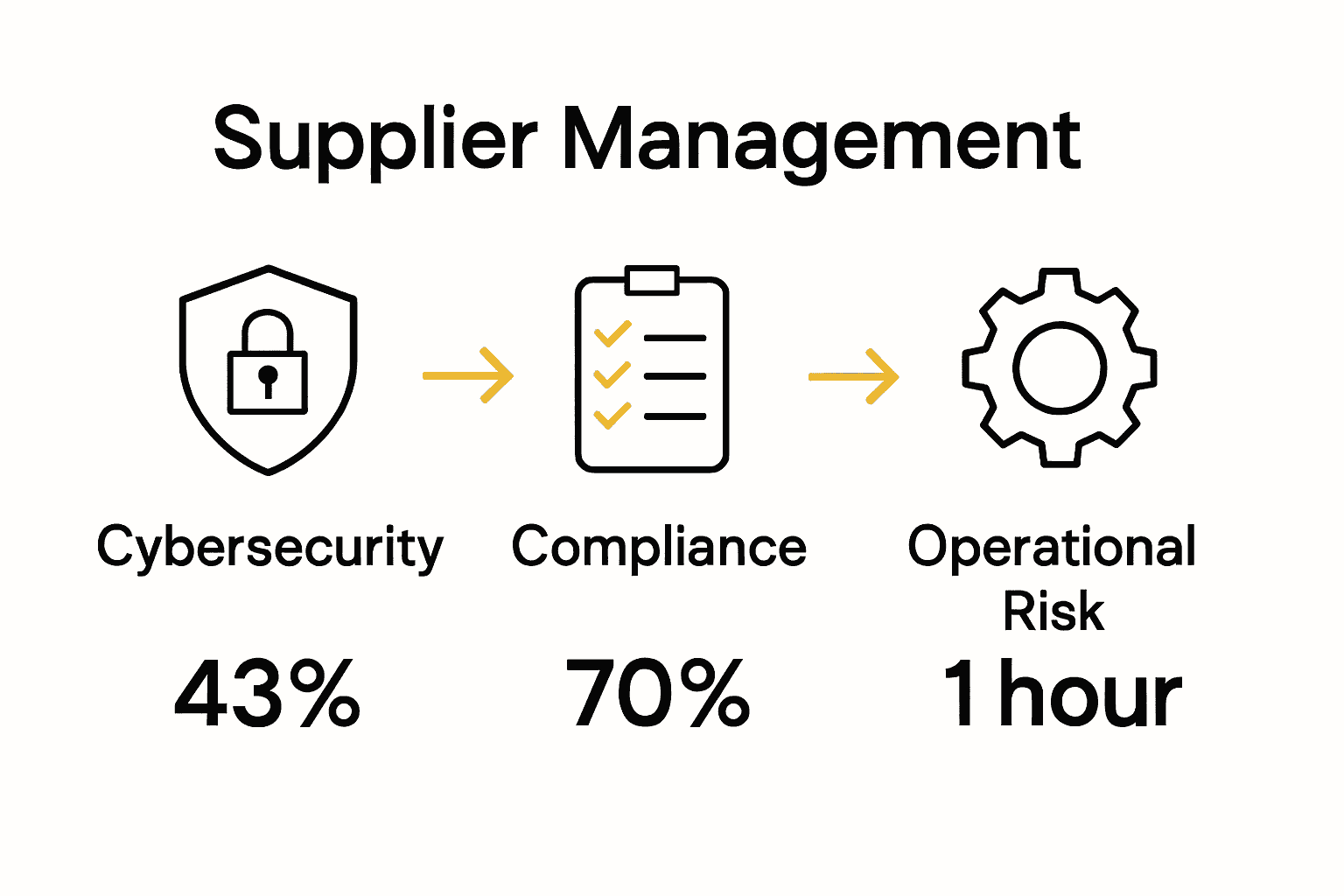
- Cybersecurity Risks: Potential vulnerabilities introduced through external system integrations
- Compliance Risks: Potential regulatory violations or legal non-conformance
- Operational Risks: Disruptions to core business processes
- Financial Risks: Unexpected cost overruns or financial instability of suppliers
- Reputational Risks: Potential damage from supplier misconduct or performance failures
- Geopolitical Risks: International regulatory or political challenges
Explore our comprehensive guide on third-party vendor risk assessment to develop robust mitigation strategies. Critically, organizations must recognize that even seemingly low-critical suppliers can introduce significant cyber or operational risks, demanding a comprehensive and nuanced approach to risk evaluation.
Successful risk management requires developing sophisticated assessment frameworks that go beyond surface-level evaluations. This involves implementing continuous monitoring processes, conducting regular comprehensive audits, maintaining flexible risk mitigation strategies, and creating adaptive response mechanisms that can quickly address emerging vulnerabilities across the entire supplier ecosystem.
Integrating Third Party Suppliers in SaaS Workflows
SaaS workflow integration represents a sophisticated process of seamlessly connecting external supplier capabilities with organizational technology ecosystems. Modern software environments demand intelligent, secure, and flexible approaches to incorporating third-party services that enhance operational capabilities while maintaining robust security protocols.
Key strategies for effective third-party supplier integration include:
- API-Based Connectivity: Utilizing standardized integration protocols
- Single Sign-On (SSO) Implementation: Streamlining authentication processes
- Real-Time Data Synchronization: Ensuring consistent information flow
- Granular Access Controls: Managing permissions and visibility
- Automated Compliance Monitoring: Tracking supplier interactions continuously
Explore our comprehensive guide on vendor risk management to understand the nuanced approach required for successful integration. Successful SaaS workflow integration demands more than technical connectivity—it requires creating adaptive frameworks that can quickly respond to changing technological landscapes and evolving business requirements.
The most effective integration strategies prioritize scalability, security, and seamless user experience. This involves developing modular integration architectures that allow for rapid onboarding of new suppliers, implementing robust security protocols, and creating intuitive interfaces that enable smooth collaboration across different technological platforms and organizational boundaries.
Streamline Third Party Supplier Management with Skypher
If you feel overwhelmed by the complexity of third-party supplier management, you are not alone. Many organizations struggle to balance risk assessment, compliance tracking, and seamless integration while keeping up with demanding security questionnaires. As highlighted in our Complete Guide, the persistent pressure to vet suppliers quickly and accurately can put business operations and client trust at risk.
Ready to break free from manual processes and endless documentation? Discover how Skypher removes bottlenecks by automating your entire security questionnaire workflow, integrating with over 40 TPRM platforms, and empowering teams with real-time collaboration and advanced AI. See how our AI Questionnaire Automation Tool can respond to even the toughest requirements faster and with more confidence. Take control of your supplier risk and compliance challenges today—explore Skypher and experience secure, efficient third-party management now.
Frequently Asked Questions
What are third-party suppliers in business?
Third-party suppliers are independent organizations that provide goods, services, or support to businesses, operating outside the core organizational structure. They can include vendors, consultants, contractors, service providers, and technology partners.
What types of third-party supplier arrangements exist?
There are several types, including strategic partnerships, transactional contracts, managed services, technology integration, and professional consulting. Each arrangement serves specific business needs and operational requirements.
How can organizations effectively manage third-party supplier compliance?
Organizations can manage compliance by establishing rigorous frameworks that ensure suppliers meet specific regulatory standards, maintain documentation integrity, provide material traceability, and allow for regular audits. Continuous monitoring and adaptive compliance strategies are essential.
What are the common risks associated with third-party suppliers?
Common risks include cybersecurity threats, compliance issues, operational disruptions, financial instability, reputational damage, and geopolitical challenges. It's crucial for organizations to implement comprehensive risk management strategies to mitigate these potential vulnerabilities.