

TL;DR:
- A trust page publicly documents an organization's security certifications, privacy policies, and compliance posture. It streamlines vendor evaluations by providing instant access to key documents and verified trust signals. Maintaining an updated, searchable trust page enhances credibility and accelerates sales cycles.
A trust page is a centralized online hub that publicly documents an organization's security certifications, privacy policies, and compliance posture for any stakeholder who needs to verify it. Unlike a generic "About" page, a dedicated trust hub gives procurement teams, enterprise buyers, and security reviewers a single place to find SOC 2 reports, ISO 27001 certificates, penetration test summaries, and data handling descriptions without sending a single email. Trust in modern buyers has shifted from "take our word for it" to verifiable, public registries that anyone can check independently. That shift makes a well-built trust page one of the most practical credibility assets a company can publish.
What should a trust page include?
The most effective trust pages combine formal compliance documentation with human identity signals. Each element serves a different audience: security teams want certifications, legal teams want privacy policies, and procurement teams want to know who they are actually dealing with.

Compliance certifications and audit reports form the foundation. SOC 2 Type II reports, ISO 27001 certificates, and penetration test summaries are the documents enterprise buyers request most often. Publishing them directly, or linking to a controlled access workflow for sensitive versions, removes the back-and-forth that slows vendor evaluations. You can read more about how SOC 2 compliance reduces sales friction specifically for SaaS companies.
Privacy and data handling descriptions answer the questions that legal and compliance teams ask before any contract is signed. These sections should describe data residency, retention periods, subprocessor lists, and breach notification timelines in plain language, not legal boilerplate.
Real-time update logs and version history separate credible trust pages from static PDF dumps. Outdated documents cause immediate distrust during audits. A visible "last updated" timestamp and a changelog give reviewers confidence that the information reflects your current posture, not last year's.
Third-party trust badges and verification seals carry measurable weight. 82% of shoppers are more likely to trust sites displaying third-party verified badges, and 40% interpret a missing badge as a potential fraud signal. That data comes from consumer ecommerce, but the psychology applies directly to B2B procurement decisions.
Professional identity signals close the gap between documentation and human credibility. Anonymous "we" copy is a credibility killer in B2B contexts. Named team members, employee LinkedIn profiles, and client logos linked to actual case studies tell a buyer that real, accountable people stand behind the claims on the page.
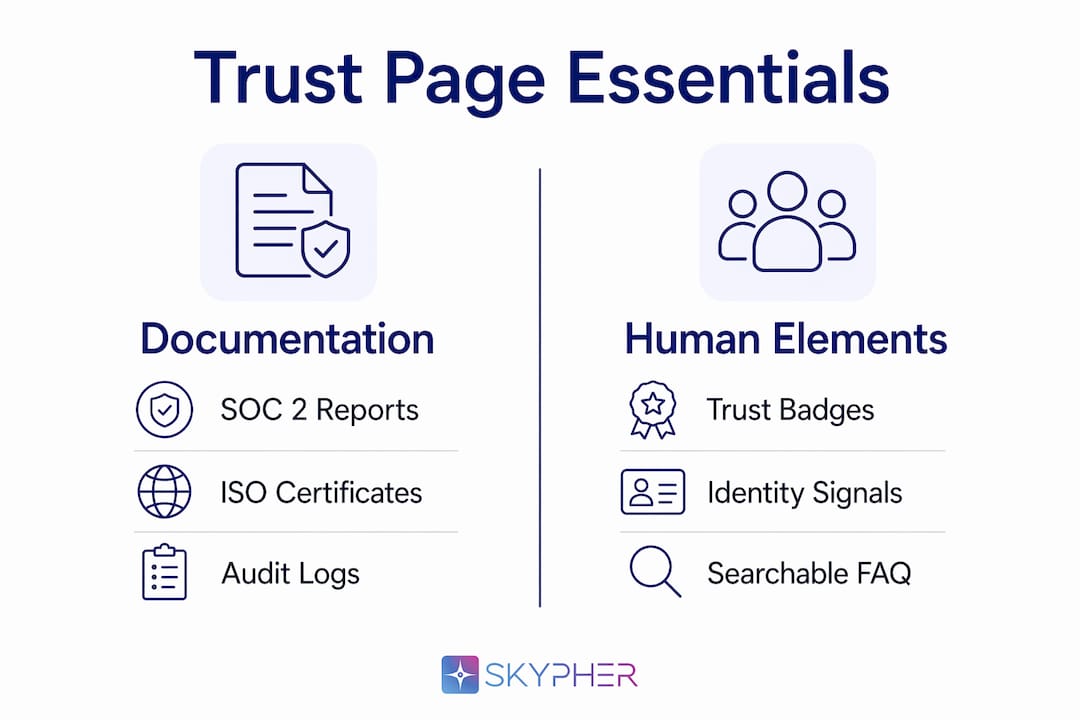
Pro Tip: Add a searchable FAQ or filter system to your trust page so security reviewers can find specific controls, frameworks, or certifications without scrolling through every document.
How does a trust page reduce sales friction?
A trust page functions as a sales enablement tool that replaces days of manual email exchanges with self-service access to compliance documentation. That is its most underappreciated function. Most security teams treat it as a legal disclosure requirement. Sales teams that treat it as a live sales asset close deals faster.
The mechanism is straightforward. When a prospect's security team sends a 150-question security questionnaire, the first step is usually asking the vendor to share their SOC 2 report, their data processing agreement, and their subprocessor list. If all three are already published and searchable on a trust page, that first round of questions disappears. The questionnaire still arrives, but it arrives shorter and later in the cycle.
Here is how that plays out in practice:
- Publish your core compliance documents publicly. SOC 2 summaries, ISO 27001 scope statements, and GDPR data processing addendums can be available without a login. This handles the majority of standard questions before they are even asked.
- Gate sensitive documents behind a "request access" workflow. Full audit reports and penetration test details contain information you do not want indexed publicly. Request access workflows protect intellectual property while flagging high-intent leads to your sales team the moment someone requests access.
- Track document engagement. Knowing which prospects have downloaded your SOC 2 report or reviewed your subprocessor list gives your sales team a real signal of where a deal stands in the security review phase.
- Link the trust page from your sales deck and proposal templates. Sending a direct link during the proposal stage positions your company as prepared and transparent before the buyer even asks.
18% of cart abandonment occurs because buyers do not trust the payment or vendor process. That number reflects a direct revenue cost of missing trust signals, not just a reputational one.
Pro Tip: Connect your trust page's document access requests to your CRM so sales reps get an automatic notification when a prospect reviews sensitive compliance materials. That is a buying signal worth acting on immediately.
Common pitfalls in building and maintaining trust pages
Most trust pages fail not because they lack certifications, but because they are built once and never touched again. A static trust page signals to a security reviewer that your security program is equally static.
The most frequent mistakes include:
- Publishing outdated reports without version dates. A SOC 2 report from two years ago with no "last updated" label raises more questions than it answers. Every document should carry a clear date and a note on when the next review is scheduled.
- Burying documents in unnavigable layouts. If a reviewer has to click through four pages to find your data processing agreement, they will assume the information is being hidden. Organize content by audience type: security teams, legal teams, and procurement teams have different needs.
- Using anonymous corporate copy. Phrases like "our team is committed to security" without names, titles, or verifiable credentials read as marketing, not assurance. Identity and traceability are what separate credible B2B trust pages from generic website copy.
- Oversharing sensitive operational details. Transparency does not mean publishing your full network architecture. The goal is to answer the questions buyers legitimately need answered, not to expose your internal security controls to bad actors.
- Neglecting mobile formatting. Security reviewers often access vendor documentation on mobile devices during travel or off-site meetings. A trust page that breaks on mobile loses credibility before a single document is read.
The build trust online principle that applies here is consistency. A trust page that is updated quarterly and clearly dated builds more confidence than a beautifully designed page that was last touched 18 months ago.
Best practices for launching and optimizing a trust page
Placement determines whether your trust page gets found or ignored. The three locations that generate the most engagement are the main navigation bar, the footer alongside privacy and legal links, and a direct link in your sales proposal template. Each placement serves a different audience at a different stage of the buying process.
Integrating trust badges effectively
Trust badges work best when they are placed near the specific claim they verify. An ISO 27001 badge belongs next to your data security section, not floating in a generic header. Clicking a badge should open the actual certificate or a third-party verification page, not a dead link or a marketing page. Unverifiable badges damage credibility more than no badge at all.
Using analytics to identify high-intent prospects
Your trust page is a behavioral data source. Prospects who spend significant time on your SOC 2 section or who request access to your penetration test summary are in active security review mode. Setting up page-level analytics with event tracking on document downloads and access requests gives your sales team a prioritized list of accounts to follow up with. This is the function that most companies leave completely unused.
Conducting regular audits
A trust page audit should happen on the same schedule as your compliance reviews. Every time a certification is renewed, a new subprocessor is added, or a policy changes, the trust page should reflect that update within days, not months. Consistent support and reliability build more authentic trust than any single certification. That principle applies directly to how buyers perceive a company that keeps its public compliance documentation current.
Pro Tip: Set a calendar reminder tied to each certification's renewal date. When the certificate renews, update the trust page the same day and add a changelog entry. Buyers notice when documentation is current.
| Placement | Best audience | Primary benefit |
|---|---|---|
| Main navigation | All site visitors | Maximum discoverability |
| Footer | Legal and compliance teams | Expected location for formal documents |
| Sales proposal link | Active prospects | Signals preparedness during evaluation |
| Checkout or contract page | Buyers at decision stage | Reduces last-minute trust objections |
| Product documentation | Existing customers | Supports ongoing compliance reviews |
Key Takeaways
A trust page is the single most efficient tool for converting security documentation into buyer confidence, and it works only when it is current, searchable, and tied to real identities.
| Point | Details |
|---|---|
| Core content requirements | Publish SOC 2 reports, ISO 27001 certificates, privacy policies, and subprocessor lists as the minimum viable set. |
| Real-time updates matter | Outdated documents erode trust faster than missing ones; add version dates and a changelog to every document. |
| Gate sensitive materials | Use "request access" workflows to protect IP while capturing high-intent lead signals for your sales team. |
| Professional identity signals | Named team members and client logos linked to case studies outperform anonymous corporate copy in B2B credibility. |
| Placement drives discovery | Link your trust page from navigation, footer, and sales proposals to reach buyers at every stage of evaluation. |
Why most companies treat trust pages as an afterthought
I have reviewed hundreds of vendor trust pages over the years, and the pattern is almost always the same. A company earns its SOC 2 certification, uploads the summary PDF to a subdomain, and considers the job done. The page sits untouched for 14 months until a major enterprise prospect asks for updated documentation and the sales team scrambles.
The companies that get this right treat their trust page the way a finance team treats a balance sheet: it is a live document that reflects current reality, not a historical artifact. The reciprocal nature of consistent reliability means that buyers who see a trust page updated last week trust the company more than one with a beautiful design and a 2023 timestamp.
The AI economy has made this more urgent, not less. Buyers now use AI tools to research vendors before the first sales call. A trust page with structured, searchable, current compliance data gets surfaced by those tools. A static PDF does not. The companies investing in dynamic trust centers today are building a distribution advantage that will compound over the next three years.
My honest advice: treat your trust page as a product, assign it an owner, and put it on a release schedule. The companies that do this do not just close deals faster. They attract better-fit buyers who have already self-qualified through the documentation.
— Gaspard
How Skypher helps you build a credible, current trust page
Building a trust page is straightforward. Keeping it accurate, searchable, and connected to your sales workflow is where most teams fall short.

Skypher's AI questionnaire automation platform gives security and sales teams a centralized knowledge base that feeds both your trust page and your questionnaire responses from a single source of truth. When a certification renews or a policy changes, the update flows through automatically. Skypher integrates with over 40 third-party risk management platforms, including OneTrust and ServiceNow, and connects directly with Slack and Microsoft Teams so your team gets notified the moment a prospect requests access to sensitive documents. The smart security knowledge base keeps your compliance content current without manual updates, so your trust page always reflects your actual security posture.
FAQ
What is a trust page?
A trust page is a dedicated webpage where a company publicly documents its security certifications, privacy policies, compliance reports, and data handling practices for buyers and stakeholders to review independently.
What certifications should appear on a trust page?
SOC 2 Type II reports, ISO 27001 certificates, and penetration test summaries are the most commonly requested documents in enterprise B2B vendor evaluations.
How does a trust page reduce security questionnaire workload?
Publishing core compliance documents publicly eliminates the first round of standard questions that buyers send, shortening the questionnaire and moving the sales cycle forward faster.
How often should a trust page be updated?
A trust page should be updated every time a certification renews, a policy changes, or a new subprocessor is added. Quarterly audits tied to your compliance review schedule are the minimum standard.
Should all compliance documents be publicly accessible?
No. Publish summaries and certificates publicly, and gate full audit reports and penetration test details behind a "request access" workflow to protect sensitive information while capturing lead signals.
Recommended
- Trust Center Platform | Share Security & Compliance Posture | Skypher
- DDQ Automation for Private Equity and Credit: Moving from Text Drafting to Fiduciary Accuracy
- How to Deflect 30% of Security Questionnaires with an Automated Trust Center
- Best Practices for Automating Your Security Questionnaires Response Process (1/3)